Report ID: 1311 |
Published Date: 10 Sep 2026 |
Report Format: |
Delivery Timeline: 48-72 Business Hours
Second Generation Biofuel Market Outlook:
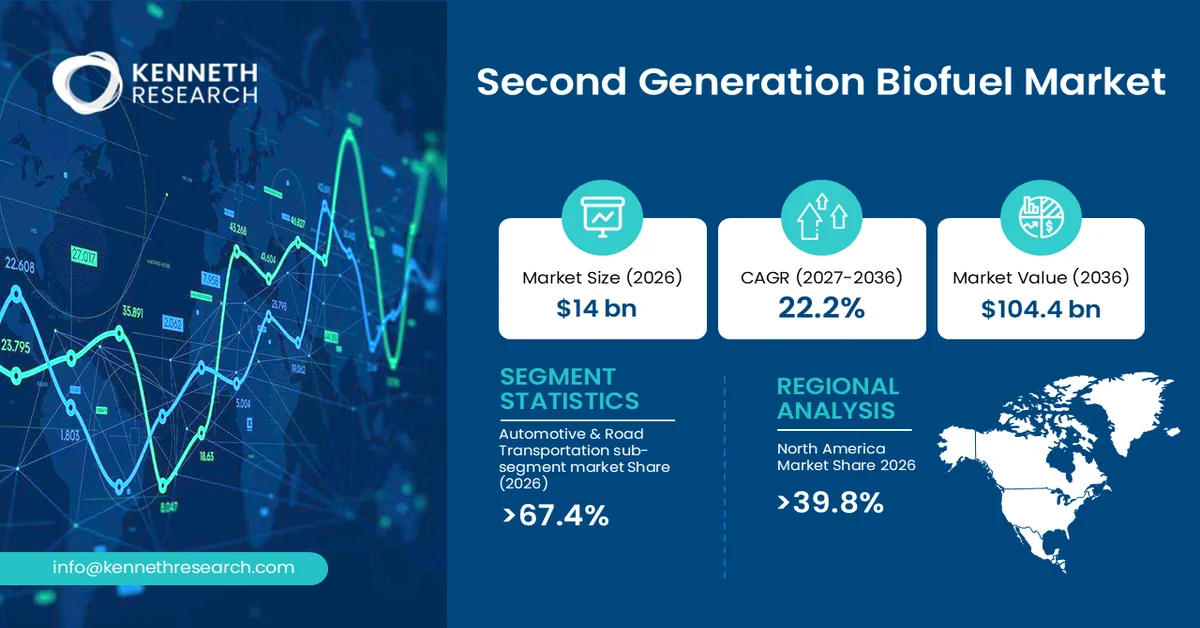
Second Generation Biofuel Market size was valued at USD 14 billion in 2026 and is projected to reach USD 104.4 billion by the end of 2036, rising at a CAGR of 22.2% during the forecast period, i.e., 2027–2036. In 2027, the industry size of the global second generation biofuel is estimated at USD 17.2 billion.
Government-led renewable-fuel mandates are a primary growth driver for the second generation biofuel market, as regulatory programs create demand for fuels produced from non-food biomass, wastes, and residues. In the United States, EPA’s 2026–2027 Renewable Fuel Standard includes a 70% reallocation of small-refinery exemptions, reinforcing obligated-market demand and policy support.
The second generation biofuel market comprises fuels produced from non-food and lignocellulosic biomass rather than conventional food-based feedstocks. It includes advanced fuel pathways that convert agricultural and forestry residues, dedicated energy crops, municipal and other organic wastes, used oils, fats, and related renewable resources into transportation fuels. Key characteristics include diversified feedstock utilization, conversion through biochemical, thermochemical, catalytic, or integrated biorefinery processes, and potential compatibility with existing fuel infrastructure depending on the fuel pathway.
The market is strategically relevant because it expands the feedstock base for renewable transportation energy while reducing direct competition with food uses associated with some first-generation biofuels. The U.S. Department of Energy identifies cellulosic ethanol, biodiesel, and hydrocarbon drop-in fuels among biofuel pathways, while its bioenergy programs support technologies for converting biomass into fuels. Commercial relevance therefore spans feedstock suppliers, technology developers, biorefineries, fuel producers, refiners, distributors, and transport operators. Policy compliance, lifecycle emissions performance, feedstock availability, conversion efficiency, and production economics are central considerations for investment and deployment.
Key Second Generation Biofuel Market Insights Summary:
Key Takeaways: Market Trends & Insights
- The second generation biofuel market is valued at USD 14.0 billion in 2026
- The market is projected to reach USD 104.4 billion by 2036, expanding at a 22.2% CAGR from 2027 to 2036
- Automotive & Road Transportation leads the End-User segment with a 67.4% market share in 2026
- Biodiesel is identified as the second and fastest analysis segment within the Fuel Type category
- North America dominates with a 39.8% market share in 2026, supported by market activity across the United States and Canada
Market Drivers
- Expansion of sustainable biomass feedstock availability
- Decarbonization of hard-to-electrify transport
- Increasing investment in advanced biofuel conversion technologies
- Strengthening low-carbon fuel policies and renewable-fuel mandates
Challenges
- High Production and Scale-Up Costs
- Fragmented Biomass Supply Chains
Second Generation Biofuel Market Overview & Supply Chain
Second Generation Biofuel Market adoption is increasing globally as governments, fuel producers, and transportation industries seek lower-emission alternatives to conventional petroleum fuels while improving energy security and utilizing non-food biomass resources. Advanced biofuels are particularly relevant to sectors where direct electrification remains challenging, including heavy road transport, aviation, and maritime applications. Technological progress in biomass conversion, upgrading, and refining is also enabling waste, agricultural residues, forestry resources, and other renewable feedstocks to be converted into transportation fuels.
The value chain begins with the sourcing and aggregation of renewable feedstocks, including agricultural residues, forestry residues, organic wastes, used oils and fats, algae, and other non-food biomass resources. Feedstock suppliers, farmers, forestry operators, waste-management companies, and collection networks provide the materials required for conversion. Producers then preprocess and condition these inputs before applying biochemical or thermochemical conversion technologies to generate intermediates and fuels. Refiners and upgrading facilities further process these outputs to achieve required fuel specifications and compatibility with existing infrastructure. Distribution involves fuel terminals, pipelines, storage facilities, blending operations, and transportation networks that move finished products toward regional markets. End users include road-transport operators, fleet owners, aviation companies, shipping operators, and industrial consumers.
Second Generation Biofuel Market: Growth Drivers & Challenges
Growth Drivers
- Expansion of sustainable biomass feedstock availability: The increasing availability of agricultural residues, forestry resources, waste streams, and other non-food biomass is strengthening the feedstock foundation for second-generation biofuel production. Unlike conventional biofuels that can rely heavily on food-based crops, advanced conversion technologies can transform underutilized residues and wastes into transportation fuels, improving resource efficiency while reducing competition with food production. In March 2024, the U.S. Department of Energy reported that the United States could sustainably produce more than 1 billion tons of biomass per year, providing a broader resource base for renewable fuels and other bioproducts.
- Decarbonization of hard-to-electrify transport: The push to reduce transportation-sector emissions is creating structural demand for low-carbon liquid fuels that can operate within existing vehicle and fuel infrastructure. Second-generation biofuels can convert wastes, residues, and other renewable carbon sources into fuels suitable for applications where direct electrification remains technically or economically challenging.
Challenges
- High production and scale-up costs: The root cause is the technological complexity of converting lignocellulosic biomass and other difficult feedstocks into commercially consistent fuels. Pretreatment, enzymatic conversion, process integration, and specialized equipment introduce additional technical requirements compared with established conventional biofuel pathways. These requirements can increase project-development risk and make financing more difficult, particularly when developers must demonstrate reliable performance at commercial scale.
- Fragmented biomass supply chains: The root cause is the dispersed and heterogeneous nature of agricultural residues, forestry waste, and other non-food biomass resources. Unlike standardized fossil-fuel feedstocks, biomass can vary considerably in moisture, composition, quality, and geographic availability, requiring specialized collection, preprocessing, storage, and transportation arrangements. This fragmentation creates operational exposure for biorefineries because consistent feedstock delivery is essential for maintaining plant utilization and predictable conversion performance.
Second Generation Biofuel Market Size and Forecast:
| Report Attribute | Details |
|---|---|
| Base Year |
2026 |
| Forecast Period |
2027-2036 |
| CAGR |
22.2% |
| Base Year Market Size (2026) |
USD 14 Billion |
| Forecast Year Market Size (2036) |
USD 104.4 Billion |
| Regional Scope |
|
Second Generation Biofuel Market Segmentation Analysis:
End-User Segment Analysis
In the end-user segment, Automotive & Road Transportation sub-segment is anticipated to capture the largest market share of 67.4% the end of 2026.
Automotive & road transportation dominates the second generation biofuel market because road mobility continues to require substantial volumes of liquid transportation fuel, while fleet operators and fuel suppliers increasingly seek lower-carbon alternatives that can integrate with existing infrastructure. Demand is supported by freight movement, commercial vehicles, and long-distance road travel, where liquid fuels remain operationally important. The U.S. Energy Information Administration reported that U.S. vehicle miles traveled reached 9 billion miles per day in 2024, indicating substantial underlying road-transport activity. Industry adoption is also benefiting from renewable diesel and other advanced fuels that can be incorporated into established fuel-distribution systems..
Fuel Type Segment Analysis
The Biodiesel is projected to grow as the second-largest segment in the second generation biofuel market due to four converging demand drivers.
Biodiesel is projected to grow strongly within the second generation biofuel market as governments, fuel suppliers, and fleet operators seek lower-carbon alternatives for diesel-dependent transportation. Demand is supported by its compatibility with established diesel-use infrastructure and by policies that encourage renewable fuel adoption, enabling broader integration without requiring an immediate replacement of existing vehicle fleets. Industry adoption is being reinforced by blending requirements, clean-fuel programs, and increasing interest in waste- and residue-based feedstocks. On the supply side, expanding feedstock sourcing and improved processing capabilities can strengthen biodiesel availability while supporting more diversified production networks.
Our in-depth analysis of the second generation biofuel market includes the following segments:
|
Segment |
Sub-segment |
|
Fuel Type |
|
|
Feedstock |
|
|
End-User |
|
Second Generation Biofuel Market Regional Insights:
North America Market Trends & Insights:
North America second generation biofuel market is projected to hold the largest revenue share of 39.8% the end of 2026.
It is supported by established biofuel infrastructure, substantial transportation-fuel demand, expanding renewable-fuel production, and supportive decarbonization policies. The region benefits from a mature ecosystem spanning feedstock suppliers, refiners, fuel distributors, technology developers, and end users.
Within the region, the United States represents the principal market, supported by federal renewable-fuel policies, state-level clean-fuel programs, established refining capacity, and growing investment in renewable diesel and other advanced fuels.
Canada complements regional growth through federal clean-fuel policy, increasing emphasis on lower-carbon transportation fuels, and its established agricultural and forestry-resource base. Looking ahead, continued investment in production capacity, feedstock infrastructure, and low-carbon fuel deployment should reinforce North America's role as a major production and consumption hub for advanced biofuels.
Asia Pacific Market Trends & Insights:
Asia Pacific is positioned for continued expansion in second-generation biofuels as transportation demand, industrialization, aviation activity, and decarbonization requirements increase the need for lower-carbon liquid fuels. Governments are strengthening policy frameworks while domestic energy companies and aviation operators develop new pathways for sustainable fuels.
Within the region, China offers significant opportunities through coordinated government support for renewable fuels and pilot deployment across transportation applications. Its emphasis on sustainable aviation fuel and waste-based feedstocks can support technology commercialization.
Japan is developing a more structured SAF ecosystem through government-industry coordination, production incentives, and supply-chain initiatives. Its focus on aviation decarbonization should create opportunities for advanced fuel producers and technology partners, particularly where imported and domestically produced feedstocks can be integrated into reliable supply networks.
Leading Companies Operating in the Global Second Generation Biofuel Market:
Here is a list of upstream, downstream, and key players operating in the second generation biofuel market competitive ecosystem:
- Enerkem Inc. (Canada)
- Company Overview
- Business Strategy
- Key Product Offerings
- Financial Performance
- Key Performance Indicators
- Risk Analysis
- Recent Development
- Regional Presence
- SWOT Analysis
- GranBio (Brazil)
- POET, LLC (United States)
- Renewable Energy Group, Inc. (United States)
Recent Developments
- In July 2026, Enerkem faced an enforcement order from Alberta Environment and Protected Areas requiring remediation of its shuttered Edmonton biofuel facility, citing toxic chemicals left in tanks, abandoned waste containers, and soil and groundwater contamination exceeding provincial guidelines.
- In May 2026, POET commissioned a 5 GWh thermal energy storage system in partnership with Antora Energy at its Big Stone City, South Dakota facility. The project uses over 200 thermal batteries to store electricity as heat in insulated carbon blocks, providing competitively priced, around-the-clock energy under a long-term heat offtake agreement to support bioethanol production.
Frequently Asked Question
In 2026, the second generation biofuel Market exceeded USD 14 billion.
The second generation biofuel Market is projected to reach USD 104.4 billion by the end of 2036, expanding at a CAGR of 22.2% over the forecast period (2027-2036).
The major players in the market are Enerkem Inc., GranBio, POET, LLC, Renewable Energy Group, Inc., and others.
In the End-User segment, the Automotive & Road Transportation sub-segment is anticipated to capture the largest market share of 67.4% in the future and exhibit lucrative growth opportunities during 2027-2036. This growth trajectory is largely attributed to increasing demand for lower-carbon liquid fuels in road transportation.
North America is projected to hold the largest market share of 39.8% by the end of 2036 and provide more business opportunities in the future. Continuous investments in renewable diesel and other advanced fuels across the United States and Canada are fostering the region's dominance.
Why Choose Kenneth Research ?
-
Insight with Impact : We don’t just gather data — we uncover stories, trends, and opportunities that fuel business growth.
-
Experts Who Get It : Our team speaks your industry’s language and knows what really matters to your customers and market.
-
Custom-Built for You : Forget one-size-fits-all. We craft research and consulting solutions as unique as your business vision.
-
Partners, Not Just Providers : We work with you, not for you — collaborating closely to turn insights into smart, strategic moves.
-
Results That Speak : Our work powers brands, startups, and industry leaders alike — with a track record of ideas that work in the real world.
Report ID: 1311 |
Published Date: 10 Sep 2026 |
Report Format: |
Delivery Timeline: 48-72 Business Hours

Copyright © 2025 Kenneth Research. All rights reserved. Terms of Use | Privacy Policy
