Report ID: 1454 |
Published Date: 28 Sep 2026 |
Report Format: |
Delivery Timeline: 48-72 Business Hours
Satellite Manufacturing Market Outlook:
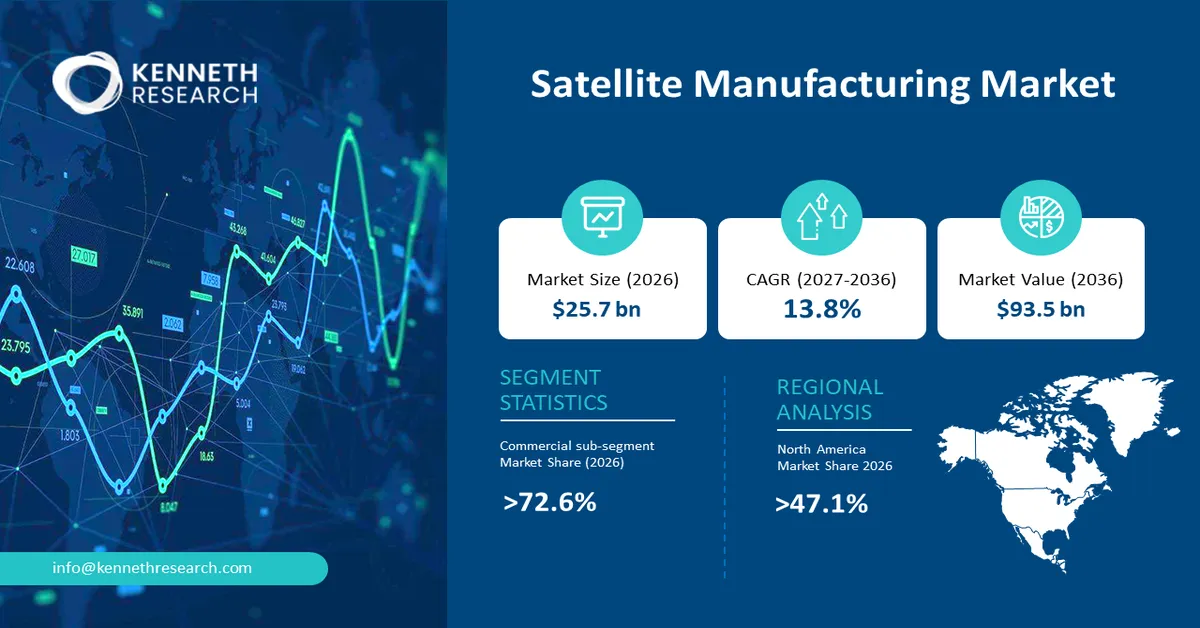
Satellite Manufacturing Market size was valued at USD 25.7 billion in 2026 and is projected to reach USD 93.5 billion by the end of 2036, rising at a CAGR of 13.8% during the forecast period, i.e., 2027-2036. In 2027, the industry size of the global satellite manufacturing market is estimated at USD 29.2 billion.
The primary growth driver for the satellite manufacturing market is rising demand for commercial satellite-based connectivity and data services, particularly broadband applications in low Earth orbit.
The satellite manufacturing market comprises the design, engineering, fabrication, assembly, integration, testing, and qualification of satellites and their major subsystems for deployment in space. The market encompasses spacecraft platforms, structural components, power systems, propulsion, thermal-management systems, avionics, communications payloads, sensors, and other mission-specific equipment required to deliver satellite capabilities.
A defining characteristic of the market is its transition from predominantly bespoke spacecraft production toward more standardized, modular, and scalable manufacturing approaches. Small satellites, software-defined payloads, high-throughput satellites, and low Earth orbit (LEO) constellations are contributing to this evolution. ESA notes that the upstream satellite industry covers manufacturing, launching, and maintaining satellites, while changing downstream requirements are influencing spacecraft designs and production models.
Key Satellite Manufacturing Market Insights Summary:
Key Takeaways: Market Trends & Insights
- The satellite manufacturing market is valued at USD 25.7 billion in 2026 and is projected to reach USD 93.5 billion by 2036, growing at a CAGR of 13.8%.
- The commercial segment leads the type of business category, holding 72.6% market share in 2026, driven by satellite communications and Earth observation.
- Low Earth Orbit (LEO) is the fastest-growing segment, supported by constellation deployment, commercial communications, and Earth observation demand.
- North America dominates with a 47.1% market share in 2026, supported by strong aerospace capabilities, government programs, and commercial satellite activity.
- Asia Pacific offers significant opportunities, with China and Japan advancing satellite manufacturing, commercial space activity, and government-supported space programs.
Market Drivers
- Increasing Adoption of LEO Constellations
- Expansion of Commercial Earth-Observation and Satellite Services
- Government Investment in Space Infrastructure
- Advancements in Small-Satellite Manufacturing and Modular Architectures
Challenges
- Space-Qualified Component Supply Constraints
- Increasing Compliance and Orbital Sustainability Requirements
Satellite Manufacturing Market Overview & Supply Chain
Adoption of satellite manufacturing market capabilities is increasing globally as satellite communications, Earth observation, navigation, scientific missions, and government space programs expand their reliance on increasingly capable spacecraft. The sector is also being reshaped by smaller spacecraft, LEO constellations, higher-throughput payloads, software-defined systems, and more standardized production approaches. These developments are increasing the importance of scalable manufacturing, advanced electronics, precision engineering, systems integration, and qualification capabilities.
The satellite manufacturing market value chain begins with raw materials and specialized inputs, including aluminum and other aerospace-grade alloys, composite materials, semiconductor components, sensors, optical systems, batteries, solar-cell technologies, propulsion components, and electronic assemblies. Component manufacturers and specialized technology suppliers provide these inputs to spacecraft manufacturers, who undertake spacecraft architecture, subsystem engineering, fabrication, assembly, integration, and environmental qualification. Production typically involves close coordination among prime contractors, subsystem specialists, electronics suppliers, payload developers, and testing organizations. Following manufacturing and acceptance, completed spacecraft move through launch-service providers and mission-integration channels before deployment to their designated orbits.
Satellite Manufacturing Market: Growth Drivers & Challenges
Growth Drivers:
- Increasing adoption of LEO constellations: Increasing deployment of LEO spacecraft is encouraging manufacturers to develop scalable, repeatable, and modular production capabilities. Constellation-based missions require multiple compatible spacecraft, creating demand for standardized platforms, common subsystems, streamlined integration, and efficient testing procedures. These shifts are manufacturing away from entirely bespoke spacecraft toward production approaches that can accommodate recurring orders while maintaining mission-specific flexibility.
- Expansion of commercial earth-observation and satellite services: Growing reliance on satellite-derived information is stimulating demand for spacecraft equipped with specialized imaging, sensing, communications, and data-processing capabilities. Commercial users increasingly require satellite systems tailored to applications such as environmental monitoring, mapping, resource management, infrastructure assessment, and maritime observation.
Challenges:
- Space-qualified component supply constraints: The availability of specialized, space-qualified components can constrain satellite manufacturing because many critical inputs require stringent qualification, radiation tolerance, reliability testing, and long production cycles. Semiconductors, sensors, propulsion components, high-performance batteries, optical systems, and other specialized hardware may have limited qualified suppliers, creating dependencies within the manufacturing chain.
- Increasing compliance and orbital sustainability requirements: Stricter expectations surrounding orbital debris mitigation, spacecraft disposal, collision avoidance, spectrum coordination, and space-object tracking are adding requirements to spacecraft design and manufacturing. Compliance considerations increasingly need to be incorporated during the architecture and engineering stages rather than addressed only before launch. This can influence propulsion selection, spacecraft control systems, tracking capabilities, end-of-life mechanisms, and mission design.
Satellite Manufacturing Market Size and Forecast:
| Report Attribute | Details |
|---|---|
| Base Year |
2026 |
| Forecast Period |
2027-2036 |
| CAGR |
13.8% |
| Base Year Market Size (2026) |
USD 25.7 billion |
| Forecast Year Market Size (2036) |
USD 93.5 billion |
| Regional Scope |
|
Satellite Manufacturing Market Segmentation Analysis:
Type of Business Segment Analysis
In the type of business segment, commercial sub-segment is anticipated to capture the largest market share of 72.6% by the end of 2026.
Commercial applications dominate the satellite manufacturing market because private-sector demand is increasingly centered on communications, broadband connectivity, Earth observation, and satellite-enabled digital services. Commercial operators are also adopting constellation-based architectures that require scalable spacecraft production, standardized platforms, and recurring satellite replenishment. ESA notes that the satellite industry is shifting toward LEO and very-high-throughput systems in response to increasing commercial demand for broadband constellations, creating structural changes in satellite manufacturing and related infrastructure. On the supply side, manufacturers are responding with modular spacecraft buses, software-defined payloads, standardized subsystems, and production approaches suited to repeat orders. Going forward, commercial demand is likely to remain closely linked to connectivity expansion, constellation deployment, Earth-observation services, and greater integration between satellite and terrestrial networks.
Category Segment Analysis
The Low Earth Orbit (LEO) is projected to grow as the second-largest segment in the satellite manufacturing market due to four converging demand drivers.
Low Earth Orbit (LEO) is projected to expand strongly within the satellite manufacturing market because its relatively close proximity to Earth supports communications, Earth observation, scientific missions, and other applications requiring frequent access and lower-latency connectivity. Commercial constellation deployment is a major demand catalyst, encouraging operators to procure repeatable spacecraft platforms and manufacturers to develop standardized buses, modular payloads, and scalable production processes. The European Space Agency reported that 2,409 new tracked payloads entered Earth orbit in 2022, with launches dominated by satellites establishing or expanding commercial constellations in LEO. This demand is encouraging investment in small-satellite production, propulsion, power systems, communications payloads, and automated integration. Supply-side development is also supported by increasingly standardized spacecraft architectures and specialized component ecosystems.
Our in-depth analysis of the satellite manufacturing market includes the following segments:
|
Segment |
Sub-segment |
|
Category |
|
|
Mass |
|
|
Type of Business |
|
|
Application |
|
Satellite Manufacturing Market Regional Insights:
North America Market Trends & Insights:
North America satellite manufacturing is projected to hold the largest revenue share of 47.1% by the end of 2026.
It is supported by an established aerospace industrial base, substantial government space programs, mature commercial satellite capabilities, and extensive launch infrastructure. The region benefits from integrated manufacturing ecosystems spanning spacecraft primes, component suppliers, launch providers, research institutions, and defense organizations.
Within North America, the United States remains the principal manufacturing and investment center, supported by NASA, the Department of Defense, the U.S. Space Force, commercial satellite operators, and a broad private-sector supplier base.
Canada, identified in the input as Country 2, contributes advanced electronics, precision engineering, spacecraft technologies, and established aerospace capabilities. Its participation in satellite and launch programs supports regional technology development and supplier diversification. Together, these capabilities reinforce North America's position as a major hub for spacecraft development, integration, testing, and deployment.
Asia Pacific Market Trends & Insights:
Asia Pacific is becoming an increasingly important hub for the satellite manufacturing market, supported by expanding satellite communications, Earth observation, navigation, scientific missions, and commercial space activity. Industrial development is being reinforced by government initiatives designed to strengthen domestic spacecraft capabilities, encourage private-sector participation, and develop supporting supply chains.
China is developing an increasingly integrated space industrial ecosystem spanning satellite development, applications, research, and commercial aerospace activity. Beijing’s 2024 action plan specifically supports satellite and rocket manufacturing clusters, constellation operations, and aerospace-information applications, creating opportunities for domestic suppliers and technology developers.
Japan is pursuing a complementary strategy focused on strengthening private-sector space technology capabilities. Its Space Strategy Fund supports commercial satellite constellations, satellite components and supply chains, and satellite-data applications, while providing a framework for collaboration between government institutions, JAXA, and private companies.
Leading Companies Operating in the Satellite Manufacturing Market:
Here is a list of upstream, downstream, and key players operating in the satellite manufacturing market competitive ecosystem:
- SpaceX (U.S.)
- Company Overview
- Business Strategy
- Key Product Offerings
- Financial Performance
- Key Performance Indicators
- Risk Analysis
- Recent Development
- Regional Presence
- SWOT Analysis
- Airbus Defence and Space (France)
- Lockheed Martin Space (U.S.)
- Northrop Grumman (U.S.)
- Thales Alenia Space (France/Italy)
Recent Developments
- In September 2026, Airbus Defence and Space signed the initial contract to design and build the first layer of satellites for Europe's IRIS² constellation. Airbus will produce the platforms and integrate the satellites, with at least 66 satellites to be delivered in 2029 for the sovereign pillar delivering military Ka-bands.
- In September 2026, Northrop Grumman was selected to deliver a space domain awareness prototype satellite for the GHOST-R mission. Using the ESPASat-L platform, the satellite will characterize objects in geosynchronous orbit on an accelerated 24-month timeline.
Frequently Asked Question
In 2026, the satellite manufacturing market exceeded USD 25.7 billion.
The satellite manufacturing market is projected to reach USD 93.5 billion by the end of 2036, expanding at a CAGR of 13.8% over the forecast period (2027-2036).
The major players in the market are SpaceX, Airbus Defence and Space, Lockheed Martin Space, Northrop Grumman, and Thales Alenia Space.
In the type of business segment, the commercial sub-segment is anticipated to capture the largest market share of 72.6% in the future and exhibit lucrative growth opportunities during 2027-2036. This growth trajectory is largely attributed to expanding commercial demand for satellite communications, Earth observation, and satellite-enabled services.
North America is projected to hold the largest market share of 47.1% by the end of 2026 and provide more business opportunities in the future. Continuous investments in satellite manufacturing, space infrastructure, commercial satellite capabilities, and government space programs across the region are fostering its dominance.
Why Choose Kenneth Research ?
-
Insight with Impact : We don’t just gather data — we uncover stories, trends, and opportunities that fuel business growth.
-
Experts Who Get It : Our team speaks your industry’s language and knows what really matters to your customers and market.
-
Custom-Built for You : Forget one-size-fits-all. We craft research and consulting solutions as unique as your business vision.
-
Partners, Not Just Providers : We work with you, not for you — collaborating closely to turn insights into smart, strategic moves.
-
Results That Speak : Our work powers brands, startups, and industry leaders alike — with a track record of ideas that work in the real world.
Report ID: 1454 |
Published Date: 28 Sep 2026 |
Report Format: |
Delivery Timeline: 48-72 Business Hours

Copyright © 2025 Kenneth Research. All rights reserved. Terms of Use | Privacy Policy
