Report ID: 1170 |
Published Date: 25 Aug 2026 |
Report Format: |
Delivery Timeline: 48-72 Business Hours
Rigid Foam Market Outlook:
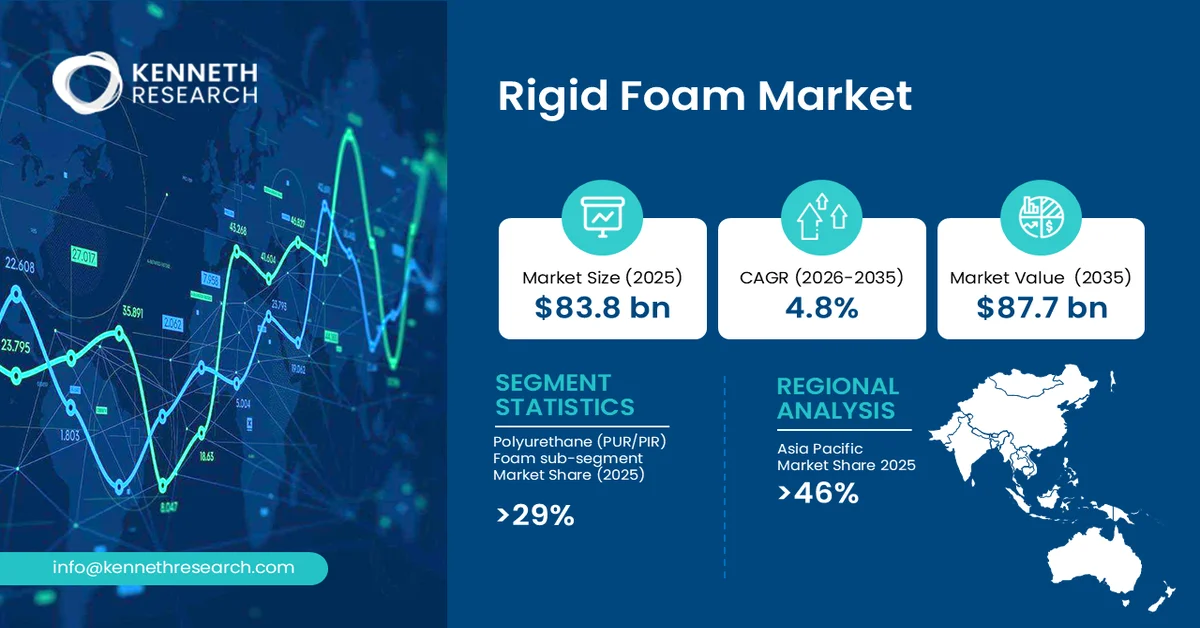
Rigid Foam Market size was valued at USD 83.8 billion in 2025 and is projected to reach USD 133.7 billion by the end of 2035, rising at a CAGR of 4.8% during the forecast period, i.e., 2026–2035. In 2026, the industry size of the rigid foam is estimated at USD 87.7 billion.
The primary growth driver of the rigid foam market is rising demand for energy-efficient insulation across buildings, refrigeration, appliances, and industrial facilities. Stricter energy-efficiency requirements, increasing construction activity, and the need to reduce heating and cooling losses are encouraging manufacturers and building operators to adopt high-performance rigid foam insulation solutions globally.
The rigid foam market comprises lightweight, closed-cell or semi-rigid polymeric foam materials manufactured into insulation boards, panels, molded components, and other engineered forms. Major materials include polyurethane and polyisocyanurate foams, polystyrene foams, and other polymer-based rigid foam systems designed to provide thermal insulation, dimensional stability, moisture resistance, and structural support.
A key characteristic of rigid foam is its combination of low thermal conductivity and lightweight construction, allowing manufacturers and building professionals to achieve insulation performance without substantial increases in material thickness or structural loading. Depending on formulation and application, rigid foam products can also provide resistance to moisture, chemicals, and temperature variation.
Key Rigid Foam Market Insights Summary:
Key Takeaways: Market Trends & Insights
- Rigid Foam Market projected to grow from USD 83.8 billion in 2025 to USD 133.7 billion by 2035 at a 4.8% CAGR.
- Asia Pacific accounted for the largest regional share at 46% in 2025, supported by expanding construction, manufacturing, refrigeration, and energy-efficiency investments across China and Japan.
- Polyurethane (PUR/PIR) Foam is expected to remain the leading Foam Type segment with a 29% market share in 2025, driven by demand for high-performance thermal insulation across construction and industrial applications.
- Molded Foam is projected to witness steady growth as demand increases for lightweight, customized, and shape-specific components across appliances, automotive, refrigeration, packaging, and industrial applications.
- The market is benefiting from increasing emphasis on energy-efficient insulation, advanced low-emission foam technologies, cold-chain expansion, and sustainable building solutions, creating new opportunities for rigid foam manufacturers.
Market Drivers
- Rising demand for energy-efficient building envelopes and insulation.
- Expansion of cold-chain, refrigeration, and temperature-controlled infrastructure.
- Increasing construction and renovation activity across emerging economies.
- Development of lightweight, high-performance, and lower-emission rigid foam technologies.
Challenges
- Transition to lower-gwp blowing agents
- Raw material and production cost volatility
Rigid Foam Market: Market Overview & Supply Chain
Global adoption of rigid foam is increasing as construction and industrial sectors prioritize thermal efficiency, lower operating energy requirements, and improved building-envelope performance. Demand is supported by insulation requirements in walls, roofs, floors, cold-storage facilities, refrigeration, and industrial equipment. Technological advances in high-performance foam formulations and manufacturing are improving insulation efficiency while enabling thinner, lightweight designs. Regulatory emphasis on building energy performance is also strengthening demand for effective insulation solutions. The International Energy Agency reports that buildings accounted for around 30% of global energy demand in 2024, highlighting the importance of energy-efficiency measures such as high-performance insulation in reducing building energy consumption.
The rigid foam value chain begins with petrochemical and chemical inputs, including polymer precursors, blowing agents, additives, catalysts, and other formulation components supplied by specialty chemical producers. Foam manufacturers convert these inputs through reaction, blending, expansion, molding, lamination, and curing processes into boards, panels, molded components, and other finished products. Fabricators and insulation specialists may further cut, shape, laminate, or integrate foam into building systems and industrial equipment. Distribution occurs through manufacturers' direct sales channels, building-material suppliers, specialized insulation providers, and industrial procurement networks.
Rigid Foam Market: Growth Drivers & Challenges
Growth Drivers:
- Rising demand for energy-efficient building envelopes: Increasing emphasis on building energy efficiency is strengthening demand for rigid foam insulation across walls, roofs, floors, and retrofit applications. Rigid polyurethane, polyisocyanurate, and other foam systems provide high thermal resistance while allowing comparatively compact insulation designs, making them attractive for new construction and renovation. Government efficiency programs and updated building-performance requirements are encouraging developers and property owners to improve thermal envelopes and reduce energy losses. The U.S. Department of Energy identifies opaque building envelopes as a significant energy-efficiency opportunity and states that they affect 28% of building energy use in the United States. This focus is encouraging insulation manufacturers to develop thinner, higher-performance, and more sustainable foam solutions.
- Expansion of cold-chain, refrigeration, and temperature-controlled infrastructure: Expansion of food cold chains, pharmaceutical storage, refrigerated transportation, and energy-efficient appliances is creating additional applications for rigid foam materials. Their low thermal conductivity, moisture resistance, lightweight construction, and dimensional stability make them suitable for insulated panels, refrigerated cabinets, cold rooms, and transport systems requiring dependable temperature control. Growing investment in modern food distribution networks and temperature-sensitive healthcare logistics is encouraging manufacturers to adopt higher-performance insulation solutions that minimize thermal losses while supporting compact equipment designs. At the same time, appliance manufacturers are improving energy performance and seeking insulation materials that deliver stronger thermal protection without substantially increasing product dimensions.
Challenges:
- Transition to lower-GWP blowing agents: Rigid foam manufacturers face increasing technical and commercial pressure to replace conventional blowing agents with lower-global-warming-potential alternatives. Environmental regulations governing hydrofluorocarbons and hydrochlorofluorocarbons require manufacturers to reformulate foam systems, qualify new chemicals, and modify production processes. These transitions can increase formulation complexity, equipment requirements, testing needs, and compliance costs, particularly for smaller producers. The UNEP Technology and Economic Assessment Panel notes that transitions can be delayed by higher blowing-agent costs and additional safety requirements.
- Raw material and production cost volatility: Rigid foam production remains exposed to fluctuations in petrochemical-derived inputs, specialized additives, blowing agents, and energy-intensive manufacturing processes. Changes in input availability or procurement costs can compress manufacturer margins and complicate long-term pricing agreements with construction, appliance, refrigeration, and industrial customers. Supply disruptions can also create difficulties in maintaining consistent production schedules and fulfilling project-specific insulation requirements. These pressures are particularly important where manufacturers operate under fixed-price contracts or compete in cost-sensitive construction markets. In addition, transitioning production toward new formulations may require additional testing, equipment adjustments, and workforce training, increasing capital requirements.
Rigid Foam Market Size and Forecast:
| Report Attribute | Details |
|---|---|
| Base Year |
2025 |
| Forecast Year |
2026-2035 |
| CAGR |
4.8% |
| Base Year Market Size (2025) |
USD 83.8 billion |
| Forecast Year Market Size (2035) |
USD 87.7 billion |
| Regional Scope |
|
Rigid Foam Market Segmentation Analysis:
Foam Type Segment Analysis
In the Foam Type segment, the Polyurethane (PUR/PIR) Foam sub-segment is anticipated to capture the largest market share of 29% in 2025.
Its dominance is supported by strong demand for high-performance thermal insulation across buildings, refrigeration, industrial equipment, and insulated panels. PUR/PIR foam combines low thermal conductivity, lightweight construction, dimensional stability, and strong insulation performance, making it suitable for applications where space efficiency and thermal protection are important. The supply side also benefits from established manufacturing technologies and broad availability of polyurethane systems and processing capabilities. Regulatory emphasis on energy-efficient buildings and lower-emission foam technologies is further encouraging manufacturers to improve PUR/PIR formulations and blowing-agent systems. The U.S. Department of Energy identifies polyurethane and polyisocyanurate among insulation materials used to improve building thermal performance, reinforcing their relevance in energy-efficient construction.
Product Type Segment Analysis
In the Product Type segment, the Molded Foam sub-segment is projected to grow steadily as manufacturers seek lightweight, shape-specific foam components for applications requiring precise geometry, cushioning, insulation, and structural performance. Demand is supported by automotive components, appliances, refrigeration equipment, furniture, packaging, and specialized industrial products where molded production enables complex shapes and consistent part dimensions. Industry adoption is also benefiting from improvements in mold-filling simulation, automated processing, and formulation control, which can improve production consistency and reduce material waste. On the supply side, established polyurethane processing infrastructure and adaptable molding technologies allow manufacturers to develop application-specific foam components efficiently. Government-supported research is also advancing moldable thermoset foam technologies for building construction and temperature-controlled transportation, broadening potential applications.
Our in-depth analysis of the global rigid foam market includes the following segments:
|
Segment |
Sub-segment |
|
Foam Type |
|
|
Product Type |
|
Rigid Foam Market Regional Insights:
Asia Pacific Market Trends & Insights:
Asia Pacific is projected to remain the dominant region in the rigid foam market, accounting for 46% in 2025.
Regional leadership is supported by extensive construction activity, expanding manufacturing capacity, rising demand for energy-efficient buildings, and growing applications in refrigeration, appliances, transportation, and industrial insulation. China and Japan provide strong production and technology ecosystems, while government emphasis on building efficiency and industrial modernization supports adoption of advanced insulation materials. The region also benefits from established chemical and polymer manufacturing infrastructure, enabling local production of foam systems and related components.
Japan's mature construction and manufacturing industries support demand for high-performance insulation materials. Manufacturers are increasingly focused on energy-efficient buildings, advanced refrigeration, and lightweight industrial components, creating opportunities for polyurethane, polyisocyanurate, and other rigid foam solutions.
China represents a major regional production and consumption center, supported by extensive construction activity, appliance manufacturing, refrigeration, and industrial production. Its large manufacturing base provides opportunities for rigid foam producers to expand local supply and develop application-specific products.
North America Market Trends & Insights:
North America represents an important market for rigid foam, supported by demand for energy-efficient building envelopes, renovation activity, refrigeration, cold storage, and industrial insulation. The region's mature construction sector and emphasis on improving thermal performance are encouraging adoption of high-performance insulation materials. Government initiatives are also creating opportunities: the U.S. Department of Energy promotes improved opaque building-envelope technologies, while Canada’s Green Buildings Strategy supports higher energy efficiency in homes and buildings.
The U.S. remains a major demand center due to extensive residential and commercial building stock, renovation requirements, and increasing emphasis on energy-efficient envelopes. Federal support for insulation and air-sealing improvements further encourages adoption of high-performance insulation products.
Canada offers strong opportunities through energy-efficiency programs and building-retrofit initiatives. Government support for greener homes and higher-performance buildings is encouraging insulation upgrades and creating additional demand for rigid foam solutions in residential and commercial applications.
Leading Companies Operating in the Global Rigid Foam Market:
Here is a list of upstream, downstream, and key players operating in the global rigid foam market competitive ecosystem:
- Kingspan Group(Ireland)
- Company Overview
- Business Strategy
- Key Product Offerings
- Financial Performance
- Key Performance Indicators
- Risk Analysis
- Recent Development
- Regional Presence
- SWOT Analysis
- Owens Corning(United States)
- DuPont(United States)
- Recticel(Belgium)
Recent Developments
- February 2026: Owens Corning announced progress on a new fiberglass insulation production line at its Kansas City, Kansas facility, following the construction start announced in 2025.
- February 2026: Kingspan reported continued expansion of its insulated building-envelope business and highlighted the launch of PowerPanel 2.0, integrating its QuadCore insulated panel technology with photovoltaic technology.
Frequently Asked Question
In 2025, the rigid foam market exceeded USD 83.8 billion.
The rigid foam market is projected to reach USD 133.7 billion by the end of 2035, expanding at a CAGR of 4.8% over the forecast period (2026-2035).
The major players in the market are Kingspan Group, Owens Corning, DuPont, Saint-Gobain, Recticel, and Carlisle Companies, among others.
In the Foam Type segment, the Polyurethane (PUR/PIR) Foam sub-segment is anticipated to capture the largest market share of 29% in the future and exhibit lucrative growth opportunities during 2026–2035. This growth trajectory is largely attributed to strong demand for high-performance thermal insulation across buildings, refrigeration, and industrial applications.
Asia Pacific is projected to hold the largest market share of 46% in the future and provide more business opportunities. Expanding construction, manufacturing, refrigeration, and energy-efficiency investments across Japan and China are fostering the region's dominance.
Why Choose Kenneth Research ?
-
Insight with Impact : We don’t just gather data — we uncover stories, trends, and opportunities that fuel business growth.
-
Experts Who Get It : Our team speaks your industry’s language and knows what really matters to your customers and market.
-
Custom-Built for You : Forget one-size-fits-all. We craft research and consulting solutions as unique as your business vision.
-
Partners, Not Just Providers : We work with you, not for you — collaborating closely to turn insights into smart, strategic moves.
-
Results That Speak : Our work powers brands, startups, and industry leaders alike — with a track record of ideas that work in the real world.
Report ID: 1170 |
Published Date: 25 Aug 2026 |
Report Format: |
Delivery Timeline: 48-72 Business Hours

Copyright © 2025 Kenneth Research. All rights reserved. Terms of Use | Privacy Policy
