Report ID: 1036 |
Published Date: 28 Jul 2026 |
Report Format: |
Delivery Timeline: 48-72 Business Hours
Respiratory Virus Vaccines Market Outlook:
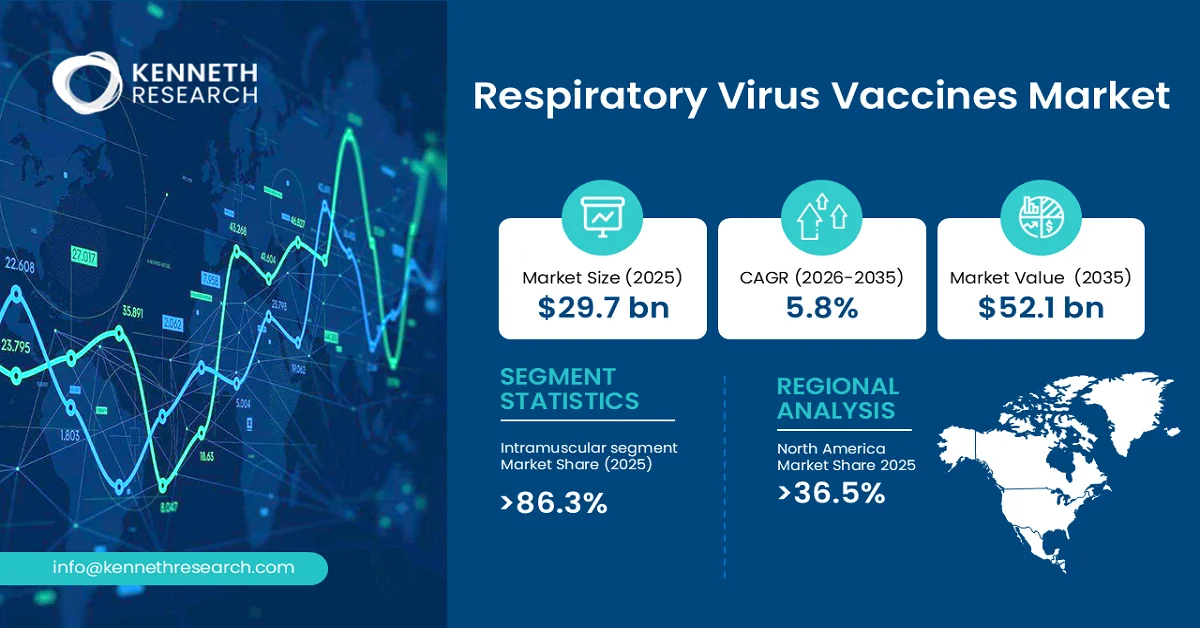
Respiratory Virus Vaccines Market size was valued at USD 29.7 billion in 2025 and is projected to reach USD 52.1 billion by the end of 2035, rising at a CAGR of 5.8% during the forecast period, i.e., 2026–2035. In 2026, the industry size of respiratory virus vaccines is estimated at USD 31.5 billion.
Growing government-backed immunization programs, expanding availability of vaccines targeting influenza, respiratory syncytial virus (RSV), and other respiratory pathogens, together with increased emphasis on pandemic preparedness and adult vaccination, are driving sustained demand for respiratory virus vaccines. Strengthening public health policies and investments in vaccine innovation continue to support long-term market growth.
The respiratory virus vaccines market comprises the development, manufacturing, distribution, and commercialization of vaccines designed to prevent viral respiratory infections, including influenza, respiratory syncytial virus (RSV), coronavirus, parainfluenza, adenovirus, and other clinically significant respiratory pathogens. These vaccines are administered across pediatric, adult, elderly, and high-risk populations through national immunization programs, healthcare providers, pharmacies, and institutional vaccination campaigns.
The market is characterized by continuous research into improved antigen design, adjuvant technologies, recombinant platforms, viral vector technologies, mRNA-based formulations, and combination vaccines that enhance immunogenicity, broaden strain coverage, and improve manufacturing responsiveness. Products are delivered through multiple routes of administration, with intramuscular vaccination remaining the predominant approach due to its established safety profile and widespread clinical adoption.
Key Respiratory Virus Vaccines Market Insights Summary:
Key Takeaways: Market Trends & Insights
- Respiratory Virus Vaccines Market expected to expand from USD 31.5 billion in 2026 to USD 52.1 billion by 2035 at a CAGR of 5.8%
- Intramuscular route of administration held the leading share of 86.3% in 2025 driven by established clinical practice and broad compatibility with respiratory vaccine platforms
- North America accounted for the largest regional share of 36.5% in 2025 supported by advanced vaccine manufacturing capabilities and strong public immunization infrastructure
- Influenza remained the leading virus type segment with continued demand driven by annual vaccination programs, established production capacity, and ongoing formulation advancements
- Growing government-backed immunization initiatives, expanding adult vaccination programs, and innovation in next-generation vaccine technologies are strengthening long-term market growth
Market Drivers
- Increasing investment in pandemic preparedness and vaccine manufacturing infrastructure
- Growing adoption of combination and multivalent respiratory vaccines
- Expansion of immunization programs in emerging economies
- Rising public-private collaborations for vaccine research and commercialization
Challenges
- Complex Strain Evolution and Continuous Vaccine Reformulation
- Cold-Chain Dependence and Manufacturing Capacity Constraints
Respiratory Virus Vaccines Market Overview & Supply Chain
Global adoption of respiratory virus vaccines is increasing as governments strengthen immunization strategies, expand adult vaccination recommendations, and invest in preparedness against seasonal and emerging respiratory pathogens. Advances in vaccine platforms, including mRNA, recombinant protein, and adjuvanted technologies, are improving product effectiveness and manufacturing agility. Regulatory agencies are also accelerating evaluation pathways for vaccines addressing unmet public health needs, while healthcare systems increasingly prioritize preventive care to reduce the burden of respiratory infections. This favorable policy and innovation environment continues to support broader vaccine deployment across both developed and emerging economies. Reflecting the scale of global immunization efforts, the World Health Organization (WHO) reported that 110 million infants received three doses of diphtheria-tetanus-pertussis (DTP3) vaccine worldwide in 2024, demonstrating the extensive immunization infrastructure that also supports the adoption of respiratory virus vaccines.
The respiratory virus vaccines industry value chain begins with the sourcing of biological materials, including viral seed strains, recombinant proteins, nucleic acids, lipid components, adjuvants, stabilizers, culture media, and sterile packaging materials supplied by specialized life sciences manufacturers. Vaccine developers conduct antigen discovery, formulation development, clinical evaluation, regulatory documentation, and large-scale manufacturing under stringent quality and biosafety standards. Production involves upstream bioprocessing, purification, fill-finish operations, quality assurance, and cold-chain packaging to preserve vaccine integrity. Distribution is coordinated through government procurement agencies, international procurement organizations, pharmaceutical wholesalers, hospital networks, retail pharmacies, and vaccination centers using temperature-controlled logistics. End users include pediatric and adult populations, older adults, healthcare workers, pregnant women, and other high-risk groups receiving vaccines through public immunization programs and private healthcare providers. Major stakeholders comprise biotechnology companies, pharmaceutical manufacturers, contract development and manufacturing organizations (CDMOs), regulatory authorities, public health agencies, healthcare providers, distributors, and international health organizations collaborating to ensure reliable vaccine availability and immunization coverage.
Respiratory Virus Vaccines Market: Growth Drivers & Challenges
Growth Drivers:
- Expansion of National Adult and Maternal Immunization Programs: The expansion of national immunization strategies beyond childhood vaccination is creating sustained demand for respiratory virus vaccines across adult, older adult, and maternal populations. Governments are increasingly incorporating respiratory disease prevention into routine public health policies to reduce hospitalizations, protect vulnerable groups, and strengthen healthcare resilience during seasonal outbreaks. These initiatives encourage broader procurement, improve reimbursement frameworks, and support investments in cold-chain infrastructure and vaccination delivery systems. The resulting increase in vaccination accessibility also incentivizes manufacturers to expand production capacity and accelerate the commercialization of next-generation vaccines. Looking ahead, continued integration of respiratory virus vaccines into national immunization schedules is expected to support long-term product adoption while fostering innovation in combination vaccines and broader protection against multiple respiratory pathogens. In 2024, the World Health Organization (WHO) recommended that all countries introduce immunization products to prevent severe RSV disease in infants, reinforcing global policy support for respiratory virus immunization.
- Rapid Innovation in Vaccine Platform Technologies: Continuous innovation in vaccine technologies is transforming the respiratory virus vaccines landscape by enabling faster antigen development, improved immune responses, and greater adaptability to evolving viral strains. Advances in mRNA, recombinant protein, viral vector, and adjuvant technologies are allowing manufacturers to develop products with enhanced efficacy and improved scalability while reducing development timelines. These technological improvements also support the creation of multivalent and combination vaccines capable of protecting against multiple respiratory pathogens through a single administration, improving patient compliance and healthcare efficiency. Increased collaboration between biotechnology firms, pharmaceutical companies, research institutions, and public health organizations is accelerating clinical development and regulatory submissions. As manufacturing platforms become more flexible and globally distributed, the industry is expected to respond more effectively to emerging respiratory threats while supporting sustainable vaccine supply and long-term innovation.
Challenges:
- Complex Strain Evolution and Continuous Vaccine Reformulation: Respiratory viruses, particularly influenza, undergo frequent genetic changes that complicate vaccine design and reduce the predictability of long-term product effectiveness. Manufacturers must continuously monitor circulating strains, update antigen compositions, and coordinate with regulatory authorities to align formulations with evolving epidemiological patterns. This recurring development cycle increases research, manufacturing, and regulatory complexity while compressing production timelines before seasonal vaccination campaigns. Commercially, companies face greater inventory management risks, forecasting uncertainty, and potential product obsolescence if circulating strains differ from anticipated variants. Healthcare providers and procurement agencies also encounter planning challenges when vaccine recommendations change. Looking ahead, investments in broadly protective and universal respiratory virus vaccines may reduce dependence on frequent reformulation, but achieving durable cross-strain immunity remains a significant scientific and commercial challenge that continues to influence competitive positioning across the industry.
- Cold-Chain Dependence and Manufacturing Capacity Constraints: Respiratory virus vaccines require highly controlled manufacturing environments and temperature-sensitive distribution networks to maintain product quality from production through administration. Specialized production facilities, sterile fill-finish operations, quality testing, and validated cold-chain logistics create substantial operational complexity across the supply chain. Capacity limitations become particularly evident during periods of elevated demand, when manufacturers must balance routine immunization programs with emergency public health requirements. Commercially, these constraints increase production costs, extend lead times, and create barriers for market expansion in regions with limited logistics infrastructure. Manufacturers must also make significant capital investments to comply with evolving quality and regulatory standards. Over the long term, expansion of regional manufacturing capabilities, improved thermostable formulations, and modernization of cold-chain infrastructure are expected to strengthen supply resilience, although implementation will require sustained investment and coordinated industry collaboration.
Respiratory Virus Vaccines Market Size and Forecast:
| Report Attribute | Details |
|---|---|
| Base Year |
2025 |
| Forecast Year |
2026-2035 |
| CAGR |
5.8% |
| Base Year Market Size (2025) |
USD 29.7 billion |
| Forecast Year Market Size (2035) |
USD 52.1 billion |
| Regional Scope |
|
Respiratory Virus Vaccines Market Segmentation Analysis:
Route of Administration Segment Analysis
In the route of administration segment, the intramuscular sub-segment is anticipated to capture the largest market share of 86.3% by the end of 2025.
The intramuscular segment dominates the respiratory virus vaccines market because it is the most established and clinically validated route for administering prophylactic vaccines against influenza, respiratory syncytial virus (RSV), COVID-19, and several other respiratory pathogens. Its widespread adoption is supported by extensive clinical evidence demonstrating consistent immune responses, compatibility with diverse vaccine platforms, and ease of integration into routine immunization programs. Healthcare providers are highly familiar with intramuscular administration protocols, enabling efficient delivery across hospitals, clinics, pharmacies, and community vaccination campaigns. On the supply side, manufacturers have optimized production, packaging, and regulatory documentation around injectable formulations, ensuring reliable large-scale commercialization and global distribution through established cold-chain networks. The segment is also well positioned to benefit from continued development of combination and next-generation vaccines designed for broad respiratory protection. Supporting sustained demand, the U.S. Centers for Disease Control and Prevention (CDC) reported that 50.2% of children aged 6 months through 17 years received at least one influenza vaccine dose during the 2024–25 influenza season, reflecting the continued reliance on intramuscular vaccination within routine immunization programs.
Virus Type Segment Analysis
The influenza sub-segment is projected to grow as the second-largest segment in the respiratory virus vaccines market due to four converging demand drivers.
The influenza segment is projected to experience sustained growth due to the continued circulation of seasonal influenza viruses, recurring annual vaccination recommendations, and expanding immunization initiatives targeting older adults, children, pregnant women, and individuals with chronic health conditions. Governments and public health agencies continue to prioritize influenza prevention to reduce pressure on healthcare systems during peak respiratory disease seasons, supporting stable procurement and vaccination campaigns. Industry adoption is further reinforced by continuous improvements in vaccine formulations, including cell-based, recombinant, adjuvanted, and high-dose influenza vaccines that enhance protection for vulnerable populations. On the supply side, established global manufacturing capacity, well-defined regulatory pathways, and mature distribution networks enable reliable annual vaccine production and deployment. Future growth is expected to be supported by the development of combination respiratory vaccines and broader adult immunization strategies.
Our in-depth analysis of the global respiratory virus vaccines market includes the following segments:
|
Segment |
Sub-segment |
|
Virus Type |
|
|
Technology Platform |
|
|
Patient Age Group |
|
|
Route of Administration |
|
Respiratory Virus Vaccines Market Regional Insights:
North America Market Trends & Insights:
North America respiratory virus vaccines market is projected to hold the largest revenue share of 36.5% by the end of 2025.
The region benefits from sustained investments in vaccine innovation, strong regulatory oversight, and efficient procurement mechanisms that accelerate the adoption of newly approved respiratory virus vaccines. Mature cold-chain logistics, extensive healthcare access, and collaborations between public health agencies and vaccine manufacturers further strengthen regional supply security and commercialization. In addition, continuous surveillance of respiratory pathogens and supportive reimbursement frameworks encourage consistent vaccine uptake across priority populations. Reinforcing the region's leadership in vaccine deployment, the U.S. Centers for Disease Control and Prevention (CDC) reported that 157.72 million influenza vaccine doses had been distributed in the United States by March 9, 2024, during the 2023–2024 influenza season, demonstrating the country's large-scale immunization capacity.
The United States serves as the principal growth engine within North America owing to its robust vaccine research ecosystem, strong presence of leading pharmaceutical and biotechnology companies, extensive clinical trial activity, and well-established adult and pediatric immunization programs. Continuous investments in next-generation respiratory vaccines and pandemic preparedness further reinforce its market position.
Canada complements regional leadership through proactive public health planning, universal healthcare coverage, and coordinated vaccination initiatives led by federal and provincial authorities. The country's emphasis on infectious disease surveillance, strategic vaccine procurement, and preparedness planning supports stable vaccine demand while fostering collaboration with global manufacturers. Together, these factors position North America as the leading regional hub for respiratory virus vaccine development, production, regulatory advancement, and widespread clinical adoption.
Asia Pacific Market Trends & Insights:
Asia Pacific is expected to experience strong growth in the respiratory virus vaccines market due to expanding immunization programs, increasing awareness of respiratory infectious diseases, and rising investments in vaccine research and manufacturing capabilities. Governments across the region are strengthening disease surveillance systems, enhancing pandemic preparedness, and promoting domestic vaccine production to improve healthcare security and reduce dependence on imported products. Rapid urbanization, aging populations, and greater recognition of adult immunization are contributing to sustained demand for respiratory virus vaccines. In parallel, expanding cold-chain infrastructure, improvements in healthcare accessibility, and supportive regulatory reforms are facilitating broader vaccine deployment across both developed and emerging economies. The region also presents significant opportunities for manufacturers through technology transfer partnerships, localized production, and the development of innovative vaccines tailored to regional epidemiological needs.
China is a major contributor to regional growth owing to its extensive vaccine manufacturing capacity, expanding biotechnology sector, and government support for infectious disease prevention and vaccine innovation. Investments in advanced production technologies, clinical research, and public health infrastructure continue to strengthen the country's position in respiratory vaccine development and supply.
Japan supports regional advancement through its sophisticated pharmaceutical industry, stringent regulatory framework, and strong emphasis on preventive healthcare. Ongoing research into next-generation vaccine platforms, combined with an aging population and established immunization infrastructure, is driving continued adoption of respiratory virus vaccines. Collaborative initiatives among government agencies, academic institutions, and pharmaceutical companies are expected to further enhance innovation, manufacturing resilience, and long-term market opportunities across the Asia Pacific region.
Leading Companies Operating in the Global Respiratory Virus Vaccines Market:
Here is a list of upstream, downstream, and key players operating in the global respiratory virus vaccines market competitive ecosystem:
- Blue Lake Biotechnology (United States)
- Company Overview
- Business Strategy
- Key Product Offerings
- Financial Performance
- Key Performance Indicators
- Risk Analysis
- Recent Developmen
- BioNTech SE (Germany)
- Clover Biopharmaceuticals (China)
- Bavarian Nordic A/S (Denmark)
- Sinovac Biotech Ltd. (China)
- Serum Institute of India Pvt. Ltd. (India)
- Bharat Biotech (India)
Recent Developments
- In March 2025, the World Health Organization (WHO) prequalified Pfizer's Abrysvo as the first maternal RSV vaccine for global use, followed by a Gavi commitment in July 2025 to open a funding window for RSV maternal immunization programs. This marks a critical milestone for introducing maternal RSV vaccination in low- and middle-income countries, where 98% of pediatric RSV deaths occur.
- In 2024, the RSV prophylaxis market expanded rapidly with three approved adult vaccines—GSK's Arexvy, Pfizer's Abrysvo, and Moderna's mRESVIA—alongside AstraZeneca/Sanofi's Beyfortus (nirsevimab) for infant protection. The RSV pipeline remains active with 30 candidates in clinical development, including protein-based, live-attenuated, mRNA, and monoclonal antibody approaches targeting infants, toddlers, children, and adults.
Frequently Asked Question
In 2025, the respiratory virus vaccines market exceeded USD 29.7 billion.
The respiratory virus vaccines market is projected to reach USD 52.1 billion by the end of 2035, expanding at a CAGR of 5.8% over the forecast period (2026–2035).
The major players in the market are Blue Lake Biotechnology (United States), BioNTech SE (Germany), Clover Biopharmaceuticals (China), Bavarian Nordic A/S (Denmark), Sinovac Biotech Ltd. (China), Serum Institute of India Pvt. Ltd. (India), Bharat Biotech (India), and others.
In the Route of Administration segment, the Intramuscular sub-segment is anticipated to capture the largest market share of 86.3% in the future and exhibit lucrative growth opportunities during 2026–2035. This growth trajectory is largely attributed to its widespread clinical adoption, established administration protocols, and compatibility with a broad range of respiratory virus vaccine platforms.
North America is projected to hold the largest market share of 36.5% by the end of 2035 and provide more business opportunities in the future. Continuous investments in vaccine research, advanced manufacturing capabilities, and comprehensive immunization programs across the United States and Canada are fostering the region's dominance.
Why Choose Kenneth Research ?
-
Insight with Impact : We don’t just gather data — we uncover stories, trends, and opportunities that fuel business growth.
-
Experts Who Get It : Our team speaks your industry’s language and knows what really matters to your customers and market.
-
Custom-Built for You : Forget one-size-fits-all. We craft research and consulting solutions as unique as your business vision.
-
Partners, Not Just Providers : We work with you, not for you — collaborating closely to turn insights into smart, strategic moves.
-
Results That Speak : Our work powers brands, startups, and industry leaders alike — with a track record of ideas that work in the real world.
Report ID: 1036 |
Published Date: 28 Jul 2026 |
Report Format: |
Delivery Timeline: 48-72 Business Hours

Copyright © 2025 Kenneth Research. All rights reserved. Terms of Use | Privacy Policy
