Report ID: 1169 |
Published Date: 25 Aug 2026 |
Report Format: |
Delivery Timeline: 48-72 Business Hours
Resins In Paints And Coatings Market Outlook:
Resins In Paints and Coatings Market size was valued at USD 39.1 billion in 2025 and is projected to reach USD 62.9 billion by the end of 2035, rising at a CAGR of 4.9% during the forecast period, i.e., 2026-2035. In 2026, the industry size of Resins In Paints and Coatings is estimated at USD 40.9 billion.
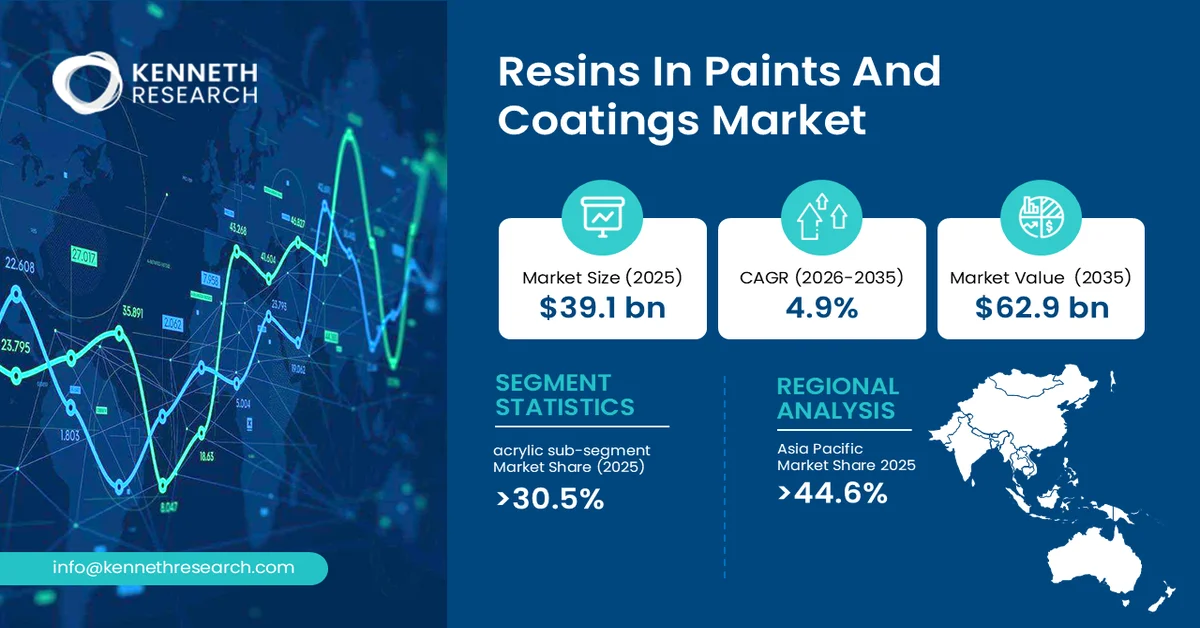
Growing demand for lower-emission and more environmentally responsible coatings is a key growth driver for resins in paints and coatings. Regulatory and sustainability pressures are encouraging manufacturers to develop waterborne, low-VOC, and higher-performance formulations, while resin technologies increasingly enable improved durability, adhesion, weather resistance, and application performance across architectural and industrial coating systems.
The Resins In Paints And Coatings Market comprises resin and polymeric binder systems used as fundamental film-forming components in paint and coating formulations. Resins bind pigments and other formulation ingredients together and enable the finished coating to adhere to substrates while providing properties such as hardness, flexibility, durability, chemical resistance, weatherability, gloss, and surface protection.
Key resin systems include acrylic, alkyd, epoxy, polyurethane, polyester, vinyl, and other specialized chemistries. Their selection depends on the substrate, application method, exposure conditions, required appearance, curing mechanism, and performance requirements. Resin systems can be incorporated into waterborne, solventborne, high-solids, and other coating formulations.
Key Resins In Paints And Coatings Market Insights Summary:
Key Takeaways: Market Trends & Insights
- The Resins In Paints and Coatings Market is valued at USD 39.1 billion in 2025 and is projected to reach USD 62.9 billion by 2035, expanding at a 4.9% CAGR during 2026–2035
- The market is projected to increase from USD 40.9 billion in 2026 to USD 62.9 billion by 2035, reflecting sustained demand for resin technologies across paints and coatings applications
- Acrylic resin is the leading Resin Type segment, accounting for a 30.5% market share in 2025, supported by weatherability, adhesion, durability, and broad architectural and industrial applicability
- Asia-Pacific is the dominant regional market, holding a 44.6% market share in 2025, with China and India serving as key demand and manufacturing centers
- Architectural is identified as the second and fastest analysis segment within the End-User Industry category, supported by construction, renovation, infrastructure development, and demand for durable coating systems
Market Drivers
- Infrastructure rehabilitation and corrosion-protection requirements
- Rising performance requirements across industrial applications
- Sustainability-driven development of lower-emission and resource-efficient resin technologies
- Expansion of architectural and construction coating applications
Challenges
- Tightening emission compliance and reformulation complexity
- Petrochemical feedstock dependence and supply-chain exposure
Resins In Paints And Coatings Market Overview & Supply Chain
Adoption of resins in paints and coatings is increasing globally as manufacturers and end users seek coatings that combine surface protection, durability, appearance, and environmental compliance. Resin chemistry is central to achieving these performance attributes while supporting the transition toward waterborne, low-emission, high-solids, and other advanced coating technologies. Regulatory pressure is also strengthening the need for improved formulation control. For example, the U.S. Environmental Protection Agency’s 2022 final rule for paint stripping and miscellaneous surface coating operations estimated that implementation would reduce hazardous air pollutant emissions from affected surface-coating operations by 6,900 tons per year. This regulatory direction reinforces the industrial importance of resin systems that enable compliant formulations without compromising coating performance.
The resins in paints and coatings value chain begins with feedstocks and chemical intermediates, including petrochemical-derived and specialty raw materials used to manufacture polymeric resin systems. Resin producers convert these inputs through controlled polymerization, modification, blending, and finishing processes to produce application-specific binder technologies. Manufacturers of paints and coatings then formulate resins with pigments, solvents or water, additives, and other functional ingredients to create finished coating products. Distribution occurs through direct industrial sales, specialty chemical distributors, regional distributors, and established coatings supply networks. End users span construction and architectural applications, infrastructure, transportation, industrial equipment, metal products, wood, and other manufacturing sectors. Major stakeholders therefore include chemical feedstock suppliers, resin manufacturers, coatings formulators, distributors, contractors, industrial users, building-material companies, and regulatory authorities.
Resins In Paints And Coatings Market: Growth Drivers & Challenges
Growth Drivers:
- Infrastructure rehabilitation and corrosion-protection requirements: Infrastructure rehabilitation is strengthening demand for protective coating systems, particularly where steel and other exposed materials require corrosion mitigation and extended service life. Resin systems are a critical component because they determine adhesion, chemical resistance, weatherability, flexibility, and barrier performance in protective coatings. Public infrastructure proagrams therefore create downstream opportunities for resin suppliers as bridge rehabilitation, replacement, and preservation projects require coating systems suited to demanding service environments. The U.S. Federal Highway Administration states that its Bridge Investment Program is designed to replace, rehabilitate, preserve, and protect bridges, directly linking infrastructure investment with preservation requirements. In addition, FHWA published its 2024 Best Practices for Corrosion Control and Mitigation report, highlighting corrosion control as an important infrastructure-management consideration.
- Rising performance requirements across industrial applications: Industrial users increasingly require coatings to deliver multiple functions beyond basic surface decoration, including corrosion resistance, abrasion resistance, chemical resistance, weather protection, adhesion, and long-term durability. This trend supports demand for resin systems engineered around specific substrates, curing conditions, operating environments, and application processes. The growth mechanism is therefore driven by performance specification rather than simply higher coating consumption: more demanding end-use requirements encourage formulators to adopt resin chemistries capable of meeting tighter technical specifications. This creates opportunities for specialty resin suppliers with differentiated technologies, formulation expertise, and technical support capabilities. It also encourages closer collaboration between resin producers and coatings manufacturers to optimize binder performance for individual applications.
Challenges:
- Tightening emission compliance and reformulation complexity: Stricter environmental requirements for coating emissions create a structural restraint because resin suppliers and coating manufacturers must reformulate products while preserving application performance. Regulations governing VOC emissions vary by coating category and jurisdiction, requiring manufacturers to manage different formulation specifications, testing protocols, documentation, and compliance requirements. The U.S. Environmental Protection Agency maintains separate regulatory frameworks covering architectural, automotive-refinish, aerospace, aerosol, and other surface-coating applications, illustrating the complexity of compliance across end uses. This increases formulation-development costs and can lengthen qualification cycles when established resin systems must be adapted to waterborne, high-solids, powder, or other lower-emission technologies. Commercially, suppliers may face higher technical-service requirements and slower customer conversion.
- Dependence on petrochemical feedstocks and supply-chain volatility: Many conventional resin systems depend on petrochemical-derived intermediates, exposing manufacturers to disruptions in upstream chemical availability, energy markets, logistics, and regional production capacity. Because resin manufacturing is integrated with broader chemical supply chains, interruptions affecting key intermediates can propagate into coating production, inventory planning, customer deliveries, and pricing decisions. This creates commercial pressure for both resin producers and coating formulators, particularly where alternative qualified feedstocks or suppliers are limited. The challenge is not simply the cost of raw materials; changing a resin input can require reformulation, performance validation, customer approval, and potentially new regulatory documentation. Consequently, manufacturers may need to maintain alternative sourcing arrangements and develop greater feedstock flexibility.
Resins In Paints and Coatings Market Size and Forecast:
| Report Attribute | Details |
|---|---|
| Base Year |
2025 |
| Forecast Year |
2026-2035 |
| CAGR |
4.9% |
| Base Year Market Size (2025) |
USD 39.1 billion |
| Forecast Year Market Size (2035) |
USD 62.9 billion |
| Regional Scope |
|
Resins In Paints And Coatings Market Segmentation Analysis:
Resin Type Segment Analysis
In the resin type segment, the acrylic sub-segment is anticipated to capture the largest market share of 30.5% by the end of 2025.
Acrylic resin dominates the resin-type segment because it offers a balanced combination of weatherability, color retention, adhesion, hardness, flexibility, and resistance to ultraviolet exposure, making it suitable for architectural and numerous industrial coating applications. Demand is reinforced by construction, renovation, decorative finishing, and protective coating requirements, where long-lasting appearance and surface protection are important purchasing criteria. The U.S. Bureau of Labor Statistics reported 342,200 construction and maintenance painter jobs in 2024, demonstrating the substantial workforce associated with applying paints and coatings across buildings, machinery, bridges, and other structures. Acrylic technologies are also benefiting from formulation development aimed at waterborne and lower-emission coatings, including research into improving film formation while reducing reliance on volatile coalescents.
End-User Segment Analysis
The Architectural is projected to grow as the second-largest segment in the Resins In Paints and Coatings market due to four converging demand drivers.
The architectural segment is projected to grow as residential, commercial, institutional, and renovation projects increasingly require coatings that combine decorative appeal with surface protection and durability. Demand is supported by new construction, refurbishment, maintenance, and changing preferences for finishes that provide improved weatherability, color retention, washability, and lower-emission characteristics. Industry adoption is also shifting toward waterborne and other advanced coating formulations, increasing the importance of resin systems that can deliver performance while meeting evolving environmental requirements.
Our in-depth analysis of the global Resins In Paints And Coatings market includes the following segments:
|
Segment |
Sub-segment |
|
Resin Type |
|
|
End-User Industry |
|
Resins In Paints And Coatings Market Regional Insights:
Asia Pacific Market Trends & Insights:
Asia Pacific Resins In Paints and Coatings market is projected to hold the largest revenue share of 44.6% by the end of 2025.
Its leadership reflects the region’s extensive manufacturing base, large construction and infrastructure activity, expanding industrial production, and strong demand for architectural and protective coatings. China, India, and other Asian economies provide substantial downstream consumption while also supporting resin and coatings manufacturing capacity. The region’s combination of domestic demand, industrial investment, construction activity, and established chemical supply chains strengthens both production and consumption. Government infrastructure programs, urban development, industrial expansion, and building renovation further support demand for resin-based coating systems.
China represents a major regional demand center, supported by its extensive construction and manufacturing ecosystem. China’s National Bureau of Statistics reported that 998.31 million square meters of building floor space were completed in 2023, indicating substantial ongoing activity relevant to architectural coatings.
India is another important growth market, supported by infrastructure development, urbanization, housing construction, and industrial investment. Together, China and India strengthen Asia-Pacific’s consumption base while creating opportunities for resin producers to expand localized production, technical capabilities, and application-specific coating solutions.
North America Market Trends & Insights:
North America represents an important secondary region for resins in paints and coatings, supported by established construction, infrastructure, manufacturing, automotive, and industrial maintenance activity. Demand is increasingly influenced by renovation, asset preservation, corrosion protection, and requirements for coatings that combine durability with environmental compliance. Government initiatives supporting infrastructure modernization and building investment create opportunities for protective, architectural, and specialty coating systems. The region’s mature coatings industry also supports adoption of technically differentiated resin chemistries, particularly where customers prioritize lifecycle performance, application efficiency, and regulatory compliance.
In the United States, demand is supported by its broad industrial and construction base, including transportation infrastructure, commercial buildings, manufacturing facilities, and residential construction. Public investment programs can stimulate downstream requirements for protective and architectural coatings.
Canada offers complementary opportunities through construction, infrastructure renewal, industrial facilities, and institutional development. Statistics Canada reported continued expansion in Canadian building-construction activity during 2024, with growth across residential and non-residential components, reinforcing the underlying application base for architectural and protective coatings. Together, the United States and Canada provide resin suppliers with opportunities to expand advanced formulations, strengthen local technical support, and serve increasingly performance- and sustainability-oriented coating applications.
Leading Companies Operating in the Global Resins In Paints And Coatings Market:
Here is a list of upstream, downstream, and key players operating in the global Resins In Paints And Coatings Market competitive ecosystem:
- BASF SE (Germany)
- Company Overview
- Business Strategy
- Key Product Offerings
- Financial Performance
- Key Performance Indicators
- Risk Analysis
- Recent Development
- Regional Presence
- SWOT Analysis
- Arkema S.A. (France)
- Dow Inc. (United States)
- Hexion Inc. (United States)
Recent Developments
- In September 2025, BASF, Arkema, and AkzoNobel announced a value-chain partnership to lower the carbon footprint of architectural powder coatings. BASF supplies bio-attributed neopentyl glycol (NPG) with zero carbon footprint to Arkema, who transforms it into low-carbon resins for AkzoNobel's Interpon powder coatings. The collaboration has reduced the carbon footprint of AkzoNobel's Interpon D range by up to 40% through supplier-specific product carbon footprint data and bio-attributed raw materials.
- In March 2025, BASF more than doubled production capacity for polyester and polyurethane resins at its Caojing plant in Shanghai, China, increasing annual capacity from 8,000 to 18,800 metric tons. The facility, powered by 100% renewable energy, also plans additional process optimizations for electrocoat binder production starting in early 2026 to support growing automotive coatings demand across Asia Pacific.
Frequently Asked Question
In 2025, the resins in paints and coatings market exceeded USD 39.1 billion.
The resins in paints and coatings market is projected to reach USD 62.9 billion by the end of 2035, expanding at a CAGR of 4.9% over the forecast period (2026-2035).
The major players in the market are BASF SE, Arkema S.A., Dow Inc., Hexion Inc., and others.
In the resin type segment, the acrylic sub-segment is anticipated to capture the largest market share of 30.5% in the future and exhibit lucrative growth opportunities during 2026-2035. This growth trajectory is largely attributed to its strong weatherability, adhesion, durability, and suitability for architectural and industrial coating applications.
Asia-Pacific is projected to hold the largest market share of 44.6% by the end of 2025 and provide more business opportunities in the future. Strong manufacturing activity, construction and infrastructure development, and demand across China and India are fostering the region's dominance.
Why Choose Kenneth Research ?
-
Insight with Impact : We don’t just gather data — we uncover stories, trends, and opportunities that fuel business growth.
-
Experts Who Get It : Our team speaks your industry’s language and knows what really matters to your customers and market.
-
Custom-Built for You : Forget one-size-fits-all. We craft research and consulting solutions as unique as your business vision.
-
Partners, Not Just Providers : We work with you, not for you — collaborating closely to turn insights into smart, strategic moves.
-
Results That Speak : Our work powers brands, startups, and industry leaders alike — with a track record of ideas that work in the real world.
Report ID: 1169 |
Published Date: 25 Aug 2026 |
Report Format: |
Delivery Timeline: 48-72 Business Hours

Copyright © 2025 Kenneth Research. All rights reserved. Terms of Use | Privacy Policy
