Report ID: 1174 |
Published Date: 26 Aug 2026 |
Report Format: |
Delivery Timeline: 48-72 Business Hours
Renewable Energy Storage Market Outlook:
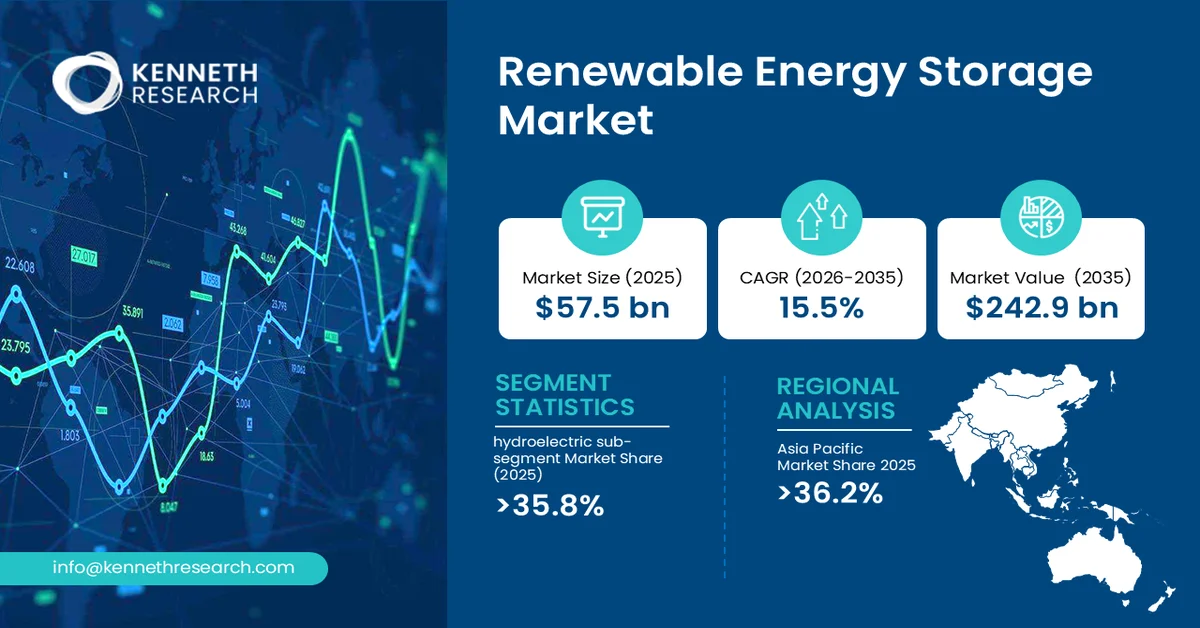
Renewable Energy Storage Market size was valued at USD 57.5 billion in 2025 and is projected to reach USD 242.9 billion by the end of 2035, rising at a CAGR of 15.5% during the forecast period, i.e., 2026-2035. In 2026, the industry size of the renewable energy storage is estimated at USD 66.4 billion.
The primary growth driver for the renewable energy storage market is the accelerating integration of variable renewable power into electricity grids. Energy storage enables excess solar and wind generation to be shifted to periods of higher demand, improves grid balancing, and strengthens power-system reliability.
The renewable energy storage market encompasses technologies, systems, and associated solutions used to store energy generated from renewable sources and release it when required. The market includes storage technologies such as pumped-storage hydropower, batteries, thermal storage, and other long-duration systems designed to improve the flexibility and reliability of renewable electricity systems. These solutions can absorb surplus electricity during periods of high renewable generation and discharge it when renewable output declines or electricity demand increases.
Key characteristics include energy-shifting capability, rapid response, grid balancing, renewable-power integration, and the ability to provide short- and long-duration flexibility. Storage can operate at utility, commercial, and distributed levels, depending on system requirements.
Key Renewable Energy Storage Market Insights Summary:
Key Takeaways: Market Trends & Insights
- Renewable Energy Storage Market projected to grow from USD 57.5 billion in 2025 to USD 242.9 billion by 2035 at a 15.5% CAGR.
- Asia Pacific accounted for the largest regional share at 36.2% in 2025, supported by rapid renewable-power deployment, grid modernization, and strong energy-storage development across Japan and China.
- Hydroelectric is expected to remain the leading Source segment with a 35.8% market share, supported by its established infrastructure, long-duration storage capabilities, and role in grid balancing.
- Commercial applications are projected to experience strong growth as businesses increasingly adopt energy storage for renewable integration, power reliability, demand management, and energy-cost optimization.
Market Drivers
- Government-led expansion of energy storage infrastructure
- Increasing need for grid flexibility and renewable integration
- Advancements in battery and long-duration storage technologies
- Growing electrification and rising demand for reliable, flexible power systems
Challenges
- High capital requirements and lengthy project development
- Supply chain and manufacturing constraints
Renewable Energy Storage Market Overview & Supply Chain
Global adoption of renewable energy storage is increasing as power systems integrate larger volumes of variable renewable electricity and require greater flexibility to balance generation with demand. Storage technologies enable excess renewable electricity to be retained and dispatched when generation falls, while also supporting grid stability, peak management, and improved utilization of renewable assets. According to the U.S. Energy Information Administration (EIA), U.S. generators added 10.4 GW of new utility-scale battery storage capacity in 2024, demonstrating accelerating deployment of storage technologies alongside expanding renewable generation.
The renewable energy storage value chain begins with raw-material and component suppliers providing battery minerals, electrochemical materials, metals, power electronics, turbines, pumps, reservoirs, control systems, and thermal-storage media. Technology manufacturers then convert these inputs into battery systems, pumped-storage equipment, thermal storage units, energy-management systems, and integrated storage solutions. System integrators combine storage hardware with inverters, controls, monitoring platforms, and renewable generation assets before project developers and engineering, procurement, and construction companies deploy systems at utility, commercial, and distributed sites.
Renewable Energy Storage Market: Growth Drivers & Challenges
Growth Drivers:
- Government-led expansion of energy storage infrastructure: Government policies supporting grid-scale energy storage are accelerating market adoption by improving project economics, establishing procurement frameworks, and creating clearer demand visibility for storage developers. As renewable generation expands, policymakers are increasingly recognizing storage as essential infrastructure for balancing variable electricity supply, managing peak demand, and maintaining grid reliability. In India, the Ministry of Power reported that the National Electricity Plan projects a requirement for 208 GWh of Battery Energy Storage Systems by 2030 to facilitate integration of increasing renewable generation.
- Increasing need for grid flexibility and renewable integration: The rapid deployment of intermittent solar and wind generation is increasing the need for flexible resources capable of balancing electricity supply and demand in real time. Renewable energy storage addresses this requirement by shifting electricity from periods of surplus generation to periods of higher demand while also providing frequency regulation, reserve capacity, voltage support, and other grid services. Storage therefore allows utilities and renewable developers to improve asset utilization and reduce renewable curtailment while strengthening overall system reliability. Growing electrification of transportation, buildings, industrial processes, and data centers is further increasing the importance of flexible power infrastructure.
Challenges:
- High capital requirements and lengthy project development: Large-scale renewable energy storage projects, particularly hydroelectric and other long-duration systems, face substantial upfront investment requirements and extended development timelines. The root cause is the need for specialized infrastructure, grid interconnection, engineering, environmental assessment, land or water resources, and extensive permitting before commercial operation. These requirements can increase financing costs and expose developers to regulatory and construction uncertainty. The U.S. Department of Energy identifies lengthy permitting and licensing processes as important barriers to hydropower and pumped-storage development.
- Supply chain and manufacturing constraints: Renewable energy storage deployment is also constrained by supply-chain weaknesses affecting specialized equipment, components, critical materials, and manufacturing capabilities. The challenge is particularly relevant for technologies requiring highly engineered components and specialized production capacity, where limited supplier availability can increase procurement risks and project costs.
Renewable Energy Storage Market Size and Forecast:
| Report Attribute | Details |
|---|---|
| Base Year |
2025 |
| Forecast Year |
2026-2035 |
| CAGR |
15.5% |
| Base Year Market Size (2025) |
USD 57.5 billion |
| Forecast Year Market Size (2035) |
USD 242.9 billion |
| Regional Scope |
|
Renewable Energy Storage Market Segmentation Analysis:
Source Segment Analysis
In the source segment, the hydroelectric sub-segment is anticipated to capture the largest market share of 35.8% by the end of 2025.
Its leadership is supported by the established role of hydropower in providing dispatchable electricity and grid flexibility, particularly as power systems integrate increasing volumes of intermittent renewable generation. Hydroelectric storage, especially pumped-storage facilities, can shift electricity across demand periods while supporting system balancing and reliability. China remains a major contributor to this segment, supported by extensive hydropower infrastructure and continued development of pumped-storage projects. According to China's National Energy Administration, pumped-storage capacity reached 58.69 GW at the end of 2024, reflecting continued expansion of storage infrastructure.
Application Segment Analysis
The commercial application segment is projected to grow as businesses increasingly adopt energy storage to improve power reliability, manage demand, integrate on-site renewable generation, and reduce exposure to grid constraints. Commercial facilities can use storage to shift electricity consumption, support critical loads during outages, and coordinate renewable generation with building demand. Adoption is also expanding as energy-management systems become more sophisticated and storage technologies become suitable for different operating profiles. On the supply side, technology providers are developing integrated battery and thermal-storage solutions that can be combined with solar generation, building controls, and energy-management platforms. The U.S. Department of Energy highlights thermal energy storage as a solution for commercial buildings that can be integrated with on-site renewable energy and help manage energy demand.
Our in-depth analysis of the global renewable energy storage market includes the following segments:
|
Segment |
Sub-segment |
|
Source |
|
|
Application |
|
|
Storage Technology |
|
|
Connection Type |
|
|
Ownership |
|
Renewable Energy Storage Market Regional Insights:
Asia Pacific Market Trends & Insights:
Asia Pacific is the dominant region in the renewable energy storage market, accounting for 36.2% in 2025.
Regional leadership is supported by rapid renewable-power deployment, large-scale grid modernization, expanding electricity demand, and strong manufacturing capabilities across the energy-storage value chain. Governments are increasingly integrating storage into power-system planning to improve renewable utilization, grid flexibility, and energy security. China is particularly influential, with the National Energy Administration reporting that the country’s new-type energy-storage capacity reached 73.76 GW by the end of 2024, demonstrating substantial deployment alongside renewable generation.
Japan represents an important high-value market because of its advanced electricity infrastructure, emphasis on energy security, and need for flexible resources that can support renewable integration. Its mature technology ecosystem also supports deployment of sophisticated storage solutions across utility and distributed applications.
China remains the region's principal growth engine, supported by extensive renewable-generation capacity, domestic manufacturing capabilities, and government-backed energy-storage development. The country's National Energy Administration has emphasized new-type storage as a key technology for building a modern power system and supporting renewable-energy utilization.
North America Market Trends & Insights:
North America represents a strategically important region for the renewable energy storage market, supported by expanding renewable generation, grid modernization, electrification, and increasing requirements for reliable and flexible power infrastructure. Utilities and commercial power users are adopting storage to manage renewable intermittency, improve grid resilience, shift electricity consumption, and support distributed energy resources. Government initiatives are also strengthening the regional ecosystem. In the U.S., the Department of Energy released an updated Energy Storage Strategy and Roadmap to guide research, development, demonstration, and deployment while supporting resilient and reliable electricity systems.
The U.S. is the principal contributor to regional growth, supported by extensive renewable deployment, sophisticated electricity markets, strong technology development, and increasing utility and commercial adoption of storage. The EIA reported that utility-scale battery storage capacity surpassed 26 GW in 2024, reflecting rapid deployment alongside renewable generation.
Canada offers additional opportunities through its large renewable-power base, hydropower resources, grid modernization requirements, and growing interest in storage technologies that can complement variable renewable generation.
Renewable Energy Storage Market: Competitive Landscape
Here is a list of upstream, downstream, and key players operating in the global renewable energy storage market competitive ecosystem:
- Tesla(United States)
- Company Overview
- Business Strategy
- Key Product Offerings
- Financial Performance
- Key Performance Indicators
- Risk Analysis
- Recent Development
- Regional Presence
- SWOT Analysis
- Sungrow(China)
- GE Vernova(United States)
- Voith(Germany)
Recent Developments
- April 2026 – Tesla reported continued deployment of its energy-storage products in its first-quarter 2026 business update, highlighting ongoing commercial expansion of its stationary storage portfolio.
- March 2026 –Sungrow announced a strengthened partnership with Delta Capacity for European energy-storage projects. The collaboration supports broader deployment of Sungrow's energy-storage solutions and strengthens its position in the European storage market.
Frequently Asked Question
In 2025, the renewable energy storage market exceeded USD 57.5 billion.
The renewable energy storage market is projected to reach USD 242.9 billion by the end of 2035, expanding at a CAGR of 15.5% over the forecast period (2026–2035).
The major players in the market are Tesla, Sungrow, GE Vernova, Voith, ANDRITZ, and others.
In the Source segment, the Hydroelectric sub-segment is anticipated to capture the largest market share of 35.8% in the future and exhibit lucrative growth opportunities during 2026–2035. This growth trajectory is largely attributed to the increasing need for long-duration energy storage and grid flexibility to support renewable-power integration.
Asia Pacific is projected to hold the largest market share of 36.2% by the end of 2025 and provide more business opportunities in the future. Continuous investments in renewable power infrastructure, grid modernization, and energy-storage deployment across Japan and China are fostering the region's dominance.
Why Choose Kenneth Research ?
-
Insight with Impact : We don’t just gather data — we uncover stories, trends, and opportunities that fuel business growth.
-
Experts Who Get It : Our team speaks your industry’s language and knows what really matters to your customers and market.
-
Custom-Built for You : Forget one-size-fits-all. We craft research and consulting solutions as unique as your business vision.
-
Partners, Not Just Providers : We work with you, not for you — collaborating closely to turn insights into smart, strategic moves.
-
Results That Speak : Our work powers brands, startups, and industry leaders alike — with a track record of ideas that work in the real world.
Report ID: 1174 |
Published Date: 26 Aug 2026 |
Report Format: |
Delivery Timeline: 48-72 Business Hours

Copyright © 2025 Kenneth Research. All rights reserved. Terms of Use | Privacy Policy
