Report ID: 1088 |
Published Date: 14 Aug 2026 |
Report Format: |
Delivery Timeline: 48-72 Business Hours
Renal Disease Market Outlook:
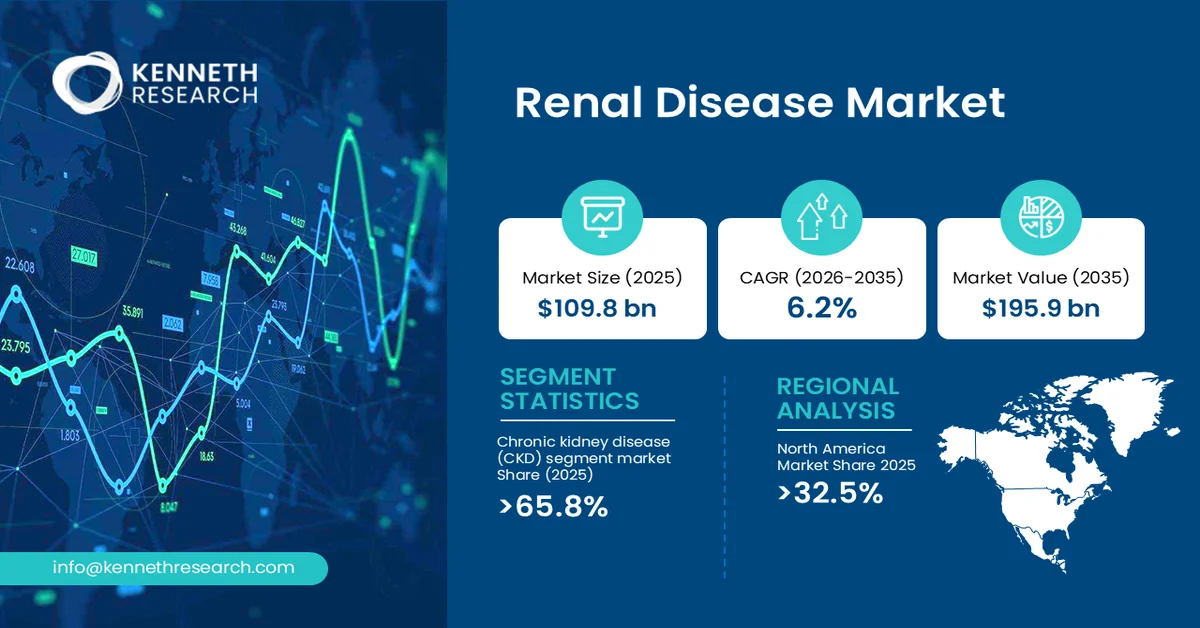
Renal Disease Market size was valued at USD 109.8 billion in 2025 and is projected to reach USD 195.9 billion by the end of 2035, rising at a CAGR of 6.2% during the forecast period, i.e., 2026–2035. In 2026, the industry size of the Renal Disease Market is estimated at USD 116.6 billion.
The primary growth driver of the Renal Disease Market is the increasing burden of chronic kidney disease (CKD), supported by rising prevalence of diabetes, hypertension, and aging populations. The growing need for early diagnosis, long-term disease management, dialysis, transplantation, and advanced therapeutics continues to expand demand across global healthcare systems.
The Renal Disease Market comprises the products, services, and clinical interventions used for the prevention, diagnosis, monitoring, and treatment of disorders affecting kidney function. It includes therapies for chronic kidney disease (CKD), acute kidney injury (AKI), end-stage kidney disease (ESKD), inherited renal disorders, and related complications. The market encompasses pharmaceuticals, dialysis systems, renal replacement therapies, diagnostic assays, imaging technologies, transplantation support, and digital disease management solutions delivered across hospitals, specialty clinics, dialysis centers, and home-based care settings.
A defining characteristic of the market is its multidisciplinary approach, integrating nephrology care with laboratory diagnostics, medical devices, biologics, precision medicine, and long-term patient monitoring. The increasing adoption of home dialysis technologies, biomarker-based diagnostics, and value-based care models is reshaping treatment pathways while improving patient outcomes and healthcare efficiency.
From an industrial perspective, the Renal Disease Market plays a critical role in global healthcare infrastructure by addressing one of the leading chronic disease burdens. It supports sustained investment in medical technologies, pharmaceutical innovation, clinical research, and healthcare services aimed at delaying disease progression, reducing complications, and improving quality of life for patients with kidney disorders.
Key Renal Disease Market Insights Summary:
Key Takeaways: Market Trends & Insights
- Renal Disease Market is projected to grow from USD 116.6 billion in 2026 to USD 195.9 billion by 2035, reflecting sustained demand driven by long-term kidney disease management and therapeutic innovation
- Chronic Kidney Disease (CKD) remains the leading segment, accounting for 65.8% of the market in 2025, supported by increasing adoption of early diagnosis, integrated care pathways, and continuous treatment requirements
- North America held the dominant regional position with a 32.5% market share in 2025, driven by advanced nephrology infrastructure, strong regulatory support, and significant investments across the United States and Canada
- The dialysis application segment is expected to witness robust growth due to expanding home dialysis adoption, technological advancements in renal replacement therapy, and increasing deployment of connected patient monitoring solutions
- The market is forecast to expand at a 6.2% CAGR during 2026-2035, supported by innovation in diagnostics, precision medicine, digital health integration, and growing investments in comprehensive renal care services
Market Drivers
- Increasing adoption of home dialysis and remote patient monitoring solutions
- Rising investments in precision medicine and biomarker-based renal diagnostics
- Growing healthcare expenditure focused on chronic disease management
- Expanding public-private collaborations supporting nephrology research and innovation
Challenges
- High cost of comprehensive renal care and long-term treatment
- Limited availability of skilled nephrology workforce and specialized care infrastructure
Renal Disease Market Overview & Supply Chain
The adoption of renal disease diagnostics, therapeutics, dialysis technologies, and transplant support services is increasing globally as healthcare systems prioritize earlier detection, chronic disease management, and improved patient outcomes. Advances in biomarker-based diagnostics, home dialysis technologies, tele-nephrology, and precision medicine are enhancing clinical decision-making while reducing the burden on hospital infrastructure. Regulatory agencies are also encouraging standardized kidney disease screening and integrated chronic care pathways, accelerating innovation across pharmaceuticals, medical devices, and digital health. The growing clinical need is underscored by public health data: the U.S. Centers for Disease Control and Prevention (CDC) reported in 2024 that more than 1 in 7 U.S. adults have chronic kidney disease, and as many as 9 in 10 are unaware they have the condition, highlighting the importance of expanding diagnostic access and long-term disease management strategies.
The Renal Disease Market value chain begins with the procurement of pharmaceutical active ingredients, biologics, dialysis membranes, polymers, medical-grade plastics, sensors, diagnostic reagents, and specialized electronic components used in renal care devices. Manufacturers transform these inputs into medicines, dialysis equipment, consumables, imaging systems, laboratory diagnostics, and digital monitoring platforms while complying with stringent quality, safety, and regulatory standards. Distribution occurs through pharmaceutical wholesalers, medical device distributors, hospital procurement networks, specialty pharmacies, and direct supply agreements with dialysis providers and healthcare systems. Clinical implementation is supported by nephrologists, hospitals, dialysis centers, transplant programs, diagnostic laboratories, and home healthcare providers that deliver integrated patient care. Major stakeholders include pharmaceutical companies, medical device manufacturers, contract manufacturing organizations, healthcare providers, insurers, regulatory authorities, research institutions, and patient advocacy organizations, all of which contribute to innovation, reimbursement, clinical adoption, and long-term disease management across the renal care ecosystem.
Renal Disease Market: Growth Drivers & Challenges
Growth Drivers:
- advancements in renal care technologies and regulatory approvals: Continuous innovation in renal care technologies is accelerating the adoption of advanced treatment modalities across hospitals, specialty clinics, and home healthcare settings. Manufacturers are introducing next-generation dialysis systems, digital monitoring capabilities, and user-friendly platforms that improve treatment efficiency while supporting personalized patient care. Regulatory approvals for innovative devices encourage healthcare providers to modernize renal care infrastructure and expand access to home-based therapies, helping reduce pressure on conventional dialysis centers. These advancements also stimulate investments in research, manufacturing, and clinical partnerships, strengthening the competitive landscape. Over the long term, greater integration of connected devices, remote monitoring, and automated treatment systems is expected to enhance clinical outcomes, optimize resource utilization, and improve patient adherence. Reflecting this innovation trend, the U.S. Food and Drug Administration (FDA) granted 510(k) clearance for the Tablo® Hemodialysis System on June 21, 2023, supporting broader deployment of advanced hemodialysis technology in clinical practice.
- Expansion of early diagnosis and integrated chronic disease management: Growing emphasis on early diagnosis and integrated chronic disease management is creating sustained demand across the renal care ecosystem. Healthcare systems are increasingly implementing multidisciplinary care pathways that combine nephrology services, laboratory diagnostics, imaging, pharmaceutical therapies, nutritional support, and digital patient monitoring. Earlier identification of kidney impairment enables timely therapeutic intervention, delaying disease progression and reducing complications associated with advanced renal disorders. This integrated approach also improves coordination between primary care physicians, nephrologists, dialysis providers, and transplant centers, resulting in more efficient resource utilization and better continuity of care. As precision medicine, artificial intelligence, and predictive analytics become more widely incorporated into clinical workflows, providers are expected to deliver increasingly individualized treatment strategies. These developments will continue to encourage investment in innovative diagnostics, therapeutic solutions, and long-term disease management programs, reinforcing sustainable growth across the renal disease industry.
Challenges:
- High cost of comprehensive renal care and long-term treatment: The long-term management of renal diseases requires continuous clinical supervision, recurring diagnostic evaluations, specialized pharmaceuticals, dialysis procedures, and, in some cases, kidney transplantation. These cumulative costs create financial pressure on healthcare providers, payers, and patients, particularly in systems with constrained reimbursement frameworks. Healthcare facilities must also invest in sophisticated dialysis infrastructure, maintenance, trained personnel, and regulatory compliance, increasing operational expenditures. Commercially, these factors can delay procurement decisions, limit technology adoption in cost-sensitive markets, and reduce the pace of expansion for innovative renal care solutions. Manufacturers often face extended sales cycles due to complex reimbursement negotiations and budgetary constraints among healthcare institutions. Looking ahead, while value-based care models and home-based treatment innovations may improve cost efficiency, affordability will remain a critical factor influencing purchasing decisions, treatment accessibility, and competitive positioning across the renal disease industry.
- Limited availability of skilled nephrology workforce and specialized care infrastructure: The delivery of high-quality renal care depends on specialized nephrologists, dialysis nurses, transplant coordinators, laboratory professionals, and biomedical technicians capable of managing complex treatment pathways. Many healthcare systems continue to experience shortages of trained personnel and uneven distribution of specialized renal care facilities, particularly outside major urban centers. These workforce and infrastructure gaps restrict the implementation of advanced diagnostic technologies, home dialysis programs, and multidisciplinary care models. From a commercial perspective, equipment manufacturers and pharmaceutical companies may encounter slower product adoption where provider capacity is insufficient to support new therapies or technologies. Healthcare organizations must also allocate substantial resources toward workforce training and clinical support services before introducing innovative renal solutions. As demand for kidney disease management continues to expand, strengthening clinical expertise and healthcare infrastructure will remain essential for sustaining long-term market development.
Renal Disease Market Size and Forecast:
| Report Attribute | Details |
|---|---|
| Base Year |
2025 |
| Forecast Year |
2026-2035 |
| CAGR |
6.2% |
| Base Year Market Size (2025) |
USD 109.8 billion |
| Forecast Year Market Size (2035) |
USD 195.9 billion |
| Regional Scope |
|
Renal Disease Market Segment Analysis:
By Type Segment Analysis
In the by type segment, the chronic kidney disease (CKD) sub-segment is anticipated to capture the largest market share of 65.8% by the end of 2025.
Chronic kidney disease (CKD), the leading sub-segment by type, dominates the Renal Disease Market due to its substantial clinical burden, prolonged treatment duration, and requirement for continuous disease monitoring. Patients diagnosed with CKD typically require long-term pharmacological therapy, routine laboratory testing, imaging, nutritional management, and periodic nephrology consultations, generating sustained demand across the healthcare ecosystem. Healthcare providers are increasingly adopting integrated CKD management pathways that emphasize early diagnosis, risk stratification, and coordinated multidisciplinary care to delay progression to kidney failure. On the supply side, pharmaceutical companies, diagnostic manufacturers, and medical device developers continue to expand their portfolios with innovative therapies, biomarker-based diagnostics, and digital monitoring solutions tailored to CKD management. Government-backed surveillance further demonstrates rising clinical demand. According to the 2025 United States Renal Data System (USRDS) Annual Data Report, the proportion of older adults enrolled in Medicare fee-for-service with diagnosed CKD increased from 10.3% in 2013 to 17.1% in 2023, reflecting the growing need for CKD-related healthcare services and interventions. Looking ahead, advances in precision medicine, predictive analytics, and personalized nephrology care are expected to further strengthen the segment's leadership.
By Application Segment Analysis
The Dialysis is projected to grow as the second-largest segment in the Renal Disease market due to four converging demand drivers.
The dialysis sub-segment is projected to experience sustained growth as healthcare systems continue expanding access to life-sustaining renal replacement therapy for patients with advanced kidney disease. Increasing emphasis on home-based treatment models, personalized care, and improved patient convenience is encouraging broader adoption of both hemodialysis and peritoneal dialysis. Healthcare providers are integrating connected dialysis technologies, remote patient monitoring, and digital care coordination to improve treatment adherence while optimizing clinical resources. On the supply side, manufacturers are investing in portable dialysis systems, biocompatible consumables, and automated treatment platforms that enhance operational efficiency and support decentralized care delivery. Policy support is also reinforcing long-term demand. The Centers for Medicare & Medicaid Services (CMS) continues to provide payment adjustments and training add-on payments for home and self-dialysis modalities under the End-Stage Renal Disease Prospective Payment System, promoting broader adoption of alternative dialysis settings and technologies. Looking ahead, continued innovation in home dialysis equipment, digital health integration, and patient-centered care models is expected to strengthen the segment's growth trajectory while improving accessibility and treatment outcomes.
Our in-depth analysis of the global Renal Disease market includes the following segments:
|
Segment |
Sub-segment |
|
By Type |
|
|
By Application |
|
Neurology Patient Monitoring Market Regional Insights:
North America Market Trends & Insights:
North America Renal Disease market is projected to hold the largest revenue share of 32.5% by the end of 2025.
The region benefits from strong reimbursement frameworks, extensive clinical research, and supportive regulatory pathways that facilitate the commercialization of innovative renal therapies and medical devices. High adoption of home dialysis solutions, digital health platforms, and precision medicine further strengthens the regional ecosystem. In addition, collaborations among healthcare providers, research institutions, biotechnology companies, and public health agencies continue to accelerate innovation while improving patient access to advanced renal care. Government-backed research funding and national kidney disease surveillance programs also contribute to evidence-based policy development and sustained industry investment.
The United States serves as the principal growth engine within North America due to its advanced nephrology network, strong pharmaceutical and medical device innovation capabilities, and extensive deployment of dialysis and transplant services. Continuous investments in digital health, artificial intelligence-enabled disease monitoring, and value-based kidney care models support sustained commercialization of renal technologies.
Canada complements regional growth through its publicly funded healthcare system, expanding renal replacement therapy programs, and growing emphasis on home-based dialysis and multidisciplinary chronic kidney disease management. Collaborative research initiatives, standardized clinical guidelines, and ongoing investments in transplant services further reinforce Canada's role in strengthening North America's position as the leading regional market for renal disease management.
Europe Market Trends & Insights:
Europe represents a strategically important region in the Renal Disease Market, supported by strong demand for advanced nephrology care, widespread access to universal healthcare, and a mature life sciences ecosystem. The region continues to witness increasing adoption of innovative renal diagnostics, targeted therapeutics, home dialysis technologies, and integrated chronic disease management programs. Industrial activity is reinforced by the presence of leading pharmaceutical manufacturers, medical device companies, contract research organizations, and specialized healthcare providers engaged in renal care innovation. Government initiatives promoting early chronic kidney disease detection, digital health integration, and patient-centered care are encouraging the modernization of treatment pathways across healthcare systems. In addition, collaborative research programs and cross-border partnerships are accelerating the development of precision medicine and next-generation renal technologies. Looking ahead, opportunities are expected to emerge from expanding home-based renal replacement therapies, artificial intelligence-enabled clinical decision support, biomarker-driven diagnostics, and sustainability-focused medical device manufacturing, positioning Europe as a key innovation hub within the global renal disease landscape.
Germany plays a pivotal role in the regional market through its advanced hospital infrastructure, robust medical technology sector, and strong capabilities in pharmaceutical research and manufacturing. The country continues to invest in modern dialysis facilities, digital healthcare solutions, and clinical research that support the adoption of innovative renal disease management approaches.
Meanwhile, the United Kingdom is strengthening its position through integrated kidney care pathways, increasing utilization of digital health platforms, and continued emphasis on preventive nephrology services. Ongoing collaboration among healthcare providers, academic institutions, and industry participants is fostering innovation in diagnostics, renal therapeutics, and home-based treatment models, enabling both countries to remain central contributors to Europe's evolving renal disease ecosystem.
Leading Companies Operating in the Global Renal Disease Market:
Here is a list of upstream, downstream, and key players operating in the global Renal Disease Market competitive ecosystem:
- U.S. Renal Care, Inc. (United States)
- Company Overview
- Business Strategy
- Key Product Offerings
- Financial Performance
- Key Performance Indicators
- Risk Analysis
- Recent Development
- Regional Presence
- SWOT Analysis
- Fresenius Medical Care AG & Co. KGaA (Germany)
- DaVita Inc. (United States)
- B. Braun Melsungen AG (Germany)
- Vertex Pharmaceuticals (United States)
Recent Developments
- January 2025: The U.S. FDA approved Ozempic® (semaglutide) to reduce the risk of chronic kidney disease progression, kidney failure, and cardiovascular death in adults with type 2 diabetes and CKD, making it the first GLP-1 receptor agonist with this indication.
- June 2025: Fresenius Medical Care announced the broader U.S. commercialization of its 5008X CAREsystem after receiving FDA 510(k) clearance, supporting the rollout of high-volume hemodiafiltration (HDF) therapy for patients with kidney disease.
Frequently Asked Question
In 2025, the Renal Disease Market exceeded USD 109.8 billion.
The renal disease market is projected to reach USD 195.9 billion by the end of 2035, expanding at a CAGR of 6.2% over the forecast period (2026-2035).
The major players in the market are U.S. Renal Care, Inc. (United States), Fresenius Medical Care AG & Co. KGaA (Germany), DaVita Inc. (United States), B. Braun Melsungen AG (Germany), Vertex Pharmaceuticals (United States), and others.
In the by type segment, the chronic kidney disease (CKD) sub-segment is anticipated to capture the largest market share of 65.8% in the future and exhibit lucrative growth opportunities during 2026-2035. This growth trajectory is largely attributed to increasing emphasis on early diagnosis and integrated chronic disease management, which is driving sustained demand for long-term renal care solutions.
North America is projected to hold the largest market share of 32.5% by the end of 2025 and provide more business opportunities in the future. Continuous investments in advanced nephrology care, innovative renal technologies, and integrated healthcare infrastructure across the United States and Canada are fostering the region's dominance.
Why Choose Kenneth Research ?
-
Insight with Impact : We don’t just gather data — we uncover stories, trends, and opportunities that fuel business growth.
-
Experts Who Get It : Our team speaks your industry’s language and knows what really matters to your customers and market.
-
Custom-Built for You : Forget one-size-fits-all. We craft research and consulting solutions as unique as your business vision.
-
Partners, Not Just Providers : We work with you, not for you — collaborating closely to turn insights into smart, strategic moves.
-
Results That Speak : Our work powers brands, startups, and industry leaders alike — with a track record of ideas that work in the real world.
Report ID: 1088 |
Published Date: 14 Aug 2026 |
Report Format: |
Delivery Timeline: 48-72 Business Hours

Copyright © 2025 Kenneth Research. All rights reserved. Terms of Use | Privacy Policy
