Report ID: 1058 |
Published Date: 06 Aug 2026 |
Report Format: |
Delivery Timeline: 48-72 Business Hours
Renal Dialysis Market Outlook:
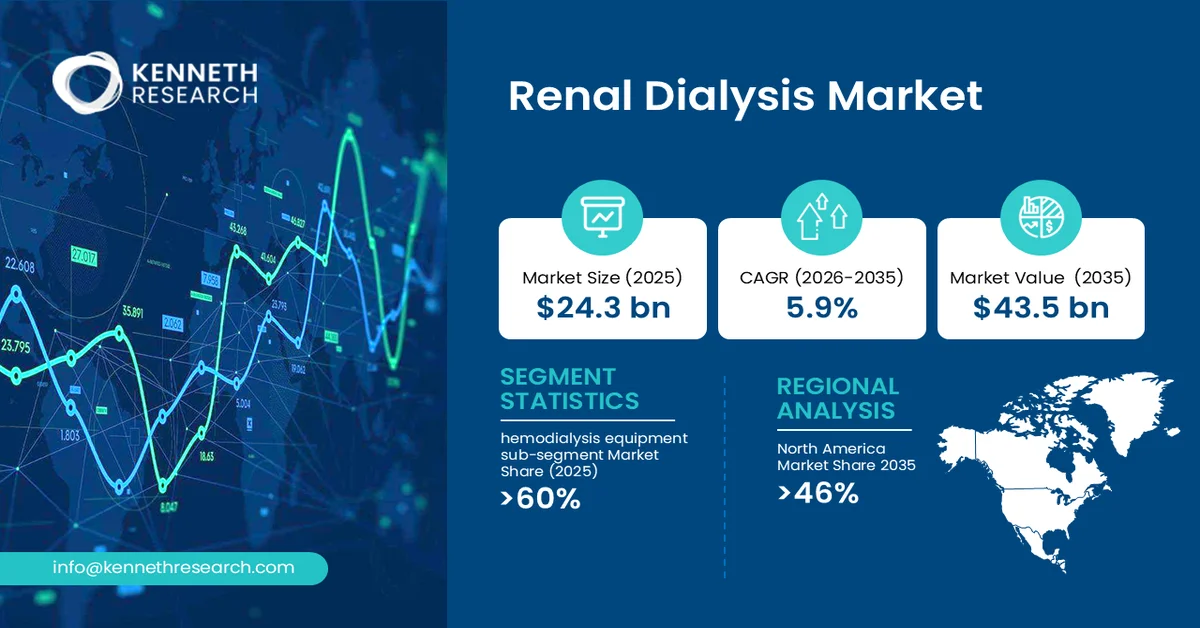
Renal Dialysis Market size was valued at USD 24.3 billion in 2025 and is projected to reach USD 43.5 billion by the end of 2035, rising at a CAGR of 5.9% during the forecast period, i.e., 2026-2035. in 2026, the industry size of the renal dialysis is estimated at USD 25.7 billion.
The primary growth driver of the renal dialysis market is the increasing global burden of chronic kidney disease and end-stage renal disease requiring long-term renal replacement therapy. Expanding healthcare infrastructure, broader access to dialysis services, technological improvements in dialysis systems, and growing investment in kidney care programs continue to support sustained market expansion.
The renal dialysis market encompasses medical equipment, consumables, and associated technologies designed to perform renal replacement therapy for patients whose kidneys can no longer adequately filter waste products, excess fluids, and electrolytes from the blood. The market primarily includes hemodialysis and peritoneal dialysis systems, along with supporting accessories, dialyzers, tubing sets, dialysis concentrates, water treatment systems, and monitoring technologies used across hospitals, dedicated dialysis centers, and home-care settings.
Renal dialysis serves as an essential life-sustaining therapy for individuals with chronic kidney disease progressing to end-stage renal disease or those experiencing acute kidney injury requiring temporary renal support. Continuous innovation in dialysis equipment has improved treatment precision, patient safety, operational efficiency, and compatibility with home-based care models. The market holds significant industrial relevance because it supports a critical component of global nephrology services, driving demand for advanced medical devices, consumables, digital patient monitoring, and specialized healthcare infrastructure. As healthcare systems continue prioritizing kidney disease management and expanding access to renal replacement therapies, the renal dialysis market remains an integral segment of the global medical device and renal care industry.
Key Renal Dialysis Market Insights Summary:
Key Takeaways: Market Trends & Insights
- Renal dialysis market projected to grow from USD 24.3 billion in 2025 to USD 43.5 billion by 2035 at a 5.9% CAGR
- North America is projected to account for the largest regional share at 46% by 2035, supported by advanced renal care infrastructure, favorable reimbursement policies, and widespread adoption of innovative dialysis technologies
- Hemodialysis equipment is anticipated to remain the leading product type segment with a 60% market share, driven by its extensive clinical adoption, established dialysis center infrastructure, and continuous technological advancements
- Hemodialysis will continue to be the dominant application segment due to its widespread use as the standard renal replacement therapy for patients with end-stage kidney disease and expanding availability of dialysis services
- The market is benefiting from increasing demand for long-term renal replacement therapy, expansion of home dialysis solutions, digital integration in dialysis systems, and continued investment in advanced kidney care technologies
Market Drivers
- Expansion of dedicated dialysis centers and renal care infrastructure across emerging economies.
- Increasing adoption of home dialysis and remote patient monitoring technologies.
- Growing public and private investment in nephrology research and renal replacement technologies.
- Rising elderly population with a higher prevalence of chronic kidney disease and end-stage renal disease.
Challenges
- High treatment infrastructure and operational costs
- Dependence on skilled healthcare professionals and complex care delivery
Renal Dialysis Market Overview & Supply Chain
The adoption of renal dialysis is increasing globally due to the rising prevalence of chronic kidney disease (CKD), expanding availability of specialized nephrology services, and continuous advances in dialysis equipment that improve treatment efficiency, patient safety, and home-based care capabilities. Governments and public health agencies are also prioritizing early detection and management of kidney disease, strengthening the need for renal replacement therapies. According to the U.S. Centers for Disease Control and Prevention (CDC), about 360 people begin treatment for kidney failure (dialysis or kidney transplant) every day in the United States, underscoring the sustained clinical demand for dialysis services and supporting continued investment in dialysis infrastructure, equipment, and trained healthcare professionals.
The renal dialysis industry operates through a highly regulated and vertically integrated value chain. Upstream activities involve sourcing medical-grade polymers, specialty membranes, stainless steel, electronic components, dialysis concentrates, water purification materials, and precision sensors required for manufacturing dialysis systems and consumables. Manufacturers integrate these inputs into dialysis machines, dialyzers, blood tubing sets, vascular access products, and water treatment systems while complying with stringent medical device quality and regulatory standards. Distribution occurs through direct sales networks, medical device distributors, hospital procurement organizations, and specialized renal care providers to ensure uninterrupted product availability. Downstream stakeholders include hospitals, independent dialysis centers, ambulatory care facilities, and home dialysis providers that deliver renal replacement therapy to patients with chronic and acute kidney disorders. The broader ecosystem includes raw material suppliers, component manufacturers, contract manufacturers, regulatory authorities, reimbursement agencies, healthcare providers, service organizations, and maintenance partners that collectively support reliable dialysis delivery and long-term patient care.
Renal Dialysis Market: Growth Drivers & Challenges
Growth Drivers:
- Rising burden of kidney failure driving long-term dialysis demand: The increasing incidence of chronic kidney disease (CKD) progressing to kidney failure remains the most significant catalyst for the renal dialysis market. As more patients require renal replacement therapy for survival, healthcare systems are expanding dialysis capacity through new treatment centers, upgraded equipment, and greater adoption of home-based dialysis technologies. This trend is also encouraging manufacturers to develop more efficient dialysis systems with enhanced automation, digital monitoring, and improved patient safety features. In parallel, governments and healthcare organizations continue investing in kidney disease surveillance and treatment infrastructure to improve patient outcomes. According to the U.S. centers for disease control and prevention (CDC), more than 1 in 7 u.s. adults may have chronic kidney disease, and as many as 9 in 10 are unaware they have the condition, highlighting the substantial population at risk of progressing to advanced kidney disease requiring dialysis. This growing patient pool is expected to sustain long-term demand for dialysis equipment, consumables, and specialized renal care services.
- Technological advancements supporting home and personalized dialysis: Technological innovation is reshaping renal dialysis by improving treatment flexibility, operational efficiency, and patient convenience. Modern dialysis platforms incorporate real-time monitoring, automated fluid management, advanced membrane technologies, and digital connectivity that enable clinicians to optimize treatment while reducing operational burden. Simultaneously, growing interest in home dialysis is encouraging manufacturers to design compact, user-friendly systems that improve patient independence and reduce reliance on in-center treatment. These advancements also align with healthcare objectives focused on lowering hospitalization rates, improving quality of life, and supporting value-based care. Future innovations such as wearable dialysis systems, artificial kidney technologies, remote patient monitoring, and predictive analytics are expected to further transform renal replacement therapy. As healthcare providers increasingly prioritize personalized treatment pathways, demand for technologically advanced dialysis solutions is anticipated to strengthen across hospitals, dialysis centers, and home-care environments.
Challenges:
- High treatment infrastructure and operational costs: Establishing and operating dialysis services requires substantial investment in specialized equipment, water purification systems, facility infrastructure, maintenance, and trained clinical personnel. In addition to capital expenditure, providers must manage recurring costs associated with consumables, equipment servicing, infection control, and regulatory compliance. These financial requirements can limit the expansion of dialysis facilities, particularly in low-resource and rural settings where patient demand may not justify significant infrastructure investment. Commercially, manufacturers and healthcare providers face pressure to balance affordability with technological innovation, especially in markets with constrained reimbursement policies. Looking ahead, stakeholders are expected to focus on cost-efficient equipment designs, scalable home dialysis solutions, and service-based business models that reduce operational expenses while maintaining treatment quality and long-term sustainability.
- Dependence on skilled healthcare professionals and complex care delivery: Renal dialysis is a highly specialized therapy that requires trained nephrologists, dialysis nurses, technicians, and biomedical engineers to ensure safe and effective treatment delivery. Workforce shortages, uneven distribution of qualified professionals, and increasing patient volumes create operational challenges for healthcare providers. Inadequate staffing can affect treatment scheduling, patient monitoring, equipment maintenance, and adherence to quality standards, ultimately influencing clinical outcomes and service efficiency. From a commercial perspective, providers may encounter higher labor costs, recruitment difficulties, and constraints on expanding dialysis capacity. Manufacturers are responding by developing more automated and user-friendly systems; however, professional oversight remains essential for many treatment settings. Over the long term, investments in workforce development, digital support technologies, and standardized training programs will be critical to sustaining the growth and accessibility of renal dialysis services.
Renal Dialysis Market Size and Forecast:
| Report Attribute | Details |
|---|---|
| Base Year |
2025 |
| Forecast Year |
2026-2035 |
| CAGR |
5.9% |
| Base Year Market Size (2025) |
USD 24.3 billion |
| Forecast Year Market Size (2035) |
USD 43.5 billion |
| Regional Scope |
|
Renal Dialysis Market Segmentation Analysis:
Product Type Segment Analysis
The hemodialysis equipment sub-segment is the leading product type in the renal dialysis market, accounting for 60% of the market in 2025.
Its leadership is supported by widespread clinical adoption for patients with end-stage kidney disease, established reimbursement pathways, and the extensive network of hospital- and center-based dialysis facilities. Demand remains strong because hemodialysis is the most commonly available renal replacement therapy across developed and emerging healthcare systems, requiring reliable dialysis machines, dialyzers, water treatment systems, and monitoring equipment. On the supply side, manufacturers continue to invest in advanced automation, digital connectivity, enhanced fluid management, and improved biocompatible technologies to increase treatment efficiency and patient safety. Government-backed surveillance also reflects the continued reliance on hemodialysis. According to the 2023 United States renal data system (USRDS), the prevalent in-center hemodialysis population decreased in 2021 for the second consecutive year due to COVID-19-related mortality, indicating that in-center hemodialysis remains the dominant modality being tracked nationally because of its substantial patient base. Continued innovation, expansion of dialysis infrastructure, and integration of remote monitoring capabilities are expected to reinforce the segment's market leadership over the forecast period.
Application Type Segment Analysis
The hemodialysis application segment is projected to witness sustained growth due to its established role as the primary treatment modality for patients with end-stage kidney disease requiring routine renal replacement therapy. Increasing diagnosis of advanced kidney disorders, greater availability of dialysis centers, and continuous improvements in treatment protocols are supporting broader clinical adoption across both developed and emerging healthcare systems. Healthcare providers continue to expand access to hemodialysis through hospital-based and standalone dialysis facilities while integrating digital monitoring and advanced treatment management systems to improve patient outcomes and operational efficiency. On the supply side, manufacturers are investing in next-generation dialysis machines, high-performance dialyzers, and connected technologies that simplify treatment delivery and maintenance. Regulatory initiatives are also encouraging innovation in home-based hemodialysis. The U.S. centers for medicare & medicaid services (CMS) has expanded eligibility for the transitional add-on payment adjustment for new and innovative equipment and supplies (TPNIES) to include certain home dialysis machines, supporting broader adoption of advanced hemodialysis technologies and accelerating innovation within the application segment. This favorable reimbursement environment, combined with continued technological progress and expanding treatment infrastructure, is expected to reinforce the segment's long-term growth trajectory.
Our in-depth analysis of the renal dialysis market includes the following segments:
|
Segment |
Sub-segment |
|
Product Type |
|
|
Application |
|
|
Modality |
|
|
End User |
|
Renal Dialysis Market Regional Insights:
North America Market Trends & Insights:
North America is projected to account for 46% of the renal dialysis market by 2035, maintaining its position as the leading regional market.
The region's dominance is supported by its well-established renal care infrastructure, widespread availability of advanced dialysis technologies, favorable reimbursement mechanisms, and strong presence of leading dialysis equipment manufacturers and service providers. Continuous investments in nephrology care, rapid adoption of technologically advanced dialysis systems, and ongoing innovation in home dialysis solutions further strengthen regional leadership. In addition, stringent medical device regulatory frameworks and sustained healthcare expenditure promote the adoption of high-quality dialysis equipment across hospitals and dedicated dialysis centers. According to the 2024 united states renal data system (USRDS), the Annual Data Report provides updated national data on kidney disease incidence, prevalence, treatment modalities, and outcomes through the end of 2022, reflecting the extensive dialysis infrastructure and comprehensive surveillance system supporting kidney care across the United States. This robust clinical ecosystem continues to reinforce North America's leadership in the global renal dialysis industry.
The United States represents the largest contributor within the region owing to its extensive network of dialysis centers, strong reimbursement environment, high adoption of technologically advanced hemodialysis equipment, and continuous investment in nephrology research and innovation. Close collaboration among healthcare providers, medical device manufacturers, and regulatory agencies has accelerated the deployment of digital monitoring technologies and home-based dialysis solutions.
Canada also contributes significantly through its publicly funded healthcare system, expanding chronic kidney disease management initiatives, and growing emphasis on improving access to dialysis services in remote and underserved communities. Continued investments in renal healthcare infrastructure, clinician training, and patient-centered treatment models across both countries are expected to sustain North America's leading position throughout the forecast period.
Asia Pacific Market Trends & Insights:
Asia Pacific is expected to remain one of the fastest-evolving regions in the renal dialysis market, supported by increasing demand for renal replacement therapies, expanding healthcare infrastructure, and greater awareness of chronic kidney disease management. Rapid urbanization, improving access to specialized nephrology services, and rising investment in modern dialysis facilities are strengthening the region's position in the global market. Governments across Asia Pacific are prioritizing universal healthcare coverage, strengthening chronic disease management programs, and expanding access to advanced medical technologies, creating favorable conditions for the adoption of dialysis equipment and related consumables. In addition, manufacturers are increasing regional production capabilities, establishing local distribution networks, and introducing technologically advanced dialysis systems to address the growing need for efficient and accessible renal care. These developments, combined with continued healthcare modernization and increasing acceptance of home-based treatment models, are expected to create substantial long-term opportunities for equipment suppliers, healthcare providers, and service organizations operating across the region.
Japan remains a mature and technologically advanced renal dialysis market, supported by its sophisticated healthcare system, high standards of nephrology care, and widespread adoption of advanced dialysis equipment. Continuous innovation in dialysis technologies, strong clinical expertise, and emphasis on treatment quality have enabled the country to maintain a well-developed renal care ecosystem.
China is emerging as a major growth market due to ongoing healthcare infrastructure expansion, increasing availability of dialysis services in secondary and tertiary healthcare facilities, and supportive policies aimed at improving access to chronic disease treatment. Growing domestic manufacturing capabilities, investments in medical technology, and expansion of specialized renal care networks are expected to further strengthen the adoption of dialysis equipment across the country, positioning both Japan and China as key contributors to the future development of the Asia Pacific renal dialysis market.
Leading Companies Operating in the Global Renal Dialysis Market:
Here is a list of upstream, downstream, and key players operating in the global renal dialysis market competitive ecosystem:
- Fresenius Medical Care(Germany)
- Company Overview
- Business Strategy
- Key Product Offerings
- Financial Performance
- Key Performance Indicators
- Risk Analysis
- Recent Development
- Regional Presence
- SWOT Analysis
- Baxter International(United States)
- Nipro Corporation(Japan)
- B. Braun SE(Germany)
- Nikkiso Co., Ltd(Japan)
Recent Developments
- May 2025: Fresenius Medical Care announced the U.S. commercial launch of the 5008X CAREsystem following FDA 510(k) clearance, expanding access to high-volume hemodiafiltration technology in the United States.
- March 2024 : Nipro Medical Corporation introduced the surdial dx hemodialysis system to the U.S. market, expanding its portfolio of advanced dialysis equipment for healthcare providers.
- October 2024: Nephro Care India Ltd. and NIT Silchar unveiled a prototype AI-enabled smart hemodialysis machine designed to improve affordability and enable remote monitoring capabilities.
Frequently Asked Question
In 2025, the renal dialysis market exceeded USD 24.3 billion.
The renal dialysis market is projected to reach USD 43.5 billion by the end of 2035, expanding at a CAGR of 5.9% over the forecast period (2026-2035).
The major players in the market are Fresenius Medical Care, Baxter International, Nipro Corporation, B. Braun SE, Nikkiso Co., Ltd., and others.
In the product type segment, the hemodialysis equipment sub-segment is anticipated to capture the largest market share of 60% in the future and exhibit lucrative growth opportunities during 2026-2035. This growth trajectory is largely attributed to the increasing demand for long-term renal replacement therapy, widespread adoption of hemodialysis in healthcare facilities, and continuous technological advancements in dialysis equipment.
North America is projected to hold the largest market share of 46% by the end of 2035 and provide more business opportunities in the future. Continuous investments in advanced renal care infrastructure, widespread adoption of innovative dialysis technologies, and strong healthcare systems in the U.S. and Canada are fostering the region's dominance.
Why Choose Kenneth Research ?
-
Insight with Impact : We don’t just gather data — we uncover stories, trends, and opportunities that fuel business growth.
-
Experts Who Get It : Our team speaks your industry’s language and knows what really matters to your customers and market.
-
Custom-Built for You : Forget one-size-fits-all. We craft research and consulting solutions as unique as your business vision.
-
Partners, Not Just Providers : We work with you, not for you — collaborating closely to turn insights into smart, strategic moves.
-
Results That Speak : Our work powers brands, startups, and industry leaders alike — with a track record of ideas that work in the real world.
Report ID: 1058 |
Published Date: 06 Aug 2026 |
Report Format: |
Delivery Timeline: 48-72 Business Hours

Copyright © 2025 Kenneth Research. All rights reserved. Terms of Use | Privacy Policy
