Report ID: 1047 |
Published Date: 28 Jul 2026 |
Report Format: |
Delivery Timeline: 48-72 Business Hours
Renal Anemia Market Outlook:
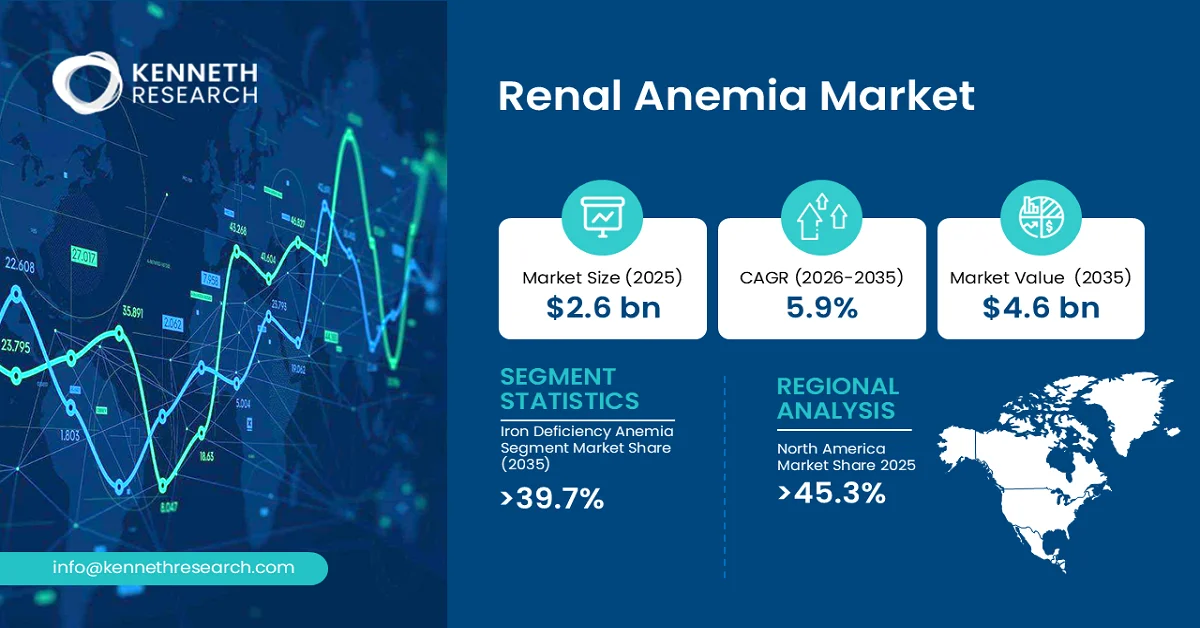
Renal Anemia Market size was valued at USD 2.6 billion in 2025 and is projected to reach USD 4.6 billion by the end of 2035, rising at a CAGR of 5.9% during the forecast period, i.e., 2026–2035. In 2026, the industry size of the renal anemia is estimated at USD 2.7 billion.
The primary growth driver for the renal anemia market is the rising burden of chronic kidney disease (CKD), which increases the need for anemia diagnosis and long-term treatment. The U.S. National Institute of Diabetes and Digestive and Kidney Diseases (NIDDK) states that more than 37 million American adults may have CKD, creating sustained demand for renal anemia therapies.
The renal anemia market comprises pharmaceutical therapies, biologics, iron replacement products, erythropoiesis-stimulating agents (ESAs), hypoxia-inducible factor prolyl hydroxylase (HIF-PH) inhibitors, blood management products, and associated clinical services used to diagnose and manage anemia caused by chronic kidney disease (CKD). Renal anemia develops when impaired kidneys produce insufficient erythropoietin, reducing red blood cell production, and is frequently compounded by iron deficiency, inflammation, and nutritional deficiencies. These factors contribute to reduced oxygen delivery throughout the body, leading to fatigue, diminished physical function, cardiovascular complications, and poorer clinical outcomes if left untreated.
The market is characterized by long-term disease management, guideline-driven treatment protocols, routine hemoglobin and iron status monitoring, and increasing adoption of targeted therapeutic approaches across dialysis and non-dialysis CKD populations. It serves hospitals, dialysis centers, specialty nephrology clinics, and outpatient healthcare providers, making it an integral component of kidney disease management. Industrially, the market supports pharmaceutical innovation, biologic manufacturing, clinical research, and healthcare delivery systems focused on improving patient outcomes, reducing transfusion dependence, and optimizing chronic disease care pathways in nephrology.
Key Renal Anemia Market Insights Summary:
Key Takeaways: Market Trends & Insights
- Renal anemia market projected to grow from USD 2.6 billion in 2025 to USD 4.6 billion by 2035 at a 5.9% CAGR
- North America accounted for the largest regional share at 45.3% in 2025 driven by advanced nephrology care infrastructure and strong pharmaceutical innovation
- Iron Deficiency Anemia is expected to remain the leading anemia type segment with a 39.7% market share by 2035 supported by increasing emphasis on iron optimization in CKD management
- Erythropoiesis-Stimulating Agents (ESAs) will continue to witness steady growth due to their established role in managing anemia associated with chronic kidney disease and reducing transfusion dependence
- The market is benefiting from expanding adoption of innovative oral therapies, integrated CKD management programs, and continuous investment in renal care research and treatment development
Market Drivers
- Increasing prevalence of chronic kidney disease across aging populations
- Growing adoption of innovative oral HIF-PH inhibitor therapies
- Expansion of integrated chronic kidney disease management programs
- Rising investments in nephrology research and precision anemia treatment development
Challenges
- Stringent reimbursement and cost-effectiveness assessment requirements
- Clinical complexity and variability in patient response
Renal Anemia Market Overview & Supply Chain
The adoption of renal anemia therapies is increasing globally because of the growing prevalence of chronic kidney disease (CKD), greater emphasis on early diagnosis, and continuous advancements in nephrology care. Healthcare systems are increasingly integrating standardized anemia screening into CKD management protocols to reduce disease progression and improve patient outcomes. Innovations such as long-acting erythropoiesis-stimulating therapies, oral hypoxia-inducible factor prolyl hydroxylase inhibitors, precision iron supplementation strategies, and digital patient monitoring are expanding treatment accessibility across both dialysis and non-dialysis settings. Regulatory agencies and clinical guideline updates continue to encourage evidence-based anemia management, while healthcare providers are prioritizing interventions that reduce transfusion dependence and improve quality of life. Industry relevance is reinforced by the U.S. Centers for Disease Control and Prevention, which reports that more than 1 in 7 U.S. adults has chronic kidney disease, highlighting the substantial patient population requiring long-term renal anemia management.
The renal anemia industry value chain begins with the procurement of pharmaceutical active ingredients, biologic raw materials, iron compounds, excipients, packaging materials, and specialized manufacturing consumables sourced from certified chemical and biotechnology suppliers. Drug manufacturers convert these inputs into erythropoiesis-stimulating agents, iron therapies, hypoxia-inducible factor prolyl hydroxylase inhibitors, and supportive formulations through regulated production processes that comply with stri ngent quality and Good Manufacturing Practice standards. Finished products undergo quality assurance, regulatory review, serialization, and cold-chain or standard pharmaceutical logistics before reaching wholesalers, specialty distributors, hospital pharmacies, retail pharmacies, and dialysis networks. Healthcare providers, including nephrologists, hospitals, dialysis centers, and specialty clinics, administer or prescribe therapies while diagnostic laboratories support treatment decisions through routine hematological monitoring. Key stakeholders include pharmaceutical companies, contract manufacturing organizations, raw material suppliers, distributors, healthcare providers, payers, regulatory authorities, and patient advocacy organizations that collectively ensure reliable product availability and continuity of care across the renal anemia treatment ecosystem.
Renal Anemia Market: Growth Drivers & Challenges
Growth Drivers:
- Advancements in Oral Therapies and Innovative Treatment Options: The renal anemia market is expanding as pharmaceutical innovation broadens the range of therapeutic options available for patients with chronic kidney disease. The introduction of oral hypoxia-inducible factor prolyl hydroxylase (HIF-PH) inhibitors complements established erythropoiesis-stimulating agents by offering alternative treatment pathways that can improve convenience, treatment adherence, and individualized patient management. These innovations are encouraging healthcare providers to optimize anemia management earlier in the disease course while reducing reliance on injectable therapies in appropriate patient populations. Regulatory approvals are also strengthening clinician confidence and accelerating commercial adoption across developed healthcare systems. A notable milestone occurred in March 2024, when Akebia Therapeutics announced U.S. FDA approval of Vafseo® (vadadustat) for treating anemia due to chronic kidney disease in adults receiving dialysis, expanding therapeutic choices for nephrologists and patients. This innovation is expected to stimulate additional research, competitive product development, and broader adoption of next-generation renal anemia therapies.
- Expansion of Integrated Chronic Kidney Disease Management Programs: The increasing integration of renal anemia management into comprehensive chronic kidney disease care pathways is creating sustained growth opportunities for the market. Healthcare providers are adopting multidisciplinary treatment models that combine nephrology consultations, laboratory monitoring, iron management, nutritional support, and personalized pharmacological interventions to improve long-term patient outcomes. These coordinated care models encourage earlier detection of declining hemoglobin levels, allowing clinicians to initiate therapy before severe complications arise. Simultaneously, wider adoption of electronic health records, clinical decision support systems, and standardized treatment guidelines is improving continuity of care across hospitals, dialysis centers, and specialty clinics. As healthcare systems continue shifting toward value-based care and preventive disease management, renal anemia treatment is becoming a routine component of CKD management rather than an isolated intervention. This transition is expected to strengthen long-term therapy adherence, improve clinical outcomes, and support sustained demand for innovative therapeutic solutions throughout the forecast period.
Challenges:
- Stringent Reimbursement and Cost-Effectiveness Assessment Requirements: One of the primary restraints affecting the renal anemia market is the increasing scrutiny applied by healthcare payers toward reimbursement decisions for newer therapies. Many innovative treatments are introduced with higher acquisition costs than established therapeutic options, prompting reimbursement agencies and insurers to require robust evidence demonstrating superior clinical value, long-term safety, and economic benefits before granting broad coverage. This often results in restricted patient eligibility, prior authorization requirements, or phased market access, limiting the commercial uptake of newly approved products. Manufacturers must therefore invest significantly in health economics, real-world evidence generation, and post-marketing studies to support reimbursement negotiations. Looking ahead, companies that successfully demonstrate improved patient outcomes, reduced hospitalization rates, and overall healthcare cost savings are likely to secure stronger market access, while therapies with limited value differentiation may continue to encounter reimbursement-related barriers.
- Clinical Complexity and Variability in Patient Response: Renal anemia management remains challenging because treatment outcomes vary considerably depending on disease stage, iron status, inflammation, comorbidities, dialysis dependence, and individual patient physiology. Clinicians frequently need to adjust therapeutic regimens based on laboratory findings and changing clinical conditions, making treatment optimization more resource-intensive than standardized chronic disease management. Concerns regarding adverse effects, fluctuating hemoglobin levels, and the need for continuous monitoring further complicate therapeutic decision-making and may delay the adoption of newer treatment approaches in routine practice. From a commercial perspective, these complexities increase the burden on manufacturers to generate comprehensive clinical evidence across diverse patient populations while supporting physician education and pharmacovigilance initiatives. As precision medicine and biomarker-guided treatment strategies continue to evolve, the industry is expected to improve treatment personalization, although clinical variability will remain a significant operational and commercial challenge.
Renal Anemia Market Size and Forecast:
| Report Attribute | Details |
|---|---|
| Base Year |
2025 |
| Forecast Year |
2026-2035 |
| CAGR |
5.9% |
| Base Year Market Size (2025) |
USD 2.6 billion |
| Forecast Year Market Size (2035) |
USD 4.6 billion |
| Regional Scope |
|
Renal Anemia Market Segmentation Analysis:
Anemia Type Segment Analysis
In the anemia type segment, the iron deficiency anemia sub-segment is anticipated to capture the largest market share of 39.7% by the end of 2035.
Iron Deficiency Anemia is the leading sub-segment in the renal anemia market because iron deficiency is one of the most prevalent and clinically significant contributors to anemia among patients with chronic kidney disease (CKD). Demand for iron replacement therapies continues to rise as healthcare providers increasingly prioritize the correction of iron deficiency before or alongside erythropoiesis-stimulating therapy to improve hemoglobin response and optimize patient outcomes. According to the 2023 United States Renal Data System (USRDS) Annual Data Report, just over half of patients with stage 4 CKD and 43% of those with stage 5 CKD had iron deficiency, underscoring the substantial clinical need for iron-based interventions in advanced kidney disease. From the supply side, manufacturers continue to expand portfolios of intravenous and oral iron formulations with improved safety profiles, dosing convenience, and compatibility with dialysis and non-dialysis treatment settings. Growing integration of iron status assessment into routine nephrology practice is further supporting consistent product utilization. Looking ahead, increasing adoption of personalized treatment protocols, earlier identification of iron deficiency, and the development of next-generation iron formulations are expected to reinforce the segment's leadership while improving therapeutic efficiency and long-term disease management.
Treatment Type Segment Analysis
The Erythropoiesis-Stimulating Agents (ESAs) is projected to grow as the second-largest segment in the renal anemia market due to four converging demand drivers.
The Erythropoiesis-Stimulating Agents (ESAs) segment is projected to experience sustained growth because these therapies remain a cornerstone of renal anemia management, particularly for patients with advanced chronic kidney disease and those undergoing dialysis. Demand is supported by established clinical guidelines that recommend ESAs for appropriate patients with insufficient endogenous erythropoietin production, helping reduce dependence on blood transfusions and improve hemoglobin levels. On the supply side, manufacturers continue to enhance ESA portfolios through longer-acting formulations, manufacturing improvements, and biosimilar development that broaden treatment accessibility and support cost optimization. Increasing integration of ESAs into multidisciplinary CKD management programs, together with continued physician familiarity and evolving reimbursement frameworks, is expected to sustain adoption. Looking ahead, expanded use alongside personalized anemia management strategies and complementary iron supplementation is likely to reinforce the segment's growth trajectory while supporting better long-term clinical outcomes.
Our in-depth analysis of the global renal anemia market includes the following segments:
|
Segment |
Sub-segment |
|
Anemia Type |
|
|
Treatment Type |
|
|
Disease Severity |
|
|
End User |
|
|
Route of Administration |
|
Renal Anemia Market Regional Insights:
North America Market Trends & Insights:
North America renal anemia market is projected to hold the largest revenue share of 45.3% by the end of 2025.
The region benefits from extensive investments in pharmaceutical research, biologics manufacturing, specialty drug distribution, and integrated dialysis networks that facilitate timely diagnosis and long-term disease management. Favorable reimbursement frameworks, well-established clinical practice guidelines, and high adoption of advanced therapeutics further reinforce regional leadership. Demand is also supported by a substantial chronic kidney disease patient population. According to the National Institute of Diabetes and Digestive and Kidney Diseases (NIDDK), approximately 2 in every 1,000 Americans are living with end-stage kidney disease (ESKD) treated with dialysis or kidney transplantation, reflecting a significant population requiring ongoing renal anemia management.
The United States represents the largest national market in the region because of its robust biopharmaceutical industry, strong presence of leading renal therapy manufacturers, comprehensive dialysis infrastructure, and continuous clinical innovation. Active regulatory pathways and ongoing therapeutic development further strengthen commercialization opportunities.
Canada complements regional growth through its publicly funded healthcare system, expanding renal replacement therapy services, and nationwide nephrology care programs. Continued investment in kidney disease management, specialized treatment centers, and collaborative clinical research supports broader adoption of renal anemia therapies, reinforcing North America's position as the leading regional market throughout the forecast period.
Europe Market Trends & Insights:
Europe represents a significant market for renal anemia therapies, supported by a mature healthcare ecosystem, widespread access to nephrology services, and strong emphasis on evidence-based chronic kidney disease management. The region continues to experience steady demand for renal anemia treatments as healthcare providers prioritize early diagnosis, individualized treatment strategies, and integrated patient care across both dialysis and non-dialysis settings. Industrial activity is driven by the presence of established pharmaceutical manufacturers, biotechnology innovators, contract development and manufacturing organizations, and advanced distribution networks. European regulatory frameworks encourage the introduction of innovative therapies and biosimilars while maintaining rigorous standards for product quality, safety, and post-marketing surveillance. Government-backed initiatives aimed at improving chronic disease management, expanding preventive healthcare, and strengthening access to specialized renal care are further supporting market development. Looking ahead, opportunities are expected to emerge from continued investment in precision medicine, digital health integration, and research focused on improving long-term outcomes for patients with chronic kidney disease and associated anemia.
Germany serves as a key contributor to the regional market owing to its advanced healthcare infrastructure, extensive network of nephrology specialists, and strong pharmaceutical manufacturing capabilities. The country's commitment to clinical research and rapid adoption of innovative therapies supports sustained demand for renal anemia treatments.
France also plays an important role through its universal healthcare system, comprehensive reimbursement mechanisms, and focus on coordinated chronic disease management. Continued investment in hospital modernization, specialized renal care services, and collaborative research initiatives is expected to strengthen the adoption of advanced anemia therapies and reinforce Europe's position as a major regional market.
Leading Companies Operating in the Global Renal Anemia Market:
Here is a list of upstream, downstream, and key players operating in the global renal anemia market competitive ecosystem:
- Akebia Therapeutics (United States)
- Company Overview
- Business Strategy
- Key Product Offerings
- Financial Performance
- Key Performance Indicators
- Risk Analysis
- Recent Development
- Novartis AG (Switzerland)
- Vifor Pharma Management Ltd. (Switzerland)
- Rockwell Medical (United States)
Recent Developments
- September 2024: The European Renal Association (ERA) published an updated clinical practice document on the use of HIF-prolyl hydroxylase inhibitors for anemia in chronic kidney disease, providing guidance on patient selection, safety monitoring, and clinical implementation as adoption of oral therapies increases.
- February 2024: Reuters reported that FibroGen regained U.S. rights to roxadustat from AstraZeneca after the companies ended their collaboration, following previous regulatory setbacks in the U.S. The move enables FibroGen to explore future development opportunities for the HIF-PHI therapy.
Frequently Asked Question
In 2025, the renal anemia market exceeded USD 2.6 billion.
The renal anemia market is projected to reach USD 4.6 billion by the end of 2035, expanding at a CAGR of 5.9% over the forecast period (2026–2035).
The major players in the market are Akebia Therapeutics (United States), Novartis AG (Switzerland), Vifor Pharma Management Ltd. (Switzerland), Rockwell Medical (United States), and others.
In the Anemia Type segment, the Iron Deficiency Anemia sub-segment is anticipated to capture the largest market share of 39.7% in the future and exhibit lucrative growth opportunities during 2026–2035. This growth trajectory is largely attributed to increasing emphasis on early identification and correction of iron deficiency as a fundamental component of chronic kidney disease anemia management.
North America is projected to hold the largest market share of 45.3% by the end of 2035 and provide more business opportunities in the future. Continuous investments in advanced nephrology care, pharmaceutical innovation, and dialysis infrastructure across the United States and Canada are fostering the region's dominance.
Why Choose Kenneth Research ?
-
Insight with Impact : We don’t just gather data — we uncover stories, trends, and opportunities that fuel business growth.
-
Experts Who Get It : Our team speaks your industry’s language and knows what really matters to your customers and market.
-
Custom-Built for You : Forget one-size-fits-all. We craft research and consulting solutions as unique as your business vision.
-
Partners, Not Just Providers : We work with you, not for you — collaborating closely to turn insights into smart, strategic moves.
-
Results That Speak : Our work powers brands, startups, and industry leaders alike — with a track record of ideas that work in the real world.
Report ID: 1047 |
Published Date: 28 Jul 2026 |
Report Format: |
Delivery Timeline: 48-72 Business Hours

Copyright © 2025 Kenneth Research. All rights reserved. Terms of Use | Privacy Policy
