Report ID: 1294 |
Published Date: 14 Sep 2026 |
Report Format: |
Delivery Timeline: 48-72 Business Hours
Recyclable 3D Printing Filament Market Outlook:
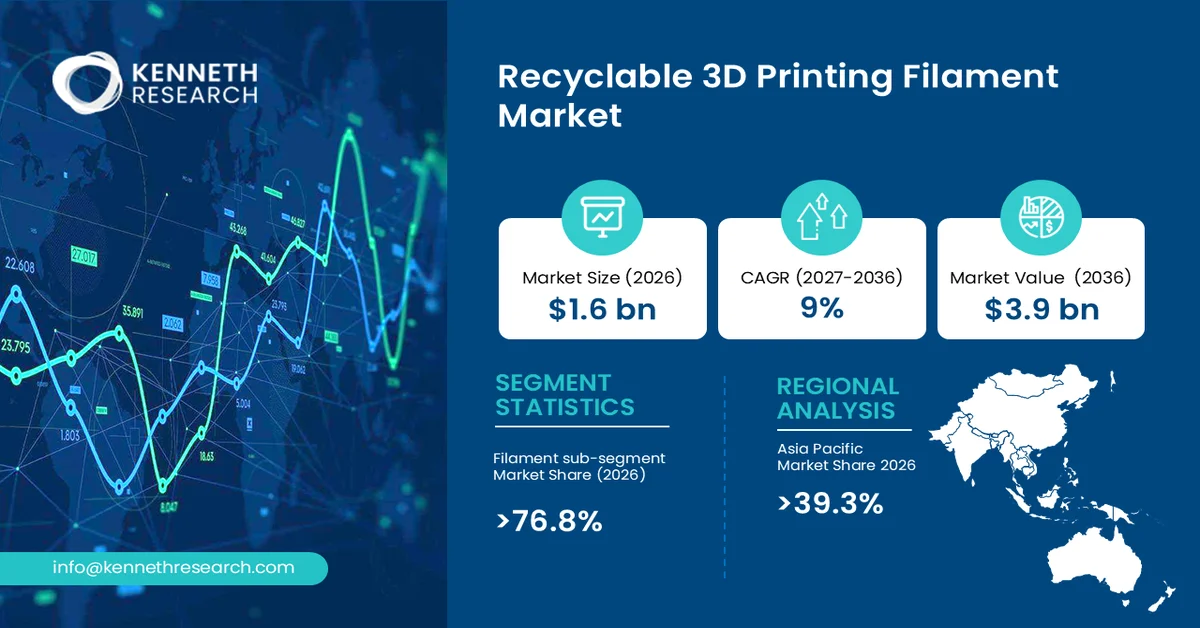
Recyclable 3D Printing Filament Market size was valued at USD 1.6 billion in 2026 and is projected to reach USD 3.9 billion by the end of 2036, rising at a CAGR of 9% during the forecast period, i.e., 2027–2036. In 2027, the industry size of the recyclable 3d printing filament is estimated at USD 1.8 billion.
The primary growth driver is the increasing emphasis on circular plastics management, supported by stronger recycling systems and policies. In Southeast and East Asia, 113 Mt of plastic waste was generated in 2022, while only 12% was effectively recycled, reinforcing the need for technologies that convert recovered plastics into usable manufacturing feedstock.
The recyclable 3d printing filament market comprises materials designed for material-extrusion additive manufacturing that can be recovered, reprocessed, reused, or incorporated into new filament feedstock. The market primarily encompasses thermoplastic filament produced from recycled or recyclable polymer streams and related material solutions intended to support more circular 3D printing workflows.
Key characteristics include compatibility with fused filament fabrication and other material-extrusion systems, controlled thermal processing, consistent filament geometry, printability, and retention of relevant mechanical and processing properties after recycling. Common polymer families used in filament-based additive manufacturing include PLA, ABS, PET-based materials, and other thermoplastics. Recyclability can involve recovering manufacturing scrap, unsuccessful prints, support structures, or end-of-life printed components and converting these materials into usable feedstock.
Key Recyclable 3D Printing Filament Market Insights Summary:
Key Takeaways: Market Trends & Insights
- Recyclable 3d printing filament market is valued at USD 1.6 billion in 2026
- The market is projected to reach USD 3.9 billion by 2036
- The Filament segment holds a 76.8% market share in 2026
- Asia Pacific leads the market with a 39.3% market share in 2026
- Manufacturing is identified as the second and fastest analysis segment, supported by increasing adoption of additive manufacturing across industrial production
Market Drivers
- Expansion of additive manufacturing across industrial production
- Rising demand for material-efficient and localized manufacturing
- Increasing adoption of circular plastics and resource-efficiency practices
- Advancement of filament extrusion, material formulation, and recycling technologies
Challenges
- Inconsistent Recycled Feedstock Quality
- Limited Economics of Closed-Loop Recycling
Recyclable 3D Printing Filament Market Overview & Supply Chain
Adoption of recyclable 3D printing filament is increasing as manufacturers seek to combine additive manufacturing with resource efficiency, localized production, material recovery, and circular-economy objectives. Filament-based additive manufacturing is particularly relevant because thermoplastic feedstocks can be processed into printed components while production workflows can incorporate recycled material streams and recoverable printing waste. Industrial users are also attracted to 3D printing for rapid prototyping, customization, shorter development cycles, and lower-volume production, strengthening its role within advanced manufacturing. Regulatory and policy attention toward plastics circularity further supports the transition toward recycled and recyclable feedstocks.
The recyclable 3D printing filament value chain begins with raw-material inputs, including virgin thermoplastic polymers, post-industrial scrap, recovered printing waste, and recycled polymer feedstocks. Material suppliers and recyclers sort, clean, process, compound, and pelletize suitable inputs before filament manufacturers convert them through extrusion, diameter control, cooling, spooling, and quality testing. Distribution then connects filament producers with specialized material distributors, 3D-printer manufacturers, online channels, industrial suppliers, and service bureaus. End users include manufacturers, engineering firms, product developers, educational institutions, healthcare organizations, and consumer/prosumer printing communities. Major stakeholders span polymer producers, recyclers, compounders, filament manufacturers, printer OEMs, distributors, additive-manufacturing service providers, industrial users, waste-management companies, standards bodies, and regulators.
Recyclable 3D Printing Filament Market - Growth Drivers & Challenges
Growth Drivers
- Expansion of Additive Manufacturing Across Industrial Production: The expansion of additive manufacturing across industrial production is strengthening demand for reliable, recyclable filament feedstocks. As manufacturers use 3D printing for prototyping, customized components, tooling, repair parts, and lower-volume production, material suppliers face greater demand for consistent thermoplastic inputs that can support repeatable printing. This creates an opportunity for recyclable filament producers to integrate recovered polymer into standardized feedstocks while addressing manufacturers’ material-efficiency objectives. NIST’s manufacturing research illustrates the economic relevance of this industrial transition: its 2024 assessment estimated U.S. shipments of goods produced using additive manufacturing at $2.8 billion, with value added estimated at $1.4 billion.
- Rising Demand for Material-Efficient and Localized Manufacturing: Demand for material-efficient and localized manufacturing is creating favorable conditions for recyclable 3D printing filament. Additive manufacturing enables companies to produce components directly from digital designs, reducing dependence on conventional tooling and supporting production closer to the point of demand. For filament-based systems, this model can be complemented by material-recovery practices in which unused material, production scrap, support structures, or discarded prints are collected for subsequent processing. The combination strengthens the business case for recyclable feedstocks because manufacturers can pursue resource efficiency without abandoning the flexibility of polymer-based additive manufacturing. It also supports decentralized production strategies for replacement parts, customized products, and short production run..
Challenges
- Inconsistent Recycled Feedstock Quality: The principal restraint is the difficulty of maintaining consistent feedstock quality across recycled polymer streams. Recovered plastics can differ in polymer composition, contamination levels, additives, moisture content, molecular weight, and previous thermal history. These variations affect extrusion behavior, filament diameter, melt flow, layer adhesion, and finished-part performance. For filament producers, the resulting process variability increases sorting, cleaning, compounding, testing, and quality-control requirements, raising operational complexity and making qualification for demanding industrial applications more difficult. Commercial buyers may consequently favor virgin materials when dimensional consistency and predictable mechanical performance are critical.
- Limited Economics of Closed-Loop Recycling: The economics of collecting, processing, and converting discarded 3D-printing plastics into usable filament can constrain commercial adoption. Recycling requires coordinated collection, identification of polymer types, contamination removal, size reduction, drying, compounding, and controlled extrusion. These activities add processing stages compared with purchasing standardized virgin resin, while dispersed waste streams can make collection volumes and logistics inefficient. The commercial challenge is particularly relevant for manufacturers seeking dependable material supply because recycled feedstock must deliver sufficient quality to justify additional handling and qualification costs. Where recycled material cannot consistently meet application requirements, users may also need blending with virgin polymer or additional formulation, weakening the economic and circularity proposition.
Recyclable 3D Printing Filament Market Size and Forecast:
| Report Attribute | Details |
|---|---|
| Base Year |
2026 |
| Forecast Year |
2027-2036 |
| CAGR |
9% |
| Base Year Market Size (2026) |
USD 1.6 billion |
| Forecast Year Market Size (2036) |
USD 3.9 billion |
| Regional Scope |
|
Recyclable 3D Printing Filament Market - Segment Analysis
Product Segment Analysis
In the product segment, the Filament sub-segment is anticipated to capture the largest market share of 76.8% by the end of 2026.
The filament segment dominates because material-extrusion systems rely directly on thermoplastic filament as their consumable feedstock, making filament demand closely tied to the installed base and utilization of fused-filament printing equipment. Demand is supported by the accessibility of filament-based printers, broad material availability, straightforward material handling, and suitability for prototyping, customized components, tooling, education, and increasingly functional parts. The U.S. Census Bureau’s 2022 Economic Census specifically expanded its survey to capture 3D-printing activity, describing additive manufacturing as a fast-growing technology used across manufacturing, consumer products, medical products, transportation, architecture, and home applications. This broadening application base supports recurring consumption of polymer feedstock.
End Use Segment Analysis
The Manufacturing is projected to grow as the second-largest segment in the recyclable 3d printing filament market due to four converging demand drivers.
The manufacturing segment is projected to grow as additive manufacturing increasingly shifts from prototyping toward production-support activities, customized components, replacement parts, tooling, and shorter production runs. Manufacturers value material-extrusion systems because they can simplify design iterations, reduce tooling dependence, and support localized or on-demand production. This transition directly benefits recyclable filament because manufacturing users have stronger incentives to manage material efficiency, production scrap, and input traceability than purely recreational users. On the supply side, improvements in polymer formulation, extrusion consistency, printer reliability, process monitoring, and material qualification are expanding the range of applications suitable for production environments. Recyclable filament suppliers can therefore differentiate through consistent mechanical properties, recycled-content verification, and compatibility with industrial workflows.
Our in-depth analysis of the global recyclable 3d printing filament market includes the following segments:
|
Segment |
Sub-segment |
|
Product |
|
|
End Use |
|
Recyclable 3D Printing Filament Market - Regional Analysis
Asia Pacific Market Trends & Insights:
Asia Pacific recyclable 3d printing filament market is projected to hold the largest revenue share of 39.3% by the end of 2026.
Asia Pacific is the dominant region in the recyclable 3d printing filament market, supported by its extensive manufacturing base, expanding additive-manufacturing ecosystem, and increasing investment in advanced production technologies. The region benefits from concentrated polymer-processing capabilities, established electronics and automotive supply chains, and growing adoption of 3D printing for industrial prototyping, tooling, customized components, and production applications.
China remains the principal country market, benefiting from large-scale manufacturing capacity, domestic technology development, and government emphasis on advanced manufacturing.
Japan represents another strategically important market, supported by sophisticated automotive, electronics, machinery, and precision-manufacturing industries. Japanese manufacturers' emphasis on material efficiency, quality control, and high-performance production provides opportunities for recyclable filament applications where consistent material properties are essential. Together, China and Japan provide complementary strengths across production scale, technology development, industrial applications, and advanced manufacturing capabilities.
North America Market Market Trends & Insights:
North America represents a significant secondary market, supported by established additive-manufacturing capabilities, sophisticated industrial users, and strong demand for customized, low-volume, and digitally enabled production. Adoption is reinforced by aerospace, automotive, healthcare, electronics, defense, and industrial-equipment applications, where 3D printing can support rapid prototyping, tooling, replacement parts, and complex component development. Government initiatives are also strengthening the regional advanced-manufacturing ecosystem.
The United States remains the region's principal market, supported by advanced manufacturing research, aerospace and defense applications, industrial prototyping, and a mature 3D-printing ecosystem. Government-backed innovation networks provide pathways for material development, process qualification, and commercialization.
Canada offers complementary opportunities through its emphasis on sustainable advanced manufacturing, polymer technologies, and collaborative industrial R&D. Its focus on eco-responsible polymers and 3D printing provides a favorable environment for recyclable filament development.
Recyclable 3D Printing Filament Market Competitive Landscape
Here is a list of upstream, downstream, and key players operating in the recyclable 3d printing filament competitive ecosystem:
- Polymaker (China)
- Company Overview
- Business Strategy
- Key Product Offerings
- Financial Performance
- Key Performance Indicators
- Risk Analysis
- Recent Development
- Regional Presence
- SWOT Analysis
- Filamentive (United Kingdom)
- FormFutura (Netherlands)
- GreenGate3D (United States)
- colorFabb BV (Netherlands)
Recent Developments
- In July 2025, Polymaker launched the Fiberon PA612-ESD filament, designed specifically for industrial applications requiring electrostatic discharge (ESD) protection. The material is based on polyamide 612 with carbon nanotubes that create a conductive network to dissipate electrostatic charges, achieving a heat deflection temperature of 157°C under 0.45MPa load. The filament is compatible with PolySupport PA12 support material for complex geometries on dual-extruder systems.
- In 2025, Filamentive continued advancing sustainable 3D printing materials, reporting that 89% of its customers consider sustainability "somewhat" or "extremely" important in their printing process. The UK-based company offers spool-less refill solutions to reduce packaging waste and is developing biodegradable materials for home composting and landfill scenarios, bridging the gap between theoretical compostability and realistic end-of-life conditions.
Frequently Asked Question
In 2026, the recyclable 3d printing filament market exceeded USD 1.6 billion.
The recyclable 3d printing filament market is projected to reach USD 3.9 billion by the end of 2036, expanding at a CAGR of 9% over the forecast period (2027-2036).
The major players in the market are Polymaker, Filamentive, FormFutura, GreenGate3D, colorFabb BV, and others.
In the Product segment, the Filament sub-segment is anticipated to capture the largest market share of 76.8% in the future and exhibit lucrative growth opportunities during 2027-2036. This growth trajectory is largely attributed to the expansion of additive manufacturing across industrial production.
Asia Pacific is projected to hold the largest market share of 39.3% by the end of 2026 and provide more business opportunities in the future. Continuous investments in advanced manufacturing, additive-manufacturing capabilities, and industrial technology development in China and Japan are fostering the region's dominance.
Why Choose Kenneth Research ?
-
Insight with Impact : We don’t just gather data — we uncover stories, trends, and opportunities that fuel business growth.
-
Experts Who Get It : Our team speaks your industry’s language and knows what really matters to your customers and market.
-
Custom-Built for You : Forget one-size-fits-all. We craft research and consulting solutions as unique as your business vision.
-
Partners, Not Just Providers : We work with you, not for you — collaborating closely to turn insights into smart, strategic moves.
-
Results That Speak : Our work powers brands, startups, and industry leaders alike — with a track record of ideas that work in the real world.
Report ID: 1294 |
Published Date: 14 Sep 2026 |
Report Format: |
Delivery Timeline: 48-72 Business Hours

Copyright © 2025 Kenneth Research. All rights reserved. Terms of Use | Privacy Policy
