Report ID: 1168 |
Published Date: 25 Aug 2026 |
Report Format: |
Delivery Timeline: 48-72 Business Hours
PPA Resin Market Outlook:
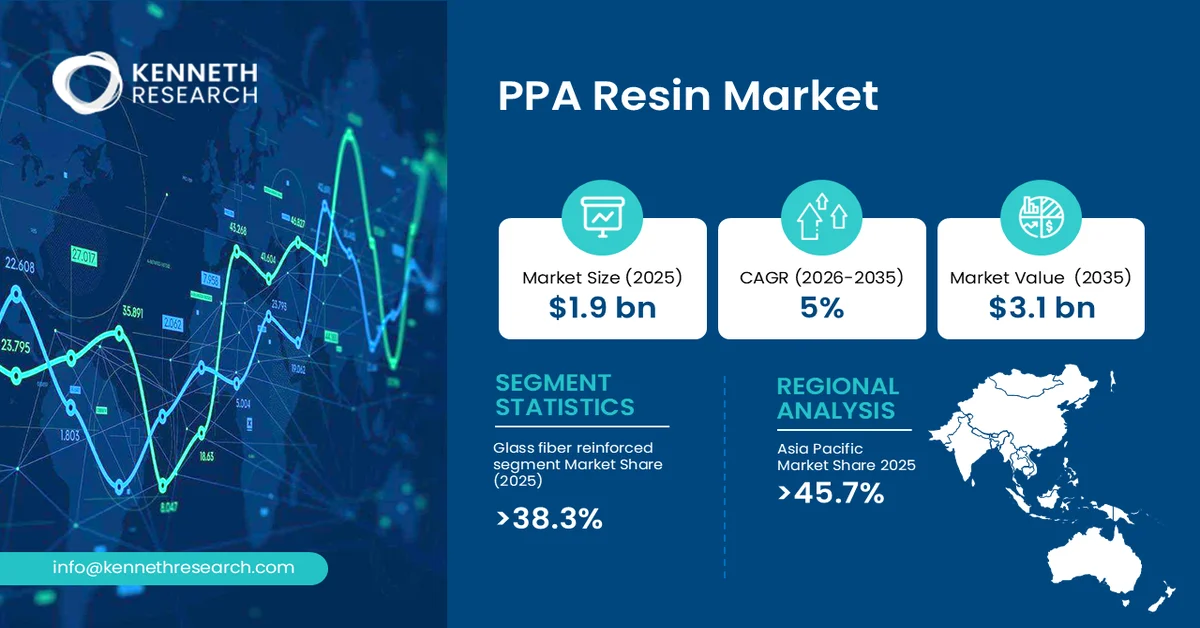
PPA Resin Market size was valued at USD 1.9 billion in 2025 and is projected to reach USD 3.1 billion by the end of 2035, rising at a CAGR of 5% during the forecast period, i.e., 2026-2035. In 2026, the industry size of PPA resin is estimated at USD 2 billion.
The primary growth driver for the PPA resin market is rising demand for lightweight, heat-resistant polymers in automotive applications as electrification expands. The International Energy Agency reports car sales exceeded 17 million units in 2024, reinforcing demand for high-performance materials across electrified vehicle systems and supporting substitution toward engineering plastics.
PPA Resin is a high-performance semi-aromatic polyamide engineering thermoplastic designed for applications requiring greater thermal, mechanical, chemical, and dimensional performance than conventional engineering plastics. PPA materials are commonly available in reinforced and modified grades, including glass-fiber-reinforced formulations, enabling manufacturers to tailor stiffness, strength, dimensional stability, and resistance to heat and aggressive operating environments.
The material is characterized by high-temperature capability, low moisture sensitivity relative to conventional polyamides, strong chemical resistance, and good dimensional stability. These properties allow PPA to replace metals and lower-performance plastics in demanding components while supporting weight reduction and design flexibility.
Key PPA Resin Market Insights Summary:
Key Takeaways: Market Trends & Insights
- 2025 global PPA resin market value stands at USD 1.9 billion
- The market is projected to reach USD 3.1 billion by 2035, expanding at a 5% CAGR from 2026 to 2035
- Glass fiber reinforced PPA leads the Product segment with a 38.3% market share in 2025
- Asia-Pacific dominates the regional landscape with a 45.7% market share in 2025
- Automotive is identified as the second and fastest analysis segment within the End Use category
Market Drivers
- Accelerating vehicle electrification and advanced automotive component development
- Rising demand for lightweight, high-performance engineering plastics
- Increasing integration of electrical and electronic systems
- Growing substitution of conventional materials with advanced engineering polymers
Challenges
- High material and processing costs
- Complex processing and moisture management
PPA Resin Market Overview & Supply Chain
Global adoption of PPA resin is increasing as manufacturers seek engineering thermoplastics that combine thermal stability, chemical resistance, dimensional performance, lightweighting potential, and compatibility with demanding automotive and electrical applications. The transition toward electrified and electronically intensive vehicles further increases the need for materials capable of performing reliably around electrical systems and under elevated operating conditions. Government industrial policy is also reinforcing advanced automotive-material manufacturing.
The PPA resin value chain begins with chemical feedstocks used to produce the monomers and intermediates required for polyphthalamide synthesis. Upstream suppliers provide aromatic and aliphatic chemical inputs, additives, stabilizers, colorants, and reinforcement materials such as glass fiber. Resin producers then polymerize and compound these inputs into base PPA grades, followed by formulation, pelletization, and quality testing according to application-specific performance requirements. Compounders and material specialists may further modify formulations to optimize strength, stiffness, thermal resistance, flame performance, or dimensional stability. Distribution typically involves direct sales to major manufacturers, specialty polymer distributors, and regional compounders. Downstream processors convert PPA compounds through injection molding and other manufacturing processes into engineered components.
PPA Resin Market: Growth Drivers & Challenges
Growth Drivers:
- Accelerating vehicle electrification and advanced automotive components: The expansion of electric and new-energy vehicles is strengthening demand for high-performance engineering plastics capable of operating reliably around electrical, thermal, and mechanical systems. PPA resin is well positioned for this transition because its heat resistance, dimensional stability, chemical resistance, and reinforcement compatibility enable lightweight component designs while maintaining performance under demanding conditions.
- Rising demand for lightweight, high-performance engineering plastics: Automotive manufacturers and component suppliers are increasingly focused on reducing component weight while maintaining mechanical strength, dimensional accuracy, durability, and resistance to aggressive operating environments. This creates a favorable environment for PPA because reinforced grades can deliver structural performance while allowing designers to consolidate components, reduce material use, and replace selected metal parts. The same characteristics extend beyond automotive applications into electrical and electronic equipment, industrial systems, and other engineered products where thermal and chemical performance are critical. For manufacturers, the value proposition is therefore not limited to polymer substitution; it also involves greater design flexibility, process efficiency, and potential component integration.
Challenges:
- High material and processing costs: PPA resin faces a structural cost disadvantage because its performance-oriented formulation and processing requirements are more demanding than those associated with conventional polyamides. Production and conversion can require tighter control of temperature, moisture, residence time, and molding conditions, while reinforced grades can introduce additional tooling and equipment considerations. These requirements increase the total conversion cost for processors and can make PPA difficult to justify in applications where standard engineering plastics already meet performance specifications. Commercially, this narrows adoption toward technically demanding components where performance benefits outweigh material and processing premiums. Smaller processors may also face greater qualification and process-development burdens when introducing unfamiliar PPA grades.
- Complex processing and moisture management: PPA processing requires disciplined moisture control and carefully managed molding conditions, creating an operational barrier for manufacturers without specialized polymer-processing capabilities. Reinforced PPA formulations can be particularly sensitive to preparation and processing consistency because fiber incorporation, drying, melt handling, and molding parameters influence final component performance. Inadequate moisture management can undermine dimensional and mechanical consistency, increasing scrap risk and requiring tighter production controls. These requirements raise implementation costs beyond the resin purchase price and can complicate qualification for new components, particularly when manufacturers are transitioning from easier-to-process materials.
PPA Resin Market Size and Forecast:
| Report Attribute | Details |
|---|---|
| Base Year |
2025 |
| Forecast Year |
2026-2035 |
| CAGR |
5% |
| Base Year Market Size (2025) |
USD 1.9 billion |
| Forecast Year Market Size (2035) |
USD 3.1 billion |
| Regional Scope |
|
PPA Resin Market Segmentation Analysis:
Product Segment Analysis
In the product segment, the Glass fiber reinforced sub-segment is anticipated to capture the largest market share of 38.3% by the end of 2025.
Glass fiber reinforced PPA dominates because it combines the resin’s high-temperature and chemical resistance with substantially improved stiffness, strength, dimensional stability, and structural performance. These characteristics make reinforced grades particularly attractive for automotive components, electrical connectors, thermal-management parts, and other applications where metal replacement and lightweighting are priorities. Adoption is being reinforced by the expansion of advanced vehicle manufacturing and electrification, which increases requirements for durable materials around power electronics and mechanically demanding components. India’s Ministry of Heavy Industries reported that approved applicants under its automobile and auto-components production-linked incentive program had achieved ₹17,896 crore of investment by March 2024, demonstrating continued industrial investment in advanced automotive manufacturing.
End Use Segment Analysis
The automotive is projected to grow as the second-largest segment in the PPA resin market due to four converging demand drivers.
Automotive is projected to be a high-growth end-use segment for PPA resin as vehicle manufacturers increasingly require lightweight materials that withstand elevated temperatures, chemicals, electrical loads, and demanding mechanical conditions. PPA’s combination of thermal stability, dimensional retention, strength, and reinforcement compatibility makes it suitable for connectors, sensors, thermal-management components, under-hood systems, and other precision applications. The transition toward electric and electronically integrated vehicles further expands opportunities because component architectures require materials with dependable electrical and thermal performance.
Our in-depth analysis of the global PPA resin market includes the following segments:
|
Segment |
Sub-segment |
|
Product |
|
|
End Use |
|
PPA Resin Market Regional Insights:
Asia Pacific Market Trends & Insights:
Asia Pacific PPA resin market is projected to hold the largest revenue share of 45.7% by the end of 2025.
The region benefits from extensive polymer-processing infrastructure, integrated supply chains, expanding local production, and sustained investment in higher-performance materials. Regulatory initiatives promoting vehicle electrification and advanced manufacturing further strengthen the regional demand environment. China is particularly important to the regional supply-and-demand ecosystem: government-reported data show that the country’s NEV production and sales reached 16.626 million and 16.49 million units, respectively, in 2025, reinforcing the scale of automotive manufacturing that can support demand for heat-resistant, lightweight engineering polymers.
China remains the region’s principal manufacturing hub, supported by its extensive automotive and electronics industries, domestic polymer-processing capabilities, and rapidly expanding electrified-vehicle ecosystem.
India represents another important growth market, where industrial policy is encouraging advanced automotive-component manufacturing. Together, China and India provide complementary demand opportunities through manufacturing scale, vehicle electrification, localization, and increasing adoption of engineered materials.
Europe Market Trends & Insights:
Europe represents an important secondary market for PPA resin, supported by an established automotive manufacturing base, sophisticated electrical and electronics industries, and increasing emphasis on lightweight, thermally resistant engineering materials. Demand opportunities are particularly relevant where manufacturers are redesigning components for electrified powertrains, thermal-management systems, sensors, connectors, and other applications requiring dimensional stability and chemical resistance. Government initiatives supporting vehicle electrification and domestic automotive manufacturing are strengthening the investment environment.
Germany remains the region's key country opportunity because of its deep automotive ecosystem, extensive Tier-1 supplier network, and concentration of engineering and manufacturing capabilities. Continued electrification creates demand for specialized polymers capable of meeting increasingly stringent component requirements.
The United Kingdom also offers attractive opportunities through its automotive electrification agenda and supply-chain investment. Its DRIVE35 program supports research, development, scale-up, and capital investment across the zero-emission vehicle supply chain, creating an environment conducive to advanced material adoption.
Leading Companies Operating in the Global PPA Resin Market:
Here is a list of upstream, downstream, and key players operating in the global PPA resin market competitive ecosystem:
- BASF SE (Germany)
- Company Overview
- Business Strategy
- Key Product Offerings
- Financial Performance
- Key Performance Indicators
- Risk Analysis
- Recent Development
- Regional Presence
- SWOT Analysis
- DuPont de Nemours, Inc. (United States)
- Celanese Corporation (United States)
- Arkema S.A. (France)
- Ensinger GmbH (Germany)
- RTP Company (United States)
Recent Developments
- In September 2025, Ensinger GmbH began providing product-specific carbon footprint data across its entire stock shape portfolio, calculated under DIN EN ISO 14040ff standards, enabling customers to assess the climate impact of material choices for machined PPA components.
- In January 2026, Arkema successfully started up its new Rilsan® Clear transparent polyamide production unit on Jurong Island, Singapore, tripling the Group's global production capacity for transparent polyamides with a US$20 million investment . While focused on transparent polyamides rather than PPA specifically, the expansion strengthens Arkema's high-performance polymer supply chain in Asia. The company also offers Rilsan® HT CZM 30, a flexible PPA grade containing 67% bio-based content for metal replacement applications.
Frequently Asked Question
In 2025, the PPA resin market exceeded USD 1.9 billion.
The PPA resin market is projected to reach USD 3.1 billion by the end of 2035, expanding at a CAGR of 5% over the forecast period (2026-2035).
The major players in the market are BASF SE, DuPont de Nemours, Inc., Celanese Corporation, Arkema S.A., Ensinger GmbH, RTP Company, and others.
In the Product segment, the Glass fiber reinforced sub-segment is anticipated to capture the largest market share of 38.3% in the future and exhibit lucrative growth opportunities during 2026-2035. This growth trajectory is largely attributed to increasing demand for high-performance, lightweight materials in automotive applications.
Asia-Pacific is projected to hold the largest market share of 45.7% by the end of 2035 and provide more business opportunities in the future. Expanding automotive manufacturing and electrification in China and India are fostering the region's dominance.
Why Choose Kenneth Research ?
-
Insight with Impact : We don’t just gather data — we uncover stories, trends, and opportunities that fuel business growth.
-
Experts Who Get It : Our team speaks your industry’s language and knows what really matters to your customers and market.
-
Custom-Built for You : Forget one-size-fits-all. We craft research and consulting solutions as unique as your business vision.
-
Partners, Not Just Providers : We work with you, not for you — collaborating closely to turn insights into smart, strategic moves.
-
Results That Speak : Our work powers brands, startups, and industry leaders alike — with a track record of ideas that work in the real world.
Report ID: 1168 |
Published Date: 25 Aug 2026 |
Report Format: |
Delivery Timeline: 48-72 Business Hours

Copyright © 2025 Kenneth Research. All rights reserved. Terms of Use | Privacy Policy
