Report ID: 1046 |
Published Date: 28 Jul 2026 |
Report Format: |
Delivery Timeline: 48-72 Business Hours
Polyp Biopsy Market Outlook:
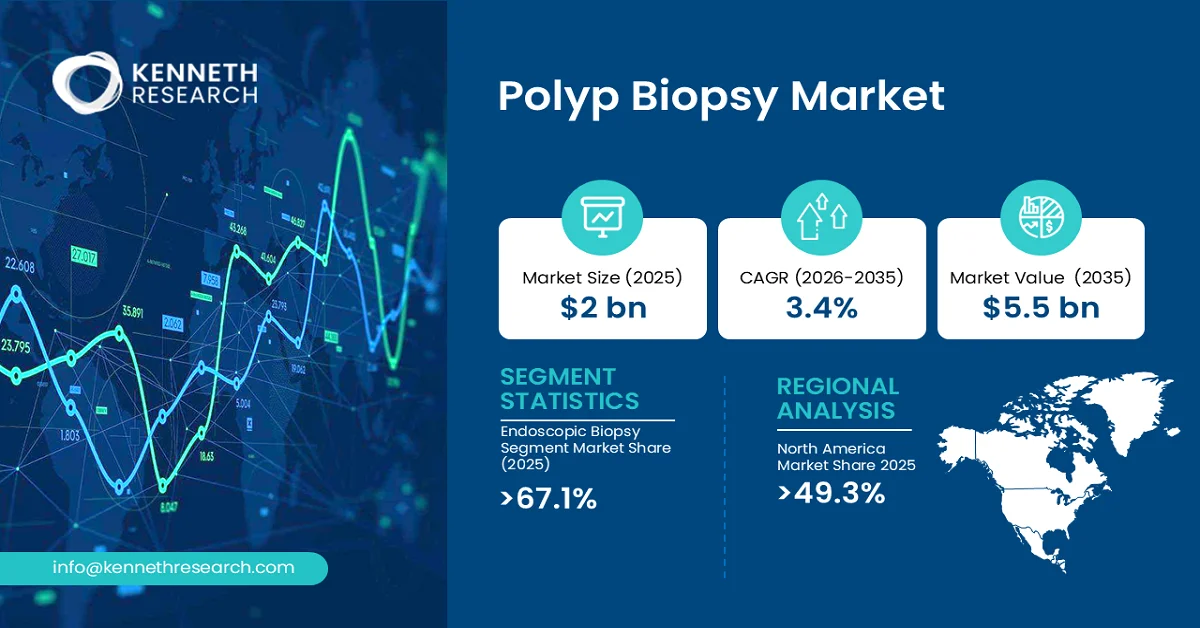
Polyp Biopsy Market size was valued at USD 2 billion in 2025 and is projected to reach USD 3.4 billion by the end of 2035, rising at a CAGR of 5.5% during the forecast period, i.e., 2026–2035. In 2026, the industry size of the polyp biopsy is estimated at USD 2.1 billion.
Growing emphasis on early colorectal cancer detection is the primary driver of the polyp biopsy market. Expanding screening programs, wider adoption of colonoscopy, and updated screening recommendations are increasing the number of detected polyps requiring histopathological evaluation. In the United States, about 7 in 10 adults aged 50–75 are up to date with colorectal cancer screening, supporting sustained demand for biopsy procedures.
The polyp biopsy market comprises medical devices, instruments, consumables, and associated clinical procedures used to obtain tissue samples from polyps detected in organs such as the colon, stomach, nasal cavity, bladder, cervix, and other epithelial surfaces. Biopsy procedures are performed primarily during endoscopic examinations, enabling physicians to remove or sample suspicious polyps for histopathological assessment to determine whether they are benign, precancerous, or malignant.
The market is characterized by the use of specialized biopsy forceps, snares, needles, specimen retrieval systems, and pathology services designed to deliver accurate tissue sampling while minimizing procedural complications. Continuous advances in endoscopic imaging, minimally invasive techniques, and precision biopsy instruments have improved diagnostic accuracy, workflow efficiency, and patient outcomes across healthcare settings.
From an industrial perspective, the market plays a vital role in preventive healthcare, oncology, gastroenterology, pulmonology, otolaryngology, and gynecology. Demand is supported by expanding cancer screening initiatives, increasing utilization of endoscopic procedures, rising healthcare investments, and the growing need for definitive pathological diagnosis to guide treatment decisions. The market also benefits from ongoing innovation in endoscopic technologies and specimen management solutions that enhance diagnostic quality and support evidence-based clinical care.
Key Polyp Biopsy Market Insights Summary:
Key Takeaways: Market Trends & Insights
- Polyp biopsy market valued at USD 2 billion in 2025 and projected to reach USD 3.4 billion by 2035 at a 5.5% CAGR
- Endoscopic Biopsy remained the leading Method segment with a 67.1% share in 2025 driven by increasing adoption of minimally invasive diagnostic procedures
- North America accounted for the largest regional share of 49.3% in 2025 supported by advanced healthcare infrastructure and extensive colorectal cancer screening programs
- Hospitals continue to be the fastest-growing end-user segment due to expanding endoscopy capacity, integrated pathology services, and investments in advanced diagnostic technologies
- Rising emphasis on early detection of colorectal cancer, technological advancements in endoscopic biopsy devices, and increasing preventive screening initiatives are accelerating long-term market growth
Market Drivers
- Increasing prevalence of gastrointestinal disorders and colorectal polyps
- Rising investments in endoscopy infrastructure across hospitals and specialty clinics
- Expansion of organized colorectal cancer screening programs
- Continuous innovation in endoscopic imaging and biopsy technologies
Challenges
- High capital and operational costs of advanced endoscopy infrastructure
- Variability in diagnostic quality and clinical expertise
Polyp Biopsy Market Overview & Supply Chain
Global adoption of polyp biopsy procedures is increasing as healthcare systems strengthen preventive screening strategies, expand access to minimally invasive diagnostics, and prioritize earlier detection of gastrointestinal and other epithelial cancers. Continuous improvements in high-definition endoscopy, enhanced imaging modalities, and precision biopsy instruments have increased diagnostic confidence while reducing procedural complexity. Clinical guidelines that encourage routine colorectal cancer screening, coupled with investments in endoscopy infrastructure and pathology services, are further supporting procedure volumes across developed and emerging healthcare markets. These trends are reinforcing the role of biopsy-based diagnosis in evidence-based clinical decision-making.
The polyp biopsy market value chain begins with suppliers of medical-grade stainless steel, specialty alloys, engineering polymers, precision wires, coatings, optical components, and sterile packaging materials used in manufacturing biopsy forceps, snares, retrieval devices, and accessory instruments. Device manufacturers integrate these materials with precision engineering, quality assurance, sterilization, and regulatory compliance processes to produce clinically approved biopsy systems that meet stringent safety and performance standards. Products are distributed through direct sales networks, specialized medical device distributors, procurement organizations, and hospital purchasing contracts, ensuring availability across healthcare facilities. End users primarily include hospitals, ambulatory surgical centers, specialty gastroenterology clinics, diagnostic centers, and academic medical institutions performing endoscopic procedures. The broader ecosystem involves raw material suppliers, component manufacturers, original equipment manufacturers (OEMs), contract manufacturing organizations, regulatory authorities, healthcare providers, pathology laboratories, reimbursement agencies, group purchasing organizations, and clinical training institutions that collectively support product adoption, procedural quality, and patient care.
Polyp Biopsy Market: Growth Drivers & Challenges
Growth Drivers:
- Expansion of Organized Colorectal Cancer Screening Programs: The expansion of organized colorectal cancer screening programs is a major catalyst for the polyp biopsy market. Governments and healthcare providers are placing greater emphasis on preventive diagnostics to identify precancerous lesions before malignant transformation, increasing the number of endoscopic examinations performed worldwide. As more individuals undergo routine screening, the likelihood of detecting suspicious polyps requiring histopathological confirmation also rises, directly driving demand for biopsy forceps, snares, specimen retrieval devices, and pathology services. This trend encourages healthcare facilities to strengthen endoscopy capacity, invest in advanced diagnostic technologies, and improve procedural workflows. Over the long term, sustained screening participation is expected to create a stable demand base for biopsy products while supporting innovation in minimally invasive tissue sampling technologies.
- Continuous Innovation in Endoscopic Imaging and Biopsy Technologies: Technological advancements in endoscopic imaging and biopsy instrumentation are significantly enhancing the efficiency and accuracy of polyp diagnosis. High-definition visualization, image-enhanced endoscopy, improved tissue acquisition devices, and ergonomic biopsy instruments enable clinicians to obtain higher-quality specimens while minimizing patient discomfort and procedural complications. These innovations improve diagnostic confidence, reduce repeat procedures, and facilitate earlier therapeutic interventions. Manufacturers are increasingly integrating precision engineering, disposable components, and compatibility with advanced endoscopic platforms to meet evolving clinical requirements. As healthcare providers continue modernizing endoscopy units and prioritizing minimally invasive diagnostic pathways, adoption of next-generation biopsy devices is expected to accelerate. Future developments incorporating digital imaging, artificial intelligence-assisted lesion detection, and enhanced specimen management will further improve procedural outcomes, strengthen pathology workflows, and reinforce the role of polyp biopsy in precision gastrointestinal diagnostics.
Challenges:
- High Capital and Operational Costs of Advanced Endoscopy Infrastructure: The adoption of advanced polyp biopsy technologies is constrained by the substantial investment required for modern endoscopy infrastructure. Healthcare providers must allocate significant resources to procure high-performance endoscopic systems, biopsy accessories, sterilization equipment, imaging platforms, and pathology support capabilities. Beyond capital expenditure, recurring costs associated with device maintenance, disposable biopsy instruments, infection control, staff training, and regulatory compliance increase the overall cost of ownership. These financial barriers are particularly challenging for smaller hospitals, community healthcare facilities, and resource-constrained healthcare systems, limiting their ability to upgrade diagnostic capabilities. Commercially, manufacturers may experience slower product adoption cycles and prolonged procurement negotiations. Looking ahead, broader access to cost-efficient technologies, flexible procurement models, and workflow optimization solutions will be important for reducing financial barriers and expanding market penetration.
- Variability in Diagnostic Quality and Clinical Expertise: The effectiveness of polyp biopsy procedures depends heavily on clinician expertise, procedural consistency, specimen quality, and pathology interpretation. Differences in endoscopic proficiency, biopsy techniques, lesion visualization, and tissue handling can influence diagnostic accuracy and may lead to inadequate sampling or repeat procedures. Variations in institutional protocols and access to experienced specialists further contribute to inconsistencies in clinical outcomes across healthcare settings. From a commercial perspective, these factors can slow the adoption of newer biopsy technologies if healthcare providers are unable to fully realize their clinical benefits without corresponding investments in training and quality assurance. Over the long term, standardized procedural guidelines, advanced clinician education, digital pathology integration, and decision-support technologies are expected to improve diagnostic consistency and strengthen confidence in biopsy-based diagnostic pathways.
Polyp Biopsy Market Size and Forecast:
| Report Attribute | Details |
|---|---|
| Base Year |
2025 |
| Forecast Year |
2026-2035 |
| CAGR |
5.5% |
| Base Year Market Size (2025) |
USD 2 billion |
| Forecast Year Market Size (2035) |
USD 3.4 billion |
| Regional Scope |
|
Polyp Biopsy Market Segmentation Analysis:
Method of Biopsy Segment Analysis
In the method of biopsy segment, the Endoscopic Biopsy sub-segment is anticipated to capture the largest market share of 67.1% by the end of 2025.
Demand is driven by the increasing use of colonoscopy and other gastrointestinal endoscopic examinations that enable physicians to detect and biopsy suspicious polyps within a single minimally invasive procedure. The method is widely adopted because it provides high-quality tissue specimens for definitive histopathological diagnosis while reducing the need for additional invasive interventions. On the supply side, manufacturers continue to introduce advanced biopsy forceps, snares, and specimen retrieval devices with improved precision, ergonomics, and compatibility with modern endoscopy systems, supporting widespread clinical adoption. The segment is also reinforced by healthcare providers' investments in advanced endoscopy units and clinician training programs. According to the U.S. National Cancer Institute, colonoscopy is the most common direct visualization test used for colorectal cancer screening in the United States, reflecting the central role of endoscopic procedures in generating biopsy demand. Looking ahead, integration of artificial intelligence-assisted lesion detection, enhanced imaging technologies, and next-generation biopsy instruments is expected to further strengthen the leadership of the endoscopic biopsy segment.
End User Segment Analysis
The hospitals is projected to grow as the second-largest segment in the polyp biopsy market due to four converging demand drivers.
The Hospitals segment is projected to experience sustained growth in the polyp biopsy market due to its central role in delivering comprehensive diagnostic, interventional, and pathological services. Hospitals remain the preferred setting for complex endoscopic procedures because they offer integrated access to advanced imaging systems, specialized gastroenterologists, pathology laboratories, anesthesia support, and multidisciplinary clinical teams. Increasing investments in hospital modernization, expansion of endoscopy suites, and adoption of minimally invasive diagnostic pathways are strengthening procedural capacity and improving patient throughput. On the supply side, medical device manufacturers continue to prioritize hospitals for the introduction of advanced biopsy forceps, disposable accessories, and integrated endoscopy platforms, supported by long-term procurement contracts and clinician training initiatives. According to the OECD Health at a Glance 2025, OECD countries had an average of 4.2 hospital beds per 1,000 population in 2023, reflecting the extensive hospital infrastructure that supports diagnostic and biopsy procedures across healthcare systems. Looking ahead, continued investments in digital pathology, artificial intelligence-assisted endoscopy, and hospital-based diagnostic capabilities are expected to reinforce the segment's long-term growth.
Our in-depth analysis of the global polyp biopsy market includes the following segments:
|
Segment |
Sub-segment |
|
Application |
|
|
Type of Polyp |
|
|
Method of Biopsy |
|
|
End User |
|
Polyp Biopsy Market Regional Insights:
North America Market Trends & Insights:
North America polyp biopsy market is projected to hold the largest revenue share of 49.3% by the end of 2025.
North America accounted for 49.3% of the polyp biopsy market in 2025, making it the leading regional market. Its dominance is supported by well-established colorectal cancer screening programs, extensive adoption of minimally invasive endoscopic procedures, and widespread availability of advanced diagnostic infrastructure. The region benefits from strong investments in hospital modernization, high penetration of high-definition endoscopy systems, and a mature pathology network capable of supporting timely histopathological diagnosis. Favorable reimbursement frameworks, evidence-based clinical guidelines, and continuous innovation by medical device manufacturers further reinforce market leadership. Regulatory oversight that emphasizes quality, patient safety, and adoption of advanced diagnostic technologies also contributes to sustained demand for biopsy devices and accessories.
The United States represents the largest contributor to regional demand, driven by extensive screening participation, advanced healthcare infrastructure, and continuous investments in endoscopy technologies across hospitals and ambulatory centers. Strong clinical adoption of minimally invasive diagnostic procedures, coupled with the presence of leading medical device manufacturers and research institutions, supports continuous product innovation and commercialization. Canada complements regional growth through organized provincial colorectal cancer screening programs, expanding access to endoscopic services, and continued investment in hospital-based diagnostic capacity. Increasing emphasis on early disease detection, standardized clinical pathways, and modernization of healthcare facilities is strengthening demand for advanced biopsy devices across both countries, reinforcing North America's long-term leadership in the global market.
Europe Market Trends & Insights:
Europe represents a strategically important region in the polyp biopsy market, supported by widespread adoption of preventive healthcare, established colorectal cancer screening programs, and strong clinical emphasis on early disease detection. Demand for polyp biopsy procedures continues to increase as healthcare providers expand access to minimally invasive endoscopic diagnostics and modernize hospital infrastructure. The region benefits from a well-developed medical device industry, advanced pathology networks, and continuous investment in digital healthcare technologies that improve diagnostic efficiency and clinical workflows. Government-led public health initiatives promoting cancer awareness, organized screening, and quality standards for gastrointestinal diagnostics further strengthen market adoption. In addition, collaboration between healthcare institutions, research organizations, and medical technology companies is accelerating the development and implementation of advanced biopsy instruments and imaging solutions. Future opportunities are expected to emerge from broader integration of artificial intelligence into endoscopy, expansion of outpatient diagnostic services, and continued investments in precision diagnostics that support earlier and more accurate clinical decision-making.
Germany is a leading contributor to regional demand due to its advanced healthcare infrastructure, extensive endoscopy capacity, and strong medical technology manufacturing ecosystem. Continuous investments in hospital modernization, clinician training, and diagnostic innovation support sustained adoption of biopsy technologies across public and private healthcare facilities.
The United Kingdom also plays a significant role through its organized cancer screening initiatives, ongoing expansion of endoscopic diagnostic services, and focus on improving patient access to early detection programs. Investments in digital pathology, integrated diagnostic pathways, and healthcare modernization are expected to further strengthen the adoption of advanced polyp biopsy solutions across both countries over the forecast period.
Leading Companies Operating in the Global Polyp Biopsy Market:
Here is a list of upstream, downstream, and key players operating in the global polyp biopsy market competitive ecosystem:
- INRAD, Inc. (United States)
- Company Overview
- Business Strategy
- Key Product Offerings
- Financial Performance
- Key Performance Indicators
- Risk Analysis
- Recent Development
- NeoDynamics AB (Sweden)
- Endo-Therapeutics, Inc. (United States)
- Argon Medical Devices, Inc. (United States)
Recent Developments
- April 2024: Researchers highlighted significant advances in endoscopic mucosal resection (EMR) and endoscopic submucosal dissection (ESD) for the removal and biopsy of large colorectal polyps. The review emphasized that these minimally invasive techniques are increasingly replacing surgical intervention for complex polyps while improving complete resection rates and patient outcomes. medical xpress covered the findings based on research published in Gastroenterology.
- April 2025: A review published in current gastroenterology reports described the growing adoption of EMR, ESD, and endoscopic full-thickness resection (EFTR) for managing complex colorectal polyps. The article highlighted that advances in endoscopic biopsy and resection technologies have reduced the need for conventional surgery in many patients.
Frequently Asked Question
In 2025, the polyp biopsy market exceeded USD 2 billion.
The polyp biopsy market is projected to reach USD 3.4 billion by the end of 2035, expanding at a CAGR of 5.5% over the forecast period (2026–2035).
The major players in the market are INRAD, Inc. (United States), NeoDynamics AB (Sweden), Endo-Therapeutics, Inc. (United States), Argon Medical Devices, Inc. (United States), and others.
In the Method segment, the Endoscopic Biopsy sub-segment is anticipated to capture the largest market share of 67.1% in the future and exhibit lucrative growth opportunities during 2026–2035. This growth trajectory is largely attributed to the expanding adoption of minimally invasive endoscopic procedures supported by increasing colorectal cancer screening programs and continuous advancements in endoscopic imaging technologies.
North America is projected to hold the largest market share of 49.3% by the end of 2035 and provide more business opportunities in the future. Continuous investments in advanced endoscopy infrastructure, widespread screening programs, and strong healthcare systems across the United States and Canada are fostering the region's dominance.
Why Choose Kenneth Research ?
-
Insight with Impact : We don’t just gather data — we uncover stories, trends, and opportunities that fuel business growth.
-
Experts Who Get It : Our team speaks your industry’s language and knows what really matters to your customers and market.
-
Custom-Built for You : Forget one-size-fits-all. We craft research and consulting solutions as unique as your business vision.
-
Partners, Not Just Providers : We work with you, not for you — collaborating closely to turn insights into smart, strategic moves.
-
Results That Speak : Our work powers brands, startups, and industry leaders alike — with a track record of ideas that work in the real world.
Report ID: 1046 |
Published Date: 28 Jul 2026 |
Report Format: |
Delivery Timeline: 48-72 Business Hours

Copyright © 2025 Kenneth Research. All rights reserved. Terms of Use | Privacy Policy
