Report ID: 1167 |
Published Date: 25 Aug 2026 |
Report Format: |
Delivery Timeline: 48-72 Business Hours
Polymerization Catalyst Market Outlook:
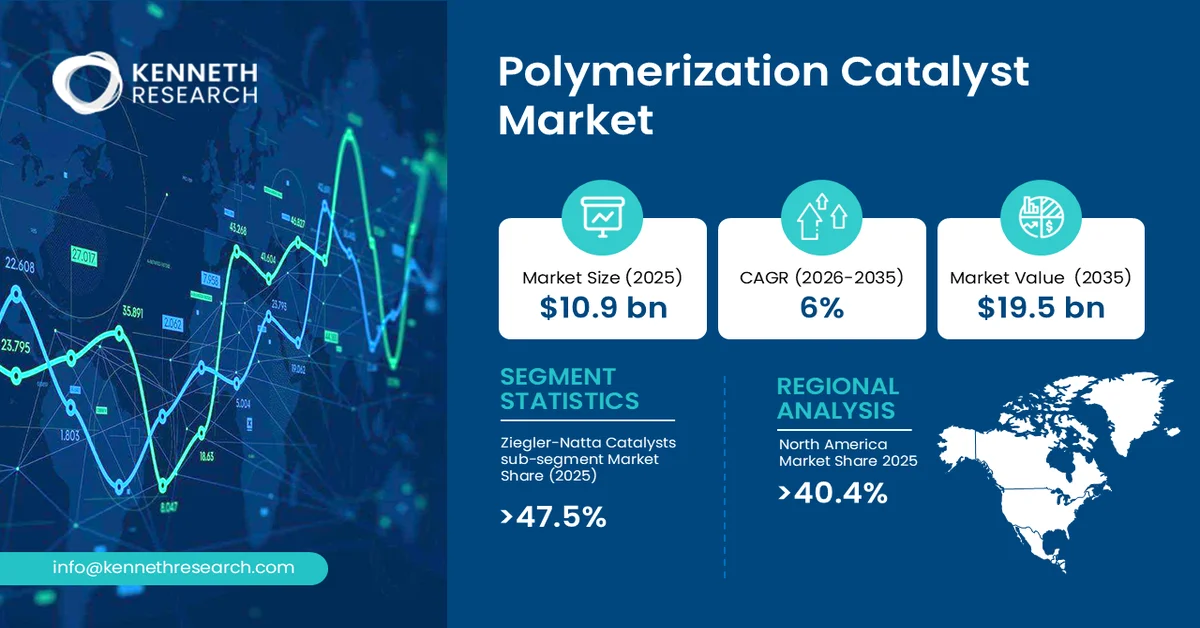
Polymerization Catalyst Market size was valued at USD 10.9 billion in 2025 and is projected to reach USD 19.5 billion by the end of 2035, rising at a CAGR of 6% during the forecast period, i.e., 2026-2035. In 2026, the industry size of Polymerization Catalysts is estimated at USD 11.5 billion.
The primary growth driver for the polymerization catalyst market is expanding polymer production across packaging, automotive, construction, electronics, and consumer applications. Growing demand for high-performance, lightweight, and recyclable polymer materials is encouraging manufacturers to adopt catalyst technologies that improve polymerization efficiency, control molecular structure, optimize material properties, and support increasingly specialized polymer grades.
The polymerization catalyst market comprises catalysts used to initiate, accelerate, and control chemical reactions that convert monomers into polymers. These catalysts are fundamental to industrial polymer manufacturing because they influence reaction rates, molecular architecture, polymer properties, production efficiency, and the consistency of finished materials. Major catalyst technologies include Ziegler-Natta catalysts, metallocene catalysts, and other catalyst systems designed for specific polymerization processes and resin requirements.
Key characteristics of polymerization catalysts include catalytic activity, selectivity, stability, compatibility with polymerization processes, and their ability to regulate polymer chain structure. Catalyst selection can affect molecular weight distribution, comonomer incorporation, branching, stereoregularity, and other properties that determine polymer performance.
Key Polymerization Catalyst Market Insights Summary:
Key Takeaways: Market Trends & Insights
- The polymerization catalyst market is valued at USD 10.9 billion in 2025, supported by growing polymer demand
- The market is projected to reach USD 19.5 billion by 2035, driven by expanding polymer applications
- The market is expected to grow at a CAGR of 6.0% during 2026-2035
- Ziegler-Natta Catalysts lead the Type segment with a 47.5% market share in 2025
- North America leads the market with a 40.4% market share in 2025
Market Drivers
- Advancements in Catalyst Performance and Production Technology
- Rising Demand for Advanced and Application-Specific Polymers
- Expansion of Polymer Manufacturing Capacity and Downstream Applications
- Growing Emphasis on Resource Efficiency, Circularity, and Lower-Impact Polymer Production
Challenges
- Catalyst Cost and Feedstock Complexity
- Stringent Process Qualification and Technology Switching Barriers
Polymerization Catalyst Market Overview & Supply Chain
Global adoption of polymerization catalysts is increasing as polymer producers seek greater control over reaction efficiency, molecular structure, material performance, and process consistency. Catalyst systems are particularly relevant to the petrochemical and plastics industries because they enable the conversion of feedstocks into polymers used across packaging, transportation, construction, electronics, healthcare, and consumer products. The transition toward more resource-efficient production is also increasing the importance of catalyst selectivity and process optimization, while regulatory pressure surrounding plastics sustainability is encouraging manufacturers to evaluate improved production routes and alternative feedstocks.
The polymerization catalyst market value chain begins with raw-material and chemical-input suppliers providing catalyst precursors, metals, ligands, activators, solvents, and specialty chemicals required for catalyst formulation. Catalyst manufacturers then undertake synthesis, formulation, activation, purification, quality control, and packaging according to polymerization-process requirements. Production may involve specialized chemical processing and controlled handling because catalyst performance depends on composition, purity, and process compatibility. Distribution typically operates through direct sales, technical supply agreements, regional distributors, and integrated relationships with polymer producers. Downstream users include polyethylene, polypropylene, specialty polymer, and other resin manufacturers that incorporate catalysts into polymerization processes. Major stakeholders therefore span petrochemical companies, catalyst developers, chemical suppliers, polymer producers, equipment and process-technology providers, distributors, research organizations, and regulatory authorities.
Polymerization Catalyst Market: Growth Drivers & Challenges
Growth Drivers
- Advancements in Catalyst Performance and Production Technology: Continuous innovation in catalyst design is strengthening demand for higher-performance polymerization systems. Catalyst manufacturers are developing technologies that improve activity, selectivity, reactor productivity, and polymer-property control, allowing producers to manufacture differentiated resins while optimizing operating conditions. This creates a direct growth mechanism: as polymer producers expand product portfolios and pursue greater process efficiency, they require catalyst systems tailored to increasingly specific polymer grades and production requirements. The industry impact extends across polyethylene, polypropylene, and specialty polymer production, where catalyst performance can influence product consistency, processing efficiency, and economics. Commercial investment is also reinforcing this trend. LyondellBasell announced the startup of a new catalyst production plant in Frankfurt, Germany, specifically supporting its Ziegler catalyst supply and polymer technology activities.
- Rising Demand for Advanced and Application-Specific Polymers: Increasing demand for polymers with tightly controlled mechanical, thermal, chemical, and processing characteristics is supporting the adoption of advanced catalyst technologies. Polymer producers increasingly need catalyst systems capable of controlling molecular architecture and enabling differentiated resin grades rather than relying solely on standardized materials. This expands the addressable role of catalysts because formulation and process requirements vary according to end-use applications such as packaging, automotive components, infrastructure, electrical equipment, and specialty products. The resulting industry impact is a shift toward catalyst solutions that provide greater control over polymer properties, production conditions, and grade differentiation. Metallocene systems are particularly relevant to this transition because their precision can support polymers with tailored performance characteristics.
Challenges
- Catalyst Cost and Feedstock Complexity: The cost and complexity of catalyst systems can constrain adoption, particularly where formulations require specialized metals, ligands, activators, or tightly controlled chemical inputs. Root causes include dependence on technically demanding synthesis routes, stringent purity requirements, specialized handling, and exposure to fluctuations in upstream chemical and metal supply conditions. These factors can increase procurement complexity and make catalyst economics more sensitive to production scale and polymer-grade requirements. For polymer manufacturers, the commercial impact extends beyond catalyst purchasing because changes in catalyst performance can affect reactor productivity, operating conditions, product consistency, and process economics. Smaller producers may face greater difficulty absorbing development and qualification costs when transitioning between catalyst systems. Over the longer term, suppliers are likely to pursue formulations that reduce dependence on expensive or complex inputs while maintaining catalytic activity and polymer-property control.
- Stringent Process Qualification and Technology Switching Barriers: Changing polymerization catalyst systems can involve substantial technical qualification because catalyst performance is closely connected to reactor configuration, operating conditions, feedstock characteristics, and targeted polymer properties. The root challenge is therefore not simply catalyst availability but the need to demonstrate consistent performance within an established production environment. Polymer producers may need extensive process testing, grade qualification, equipment adjustments, and customer validation before adopting a new catalyst technology. This creates commercial inertia and can lengthen purchasing cycles, particularly when existing catalyst systems reliably meet production specifications. The impact is significant for emerging catalyst suppliers, which must demonstrate reproducible performance and compatibility rather than compete solely on price or technical claims. Looking ahead, suppliers that provide integrated technical support, process optimization, and qualification assistance should have an advantage in overcoming switching barriers.
Polymerization Catalyst Market Size and Forecast:
| Report Attribute | Details |
|---|---|
| Base Year |
2025 |
| Forecast Year |
2026-2035 |
| CAGR |
6% |
| Base Year Market Size (2025) |
USD 10.9 billion |
| Forecast Year Market Size (2035) |
USD 19.5 billion |
| Regional Scope |
|
Polymerization Catalyst Market Segmentation Analysis:
Type Segment Analysis
In the type segment, the Ziegler-Natta Catalysts sub-segment is anticipated to capture the largest market share of 47.5% by the end of 2025.
Ziegler-Natta catalysts dominate the Type segment because of their established industrial role in large-scale polyolefin production, particularly polypropylene and polyethylene. Their broad commercial adoption is supported by mature process technology, extensive reactor compatibility, proven catalyst handling practices, and the ability to produce polymers with commercially important molecular and structural characteristics. Demand is reinforced by continuing consumption of polyolefin materials across packaging, automotive, construction, and consumer applications. Feedstock availability also supports the segment: the U.S. Energy Information Administration reported 101,252 thousand barrels of propylene product supplied in 2024, providing an indication of the substantial feedstock infrastructure supporting propylene-based plastics production.
Type Segment Analysis
The Metallocene Catalysts is projected to grow as the second-largest segment in the polymerization catalyst market due to four converging demand drivers.
Metallocene catalysts are projected to grow rapidly because polymer producers increasingly seek precise control over molecular architecture, comonomer incorporation, and resin performance. This supports demand for differentiated polyolefins serving demanding packaging, automotive, healthcare, and specialty applications where controlled material properties can provide processing or performance advantages. Adoption is also supported by the broader expansion of propylene and polypropylene production. The U.S. Energy Information Administration reported that U.S. propane exports averaged 1.4 million barrels per day in 2022, while noting that rising Asian demand for propylene is contributing to increased propane use as a petrochemical feedstock; propylene is used to manufacture polypropylene.
Our in-depth analysis of the global polymerization catalyst market includes the following segments:
|
Segment |
Sub-segment |
|
Type |
|
|
Application |
|
|
End Use Industry |
|
|
Form |
|
Polymerization Catalyst Market Regional Insights:
North America Market Trends & Insights:
North America polymerization catalyst market is projected to hold the largest revenue share of 40.4% by the end of 2025.
Regional leadership reflects the concentration of petrochemical infrastructure, established polymer manufacturing capabilities, sophisticated catalyst technology, and strong downstream demand across packaging, automotive, construction, and consumer applications. The United States provides a particularly strong production base because abundant natural-gas-derived feedstocks support integrated petrochemical operations.
The country remains the principal regional hub, supported by integrated petrochemical complexes, domestic feedstock availability, advanced polymer-processing capabilities, and substantial investment in production infrastructure. Its mature industrial base also facilitates catalyst technology adoption and technical collaboration.
Canada complements the regional ecosystem through established plastics and chemical manufacturing.
Europe Market Trends & Insights:
Europe represents a significant market for polymerization catalysts, supported by established chemical and polymer-processing industries, sophisticated manufacturing infrastructure, and strong demand for engineered materials across packaging, automotive, construction, healthcare, and electronics. Industrial activity is increasingly shaped by the region’s transition toward circular and resource-efficient plastics production. The European Commission’s plastics strategy seeks to transform how plastics are designed, produced, used, and recycled, while the Packaging and Packaging Waste Regulation is strengthening the policy environment for recyclability and recycled content. These initiatives create opportunities for catalyst technologies that enable improved polymer performance, more efficient processing, and compatibility with evolving feedstock and recycling pathways.
Germany remains a core European industrial hub, with a broad chemicals ecosystem, sophisticated polymer-processing capabilities, and strong automotive and manufacturing demand. Its established technical base supports collaboration between catalyst suppliers, chemical producers, polymer manufacturers, and process-technology companies.
France offers opportunities through its chemicals, packaging, automotive, and industrial manufacturing sectors. Government policy is increasingly supporting circular plastics infrastructure; its 2026 national plastics plan focuses on reducing dependence on virgin imported plastics while strengthening domestic recycling and reuse capabilities. These priorities can encourage demand for catalyst and polymer technologies aligned with circular production.
Polymerization Catalyst Market Competitive Landscape
Here is a list of upstream, downstream, and key players operating in the global polymerization catalyst market competitive ecosystem:
- W. R. Grace & Co.-Conn. (United States)
- Company Overview
- Business Strategy
- Key Product Offerings
- Financial Performance
- Key Performance Indicators
- Risk Analysis
- Recent Development
- Regional Presence
- SWOT Analysis
- Clariant AG (Switzerland)
- Toho Titanium Co., Ltd. (Japan)
Recent Developments
- In May 2026, W. R. Grace & Co. expanded its existing licensing agreement with India's Bharat Petroleum Corporation Limited (BPCL) to supply technology and Consista catalyst systems for two new polypropylene plants. The facilities—a 400,000-tonne plant in Kochi and a 550,000-tonne plant in Bina—will use Grace's UNIPOL™ PP process technology to produce high-quality PP homopolymers, terpolymers, impact copolymers, and random copolymers.
- In October 2025, Clariant unveiled its AddWorks™ titanium-based catalyst solutions for polyester polymerization at K 2025, scheduled for commercial launch in 2026. The innovative technology offers a sustainable, high-performance alternative to traditional antimony-based catalysts, reducing processing temperatures and energy consumption while eliminating heavy metals from production. Clariant's water-stable formulation ensures consistent catalytic activity without deactivation or unwanted by-products.
Frequently Asked Question
In 2025, the polymerization catalyst market exceeded USD 10.9 billion.
The polymerization catalyst market is projected to reach USD 19.5 billion by the end of 2035, expanding at a CAGR of 6.0% over the forecast period (2026-2035).
The major players in the market are W. R. Grace & Co. Conn., Clariant AG, Toho Titanium Co., Ltd., and others.
In the Type segment, the Ziegler-Natta Catalysts sub-segment is anticipated to capture the largest market share of 47.5% in the future and exhibit lucrative growth opportunities during 2026-2035. This growth trajectory is largely attributed to its established industrial role in large-scale polyolefin production.
North America is projected to hold the largest market share of 40.4% by the end of 2035 and provide more business opportunities in the future. Continuous investments in petrochemical infrastructure and established polymer manufacturing capabilities across the United States and Canada are fostering the region's dominance.
Why Choose Kenneth Research ?
-
Insight with Impact : We don’t just gather data — we uncover stories, trends, and opportunities that fuel business growth.
-
Experts Who Get It : Our team speaks your industry’s language and knows what really matters to your customers and market.
-
Custom-Built for You : Forget one-size-fits-all. We craft research and consulting solutions as unique as your business vision.
-
Partners, Not Just Providers : We work with you, not for you — collaborating closely to turn insights into smart, strategic moves.
-
Results That Speak : Our work powers brands, startups, and industry leaders alike — with a track record of ideas that work in the real world.
Report ID: 1167 |
Published Date: 25 Aug 2026 |
Report Format: |
Delivery Timeline: 48-72 Business Hours

Copyright © 2025 Kenneth Research. All rights reserved. Terms of Use | Privacy Policy
