Report ID: 1115 |
Published Date: 19 Aug 2026 |
Report Format: |
Delivery Timeline: 48-72 Business Hours
Polymer Nanocomposites Market Outlook:
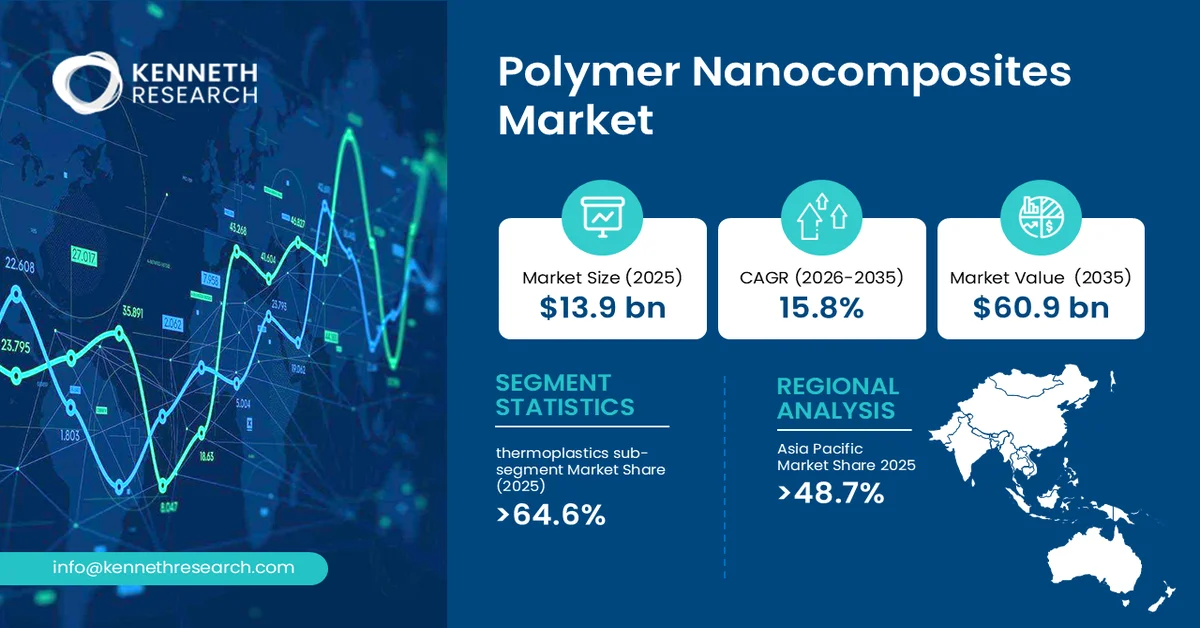
Polymer Nanocomposites Market size was valued at USD 13.9 billion in 2025 and is projected to reach USD 60.9 billion by the end of 2035, rising at a CAGR of 15.8% during the forecast period, i.e., 2026-2035. In 2026, the industry size of polymer nanocomposites is estimated at USD 16.2 billion.
Rising global demand for lightweight, high-performance, and resource-efficient materials across automotive, electronics, packaging, and industrial manufacturing is accelerating polymer nanocomposite adoption. The OECD projects that, without additional policy action, global plastics use will continue expanding substantially, reinforcing demand for advanced polymer materials with improved mechanical, thermal, and barrier performance.
The polymer nanocomposites market comprises engineered materials produced by incorporating nanoscale fillers, such as nanoclays, carbon nanotubes, graphene, metal oxides, or nanocellulose, into polymer matrices to enhance material performance beyond that of conventional polymers. These nanofillers are dispersed within thermoplastics, thermosets, or elastomers to improve properties including mechanical strength, thermal stability, flame resistance, electrical conductivity, gas barrier performance, and dimensional stability while maintaining low material weight.
Polymer nanocomposites are distinguished by their ability to achieve significant performance improvements with relatively low nanofiller concentrations, enabling manufacturers to optimize product functionality without substantial increases in material usage or processing complexity. Their compatibility with conventional polymer processing techniques, such as injection molding, extrusion, and compression molding, supports broad industrial implementation across high-volume manufacturing environments.
The market is strategically important for industries seeking lightweight, durable, and multifunctional materials to improve product performance, operational efficiency, and sustainability. Polymer nanocomposites are increasingly utilized in automotive components, electrical and electronic systems, packaging, aerospace structures, healthcare products, coatings, and industrial equipment, supporting innovation in advanced manufacturing and next-generation material engineering.
Key Polymer Nanocomposites Market Insights Summary:
Key Takeaways: Market Trends & Insights
- The Polymer Nanocomposites Market is projected to grow from USD 16.2 billion in 2026 to USD 60.9 billion by 2035, registering a CAGR of 15.8% during the forecast period
- Thermoplastics lead the polymer matrix segment with a 64.6% market share in 2025, supported by broad adoption across automotive, electronics, packaging, and industrial manufacturing applications
- Nanoclays are expected to witness strong future growth within the nanomaterial type segment due to their cost-effectiveness, superior barrier properties, and compatibility with conventional polymer processing technologies
- Asia Pacific accounted for the largest regional share of 48.7% in 2025, driven by the strong manufacturing base and expanding industrial capabilities in China and India
- North America remains a key regional market, supported by advanced materials research, specialty polymer manufacturing, and increasing commercialization of high-performance nanocomposite applications across the United States and Canada
Market Drivers
- Expansion of lightweight and high-performance manufacturing
- Increasing commercialization of functional nanomaterials
- Rising demand for advanced electronic and electrical components
- Growing adoption of sustainable and high-barrier packaging materials
Challenges
- High processing complexity and production costs
- Regulatory uncertainty and standardization gaps
Polymer Nanocomposites Market Overview & Supply Chain
Global adoption of polymer nanocomposites is increasing as manufacturers seek materials that simultaneously improve mechanical strength, thermal stability, barrier performance, flame resistance, and weight efficiency without fundamentally changing conventional polymer processing methods. Demand is accelerating across transportation, electrical and electronics, packaging, energy, and industrial manufacturing as producers pursue higher-performance materials that support product durability, resource efficiency, and regulatory compliance. Sustainability initiatives encouraging material optimization and circular manufacturing further reinforce the adoption of advanced polymer formulations incorporating nanoscale reinforcements. The OECD reported in its 2022 Global Plastics Outlook that, under current policies, global plastics use could almost triple by 2060, highlighting the growing need for innovative polymer technologies capable of delivering enhanced performance and improved material efficiency across industrial applications.
The polymer nanocomposites value chain begins with the sourcing of polymer resins, including thermoplastics, thermosets, and elastomers, alongside nanomaterials such as nanoclays, carbon nanotubes, graphene, metal oxide nanoparticles, and nanocellulose supplied by specialty chemical and advanced materials manufacturers. Material formulators then perform nanoparticle surface treatment, dispersion, and compounding to ensure uniform distribution within the polymer matrix before converting the material into pellets or masterbatches suitable for downstream processing. Component manufacturers utilize established production techniques, including injection molding, extrusion, blow molding, and compression molding, to fabricate finished products. Distribution is conducted through specialty chemical distributors, polymer compound suppliers, and direct industrial contracts serving global manufacturing networks. End users span automotive, electrical and electronics, aerospace, packaging, construction, healthcare, industrial equipment, and consumer goods sectors.
Polymer Nanocomposites Market: Growth Drivers & Challenges
Growth Drivers:
- Expansion of lightweight and high-performance manufacturing: The increasing emphasis on lightweight engineering and high-performance materials is a major catalyst for polymer nanocomposites adoption across automotive, aerospace, electronics, packaging, and industrial manufacturing. By incorporating nanoscale reinforcements into conventional polymers, manufacturers achieve higher strength-to-weight ratios, improved thermal resistance, enhanced barrier properties, and superior durability without substantially altering established processing technologies. These characteristics help manufacturers reduce material consumption while improving product reliability and operational efficiency. The technology also supports compliance with increasingly stringent sustainability and performance requirements by enabling longer product lifecycles and more efficient resource utilization. The European Commission states that 40% of plastics used in the European Union are in packaging, highlighting the importance of developing advanced polymer materials capable of delivering better performance and recyclability for one of the largest plastics applications.
- Increasing commercialization of functional nanomaterials: The growing commercialization of advanced nanomaterials is accelerating innovation throughout the polymer nanocomposites industry. Improvements in nanoparticle surface modification, dispersion technologies, and compounding techniques have enhanced the consistency and scalability of nanocomposite manufacturing while reducing processing challenges associated with agglomeration and material incompatibility. These advancements enable manufacturers to tailor polymers for specialized applications requiring electrical conductivity, electromagnetic shielding, flame retardancy, antimicrobial functionality, or enhanced chemical resistance. As research institutions, specialty chemical companies, and polymer manufacturers continue developing application-specific formulations, commercialization opportunities are expanding into medical devices, renewable energy systems, electronics, industrial equipment, and smart packaging. Future development is expected to focus on multifunctional materials that combine structural performance with sustainability objectives, supporting higher-value applications and strengthening competitive differentiation across global manufacturing industries.
Challenges:
- High processing complexity and production costs: One of the principal restraints facing the polymer nanocomposites market is the technical complexity associated with achieving uniform nanoparticle dispersion within polymer matrices. Inadequate dispersion can significantly reduce the expected improvements in mechanical, thermal, and electrical performance while increasing production variability. Manufacturers often require specialized compounding equipment, advanced processing expertise, and rigorous quality control procedures, leading to higher production costs than conventional polymer compounds. These technical and financial barriers discourage adoption among cost-sensitive manufacturers and slow commercialization in high-volume applications. Although continuous advances in processing technologies are improving manufacturing consistency, broader market penetration will depend on cost-effective production methods, standardized processing protocols, and greater industrial experience with large-scale nanocomposite manufacturing.
- Regulatory uncertainty and standardization gaps: The absence of globally harmonized standards governing nanomaterial characterization, safety assessment, labeling, and lifecycle management continues to limit broader commercialization of polymer nanocomposites. Regulatory requirements differ across jurisdictions regarding environmental evaluation, occupational exposure, product certification, and end-of-life management, creating compliance challenges for multinational manufacturers. Uncertainty surrounding long-term environmental and health considerations associated with certain nanomaterials also increases product qualification timelines and development costs. These factors complicate supply chain planning, delay customer adoption, and increase investment risk for both material suppliers and downstream manufacturers. As regulatory frameworks mature and internationally recognized testing standards become more widely adopted, greater market confidence and improved commercialization efficiency are expected to support long-term industry expansion.
Polymer Nanocomposites Market Size and Forecast:
| Report Attribute | Details |
|---|---|
| Base Year |
2025 |
| Forecast Year |
2026-2035 |
| CAGR |
15.8% |
| Base Year Market Size (2025) |
USD 13.9 billion |
| Forecast Year Market Size (2035) |
USD 60.9 billion |
| Regional Scope |
|
Polymer Nanocomposites Market Segmentation Analysis:
Polymer Matrix Segment Analysis
In the polymer matrix segment, the thermoplastics sub-segment is anticipated to capture the largest market share of 64.6% by the end of 2025.
Thermoplastics dominate the polymer matrix segment of the polymer nanocomposites market because they combine high-volume manufacturability with the ability to incorporate nanomaterials that enhance mechanical strength, thermal stability, barrier performance, and chemical resistance. Their compatibility with established processing techniques such as injection molding, extrusion, and blow molding enables rapid adoption across automotive, electrical and electronics, packaging, consumer goods, and industrial applications without requiring significant changes to production infrastructure. On the supply side, the widespread availability of engineering and commodity thermoplastic resins, mature global supply chains, and continuous innovation in nanofiller dispersion technologies support scalable commercial production and cost-effective manufacturing. Demand is further reinforced by sustainability initiatives promoting lightweight products and improved material efficiency. According to the European Environment Agency, Europe currently demands around 20 million tonnes of plastic for packaging, illustrating the substantial downstream demand for high-performance thermoplastic materials that can deliver improved functionality in packaging applications.
Nanomaterial Type Segment Analysis
The Nanoclays is projected to grow as the second-largest segment in the polymer nanocomposites market due to four converging demand drivers.
Nanoclays are projected to experience strong growth within the polymer nanocomposites market due to their ability to enhance mechanical strength, thermal stability, flame resistance, and gas barrier performance while requiring relatively low loading levels compared with conventional mineral fillers. Their cost-effectiveness and compatibility with widely used thermoplastic and thermoset matrices make them particularly attractive for packaging, automotive, construction, and electrical applications where manufacturers seek improved material performance without significantly increasing product weight or processing complexity. Industry adoption is expanding as compounders refine exfoliation and dispersion technologies, enabling more consistent material properties and scalable production. Supply-side growth is supported by well-established global bentonite and other clay mineral supply chains, providing manufacturers with reliable access to raw materials for commercial nanoclay production.
Our in-depth analysis of the global polymer nanocomposites market includes the following segments:
|
Segment |
Sub-segment |
|
Polymer Matrix |
|
|
Nanomaterial Type |
|
|
End-Use Industry |
|
Polymer Nanocomposites Market Regional Insights:
Asia Pacific Market Trends & Insights:
Asia Pacific polymer nanocomposites market is projected to hold the largest revenue share of 48.7% by the end of 2025.
The region benefits from integrated petrochemical value chains, cost-competitive manufacturing, and sustained investment in advanced materials research and industrial modernization. Government initiatives promoting domestic manufacturing, high-value materials, and sustainable industrial development further encourage the commercialization of polymer nanocomposites. In addition, the concentration of polymer resin producers, nanomaterial suppliers, and component manufacturers enables efficient supply chain integration and rapid technology adoption. According to China's Ministry of Industry and Information Technology (MIIT), China's plastic products industry produced 77.076 million tonnes of plastic products in 2024, reflecting the scale of the region's polymer processing base that supports demand for advanced polymer materials, including nanocomposites.
Within the region, China serves as the primary growth engine through its extensive polymer manufacturing infrastructure, large-scale automotive and electronics industries, and continuous investment in advanced materials innovation. The country's integrated chemical supply chain and emphasis on industrial upgrading facilitate the commercialization of high-performance polymer nanocomposites across multiple end-use sectors.
India is emerging as a significant market owing to expanding domestic manufacturing, increasing investments in automotive, electrical equipment, packaging, and infrastructure, and policy initiatives that encourage advanced materials adoption. Growing industrial production, improving polymer processing capabilities, and rising participation of domestic compounders and specialty material manufacturers position India as an important contributor to regional demand. Together, China and India strengthen Asia Pacific's leadership by combining manufacturing scale, expanding industrial applications, and increasing investment in next-generation polymer technologies.
North America Market Trends & Insights:
North America represents a strategically important market for polymer nanocomposites, supported by strong demand from automotive, aerospace, healthcare, electrical and electronics, packaging, and industrial manufacturing sectors. The region benefits from an advanced innovation ecosystem that combines materials science research, specialty chemical manufacturing, and high-value product development. Manufacturers are increasingly incorporating polymer nanocomposites to improve lightweight performance, thermal management, chemical resistance, and durability while meeting evolving sustainability and regulatory expectations. Government programs encouraging advanced manufacturing, domestic supply chain resilience, clean energy technologies, and research commercialization continue to foster investment in next-generation materials. Future opportunities are expected to arise from expanding applications in electric vehicles, battery systems, renewable energy infrastructure, smart electronics, medical devices, and high-performance packaging, supported by continued collaboration between industry, research institutions, and technology developers.
The United States remains the principal contributor to regional growth due to its mature polymer manufacturing industry, well-established specialty chemicals sector, and significant investments in nanotechnology research and commercialization. Strong demand from aerospace, defense, automotive, electronics, and healthcare industries supports continuous product innovation and the adoption of advanced polymer formulations. Meanwhile,
Canada is strengthening its position through growing capabilities in advanced materials research, sustainable manufacturing, and clean technology development. The country's focus on innovation partnerships, industrial modernization, and value-added materials production is creating opportunities for polymer nanocomposites in transportation, construction, energy, and industrial applications. Together, the United States and Canada provide a highly innovative and technologically advanced environment that supports long-term expansion of the polymer nanocomposites industry across diverse end-use sectors.
Leading Companies Operating in the Global Polymer Nanocomposites Market:
Here is a list of upstream, downstream, and key players operating in the global polymer nanocomposites market competitive ecosystem:
- Celanese Corporation (United States)
- Company Overview
- Business Strategy
- Key Product Offerings
- Financial Performance
- Key Performance Indicators
- Risk Analysis
- Recent Development
- Regional Presence
- SWOT Analysis
- RTP Company, Inc. (United States)
- Nanocyl SA (Belgium)
Recent Developments
- In 2026, a study published in Polymer elucidated the synergistic reinforcement mechanism in hybrid GO/MoS₂/polymer nanocomposites. Using Raman spectroscopy, researchers measured the effective modulus and orientation of both fillers separately, achieving a synergistic reinforcement efficiency of about 30% in hybrid nanocomposites.
- In 2026, research published in RSC Applied Polymers reviewed advances in polymer nanocomposite dielectrics for capacitive energy storage. By combining polymers with ceramic fillers, scientists have enhanced dielectric properties for applications in aerospace, oil and gas exploration, and hybrid electric vehicles. Interfacial design and microstructural engineering have significantly increased energy density.
Frequently Asked Question
In 2025, the polymer nanocomposites market exceeded USD 13.9 billion.
The polymer nanocomposites market is projected to reach USD 60.9 billion by the end of 2035, expanding at a CAGR of 15.8% over the forecast period (2026-2035).
The major players in the market are Celanese Corporation (United States), RTP Company, Inc. (United States), Nanocyl SA (Belgium), and others.
In the polymer matrix segment, the thermoplastics sub-segment is anticipated to capture the largest market share of 64.6% in the future and exhibit lucrative growth opportunities during 2026-2035. This growth trajectory is largely attributed to increasing demand for lightweight, high-performance materials across automotive, electronics, packaging, and industrial manufacturing applications.
Asia Pacific is projected to hold the largest market share of 48.7% by the end of 2025 and provide more business opportunities in the future. Continuous investments in advanced manufacturing, polymer processing, and industrial innovation across China and India are fostering the region's dominance.
Why Choose Kenneth Research ?
-
Insight with Impact : We don’t just gather data — we uncover stories, trends, and opportunities that fuel business growth.
-
Experts Who Get It : Our team speaks your industry’s language and knows what really matters to your customers and market.
-
Custom-Built for You : Forget one-size-fits-all. We craft research and consulting solutions as unique as your business vision.
-
Partners, Not Just Providers : We work with you, not for you — collaborating closely to turn insights into smart, strategic moves.
-
Results That Speak : Our work powers brands, startups, and industry leaders alike — with a track record of ideas that work in the real world.
Report ID: 1115 |
Published Date: 19 Aug 2026 |
Report Format: |
Delivery Timeline: 48-72 Business Hours

Copyright © 2025 Kenneth Research. All rights reserved. Terms of Use | Privacy Policy
