Report ID: 1288 |
Published Date: 01 Sep 2026 |
Report Format: |
Delivery Timeline: 48-72 Business Hours
Polymer Matrix Composites Market Outlook:
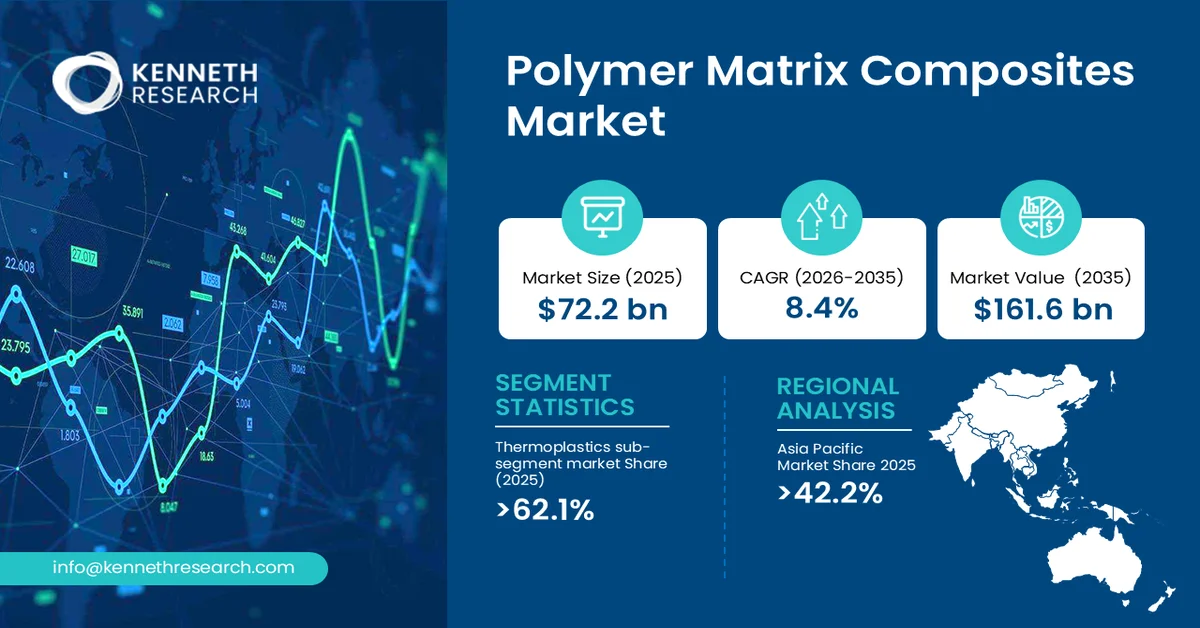
Polymer Matrix Composites Market size was valued at USD 72.2 Billion in 2025 and is projected to reach USD 161.6 Billion by the end of 2035, rising at a CAGR of 8.4% during the forecast period, i.e., 2026–2035. In 2026, the industry size of the polymer matrix composites is estimated at USD 78.2 Billion.
The primary growth driver for the polymer matrix composites market is increasing demand for lightweight, high-strength materials across automotive, aerospace, construction, wind energy, electronics, and industrial applications. Polymer matrix composites offer an attractive combination of strength-to-weight ratio, corrosion resistance, durability, and design flexibility, enabling manufacturers to reduce component weight while maintaining structural performance. Growing vehicle electrification and lightweighting requirements are further encouraging composite adoption in transportation applications.
The polymer matrix composites market comprises composite materials in which polymer resins act as the matrix and are reinforced with materials such as glass fiber, carbon fiber, or other reinforcing structures. These composites are engineered to provide enhanced mechanical, thermal, chemical, and dimensional properties compared with many conventional polymer materials.
Polymer matrix composites can be manufactured using thermoplastic or thermoset matrices and are supplied in forms suited to molding, pultrusion, filament winding, compression molding, and other manufacturing processes. Their combination of lightweight construction, strength, corrosion resistance, and processing flexibility makes them valuable across automotive, aerospace, construction, energy, marine, electronics, and industrial applications.
Key Polymer Matrix Composites Market Insights Summary:
Key Takeaways: Market Trends & Insights
- The Polymer Matrix Composites Market is projected to grow from USD 72.2 billion in 2025 to USD 161.6 billion by 2035, registering an 8.4% CAGR.
- Asia Pacific held the largest regional share at 42.2% in 2025, supported by expanding automotive, electronics, aerospace, construction, and renewable-energy manufacturing.
- Thermoplastics represented the leading Type segment with a 62.1% share in 2025, benefiting from lightweight construction, faster processing, recyclability, and suitability for high-volume manufacturing.
- Automotive is an important application area, driven by vehicle lightweighting, electric-vehicle development, improved energy efficiency, and demand for durable composite components.
- Market opportunities are supported by advances in automated processing, recyclable thermoplastic systems, lightweight structural components, and growing adoption across transportation and renewable-energy applications.
- Key challenges include high manufacturing and processing costs and recycling and end-of-life management, encouraging manufacturers to improve production efficiency and develop more circular composite solutions.
Market Drivers
- Increasing vehicle lightweighting and electrification.
- Expanding wind-energy infrastructure.
- Growing aerospace and defense applications.
- Rising demand for corrosion-resistant construction materials.
- Development of recyclable and high-performance thermoplastic composites.
Challenges
- High manufacturing and processing costs
- Recycling and end-of-life management
Polymer Matrix Composites Market Overview & Supply Chain
The polymer matrix composites market is supported by expanding demand from automotive, aerospace, construction, renewable energy, electronics, and industrial manufacturing. Their lightweight structure, high strength-to-weight ratio, corrosion resistance, and design flexibility make polymer matrix composites attractive for manufacturers seeking improved component efficiency and durability. Japan's Ministry of Economy, Trade and Industry maintains production statistics covering transport machinery, plastics, chemicals, electrical machinery, and other manufacturing industries that represent important downstream markets for composites.
The supply chain begins with polymer resins, reinforcing fibers, additives, catalysts, and other specialty inputs. Composite manufacturers combine these materials through processes such as injection molding, compression molding, pultrusion, filament winding, and automated composite manufacturing. Finished materials and components are then supplied to OEMs, component manufacturers, construction companies, and industrial users through direct sales and specialized distributors. Key stakeholders include resin and fiber producers, compounders, composite manufacturers, equipment suppliers, distributors, OEMs, fabricators, and end-use industries. Increasing localization of manufacturing and development of recyclable thermoplastic systems are also influencing supply-chain strategies.
Polymer Matrix Composites Market: Growth Drivers & Challenges
Growth Drivers
- Increasing automotive lightweighting: Automotive manufacturers are increasingly adopting lightweight materials to improve vehicle efficiency, performance, and range. Polymer matrix composites can reduce component weight while providing strength, corrosion resistance, and design flexibility. This is particularly relevant to electric vehicles, where reducing vehicle mass can support energy efficiency and driving range. The U.S. Department of Energy identifies lightweight materials, including composites, as important technologies for improving vehicle efficiency.
- Expansion of renewable energy infrastructure: Growing renewable-energy deployment is creating opportunities for polymer matrix composites, particularly in wind-energy applications. Composite materials provide the lightweight strength, fatigue resistance, and durability required for large structural components such as wind-turbine blades. As wind turbines increase in size, manufacturers require materials capable of delivering structural performance while controlling component weight. Continued expansion of renewable-energy capacity should therefore support demand for advanced composite materials and manufacturing technologies.
Challenges
- High manufacturing and processing costs: Polymer matrix composites can involve higher material, tooling, processing, and equipment costs than conventional metals or commodity polymers, particularly for advanced applications requiring specialized fibers and automated manufacturing. Complex fabrication requirements and quality-control procedures can further increase production expenses. These cost considerations can limit adoption in price-sensitive applications and make large-scale commercialization more difficult. Manufacturers are therefore focusing on faster processing, automation, material optimization, and improved production yields to reduce overall component costs.
- Recycling and end-of-life management: Recycling remains a significant challenge, particularly for thermoset composites where the polymer matrix cannot simply be remelted and reshaped. Separating reinforcement fibers from the matrix can require specialized processes and may affect recovered-material quality. Growing sustainability requirements are increasing pressure on manufacturers to establish more effective recycling and recovery pathways. Development of recyclable thermoplastic composites, improved mechanical and chemical recycling technologies, and greater use of recycled reinforcement materials could help address end-of-life concerns while supporting circularity across the composite value chain.
Polymer Matrix Composites Market Size and Forecast:
| Report Attribute | Details |
|---|---|
| Base Year |
2026 |
| Forecast Period |
2027-2036 |
| CAGR |
8.4% |
| Base Year Market Size (2026) |
USD 72.2 billion |
| Forecast Year Market Size (2036) |
USD 161.6 billion |
| Regional Scope |
|
Polymer Matrix Composites Market Segmentation Analysis:
By Type Segment Analysis
In the Type segment, Thermoplastics are anticipated to capture the largest market share of 62.1% in 2025.
Thermoplastic matrix composites are gaining adoption because they offer lightweight construction, high strength, impact resistance, design flexibility, and comparatively faster processing. Unlike many thermoset systems, thermoplastics can be reheated and reshaped, supporting opportunities for recycling and high-volume manufacturing.
Demand is particularly strong in automotive applications, where manufacturers are seeking lightweight components to improve vehicle efficiency and support electric-vehicle range. Thermoplastic composites can also enable shorter production cycles and integration of multiple functions into individual components, improving manufacturing efficiency. Continued development of high-performance thermoplastic resins, automated processing, and recyclable composite systems is expected to broaden their use across automotive, aerospace, electronics, industrial, and construction applications. As manufacturers increasingly prioritize lightweighting, production efficiency, and material recyclability, thermoplastics are positioned to maintain their leading position within the polymer matrix composites market.
Application Type Segment Analysis
The Automotive segment is expected to witness strong growth as vehicle manufacturers increasingly use polymer matrix composites to reduce weight while maintaining structural performance, durability, and design flexibility. Composite materials are used in body panels, structural components, battery-related systems, interior parts, underbody components, and other applications where weight reduction can improve vehicle efficiency.
The transition toward electric vehicles is creating additional opportunities because lightweight composite components can help offset battery weight and support longer driving ranges. The U.S. Department of Energy highlights lightweight materials, including composites, as an important pathway for improving vehicle efficiency.
Automotive manufacturers are also increasingly evaluating thermoplastic composites because of their faster processing, potential recyclability, and suitability for high-volume production. Continued vehicle electrification, lightweighting initiatives, and advances in automated composite manufacturing should create further opportunities for polymer matrix composite suppliers.
Polymer Matrix Composites Market Regional Insights:
Asia Pacific Market Trends & Insights:
Asia Pacific accounted for 42.2% of the polymer matrix composites market in 2025, supported by extensive automotive, electronics, aerospace, construction, renewable-energy, and industrial manufacturing activity. The region benefits from established composite production capabilities, expanding manufacturing infrastructure, and growing demand for lightweight materials. Japan and China remain key markets, supported by sophisticated automotive and industrial ecosystems and continued investment in advanced manufacturing technologies.
Japan has strong demand for polymer matrix composites across automotive, electronics, aerospace, and industrial applications. Its advanced manufacturing base supports adoption of lightweight and high-performance materials, particularly where dimensional stability and durability are important.
China offers substantial opportunities through its large automotive, renewable-energy, construction, and electronics industries. China's National Bureau of Statistics reported that industrial output increased 5.8% in 2024, reflecting continued manufacturing activity across industries that consume composite materials and components.
The region's expanding electric-vehicle production, renewable-energy installations, infrastructure development, and investment in automated manufacturing should further strengthen demand. Increasing development of recyclable thermoplastic composites is also expected to create opportunities for regional manufacturers seeking improved material efficiency and sustainability.
North America Market Trends & Insights:
North America represents a significant market for polymer matrix composites, supported by established automotive, aerospace, construction, renewable-energy, defense, and industrial manufacturing sectors. Demand is increasingly influenced by vehicle lightweighting, electric-mobility development, infrastructure modernization, and the need for durable materials that can withstand demanding operating conditions. The region also benefits from advanced composite-processing capabilities and strong research and development activity.
The U.S. remains the primary regional market, with applications spanning automotive components, aircraft structures, wind-energy equipment, construction materials, and industrial products. The U.S. Department of Energy identifies lightweight materials, including composites, as important technologies for improving vehicle efficiency and reducing transportation energy consumption.
Canada provides additional opportunities through aerospace, automotive, construction, energy, and advanced manufacturing applications. Government-supported industrial development and clean-energy investment are encouraging demand for lightweight and durable materials. Across North America, increasing adoption of electric vehicles, expansion of renewable-energy infrastructure, and development of automated composite manufacturing are expected to support regional demand. Manufacturers are also focusing on recyclable thermoplastic systems and more efficient processing technologies to address sustainability and production-cost considerations.
Leading Companies Operating in the Global Polymer Matrix Composites Market:
- Toray Industries(Japan)
- Company Overview
- Business Strategy
- Key Product Offerings
- Financial Performance
- Key Performance Indicators
- Risk Analysis
- Recent Development
- Regional Presence
- SWOT Analysis
- Mitsubishi Chemical Group(Japan)
- Avient(U.S)
Recent Developments
- April 2026: Toray Industries Expanded development of thermoplastic composite technologies for mobility applications, focusing on lightweight structures and high-speed processing.
- March 2026: Mitsubishi Chemical Group Advanced its thermoplastic composite materials portfolio for automotive and industrial applications, emphasizing lightweighting and processing efficiency.
Frequently Asked Question
The polymer matrix composites market was valued at USD 72.2 billion in 2025.
The market is projected to reach USD 161.6 billion by 2035, expanding at a CAGR of 8.4% during 2026–2035.
Major manufacturers include Toray Industries, Avient, Mitsubishi Chemical Group, Teijin, and Hexcel, among others.
Within the Type segment, Thermoplastics held the largest share at 62.1% in 2025, supported by their lightweight properties, faster processing potential, recyclability, and growing automotive applications.
Asia Pacific is expected to remain the leading region, accounting for 42.2% in 2025, supported by strong automotive, electronics, aerospace, construction, and renewable-energy industries across Japan and China.
Why Choose Kenneth Research ?
-
Insight with Impact : We don’t just gather data — we uncover stories, trends, and opportunities that fuel business growth.
-
Experts Who Get It : Our team speaks your industry’s language and knows what really matters to your customers and market.
-
Custom-Built for You : Forget one-size-fits-all. We craft research and consulting solutions as unique as your business vision.
-
Partners, Not Just Providers : We work with you, not for you — collaborating closely to turn insights into smart, strategic moves.
-
Results That Speak : Our work powers brands, startups, and industry leaders alike — with a track record of ideas that work in the real world.
Report ID: 1288 |
Published Date: 01 Sep 2026 |
Report Format: |
Delivery Timeline: 48-72 Business Hours

Copyright © 2025 Kenneth Research. All rights reserved. Terms of Use | Privacy Policy
