Report ID: 1080 |
Published Date: 13 Aug 2026 |
Report Format: |
Delivery Timeline: 48-72 Business Hours
Polymer Catalyst Market Outlook:
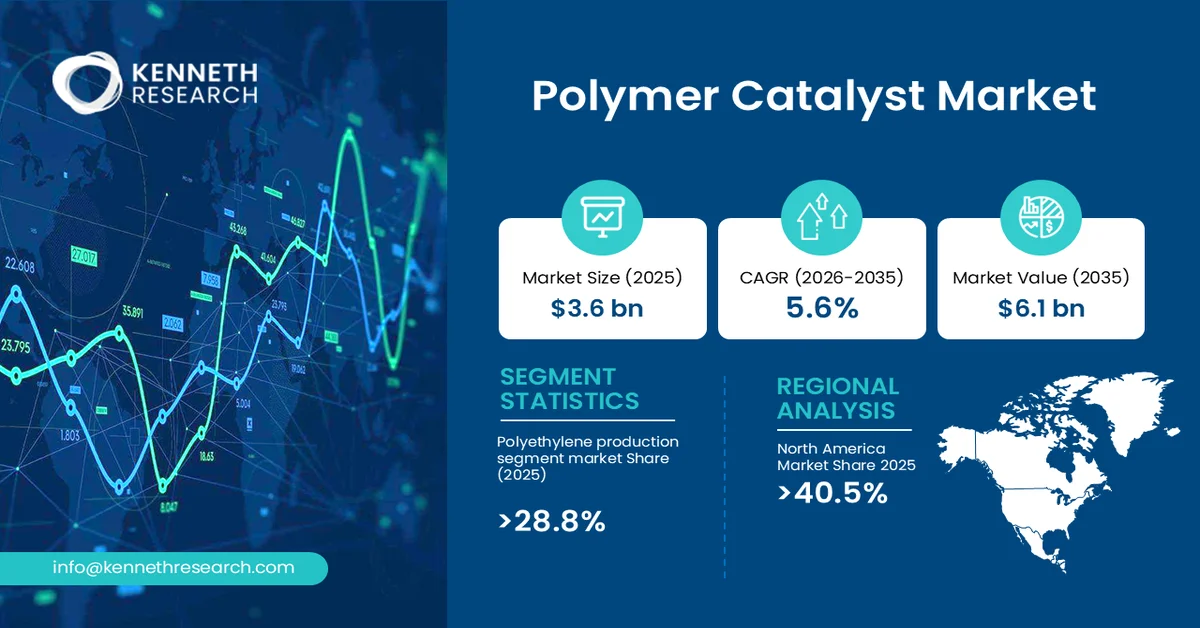
Polymer Catalyst Market size was valued at USD 3.6 billion in 2025 and is projected to reach USD 6.1 billion by the end of 2035, rising at a CAGR of 5.6% during the forecast period, i.e., 2026-2035. In 2026, the industry size of polymer catalyst is estimated at USD 3.9 billion.
The polymer catalyst market is primarily driven by rising global demand for high-performance polymers used in packaging, automotive, construction, and consumer goods. Increasing polymer production capacity, coupled with the industry's focus on catalyst efficiency, process optimization, and sustainable manufacturing, continues to accelerate the adoption of advanced polymer catalyst technologies worldwide.
The polymer catalyst market comprises catalytic materials used to initiate, accelerate, and control polymerization reactions during the production of polymers such as polyethylene, polypropylene, polyvinyl chloride, and specialty engineering plastics. These catalysts improve reaction efficiency while enabling manufacturers to achieve precise control over molecular weight, polymer architecture, crystallinity, and other material properties required for diverse industrial applications.
Polymer catalysts include technologies such as ziegler-natta catalysts, metallocene catalysts, chromium-based catalysts, and single-site catalyst systems, each designed to optimize polymer yield, product consistency, and operational efficiency. Their performance directly influences production economics by improving conversion rates, reducing energy consumption, minimizing by-products, and supporting the manufacture of high-quality polymers with application-specific characteristics.
The market plays a vital role in the global petrochemical and chemical manufacturing industries by enabling large-scale production of polymers used across packaging, automotive, construction, healthcare, electronics, agriculture, and consumer products. As worldwide plastics demand continues to expand alongside growing emphasis on resource efficiency and circular economy initiatives, advanced polymer catalyst technologies remain fundamental to improving manufacturing productivity, supporting innovation in polymer materials, and enhancing sustainability across industrial value chains.
Key Polymer Catalyst Market Insights Summary:
Key Takeaways: Market Trends & Insights
- Polyethylene production accounted for 28.8% of the polymer catalyst market in 2025 making it the leading application segment driven by strong demand across packaging automotive construction and healthcare
- Ziegler-natta catalysts are projected to witness strong growth owing to their high catalytic efficiency cost-effectiveness and widespread use in large-scale polyolefin production
- North America held the largest regional share of 40.5% in 2025 supported by advanced petrochemical infrastructure continuous catalyst innovation and strong manufacturing capabilities
- Europe is expected to create significant growth opportunities through sustainable manufacturing initiatives increasing investments in specialty polymers and ongoing catalyst technology advancements
- The polymer catalyst market is projected to grow from USD 3.6 billion in 2025 to USD 6.1 billion by 2035 at a 5.6% CAGR driven by expanding polymer production and rising demand for high-performance catalyst technologies
Market Drivers
- Expansion of petrochemical production capacity in emerging economies
- Growing demand for specialty and high-performance polymers
- Increasing adoption of energy-efficient and low-emission polymerization processes
- Rising investments in catalyst research, development, and process optimization
Challenges
- Volatility in feedstock availability and specialty raw material costs
- Lengthy qualification cycles and high switching costs for catalyst technologies
Polymer Catalyst Market Overview & Supply Chain
The adoption of polymer catalysts is increasing globally as manufacturers seek higher process efficiency, improved polymer properties, and lower production costs while complying with evolving environmental and product-quality requirements. Advanced catalyst technologies enable precise control over polymer characteristics, supporting applications across packaging, automotive, construction, healthcare, and electronics. Growing investments in petrochemical capacity, combined with the transition toward more resource-efficient manufacturing, continue to strengthen demand for high-performance catalyst systems. Policy initiatives promoting sustainable materials and circular economy practices are further encouraging innovation in catalyst development. Reflecting the expanding industrial relevance of polymers, the OECD reports that global plastics production and use reached 435 million tonnes in 2020 and, without additional policy action, are projected to increase by 70% by 2040, underscoring the need for efficient catalyst technologies that improve manufacturing productivity and material performance.
The polymer catalyst market operates through a highly integrated value chain beginning with the procurement of raw materials such as transition metals, organometallic compounds, mineral supports, specialty chemicals, and chemical intermediates sourced from global chemical suppliers and mining industries. Catalyst manufacturers formulate and synthesize these inputs into specialized catalyst systems through controlled chemical processing, quality testing, and performance validation to meet application-specific polymerization requirements. Finished catalysts are supplied directly to petrochemical producers and polymer manufacturers through long-term contracts, regional distributors, and technical sales networks, ensuring reliable delivery and ongoing process support. Polymer producers utilize these catalysts in large-scale manufacturing facilities to produce commodity and specialty polymers tailored for downstream conversion industries. The resulting polymer resins are distributed to processors and component manufacturers serving packaging, automotive, construction, healthcare, agriculture, electronics, and consumer goods sectors. Key stakeholders across the value chain include raw material suppliers, catalyst technology developers, chemical manufacturers, petrochemical companies, polymer producers, equipment suppliers, distributors, regulatory authorities, research institutions, and industrial end users, all of whom contribute to continuous innovation, quality assurance, and supply chain resilience.
Polymer Catalyst Market: Growth Drivers & Challenges
Growth Drivers:
- Expanding global polymer production and advanced manufacturing requirements: The increasing demand for high-performance polymers across packaging, automotive, construction, healthcare, and electrical applications is a major growth driver for the polymer catalyst market. Modern catalyst technologies enable manufacturers to improve polymerization efficiency, achieve tighter control over polymer properties, reduce process variability, and enhance production economics. As polymer producers expand capacity to meet evolving industrial requirements, investments in advanced catalyst systems continue to increase. Furthermore, the industry's transition toward resource-efficient manufacturing and higher-value specialty polymers is encouraging the adoption of catalysts capable of delivering superior product consistency and operational reliability.
- Increasing innovation in sustainable and high-performance catalyst technologies: Continuous innovation in catalyst chemistry is strengthening the long-term outlook for the polymer catalyst market. Manufacturers are developing catalyst systems that improve polymer quality while reducing energy consumption, waste generation, and overall production costs. Advanced technologies such as single-site catalysts, improved Ziegler-Natta formulations, and next-generation metallocene catalysts enable greater flexibility in producing application-specific polymers with enhanced mechanical and thermal properties. Growing regulatory emphasis on sustainability and circular manufacturing is further encouraging investments in catalysts that support recyclable materials, lower-emission production processes, and efficient utilization of feedstocks. Collaboration between catalyst developers, petrochemical companies, and research institutions is accelerating commercialization of innovative solutions, enabling manufacturers to address evolving customer requirements while improving operational competitiveness. These technological advancements are expected to remain a key contributor to the market's long-term development as polymer applications continue to diversify.
Challenges:
- Volatility in feedstock availability and specialty raw material costs: The polymer catalyst market faces a significant restraint from fluctuations in the availability and pricing of specialty raw materials, including transition metals, organometallic compounds, and high-purity chemical intermediates used in catalyst synthesis. These inputs are sourced through globally interconnected supply chains that remain vulnerable to geopolitical tensions, mining constraints, trade restrictions, and transportation disruptions. Such volatility raises manufacturing costs, complicates procurement planning, and compresses profit margins for catalyst producers. For polymer manufacturers, higher catalyst prices increase production costs and may delay investments in process upgrades or capacity expansion. Commercially, prolonged supply uncertainty encourages companies to diversify suppliers and maintain larger inventories, increasing working capital requirements. Looking ahead, strengthening regional supply networks, recycling critical materials, and developing alternative catalyst chemistries will become essential strategies for improving supply resilience and maintaining stable long-term competitiveness.
- Lengthy qualification cycles and high switching costs for catalyst technologies: The adoption of new polymer catalyst technologies is constrained by extensive qualification procedures and the high commercial risk associated with changing catalyst systems in existing production facilities. Polymer manufacturers typically conduct comprehensive pilot trials, process validation, product performance assessments, and regulatory compliance evaluations before approving a new catalyst, as even minor variations can alter polymer characteristics and downstream processing performance. These lengthy qualification cycles slow the commercialization of innovative catalyst technologies and create substantial barriers for new market entrants. Commercially, established catalyst suppliers benefit from long-term customer relationships, making competitive displacement difficult despite technological improvements. The associated costs of process optimization, equipment recalibration, and operator training further discourage rapid catalyst substitution. In the future, collaborative development programs, digital process simulation, and faster validation methodologies may help shorten adoption timelines, although conservative procurement practices are expected to continue influencing purchasing decisions.
Polymer Catalyst Market Size and Forecast:
| Report Attribute | Details |
|---|---|
| Base Year |
2025 |
| Forecast Year |
2026-2035 |
| CAGR |
5.6% |
| Base Year Market Size (2025) |
USD 3.6 billion |
| Forecast Year Market Size (2035) |
USD 6.1 billion |
| Regional Scope |
|
Polymer Catalyst Market Segmentation Analysis:
Application Segment Analysis
In the application segment, the polyethylene production sub-segment is anticipated to capture the largest market share of 28.8% by the end of 2025.
Polyethylene production accounted for the largest share of the polymer catalyst market in 2025 due to its extensive use across packaging, construction, consumer goods, healthcare, agriculture, and industrial applications. The production of high-density, low-density, and linear low-density polyethylene requires highly efficient catalyst systems capable of delivering consistent polymer quality, improved molecular weight control, and enhanced process efficiency. Rising demand for lightweight, durable, and cost-effective plastic materials has encouraged polymer manufacturers to invest in advanced catalyst technologies that maximize productivity while reducing energy consumption and operational costs. Supply-side expansion through new petrochemical capacities and modernization of existing polymerization facilities has further strengthened catalyst demand. According to the OECD's regional plastics outlook for Southeast and East Asia (2024), polyethylene polymers (LLDPE, LDPE, HDPE, and PET) together accounted for 29% of total plastics use in the region in 2022, demonstrating the dominant role of polyethylene across global plastics applications and reinforcing sustained demand for polymer catalysts used in its production. Looking ahead, continued investments in high-performance polyethylene grades, recyclable materials, and process optimization technologies are expected to preserve the segment's leadership.
Type Segment Analysis
The ziegler-natta catalysts is projected to grow as the second-largest segment in the polymer catalyst market due to four converging demand drivers.
Ziegler-natta catalysts are projected to witness strong growth owing to their widespread use in the commercial production of polyethylene and polypropylene, where they provide high catalytic activity, excellent polymer stereoregularity, and cost-effective large-scale manufacturing. Their ability to produce polymers with consistent mechanical properties and processability makes them the preferred choice for packaging, automotive components, consumer goods, construction materials, and industrial applications. Demand is further supported by ongoing capacity expansions in petrochemical production and increasing investments in high-throughput polymerization facilities that prioritize operational efficiency and product quality. On the supply side, catalyst manufacturers continue to improve catalyst formulations, enhance productivity, and extend catalyst lifecycles, enabling polymer producers to reduce operating costs and improve manufacturing performance. According to the International Energy Agency (IEA), demand for plastics has outpaced that of all other bulk materials, such as steel, aluminium, and cement, and has nearly doubled since 2000, reinforcing sustained demand for proven catalyst technologies used in polyolefin production. Looking ahead, continued expansion of high-performance polyolefins and the development of more efficient catalyst systems are expected to support the long-term growth of the Ziegler-Natta catalyst segment.
Our in-depth analysis of the global polymer catalyst market includes the following segments:
|
Segment |
Sub-segment |
|
Type |
|
|
Chemical Composition |
|
|
Application |
|
|
End Use Industry |
|
Polymer Catalyst Market Regional Insights:
North America Market Trends & Insights:
North America polymer catalyst market is projected to hold the largest revenue share of 40.5% by the end of 2025.
Its dominance is supported by a well-established petrochemical industry, advanced polymer manufacturing infrastructure, continuous investments in catalyst innovation, and strong integration across the chemical value chain. The region benefits from abundant hydrocarbon feedstocks, enabling large-scale production of polyethylene, polypropylene, and other polymer resins that rely on high-performance catalyst systems. Regulatory emphasis on manufacturing efficiency, product quality, emissions reduction, and sustainable industrial practices has further accelerated the adoption of advanced polymer catalysts. Ongoing investments in specialty chemicals, process optimization, and next-generation catalyst technologies continue to strengthen North America's competitive position in global polymer production.
The United States remains the primary contributor to regional leadership through its extensive chemical manufacturing base, robust research capabilities, and significant investments in polymer production facilities.
Canada complements regional growth with a strong petrochemical sector supported by abundant natural gas resources and expanding investments in value-added chemical manufacturing. According to the U.S. Census Bureau's 2021 annual Survey of manufactures, the U.S. chemical manufacturing subsector recorded USD 832.3 billion in value of shipments in 2021, demonstrating the scale of the industrial ecosystem that supports sustained demand for polymer catalysts across multiple downstream industries. Together, the United States and Canada continue to attract investments in advanced manufacturing, catalyst development, and polymer production, reinforcing North America's long-term leadership in the market.
Europe Market Trends & Insights:
Europe represents a strategically important region for the polymer catalyst market, driven by strong demand from the packaging, automotive, construction, healthcare, and specialty manufacturing sectors. The region's advanced chemical industry continuously adopts high-performance catalyst technologies to improve polymer quality, optimize production efficiency, and support the transition toward more sustainable manufacturing practices. European manufacturers are increasingly investing in catalyst innovations that enable energy-efficient polymerization processes, improved material performance, and compatibility with circular economy objectives. Government initiatives promoting low-carbon industrial production, recycling infrastructure, and sustainable materials are encouraging polymer producers to modernize manufacturing facilities and integrate advanced catalyst systems. Continued investments in specialty polymers, bio-based materials, and next-generation petrochemical technologies are expected to create additional opportunities for catalyst developers. Collaboration among chemical manufacturers, research institutions, and technology providers further accelerates innovation, strengthening Europe's position as a key center for advanced polymer production and catalyst development.
Germany serves as the region's primary growth engine due to its highly developed chemical manufacturing industry, strong research capabilities, and continuous investments in advanced polymer processing technologies. The country's emphasis on industrial automation, specialty chemicals, and sustainable production supports ongoing demand for high-performance catalyst solutions.
France complements regional growth through its diversified chemical sector, expanding investments in advanced materials, and increasing focus on environmentally responsible manufacturing. French manufacturers are adopting innovative catalyst technologies to improve operational efficiency while aligning with evolving environmental regulations and circular economy goals. Together, Germany and France continue to drive technological advancement, industrial modernization, and long-term demand for polymer catalysts across Europe's integrated chemical value chain.
Leading Companies Operating in the Global Polymer Catalyst Market:
Here is a list of upstream raw material suppliers, catalyst manufacturers, technology licensors, chemical companies, and key players operating in the global polymer catalyst market competitive ecosystem:
- BASF Catalysts (Germany)
- Company Overview
- Business Strategy
- Key Product Offerings
- Financial Performance
- Key Performance Indicators
- Risk Analysis
- Recent Development
- Regional Presence
- SWOT Analysis
- Clariant Catalysts (Switzerland)
- Univation Technologies (United States)
- Shell Catalysts & Technologies (Netherlands)
- Honeywell UOP (United States)
- Topsoe (Denmark)
- Axens (France)
- Evonik Catalysts (Germany)
Recent Developments
- In September 2025, Technip Energies announced a definitive agreement to acquire the advanced materials & catalysts business from Ecovyst Inc. for US$556 million. The acquisition expands Technip Energies' catalyst capabilities in advanced silicas and zeolites, targeting growth markets including sustainable aviation fuel, biocatalysis, and advanced plastics recycling. The transaction is expected to close by the first quarter of 2026.
- In December 2025, a groundbreaking review Published in ACS Applied Materials & Interfaces highlighted molecularly imprinted polymer (MIP)-based catalysts as an emerging trend in selective catalysis. Often called "plastic antibodies," MIPs offer stability, robustness, and lower synthesis costs compared to biological enzymes, with potential applications in reactions where corresponding enzymes are unavailable. Advanced approaches including covalent imprinting and metal-coordinating monomers have enhanced selectivity and catalytic efficiency.
Frequently Asked Question
In 2025, the polymer catalyst market exceeded USD 3.6 billion.
The polymer catalyst market is projected to reach USD 6.1 billion by the end of 2035, expanding at a CAGR of 5.6% over the forecast period (2026-2035).
The major players in the market are BASF Catalysts, Clariant Catalysts, W. R. Grace, Univation Technologies, LyondellBasell, Shell Catalysts & Technologies, Honeywell UOP, Topsoe, Axens, Johnson Matthey, Evonik Catalysts, Tosoh Corporation, Mitsui Chemicals, Chevron Phillips Chemical, Dow, SABIC, INEOS, Nouryon, Braskem, ExxonMobil, and others.
In the application segment, the polyethylene production sub-segment is anticipated to capture the largest market share of 28.8% in the future and exhibit lucrative growth opportunities during 2026-2035. This growth trajectory is largely attributed to increasing demand for high-performance polyethylene across packaging, automotive, construction, healthcare, and consumer goods applications, driving continued adoption of advanced polymer catalyst technologies.
North America is projected to hold the largest market share of 40.5% by the end of 2025 and provide more business opportunities in the future. Continuous investments in polymer manufacturing capacity, catalyst innovation, and advanced petrochemical infrastructure across the United States and Canada are fostering the region's dominance.
Why Choose Kenneth Research ?
-
Insight with Impact : We don’t just gather data — we uncover stories, trends, and opportunities that fuel business growth.
-
Experts Who Get It : Our team speaks your industry’s language and knows what really matters to your customers and market.
-
Custom-Built for You : Forget one-size-fits-all. We craft research and consulting solutions as unique as your business vision.
-
Partners, Not Just Providers : We work with you, not for you — collaborating closely to turn insights into smart, strategic moves.
-
Results That Speak : Our work powers brands, startups, and industry leaders alike — with a track record of ideas that work in the real world.
Report ID: 1080 |
Published Date: 13 Aug 2026 |
Report Format: |
Delivery Timeline: 48-72 Business Hours

Copyright © 2025 Kenneth Research. All rights reserved. Terms of Use | Privacy Policy
