Report ID: 1154 |
Published Date: 24 Aug 2026 |
Report Format: |
Delivery Timeline: 48-72 Business Hours
Polycarbonate Resin Market Outlook:
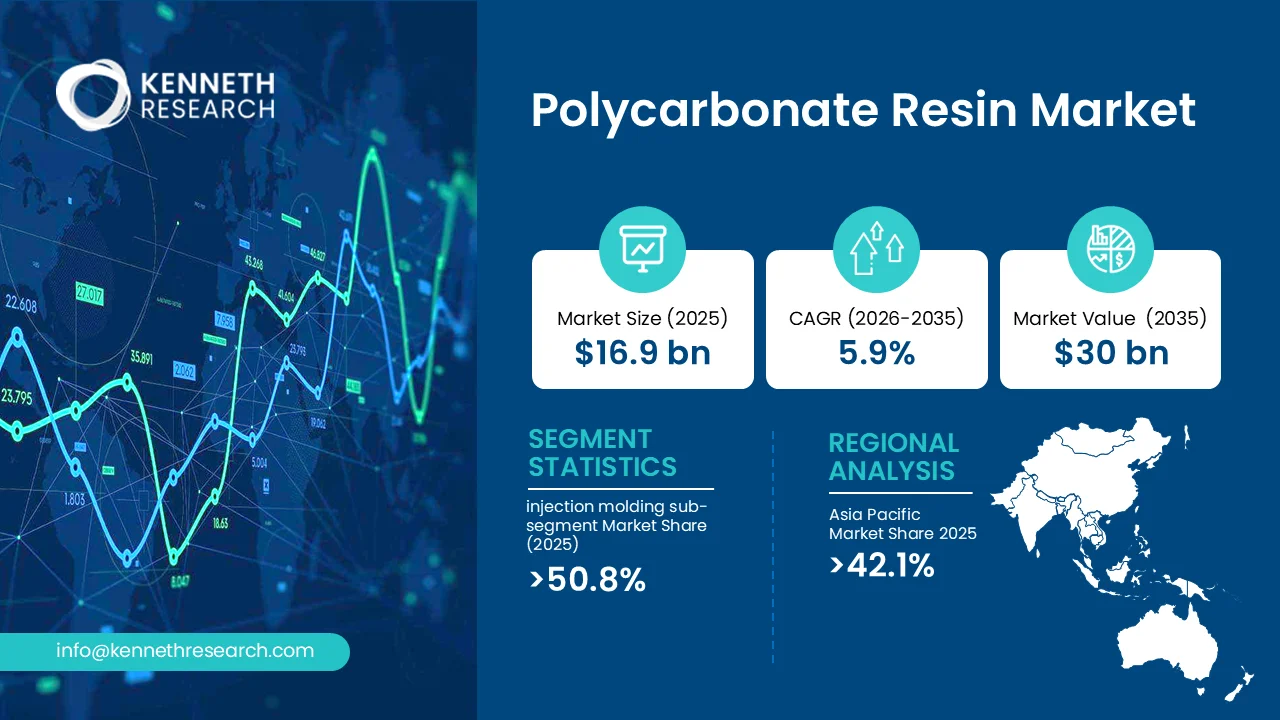
Polycarbonate Resin Market size was valued at USD 16.9 billion in 2025 and is projected to reach USD 30 billion by the end of 2035, rising at a CAGR of 5.9% during the forecast period, i.e., 2026-2035. In 2026, the industry size of polycarbonate resin is estimated at USD 17.9 billion.
Growing electrification across transportation and electronics is a primary growth driver for the polycarbonate resin market. Polycarbonate’s lightweight structure, impact resistance, electrical insulation, and thermal stability make it suitable for electric vehicles, battery systems, consumer electronics, and advanced electrical components, supporting sustained industrial demand across global manufacturing sectors. Supported by rising global electric vehicle adoption, the market benefits from expanding use of lightweight engineering plastics.
The polycarbonate resin market comprises the global production, processing, distribution, and commercialization of polycarbonate resins, a class of high-performance thermoplastic polymers widely used in engineering applications requiring a balance of mechanical strength, optical transparency, dimensional stability, and heat resistance. These resins are manufactured in multiple grades and processing forms to meet the performance requirements of industries such as automotive, electrical and electronics, construction, healthcare, consumer goods, and industrial equipment.
Polycarbonate resin is recognized for its exceptional impact resistance, lightweight characteristics, flame-retardant capability, and excellent electrical insulating properties, enabling manufacturers to replace heavier materials such as glass and certain metals in demanding applications. The material also supports precision manufacturing processes, including injection molding, extrusion, blow molding, and thermoforming, allowing the production of complex and high-value components with consistent quality.
Industrial relevance continues to expand as manufacturers prioritize lightweight materials, product durability, design flexibility, and improved safety performance across modern production systems. The versatility of polycarbonate resin makes it a critical engineering material for applications ranging from electrical housings and automotive lighting systems to medical devices, transparent glazing, and industrial equipment.
Key Polycarbonate Resin Market Insights Summary:
Key Takeaways: Market Trends & Insights
- The polycarbonate resin market is expected to grow from USD 17.9 billion in 2026 to USD 30 billion by 2035, registering a CAGR of 5.9% during the forecast period
- Injection Molding remained the leading processing technology with a 50.8% market share in 2025, driven by strong demand for precision-engineered components across automotive, electronics, medical, and industrial applications
- General Purpose grade is projected to witness robust growth owing to its balanced mechanical performance, optical clarity, cost-effectiveness, and broad adoption across multiple end-use industries
- Asia Pacific accounted for the largest regional share of 42.1% in 2025, supported by the strong manufacturing base and industrial expansion in China and Japan
- North America is expected to remain a key growth region, with the United States and Canada benefiting from advanced manufacturing, electrification initiatives, and increasing demand for high-performance engineering plastics
Market Drivers
- Increasing adoption of sustainable and recycled polycarbonate formulations
- Growing demand from medical devices and healthcare equipment manufacturing
- Expansion of renewable energy and electrical infrastructure applications
- Rising investments in smart consumer electronics and connected devices
Challenges
- Feedstock price volatility and supply chain exposure
- Tightening environmental compliance and recycling complexity
Polycarbonate Resin Market Overview & Supply Chain
The adoption of polycarbonate resin is increasing globally as manufacturers seek materials that combine lightweight performance, durability, transparency, and electrical insulation for high-value applications. Demand is being reinforced by electrification, digital infrastructure, medical devices, and advanced manufacturing, where engineering plastics improve product efficiency and design flexibility. Polycarbonate is particularly important in electrical and electronic components, automotive lighting, battery housings, and industrial equipment because of its impact resistance and thermal stability. Its compatibility with precision processing technologies further supports high-volume manufacturing across diverse industries. Reflecting the expanding industrial role of plastics, the Organisation for Economic Co-operation and Development (OECD) reported that global plastics production and use reached 435 million tonnes in 2020 and, under current policies, annual production, use, and waste generation are projected to increase by 70% by 2040, highlighting the sustained demand for advanced engineering polymers across manufacturing value chains.
The polycarbonate resin value chain begins with petrochemical feedstocks derived from crude oil and natural gas, which are processed into key intermediates and polymerized to produce polycarbonate resins in multiple grades. Raw material suppliers, chemical manufacturers, additive producers, and compounders collaborate to tailor resin properties such as flame retardancy, UV resistance, optical clarity, and impact strength for specific industrial applications. Resin manufacturers supply processors that convert the material through injection molding, extrusion, blow molding, and thermoforming into finished and semi-finished components. Distribution occurs through direct industrial supply agreements, regional distributors, and specialized polymer trading networks serving global manufacturing hubs. End users include automotive manufacturers, electrical and electronics companies, medical device producers, construction material suppliers, consumer goods manufacturers, and industrial equipment producers. The ecosystem also involves equipment manufacturers, recyclers, regulatory authorities, logistics providers, testing laboratories, and certification organizations that collectively ensure product quality, compliance, and supply continuity.
Polycarbonate Resin Market: Growth Drivers & Challenges
Growth Drivers:
- Expanding electrification and advanced electronics manufacturing: The increasing electrification of transportation, buildings, and industrial systems is significantly strengthening demand for polycarbonate resin. Manufacturers require engineering plastics that provide a combination of impact resistance, dimensional stability, flame retardancy, and electrical insulation for components used in electric vehicles, charging infrastructure, consumer electronics, data centres, and industrial automation equipment. Polycarbonate also enables lightweight product designs while supporting complex geometries through high-precision processing methods, improving manufacturing efficiency and product performance. As countries continue investing in electrification and digital infrastructure, the need for durable polymer solutions is expected to expand further.
- Increasing material substitution in high-performance industrial applications: Manufacturers across automotive, healthcare, construction, and consumer goods industries are increasingly replacing conventional materials such as glass and selected metals with high-performance engineering plastics to improve product durability, reduce weight, and enhance design flexibility. Polycarbonate resin is well positioned for this transition because it combines optical clarity with excellent mechanical and thermal properties while remaining compatible with high-volume manufacturing processes. The growing emphasis on product miniaturization, component integration, and sustainable manufacturing further encourages the adoption of multifunctional polymers that simplify assembly and improve operational efficiency. Future innovations in recycled-content formulations, bio-based feedstocks, and specialty grades are expected to broaden application opportunities, enabling polycarbonate resin to address evolving performance and regulatory requirements across multiple industrial sectors.
Challenges:
- Feedstock price volatility and supply chain exposure: Polycarbonate resin production depends on petrochemical feedstocks and specialized chemical intermediates whose availability and pricing are influenced by fluctuations in energy markets, refinery operations, geopolitical developments, and transportation disruptions. Sudden changes in raw material costs make it difficult for resin producers to maintain stable production economics and long-term pricing agreements with downstream manufacturers. This uncertainty affects procurement planning for automotive, electronics, and industrial customers that rely on predictable material costs for product development and manufacturing schedules. Commercially, producers may experience compressed profit margins or delayed customer commitments when cost increases cannot be fully transferred through the value chain. Looking ahead, manufacturers are expected to strengthen supply diversification strategies, establish long-term sourcing partnerships, and increase investments in recycled feedstocks to improve resilience against raw material market volatility.
- Tightening environmental compliance and recycling complexity: Growing environmental regulations related to plastics production, carbon emissions, waste management, and chemical safety are creating operational challenges for the polycarbonate resin industry. Manufacturers must continuously invest in cleaner production technologies, regulatory testing, product certification, and recycling infrastructure to satisfy evolving regional compliance requirements. Polycarbonate products used in multi-material applications are often difficult to recover and recycle efficiently because of contamination, additives, or complex product designs, limiting the availability of high-quality recycled material. From a commercial perspective, these compliance obligations increase operating costs and lengthen product qualification cycles, particularly for suppliers serving highly regulated industries. Over the long term, companies that develop advanced recycling technologies, improve product circularity, and introduce sustainable resin formulations are likely to strengthen their competitive position while adapting to increasingly stringent environmental expectations.
Polycarbonate Resin Market Size and Forecast:
| Report Attribute | Details |
|---|---|
| Base Year |
2025 |
| Forecast Year |
2026-2035 |
| CAGR |
5.9% |
| Base Year Market Size (2025) |
USD 16.9 billion |
| Forecast Year Market Size (2035) |
USD 30 billion |
| Regional Scope |
|
Polycarbonate Resin Market Segmentation Analysis:
Processing Technology Segment Analysis
In the processing technology segment, the injection molding sub-segment is anticipated to capture the largest market share of 50.8% by the end of 2025.
Injection molding dominates the processing technology segment because it enables the high-volume production of complex polycarbonate components with excellent dimensional accuracy, repeatability, and surface quality. The process is extensively used across automotive, electrical and electronics, medical devices, consumer products, and industrial equipment, where manufacturers require lightweight yet durable parts with tight engineering tolerances. Polycarbonate’s superior flow characteristics and ability to be molded into intricate geometries make it particularly suitable for producing transparent housings, lighting components, electrical connectors, medical instrument casings, and precision industrial parts. On the supply side, widespread availability of advanced injection molding machinery, automated production systems, and specialized mold technologies supports efficient large-scale manufacturing while reducing material waste and cycle times. Demand is expected to remain strong as industries continue to prioritize lightweight product designs, electrification, and component integration.
Grade Segment Segment Analysis
The general purpose is projected to grow as the second-largest segment in the polycarbonate resin market due to four converging demand drivers.
The general purpose grade segment is projected to grow steadily because it provides a versatile balance of mechanical strength, optical clarity, impact resistance, and processability, making it suitable for a broad range of industrial and consumer applications. Manufacturers increasingly prefer this grade for electrical and electronic housings, lighting components, appliances, consumer products, automotive interior parts, and industrial equipment where cost-effective performance is essential. Adoption is expanding as original equipment manufacturers seek standardized materials that simplify procurement, reduce production complexity, and support multiple processing technologies, particularly injection molding and extrusion. On the supply side, resin producers maintain broad production capacities for general-purpose grades due to their widespread applicability, ensuring consistent availability and economies of scale. Future growth is expected to be supported by expanding manufacturing activity and continued demand for engineering plastics across diversified industries.
Our in-depth analysis of the global polycarbonate resin market includes the following segments:
|
Segment |
Sub-segment |
|
Grade |
|
|
Application |
|
|
Processing Technology |
|
|
End-User |
|
Polycarbonate Resin Market Regional Insights:
Asia Pacific Market Trends & Insights:
Asia Pacific polycarbonate resin market is projected to hold the largest revenue share of 42.1% by the end of 2025.
The region benefits from integrated petrochemical supply chains, significant processing capacity, and strong demand from automotive, electrical and electronics, construction, and consumer goods industries. Government initiatives supporting industrial modernization, electrification, and high-value manufacturing continue to strengthen domestic production and consumption of engineering plastics. In addition, the concentration of resin manufacturers, compounders, and component producers enables efficient supply networks and cost-effective large-scale production. Reinforcing this industrial leadership, China's Ministry of Industry and Information Technology reported that China's plastic products industry produced 74.885 million tonnes in 2023, an increase of 3% year over year, highlighting the scale of the region's plastics manufacturing base that supports engineering resin demand.
China serves as the region's primary growth engine owing to its comprehensive petrochemical infrastructure, extensive electronics manufacturing, and globally competitive automotive industry. Strong domestic demand, continuous investment in advanced manufacturing, and expanding electric vehicle production support the consumption of high-performance polycarbonate resins across numerous industrial applications.
Japan complements regional leadership through its expertise in specialty chemicals, precision engineering, and high-value manufacturing. The country remains a key producer of advanced electronic components, optical products, automotive technologies, and medical equipment, where high-quality polycarbonate materials are widely utilized. Together, China and Japan provide a balanced combination of manufacturing scale, technological innovation, research capabilities, and sophisticated downstream industries, reinforcing Asia Pacific's position as the dominant regional market for polycarbonate resins.
North America Market Trends & Insights:
North America represents a strategically important market for polycarbonate resin, supported by its advanced manufacturing capabilities, strong research and development ecosystem, and broad adoption of engineering plastics across high-value industries. Demand is driven by automotive electrification, aerospace, electrical and electronics, healthcare, construction, and industrial equipment manufacturing, where performance materials are essential for durability, safety, and lightweight design. Government initiatives encouraging domestic manufacturing, resilient supply chains, clean energy technologies, and advanced industrial innovation continue to strengthen the region's demand for engineering polymers. The increasing emphasis on circular economy practices and investment in mechanical and chemical recycling technologies is also creating opportunities for sustainable polycarbonate formulations. Looking ahead, continued modernization of manufacturing facilities, expansion of electric mobility infrastructure, and growing production of sophisticated electronic and medical devices are expected to reinforce the region's long-term consumption of high-performance polycarbonate resins.
The United States is the principal contributor to regional demand due to its diversified industrial base, extensive automotive and aerospace manufacturing, advanced electronics production, and strong presence of polymer innovation and material science companies. Ongoing investments in domestic manufacturing, semiconductor production, and next-generation mobility technologies continue to expand application opportunities for polycarbonate resins.
Canada complements the regional market through its well-established automotive supply chain, industrial manufacturing sector, and growing focus on sustainable materials and advanced manufacturing. Supportive industrial policies, increasing adoption of environmentally responsible production practices, and cross-border integration with North American manufacturing networks position Canada as an important contributor to future regional growth and supply chain resilience.
Leading Companies Operating in the Global Polycarbonate Resin Market:
Here is a list of upstream, downstream, and key players operating in the global polycarbonate resin market competitive ecosystem:
- Teijin Limited (Japan)
- Company Overview
- Business Strategy
- Key Product Offerings
- Financial Performance
- Key Performance Indicators
- Risk Analysis
- Recent Development
- Regional Presence
- SWOT Analysis
- Lotte Chemical (South Korea)
- Samyang Kasei (South Korea)
Recent Developments
- In October 2025, India's Food Safety and Standards Authority (FSSAI) issued a draft amendment proposing a ban on PFAS in food contact materials and requiring polycarbonate and epoxy resin-based food contact materials to be completely free from bisphenol A (BPA) and its derivatives. The draft, published on October 6, 2025, invites stakeholder feedback within 60 days from the official Gazette notification. This regulatory shift mirrors global trends toward BPA-free and PFAS-free packaging materials.
- In June 2026, SABIC launched LNP™ ELCRIN™ DC0051RC1, the company's first polycarbonate-based compound containing 75 percent postconsumer recycled (PCR) content. The carbon fiber-reinforced compound offers excellent dimensional stability, high modulus, and UL94 V0 flame retardancy at 0.8mm, making it suitable for consumer electronics housings. The material features non-chlorinated/non-brominated flame retardant chemistry.
Frequently Asked Question
In 2025, the polycarbonate resin market exceeded USD 16.9 billion.
The polycarbonate resin market is projected to reach USD 30 billion by the end of 2035, expanding at a CAGR of 5.9% over the forecast period (2026-2035).
The major players in the market are Teijin Limited (Japan), Lotte Chemical (South Korea), Samyang Kasei (South Korea), and others.
In the processing technology segment, the Injection Molding sub-segment is anticipated to capture the largest market share of 50.8% in the future and exhibit lucrative growth opportunities during 2026-2035. This growth trajectory is largely attributed to increasing demand for high-volume production of lightweight, durable, and precision-engineered components across automotive, electrical and electronics, medical, and industrial manufacturing applications.
Asia Pacific is projected to hold the largest market share of 42.1% by the end of 2025 and provide more business opportunities in the future. Continuous investments in advanced manufacturing, petrochemical production, and high-value industries across China and Japan are fostering the region's dominance.
Why Choose Kenneth Research ?
-
Insight with Impact : We don’t just gather data — we uncover stories, trends, and opportunities that fuel business growth.
-
Experts Who Get It : Our team speaks your industry’s language and knows what really matters to your customers and market.
-
Custom-Built for You : Forget one-size-fits-all. We craft research and consulting solutions as unique as your business vision.
-
Partners, Not Just Providers : We work with you, not for you — collaborating closely to turn insights into smart, strategic moves.
-
Results That Speak : Our work powers brands, startups, and industry leaders alike — with a track record of ideas that work in the real world.
Report ID: 1154 |
Published Date: 24 Aug 2026 |
Report Format: |
Delivery Timeline: 48-72 Business Hours

Copyright © 2025 Kenneth Research. All rights reserved. Terms of Use | Privacy Policy
