Report ID: 1056 |
Published Date: 06 Aug 2026 |
Report Format: |
Delivery Timeline: 48-72 Business Hours
Pharmaceutical Market Outlook:
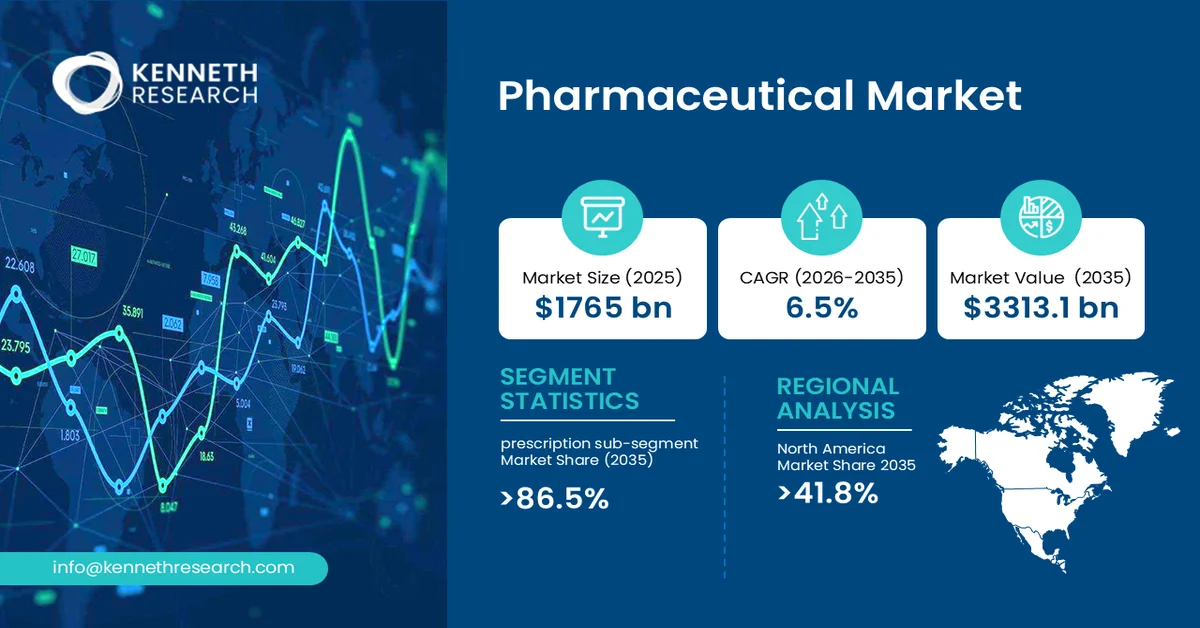
Pharmaceutical Market size was valued at USD 1765 billion in 2025 and is projected to reach USD 3313.1 billion by the end of 2035, rising at a CAGR of 6.5% during the forecast period, i.e., 2026-2035. In 2026, the industry size of the pharmaceutical is estimated at USD 1879.7 billion.
The primary growth driver of the pharmaceutical market is the increasing global demand for innovative therapeutics driven by the rising prevalence of chronic diseases, aging populations, expanding access to healthcare, and continuous advances in drug discovery technologies. Strong regulatory support for novel medicines and growing investments in pharmaceutical research further accelerate market expansion.
The pharmaceutical market comprises the global ecosystem involved in the discovery, development, manufacturing, distribution, and commercialization of medicinal products intended to prevent, diagnose, manage, and treat diseases in humans. It encompasses both prescription and non-prescription medicines across a broad range of therapeutic areas, including cardiovascular disorders, oncology, infectious diseases, metabolic disorders, neurological conditions, respiratory diseases, and rare diseases. The market includes branded and generic pharmaceuticals produced through conventional chemical synthesis as well as advanced biologics, vaccines, cell therapies, and gene therapies.
A defining characteristic of the pharmaceutical industry is its highly regulated environment, requiring rigorous clinical evaluation, quality assurance, and post-marketing pharmacovigilance to ensure the safety, efficacy, and quality of medicines. Continuous innovation in drug discovery, precision medicine, biologics, and digital technologies has significantly enhanced therapeutic outcomes and expanded treatment options. The pharmaceutical market plays a fundamental role in global healthcare systems by improving patient outcomes, reducing disease burden, supporting public health initiatives, and enabling sustainable healthcare delivery through ongoing therapeutic innovation.
Key Pharmaceutical Market Insights Summary:
Key Takeaways: Market Trends & Insights
- Pharmaceutical market projected to grow from USD 1765 billion in 2025 to USD 3313.1 billion by 2035 at a 6.5% CAGR.
- North America is projected to remain the leading regional market with a 41.8% share by 2035, supported by strong pharmaceutical innovation, advanced manufacturing capabilities, and a well-established regulatory framework.
- Prescription is expected to remain the leading type segment with an 86.5% market share, driven by increasing demand for innovative therapies, biologics, and specialty medicines for chronic and complex diseases.
- Branded pharmaceuticals are projected to witness robust growth owing to sustained investment in novel drug development, precision medicine, and expanding commercialization of advanced therapeutics.
- The market is benefiting from continuous advances in pharmaceutical research, expansion of biologics and gene therapies, digitalization of drug discovery and manufacturing, and increasing global investments in healthcare and pharmaceutical production.
Growth Drivers
- Growing prevalence of chronic diseases and age-related health conditions driving sustained demand for long-term pharmacological therapies.
- Increasing adoption of biologics, biosimilars, cell therapies, and gene therapies across multiple therapeutic areas.
- Rising investments in pharmaceutical research, strategic licensing agreements, and public-private collaborations.
- Expansion of digital health, artificial intelligence, and real-world evidence to improve drug discovery, clinical development, and post-market surveillance.
Challenges
- Escalating drug development costs and increasing regulatory complexity.
- Supply chain vulnerability and dependence on global manufacturing networks.
Pharmaceutical Market Overview & Supply Chain
The adoption of pharmaceuticals continues to increase globally as healthcare systems prioritize earlier diagnosis, chronic disease management, precision medicine, and improved patient outcomes. Advances in biologics, mRNA platforms, artificial intelligence-assisted drug discovery, and continuous manufacturing are accelerating therapeutic innovation, while increasingly harmonized regulatory pathways support faster access to high-value medicines. Governments are simultaneously strengthening essential medicine programs and pharmaceutical security to improve resilience against future public health emergencies. This expanding policy focus has reinforced the strategic importance of pharmaceutical manufacturing, supply continuity, and quality assurance across both developed and emerging economies. Reflecting this global commitment, the World Health Organization (WHO) reports that more than 150 countries have adopted national essential medicines lists based on the WHO Model List, demonstrating the widespread institutional integration of pharmaceutical products into national healthcare systems and procurement strategies.
The pharmaceutical market value chain begins with the sourcing of raw materials, including active pharmaceutical ingredients (APIs), excipients, biological materials, chemical intermediates, solvents, and specialized packaging components supplied by chemical manufacturers and biotechnology firms. These inputs undergo extensive research, formulation development, clinical validation, regulatory review, and commercial-scale manufacturing under stringent quality management systems and Good Manufacturing Practice (GMP) standards. Following production, pharmaceutical products are packaged, serialized, stored in controlled environments where required, and distributed through wholesalers, specialty distributors, logistics providers, retail pharmacies, hospital pharmacies, and digital pharmacy platforms. The principal end users include hospitals, clinics, ambulatory care centers, long-term care facilities, pharmacies, and patients receiving prescription or over-the-counter therapies. Key stakeholders throughout the value chain include research organizations, contract development and manufacturing organizations (CDMOs), pharmaceutical manufacturers, regulatory authorities, healthcare providers, payers, distributors, healthcare institutions, and procurement agencies that collectively ensure product quality, regulatory compliance, and uninterrupted medicine availability.
Pharmaceutical Market: Growth Drivers & Challenges
Growth Drivers:
- Accelerating innovation in novel drug development and regulatory approvals: Continuous innovation in pharmaceutical research is expanding the availability of advanced therapeutics for chronic, rare, infectious, and complex diseases. Investments in biologics, gene therapies, RNA-based medicines, precision therapeutics, and artificial intelligence-enabled drug discovery have strengthened research productivity and diversified treatment options. Regulatory agencies have also adopted science-based review pathways that facilitate timely evaluation of innovative medicines while maintaining rigorous safety and efficacy standards. The growing number of novel approvals encourages additional investment in research pipelines, strategic collaborations, and manufacturing capacity expansion. This innovation cycle enhances competition, broadens therapeutic choices for healthcare providers, and improves patient access to next-generation medicines. Over the long term, sustained regulatory support and scientific advancement are expected to accelerate the commercialization of increasingly personalized and targeted therapies, reinforcing the pharmaceutical market's role as a cornerstone of modern healthcare systems. Supporting this trend, the U.S. food and drug administration (FDA) reported that its center for drug evaluation and research (CDER) approved 50 novel drugs in 2024, reflecting continued innovation across multiple therapeutic categories.
- Expansion of advanced pharmaceutical manufacturing and global supply chain modernization: The pharmaceutical industry is undergoing a structural transformation as manufacturers modernize production capabilities to improve efficiency, resilience, and product quality. Investments in continuous manufacturing, automation, digital quality management, advanced analytics, and flexible production facilities enable faster scale-up of both conventional medicines and complex biologics. Simultaneously, companies are diversifying supplier networks and strengthening regional manufacturing footprints to reduce supply disruptions and improve medicine availability. The integration of digital technologies throughout manufacturing and logistics also enhances traceability, regulatory compliance, and inventory management. These developments improve operational resilience while supporting faster commercialization of innovative therapies. Looking ahead, increased adoption of smart manufacturing technologies, sustainable production practices, and geographically diversified supply chains is expected to strengthen pharmaceutical production capacity and support long-term industry growth amid evolving healthcare demands.
Challenges:
- Escalating drug development costs and regulatory complexity: The development of pharmaceutical products requires extensive preclinical research, multi-phase clinical trials, comprehensive regulatory documentation, and continuous post-marketing safety monitoring. As scientific standards evolve, manufacturers must generate increasingly robust evidence on product quality, efficacy, and long-term safety, extending development timelines and increasing financial risk. For innovative therapies such as biologics, gene therapies, and precision medicines, specialized manufacturing processes and stringent quality controls further raise commercialization costs. These factors create significant barriers for smaller biotechnology companies and increase dependence on strategic partnerships and external financing. Commercially, prolonged development cycles can delay product launches, shorten the effective period of market exclusivity, and reduce return on investment. Looking ahead, companies will increasingly rely on digital clinical development, adaptive trial designs, and collaborative regulatory engagement to improve development efficiency while maintaining compliance with evolving global regulatory requirements.
- Supply chain vulnerability and dependence on global manufacturing networks: The pharmaceutical industry relies on a highly interconnected global supply chain for active pharmaceutical ingredients, excipients, packaging materials, specialized equipment, and temperature-controlled logistics. Concentrated sourcing of critical inputs and dependence on geographically dispersed manufacturing facilities expose companies to disruptions arising from geopolitical tensions, trade restrictions, transportation bottlenecks, natural disasters, and evolving regulatory requirements. Even localized disruptions can affect production schedules, inventory availability, and timely delivery of essential medicines across multiple markets. Commercially, supply interruptions increase operational costs, complicate procurement planning, and may require manufacturers to qualify alternative suppliers or establish redundant production capacity. Over the long term, pharmaceutical companies are expected to prioritize supplier diversification, regional manufacturing expansion, digital supply chain visibility, and strategic inventory management to strengthen resilience and ensure uninterrupted product availability.
Pharmaceutical Market Size and Forecast:
| Report Attribute | Details |
|---|---|
| Base Year |
2025 |
| Forecast Year |
2026-2035 |
| CAGR |
6.5% |
| Base Year Market Size (2025) |
USD 1765 billion |
| Forecast Year Market Size (2035) |
USD 3313.1 billion |
| Regional Scope |
|
Pharmaceutical Market Segmentation Analysis:
Type Segment Analysis
The prescription sub-segment dominates largest share of 86.5% pharmaceutical market due to its indispensable role in treating chronic, acute, complex, and specialty medical conditions that require physician oversight and regulatory authorization. Demand continues to rise with the increasing use of targeted therapies, biologics, oncology medicines, cardiovascular drugs, immunotherapies, and treatments for metabolic and neurological disorders. Unlike over-the-counter medicines, prescription products are supported by clinical guidelines, reimbursement programs, and hospital formularies, making them the preferred choice for managing conditions requiring long-term medical supervision. On the supply side, pharmaceutical manufacturers continue to prioritize prescription medicines because they offer greater opportunities for innovation, intellectual property protection, and specialized therapeutic development. Continuous investment in advanced drug discovery, precision medicine, and specialty pharmaceutical manufacturing further strengthens this segment's leadership. Looking ahead, expanding access to personalized therapies, wider adoption of biologics and advanced therapeutics, and ongoing regulatory support for innovative medicines are expected to reinforce the long-term dominance of prescription pharmaceuticals across global healthcare systems.
Supporting this trend, the OECD health at a Glance 2025 reports that prescription medicines accounted for more than 75% of total retail pharmaceutical expenditure in most OECD countries in 2023, highlighting the dominant role of prescription therapies in pharmaceutical consumption and healthcare delivery.
Product Segment Analysis
The branded sub-segment is projected to experience sustained growth owing to its strong position in the commercialization of innovative medicines, specialty therapeutics, biologics, and first-in-class drug products. Demand is being driven by the continued introduction of novel therapies addressing unmet clinical needs in oncology, immunology, rare diseases, and other complex therapeutic areas where branded products often remain the standard of care. Healthcare providers frequently adopt branded medicines because they are supported by extensive clinical evidence, post-marketing safety data, physician familiarity, and comprehensive patient support programs. On the supply side, pharmaceutical companies continue to invest heavily in research and development, intellectual property protection, advanced manufacturing technologies, and lifecycle management strategies that reinforce branded product portfolios. Looking ahead, continued innovation in precision medicine, cell and gene therapies, and next-generation biologics is expected to strengthen the growth trajectory of branded pharmaceuticals, particularly as manufacturers expand indications and introduce differentiated therapies for complex diseases.
Supporting this outlook, the U.S. food and drug administration (FDA) reported that it approved 65 novel drugs through the center for drug evaluation and research (CDER) in 2023, reflecting a robust pipeline of innovative branded medicines entering the market across diverse therapeutic areas.
Our in-depth analysis of the pharmaceutical market includes the following segments:
|
Segment |
Sub-segment |
|
Type |
|
|
Product |
|
Pharmaceutical Market Regional Insights:
North America Market Trends & Insights:
North America is projected to account for 41.8% of the pharmaceutical market in 2035, maintaining its leadership through a highly developed pharmaceutical innovation ecosystem, advanced manufacturing infrastructure, strong intellectual property protection, and well-established regulatory frameworks.
The region benefits from substantial investments in pharmaceutical research, biotechnology, clinical development, and advanced manufacturing technologies that accelerate the commercialization of innovative medicines. A mature healthcare system, widespread adoption of specialty therapeutics, and robust reimbursement mechanisms further support pharmaceutical consumption across diverse therapeutic areas. Additionally, strategic public and private investments aimed at strengthening pharmaceutical manufacturing capacity and supply chain resilience continue to reinforce North America's competitive position. The presence of leading multinational pharmaceutical companies, contract development and manufacturing organizations, and world-class research institutions further enhances the region's ability to develop, manufacture, and distribute high-value pharmaceutical products on a global scale.
Supporting this leadership, the U.S. food and drug administration (FDA) highlights that all drugs manufactured for the u.s. market—whether produced domestically or internationally—must comply with the same rigorous fda safety and current good manufacturing practice (cgmp) standards, reinforcing North America's strong regulatory environment and commitment to pharmaceutical quality.
The United States serves as the primary growth engine for the regional pharmaceutical industry through its extensive research capabilities, strong venture capital ecosystem, advanced biopharmaceutical manufacturing base, and continuous pipeline of innovative therapies. Collaboration among pharmaceutical manufacturers, academic research institutions, biotechnology companies, and federal agencies accelerates drug discovery and regulatory advancement. Federal initiatives focused on strengthening domestic pharmaceutical manufacturing and supply chain resilience further support long-term industry competitiveness.
Canada complements regional leadership through its expanding life sciences sector, research-intensive universities, favorable environment for clinical research, and growing investments in biopharmaceutical manufacturing. The country's regulatory alignment with international standards, skilled scientific workforce, and increasing collaboration between public institutions and industry participants contribute to pharmaceutical innovation, production capacity, and improved access to advanced therapies across North America.
Asia Pacific Market Trends & Insights:
Asia Pacific is emerging as one of the most dynamic regions in the pharmaceutical market, supported by expanding healthcare infrastructure, rising pharmaceutical manufacturing capabilities, growing demand for innovative therapies, and increasing access to healthcare services. Governments across the region are prioritizing pharmaceutical self-reliance, domestic manufacturing, research and development, and regulatory modernization to strengthen healthcare resilience and improve medicine availability. The region has also become a preferred destination for pharmaceutical production and clinical research due to its skilled workforce, expanding manufacturing ecosystem, and cost-efficient operations. Increased investment in biotechnology, biologics, vaccine development, digital health, and advanced manufacturing technologies is accelerating industry transformation. As healthcare expenditure continues to rise and regulatory systems become more harmonized with international standards, Asia Pacific is expected to present significant opportunities for pharmaceutical manufacturers seeking to expand production, diversify supply chains, and introduce innovative therapies into rapidly developing healthcare markets.
Japan remains a leading pharmaceutical innovation hub, characterized by advanced research capabilities, a well-established regulatory framework, and strong collaboration between academia, healthcare institutions, and pharmaceutical manufacturers. The country's emphasis on precision medicine, regenerative medicine, and high-value specialty therapeutics continues to encourage innovation and commercialization of advanced pharmaceutical products. Ongoing investments in digital healthcare integration and pharmaceutical research further strengthen its competitive position within the regional market.
China plays a pivotal role in the regional pharmaceutical ecosystem through its large-scale manufacturing capacity, expanding biotechnology sector, and increasing focus on innovative drug development. Regulatory reforms, modernization of pharmaceutical quality systems, and growing investment in research infrastructure have accelerated the development and commercialization of advanced medicines. The country is also strengthening domestic production capabilities while expanding international collaboration in pharmaceutical research, contract manufacturing, and clinical development, positioning it as a major contributor to the future growth of the Asia Pacific pharmaceutical market.
Leading Companies Operating in the Global Pharmaceutical Market:
Here is a list of upstream, downstream, and key players operating in the global pharmaceutical market competitive ecosystem:
- Pfizer Inc.(United States)
- Company Overview
- Business Strategy
- Key Product Offerings
- Financial Performance
- Key Performance Indicators
- Risk Analysis
- Recent Development
- Regional Presence
- SWOT Analysis
- Roche(Switzerland)
- Merck & Co., Inc.(United States)
- Johnson & Johnson Innovative Medicine(United States)
Recent Developments
- July 2025 : Novartis announced the approval of Coartem® Baby, the first malaria medicine specifically approved for newborn babies and young infants. The approval supports broader access to age-appropriate antimalarial treatment in endemic regions.
- October 2025 :Novartis entered into an agreement to acquire Avidity Biosciences, adding its RNA-targeting therapeutic platform and late-stage neuromuscular disease programs to the company's neuroscience pipeline.
Frequently Asked Question
In 2025, the pharmaceutical market exceeded USD 1765 billion.
The pharmaceutical market is projected to reach USD 3313.1 billion by the end of 2035, expanding at a CAGR of 6.5% over the forecast period (2026-2035).
The major players in the market are Pfizer Inc., Roche, Merck & Co., Inc., Johnson & Johnson Innovative Medicine, Novartis AG, AstraZeneca PLC, Sanofi, Eli Lilly and Company, Takeda Pharmaceutical Company, and Dr. Reddy's Laboratories, among others.
In the type segment, the prescription sub-segment is anticipated to capture the largest market share of 86.5% in the future and exhibit lucrative growth opportunities during 2026–2035. This growth trajectory is largely attributed to the increasing adoption of innovative prescription therapies, biologics, and specialty medicines for chronic and complex diseases.
North America is projected to hold the largest market share of 41.8% by the end of 2035 and provide more business opportunities in the future. Continuous investments in pharmaceutical research, advanced manufacturing, and innovation across the U.S. and Canada are fostering the region's dominance.
Why Choose Kenneth Research ?
-
Insight with Impact : We don’t just gather data — we uncover stories, trends, and opportunities that fuel business growth.
-
Experts Who Get It : Our team speaks your industry’s language and knows what really matters to your customers and market.
-
Custom-Built for You : Forget one-size-fits-all. We craft research and consulting solutions as unique as your business vision.
-
Partners, Not Just Providers : We work with you, not for you — collaborating closely to turn insights into smart, strategic moves.
-
Results That Speak : Our work powers brands, startups, and industry leaders alike — with a track record of ideas that work in the real world.
Report ID: 1056 |
Published Date: 06 Aug 2026 |
Report Format: |
Delivery Timeline: 48-72 Business Hours

Copyright © 2025 Kenneth Research. All rights reserved. Terms of Use | Privacy Policy
