Report ID: 1153 |
Published Date: 24 Aug 2026 |
Report Format: |
Delivery Timeline: 48-72 Business Hours
Packaging Adhesives Market Outlook:
Packaging Adhesives Market size was valued at USD 20.9 billion in 2025 and is projected to reach USD 36.4 billion by the end of 2035, rising at a CAGR of 5.7% during the forecast period, i.e., 2026-2035. In 2026, the industry size of the packaging adhesives is estimated at USD 22.1 billion.
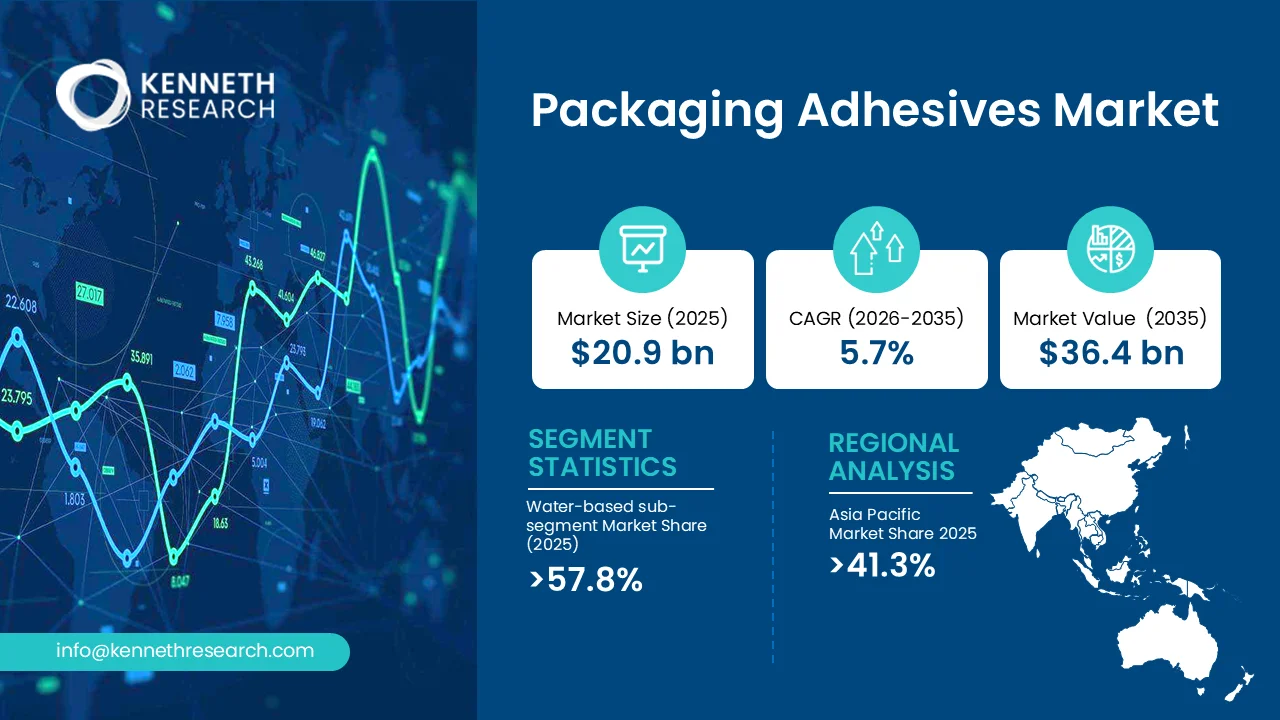
The primary growth driver for the packaging adhesives market is the expanding demand for packaged food, consumer goods, pharmaceuticals, and e-commerce shipments, which require reliable, high-performance bonding solutions. Governments are also strengthening packaging sustainability frameworks, encouraging wider adoption of recyclable-compatible, water-based, and low-emission adhesive technologies across packaging applications.
The packaging adhesives market comprises adhesive formulations specifically designed to bond, seal, laminate, label, and assemble packaging materials such as paperboard, corrugated boxes, flexible films, cartons, labels, pouches, and specialty packaging substrates. These adhesives include water-based, hot-melt, solvent-based, and reactive technologies that are selected according to substrate compatibility, production speed, bond strength, food-contact requirements, and environmental performance.
Packaging adhesives are characterized by rapid curing, high adhesion to diverse materials, resistance to temperature and moisture variations, and compatibility with automated packaging lines. Modern formulations increasingly emphasize low volatile organic compound (VOC) emissions, recyclability compatibility, and compliance with food-contact and environmental regulations, supporting the industry's transition toward more sustainable packaging systems. OECD policy discussions on sustainable flexible food-grade packaging further highlight the growing importance of adhesive selection in enabling recyclable and environmentally responsible packaging designs.
Industrially, packaging adhesives are indispensable across food and beverage, pharmaceuticals, personal care, consumer goods, logistics, and e-commerce sectors, where they ensure package integrity, product protection, efficient manufacturing, and supply chain reliability. Their role continues to expand as manufacturers pursue lightweight packaging, improved operational efficiency, and sustainable packaging innovations aligned with evolving regulatory and consumer expectations.
Key Packaging Adhesives Market Insights Summary:
Key Takeaways: Market Trends & Insights
- Packaging Adhesives Market is projected to grow from USD 22.1 billion in 2026 to USD 36.4 billion by 2035, registering a CAGR of 5.7% during the forecast period
- Water-based technology led the market with a 57.8% share in 2025, driven by increasing adoption of sustainable, low-emission, and recyclable packaging solutions across major end-use industries
- Asia Pacific accounted for the largest regional share of 41.3% in 2025, supported by strong packaging manufacturing capabilities, expanding consumer goods production, and industrial growth in China and India
- The Food and Beverage end-use industry is expected to record the fastest growth, fueled by rising consumption of packaged food, expansion of modern retail, and increasing demand for food-safe and high-performance packaging adhesives
- Continuous advancements in recyclable-compatible adhesive formulations, packaging automation, and environmentally compliant technologies are strengthening long-term growth opportunities across food, pharmaceutical, consumer goods, and e-commerce packaging applications
Market Drivers
- Expansion of sustainable packaging and circular economy initiatives
- Automation and high-speed packaging manufacturing
- Rising demand for flexible packaging across consumer and industrial applications
- Increasing innovation in bio-based, low-VOC, and food-safe adhesive technologies
Challenges
- Raw material availability and feedstock price volatility
- Increasing complexity of recycling-compatible adhesive development
Packaging Adhesives Market Overview & Supply Chain
Global adoption of packaging adhesives is accelerating as manufacturers prioritize package durability, production efficiency, recyclability, and compliance with evolving sustainability regulations. Adhesive technologies are becoming increasingly important for lightweight flexible packaging, high-speed converting operations, and food-safe packaging formats that reduce material consumption while maintaining seal integrity. Regulatory initiatives promoting circular economy practices are also encouraging the development of adhesive formulations compatible with recycling processes and lower-emission manufacturing. The industrial significance of packaging is reflected in recent government-backed data: the OECD reports that almost one-third of global annual plastics use is attributable to packaging, underscoring the critical role of packaging materials and associated adhesive systems across consumer and industrial supply chains. This growing dependence on packaging continues to stimulate innovation in water-based, hot-melt, and specialty adhesive technologies that balance performance with environmental requirements.
The packaging adhesives industry begins with the procurement of raw materials such as acrylic polymers, ethylene vinyl acetate (EVA), polyurethane precursors, natural and synthetic resins, tackifiers, waxes, plasticizers, additives, and specialty chemicals sourced from petrochemical and bio-based feedstock suppliers. Adhesive manufacturers formulate these inputs into water-based, hot-melt, solvent-based, and reactive products tailored for specific packaging substrates and production environments. Following formulation, products undergo quality validation, regulatory compliance testing, and packaging before being distributed through direct sales networks, specialty chemical distributors, and regional channel partners. Downstream integration involves converters, corrugated box manufacturers, flexible packaging producers, label manufacturers, and carton fabricators that incorporate adhesives into automated packaging operations. End users span food and beverage, pharmaceuticals, personal care, consumer goods, e-commerce, logistics, and industrial packaging sectors. Major stakeholders include raw material suppliers, adhesive formulators, equipment manufacturers, packaging converters, brand owners, logistics providers, retailers, regulatory agencies, and recycling ecosystem participants, all of whom influence product innovation, sustainability performance, and supply chain resilience.
Packaging Adhesives Market: Growth Drivers & Challenges
Growth Drivers:
- Expansion of sustainable packaging and circular economy initiatives: Sustainability objectives are reshaping packaging design, driving greater demand for adhesive technologies that support recyclable, lightweight, and resource-efficient packaging formats. Brand owners and packaging converters are increasingly selecting water-based and other environmentally compatible adhesive systems that enable fiber recovery, reduce emissions during production, and improve compatibility with recycling processes. Regulatory frameworks promoting circular material use are accelerating investment in adhesive formulations that maintain bond performance without compromising recyclability. The industrial impact extends beyond compliance, as manufacturers seek to optimize packaging performance while meeting evolving customer and retailer sustainability expectations. Looking ahead, continued innovation in bio-based raw materials, low-emission chemistries, and recycling-compatible adhesive solutions is expected to strengthen collaboration across the packaging value chain.
- Automation and high-speed packaging manufacturing: The growing adoption of automated packaging lines across food and beverage, pharmaceuticals, consumer goods, and e-commerce industries is increasing demand for high-performance adhesive technologies capable of supporting continuous, high-speed production. Modern packaging facilities require adhesives with rapid setting characteristics, consistent viscosity, and reliable bonding across diverse substrates to minimize downtime and maintain production efficiency. These performance requirements are encouraging manufacturers to develop advanced formulations compatible with automated dispensing equipment and evolving packaging materials. As production systems become more digitally integrated, adhesive suppliers are also emphasizing process consistency, predictive quality control, and application-specific customization. Over the long term, greater automation, smart manufacturing practices, and increased adoption of lightweight packaging formats are expected to elevate the importance of precision-engineered adhesive systems, creating opportunities for technology differentiation and long-term partnerships between adhesive producers, packaging converters, and consumer goods manufacturers.
Challenges:
- Volatility in raw material availability and feedstock pricing: The packaging adhesives industry remains highly dependent on petrochemical derivatives, specialty resins, polymers, tackifiers, and performance additives, making manufacturers vulnerable to fluctuations in feedstock availability and pricing. Supply disruptions caused by geopolitical developments, refinery outages, transportation constraints, and changing trade policies can significantly affect production costs and procurement timelines. This volatility complicates long-term sourcing strategies and limits manufacturers' ability to maintain stable pricing for customers. Commercially, adhesive producers often face margin pressure when raw material cost increases cannot be immediately transferred through the value chain, particularly under long-term supply agreements. Smaller manufacturers are especially exposed due to limited purchasing leverage and inventory flexibility. Looking ahead, companies are expected to diversify supplier networks, expand regional sourcing capabilities, and invest in alternative bio-based raw materials to improve supply resilience and reduce dependence on conventional petrochemical feedstocks.
- Increasing complexity of recycling-compatible adhesive development: The transition toward circular packaging systems has increased technical expectations for adhesive performance, requiring products to deliver strong bonding while remaining compatible with recycling and material recovery processes. Achieving this balance is challenging because adhesive formulations must satisfy diverse substrate combinations, food-contact regulations, production efficiency requirements, and end-of-life sustainability objectives simultaneously. Product development cycles have consequently become longer and more resource intensive, requiring continuous research, testing, and validation. From a commercial perspective, these higher development costs can delay product commercialization and create barriers for companies with limited research capabilities. Differences in recycling infrastructure and regulatory requirements across regions further complicate product standardization and market expansion. In the coming years, collaborative innovation among adhesive manufacturers, packaging converters, brand owners, and recycling organizations is expected to become increasingly important for overcoming technical compatibility challenges and accelerating the adoption of sustainable packaging solutions.
Packaging Adhesives Market Size and Forecast:
| Report Attribute | Details |
|---|---|
| Base Year |
2025 |
| Forecast Year |
2026-2035 |
| CAGR |
5.7% |
| Base Year Market Size (2025) |
USD 20.9 billion |
| Forecast Year Market Size (2035) |
USD 36.4 billion |
| Regional Scope |
|
Packaging Adhesives Market Segmentation Analysis:
Technology Segment Analysis
In the technology segment, the Water-based sub-segment is anticipated to capture the largest market share of 57.8% by the end of 2025.
Water-based technology dominates the packaging adhesives market because it aligns with the packaging industry's increasing emphasis on sustainability, regulatory compliance, and operational efficiency. These adhesives offer strong bonding performance for paper, paperboard, corrugated packaging, labels, and flexible packaging while reducing volatile organic compound (VOC) emissions compared with many conventional alternatives. Demand is being reinforced by brand owners seeking recyclable packaging solutions and converters modernizing production lines to accommodate environmentally compatible materials. On the supply side, manufacturers continue to expand portfolios of water-based formulations that deliver improved heat resistance, faster drying, and compatibility with high-speed packaging equipment, enabling wider industrial adoption across food, consumer goods, and pharmaceutical packaging. The U.S. Department of Commerce, Bureau of the Census, reported through the USDA Economic Research Service, that food and beverage manufacturing plants accounted for nearly USD 1.019 trillion in sales, shipment values, and revenue in 2021, highlighting the scale of packaging-intensive manufacturing that supports demand for reliable adhesive technologies.
End-Use Industry Segment Analysis
The Food and Beverage is projected to grow as the second-largest segment in the packaging adhesives market due to four converging demand drivers.
The food and beverage segment is projected to witness the fastest growth in the packaging adhesives market as manufacturers continue to increase the use of advanced packaging solutions that enhance product safety, extend shelf life, and improve supply chain efficiency. Rising demand for convenience foods, ready-to-eat meals, beverages, and packaged fresh products is encouraging packaging converters to adopt high-performance adhesive systems compatible with flexible packaging, cartons, labels, and corrugated boxes. On the supply side, adhesive manufacturers are introducing formulations that support food-contact compliance, faster production speeds, and compatibility with recyclable packaging materials, enabling converters to meet both operational and sustainability objectives.
Our in-depth analysis of the global packaging adhesives market includes the following segments:
|
Segment |
Sub-segment |
|
Technology |
|
|
Resin Chemistry |
|
|
Application |
|
|
End-Use Industry |
|
Packaging Adhesives Market Regional Insights:
Asia Pacific Market Trends & Insights:
Asia Pacific packaging adhesives market is projected to hold the largest revenue share of 41.3% by the end of 2025.
The region's dominance is supported by its extensive packaging manufacturing ecosystem, expanding consumer goods production, strong food processing industry, and rapidly growing e-commerce activities. Packaging converters across the region continue to invest in advanced adhesive technologies that improve production efficiency, enhance packaging performance, and support sustainability objectives. Favorable industrial policies, expanding manufacturing capacity, and increasing investments in modern packaging infrastructure have strengthened regional demand for water-based and other environmentally compatible adhesive solutions. The presence of integrated supply chains for paper, plastics, chemicals, and packaging materials further reinforces Asia Pacific's leadership by enabling cost-effective production and efficient distribution across domestic and export markets.
China remains the principal growth engine within the region owing to its large-scale manufacturing base, well-established packaging industry, and continuous investment in industrial modernization.
India is emerging as another high-growth market, supported by expanding food processing, pharmaceutical manufacturing, organized retail, and e-commerce sectors that require reliable packaging solutions. Together, China and India are expected to remain central to regional innovation, production expansion, and long-term demand for advanced packaging adhesive technologies.
North America Market Trends & Insights:
North America represents a strategically important market for packaging adhesives due to its advanced packaging industry, high adoption of automated manufacturing technologies, and strong demand from food and beverage, pharmaceutical, personal care, and e-commerce sectors. The region places significant emphasis on sustainable packaging solutions, encouraging adhesive manufacturers to develop formulations that support recyclability, lower emissions, and compliance with evolving environmental standards. Investments in smart manufacturing, digital production systems, and high-speed packaging equipment continue to increase demand for high-performance adhesive technologies capable of delivering consistent bonding across diverse packaging substrates. Future opportunities are expected to arise from the growing use of bio-based adhesive chemistries, lightweight packaging materials, and circular economy initiatives that require adhesives compatible with recycling and material recovery processes. These trends are fostering collaboration among adhesive suppliers, packaging converters, consumer goods manufacturers, and recycling stakeholders to develop next-generation packaging solutions.
The United States remains the largest contributor to the regional market, supported by its extensive food processing, pharmaceutical, consumer goods, and logistics industries. Continuous investments in packaging automation, research and development, and sustainable packaging innovation reinforce the country's leadership in adhesive technology adoption.
Canada complements regional growth through its expanding food processing and consumer packaged goods industries, alongside increasing emphasis on environmentally responsible packaging materials and manufacturing practices. Canadian packaging manufacturers are progressively adopting advanced adhesive formulations that improve production efficiency while supporting sustainability objectives. As regulatory expectations continue to evolve across North America, both countries are expected to remain key markets for innovative packaging adhesive technologies that balance operational performance with environmental compliance.
Leading Companies Operating in the Global Packaging Adhesives Market:
Here is a list of upstream, downstream, and key players operating in the global packaging adhesives market competitive ecosystem:
- Henkel AG & Co. KGaA (Germany)
- Company Overview
- Business Strategy
- Key Product Offerings
- Financial Performance
- Key Performance Indicators
- Risk Analysis
- Recent Development
- Regional Presence
- SWOT Analysis
- H.B. Fuller Company (United States)
- Bostik SA (Arkema Group) (France)
- Avery Dennison Corporation (United States)
- Dymax Corporation (United States)
- Jowat SE (Germany)
Recent Developments
- In August 2025, Henkel Adhesive Technologies introduced a new generation of its Darex COV sealants for metal packaging that are free from phthalate-based plasticizers. The phthalate-free PVC-based compounds provide reliable sealing with improved health and environmental credentials, complying with current and future regulations including the European REACH regulation. The Darex COV 73 formulation also reduces curing temperature, cutting energy consumption and carbon footprint. The product was successfully market-tested in a 2024 pilot project with Swedish metal packaging manufacturer Emballator.
- In April 2026, BASF showcased its recycling-friendly adhesive portfolio at interpack 2026, featuring water-based Epotal® lamination adhesives for easy separation of materials in PET-based multilayer packaging and label adhesives designed for easy removal from PET bottles and glass containers. The company highlighted that its acResin® UV 3532 acrylic hotmelt has been approved by RecyClass as compatible with established European PET recycling processes.
Frequently Asked Question
In 2025, the packaging adhesives market exceeded USD 20.9 billion.
The packaging adhesives market is projected to reach USD 36.4 billion by the end of 2035, expanding at a CAGR of 5.7% over the forecast period (2026-2035).
The major players in the market are Henkel AG & Co. KGaA (Germany), H.B. Fuller Company (United States), Bostik SA (Arkema Group) (France), Avery Dennison Corporation (United States), Dymax Corporation (United States), Jowat SE (Germany), and others.
In the Technology segment, the Water-based sub-segment is anticipated to capture the largest market share of 57.8% in the future and exhibit lucrative growth opportunities during 2026–2035. This growth trajectory is largely attributed to increasing demand for sustainable, low-emission, and recyclable packaging solutions across multiple end-use industries.
Asia Pacific is projected to hold the largest market share of 41.3% by the end of 2025 and provide more business opportunities in the future. Continuous investments in packaging manufacturing, industrial expansion, and sustainable packaging innovation across China and India are fostering the region's dominance.
Why Choose Kenneth Research ?
-
Insight with Impact : We don’t just gather data — we uncover stories, trends, and opportunities that fuel business growth.
-
Experts Who Get It : Our team speaks your industry’s language and knows what really matters to your customers and market.
-
Custom-Built for You : Forget one-size-fits-all. We craft research and consulting solutions as unique as your business vision.
-
Partners, Not Just Providers : We work with you, not for you — collaborating closely to turn insights into smart, strategic moves.
-
Results That Speak : Our work powers brands, startups, and industry leaders alike — with a track record of ideas that work in the real world.
Report ID: 1153 |
Published Date: 24 Aug 2026 |
Report Format: |
Delivery Timeline: 48-72 Business Hours

Copyright © 2025 Kenneth Research. All rights reserved. Terms of Use | Privacy Policy
