Report ID: 1037 |
Published Date: 28 Jul 2026 |
Report Format: |
Delivery Timeline: 48-72 Business Hours
Ovarian Cancer Diagnostics Market Outlook:
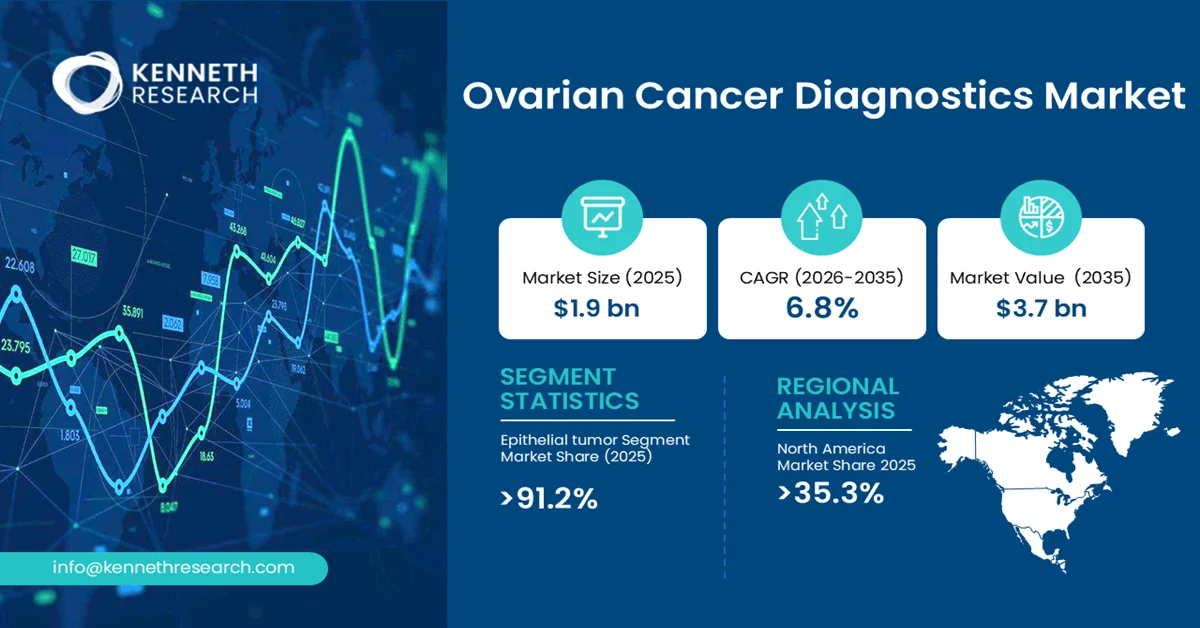
Ovarian Cancer Diagnostics Market size was valued at USD 1.9 billion in 2025 and is projected to reach USD 3.7 billion by the end of 2035, rising at a CAGR of 6.8% during the forecast period, i.e., 2026–2035. In 2026, the industry size of the ovarian cancer diagnostics is estimated at USD 2.1 billion.
The growing implementation of organized ovarian cancer screening initiatives for high-risk populations, combined with expanding adoption of molecular diagnostics and biomarker-based testing in clinical practice, is accelerating the ovarian cancer diagnostics market. Continuous improvements in laboratory technologies are enabling earlier disease detection, supporting timely treatment decisions and improved patient management.
The ovarian cancer diagnostics market comprises diagnostic products, laboratory technologies, imaging modalities, biomarker assays, molecular testing platforms, and pathology services used to identify, classify, confirm, and monitor ovarian cancer across different clinical settings. These diagnostic solutions support the detection of malignant ovarian tumors through blood-based biomarker evaluation, tissue biopsy analysis, genetic and genomic testing, histopathology, imaging examinations, and complementary laboratory investigations. The market includes instruments, reagents, consumables, software, and specialized diagnostic services deployed by hospitals, diagnostic laboratories, academic institutions, and cancer care centers to improve diagnostic accuracy and clinical decision-making.
Ovarian cancer diagnostics play a vital role in oncology by facilitating disease identification, subtype differentiation, treatment planning, therapeutic response monitoring, and recurrence surveillance. Advances in molecular pathology, precision medicine, and biomarker discovery have strengthened the integration of personalized diagnostic approaches into routine clinical workflows. The market is strategically important to healthcare systems because accurate diagnosis supports optimized patient management, multidisciplinary cancer care, clinical research, pharmaceutical development, and the broader adoption of targeted oncology therapies, contributing to improved healthcare efficiency and clinical outcomes.
Key Ovarian Cancer Diagnostics Market Insights Summary:
Key Takeaways: Market Trends & Insights
- North America led the ovarian cancer diagnostics market with a 35.3% share in 2025, driven by advanced oncology infrastructure and precision diagnostic adoption
- The epithelial tumor segment accounted for 91.2% of the market in 2025, supported by high demand for biomarker testing and molecular diagnostics
- The market was valued at USD 1.9 Billion in 2025 and is projected to reach USD 3.7 Billion by 2035
- The ovarian cancer diagnostics market is expected to expand at a 6.8% CAGR during 2026–2035, fueled by advances in precision oncology and laboratory automation
- Hospital Laboratories are projected to witness strong growth through 2035 owing to increasing investments in molecular testing and integrated diagnostic workflows
Market Drivers
- Growth in molecular and genomic diagnostic testing adoption
- Expansion of laboratory automation and digital pathology integration
- Increasing development of companion diagnostics for targeted oncology therapies
- Rising investment in precision medicine and personalized cancer care initiatives
Challenges
- High cost and limited accessibility of advanced diagnostic technologies
- Diagnostic complexity and variability in clinical interpretation
Ovarian Cancer Diagnostics Market Overview & Supply Chain
The adoption of ovarian cancer diagnostics is increasing globally as healthcare systems prioritize earlier cancer detection, precision oncology, and personalized treatment planning. Advances in molecular diagnostics, biomarker assays, genetic testing, digital pathology, and high-resolution imaging have strengthened clinicians' ability to characterize disease subtypes and guide targeted therapies. Growing investments in laboratory modernization, expanded access to genomic testing, and the integration of multidisciplinary oncology care are further supporting diagnostic adoption across hospitals and specialized cancer centers. Regulatory agencies and public health organizations are also emphasizing timely diagnosis to improve patient outcomes and optimize healthcare resource utilization.
The ovarian cancer diagnostics value chain begins with the procurement of specialized raw materials and inputs, including antibodies, diagnostic reagents, assay kits, sequencing chemicals, imaging components, pathology consumables, laboratory plastics, and software algorithms used for data interpretation. These materials are supplied by biotechnology companies, reagent manufacturers, medical device producers, and specialized chemical suppliers. Diagnostic manufacturers integrate these components into biomarker assays, molecular diagnostic platforms, imaging systems, and pathology solutions while ensuring compliance with quality management and regulatory standards. Products are distributed through medical device distributors, laboratory supply networks, hospital procurement organizations, and direct commercial channels to healthcare providers. The primary end users include hospital laboratories, independent diagnostic laboratories, oncology centers, academic medical institutions, and research organizations. Major stakeholders across the value chain comprise reagent suppliers, diagnostic technology developers, equipment manufacturers, healthcare providers, regulatory authorities, clinical researchers, distributors, reimbursement agencies, and pharmaceutical companies collaborating on companion diagnostics and precision oncology initiatives.
Ovarian Cancer Diagnostics Market: Growth Drivers & Challenges
Growth Drivers:
- Expansion of Genetic Testing and Precision Oncology Programs: The increasing adoption of genetic testing and precision oncology is strengthening the demand for ovarian cancer diagnostics by enabling earlier risk identification, accurate tumor characterization, and individualized treatment selection. Clinical laboratories are integrating molecular assays with conventional diagnostic workflows to identify hereditary mutations associated with ovarian cancer, allowing physicians to make informed therapeutic decisions and improve disease management. This transition is encouraging healthcare providers to invest in advanced sequencing platforms, biomarker assays, and companion diagnostics while supporting collaborations between diagnostic developers and pharmaceutical companies. The long-term impact is expected to include broader integration of artificial intelligence-assisted pathology, multi-gene testing panels, and personalized oncology pathways.
- Increasing Integration of Advanced Laboratory Automation: The modernization of clinical laboratory infrastructure is accelerating the adoption of ovarian cancer diagnostics by improving testing efficiency, analytical consistency, and workflow standardization. Automated sample preparation, digital pathology, integrated laboratory information systems, and high-throughput analyzers enable laboratories to process larger testing volumes while reducing turnaround times and minimizing manual variability. These technological improvements support multidisciplinary cancer care by providing clinicians with reliable diagnostic information that facilitates treatment planning and disease monitoring. Continuous innovation in diagnostic software, artificial intelligence-assisted image interpretation, and cloud-enabled laboratory management is expected to further optimize operational performance. As healthcare providers increasingly prioritize precision diagnostics and standardized laboratory practices, manufacturers are expanding portfolios with interoperable platforms capable of supporting complex oncology testing requirements across diverse clinical environments.
Challenges:
- High Cost and Limited Accessibility of Advanced Diagnostic Technologies: The widespread adoption of advanced ovarian cancer diagnostic technologies is constrained by the substantial costs associated with molecular testing platforms, next-generation sequencing systems, specialized imaging equipment, and highly trained laboratory personnel. Many healthcare providers, particularly those operating in resource-constrained settings, face financial barriers that limit investment in sophisticated diagnostic infrastructure. This disparity affects the availability of comprehensive diagnostic services and contributes to uneven access to precision oncology across different healthcare systems. Commercially, manufacturers encounter slower procurement cycles, reimbursement uncertainties, and extended return-on-investment periods when introducing premium diagnostic solutions. Looking ahead, broader adoption will depend on improving affordability, expanding reimbursement coverage, and developing cost-efficient diagnostic platforms capable of delivering high analytical performance without significantly increasing healthcare expenditure.
- Diagnostic Complexity and Variability in Clinical Interpretation: Ovarian cancer presents significant diagnostic challenges because of its heterogeneous disease characteristics, overlapping clinical manifestations, and the need to combine multiple diagnostic modalities for accurate assessment. Variability in biomarker expression, imaging findings, pathology interpretation, and genetic testing results can complicate diagnostic decision-making, requiring multidisciplinary expertise and standardized clinical protocols. These complexities increase operational demands on laboratories and healthcare providers while extending diagnostic workflows in certain cases. From a commercial perspective, diagnostic developers must continually validate new technologies across diverse patient populations and regulatory environments, increasing development costs and time to market. Future market expansion will rely on greater harmonization of diagnostic guidelines, improved clinical decision-support tools, and broader adoption of integrated testing approaches that enhance consistency and diagnostic confidence.
Ovarian Cancer Diagnostics Market Size and Forecast:
| Report Attribute | Details |
|---|---|
| Base Year |
2025 |
| Forecast Year |
2026-2035 |
| CAGR |
6.8% |
| Base Year Market Size (2025) |
USD 1.9 billion |
| Forecast Year Market Size (2035) |
USD 3.7 billion |
| Regional Scope |
|
Ovarian Cancer Diagnostics Market Segmentation Analysis:
Cancer Segment Analysis
In the cancer segment, the epithelial tumor sub-segment is anticipated to capture the largest market share of 91.2% by the end of 2025.
The epithelial tumor segment dominates the ovarian cancer diagnostics market because it represents the most clinically significant form of ovarian cancer, requiring comprehensive diagnostic evaluation throughout the patient care pathway. Demand for diagnostic solutions is driven by the need for accurate histopathological classification, biomarker assessment, molecular profiling, and imaging-based confirmation to support timely therapeutic decision-making. Healthcare providers increasingly adopt integrated diagnostic approaches combining pathology, immunohistochemistry, genomic testing, and advanced laboratory techniques to improve diagnostic precision for epithelial tumors. On the supply side, diagnostic manufacturers continue to expand portfolios with standardized assay kits, companion diagnostics, and automated pathology platforms specifically designed for epithelial malignancies, supporting widespread implementation across hospital laboratories and specialized oncology centers. According to the U.S. National Cancer Institute's SEER Program, an estimated 21,010 new ovarian cancer cases are expected in the United States in 2026, reinforcing the sustained clinical demand for robust diagnostic pathways that primarily address epithelial ovarian malignancies. Looking ahead, continued advances in precision oncology, artificial intelligence-assisted pathology, and multi-biomarker testing are expected to further strengthen the dominance of this segment by improving diagnostic accuracy and enabling more personalized treatment strategies.
End Use Segment Analysis
The hospital laboratories is projected to grow as the second-largest segment in the ovarian cancer diagnostics market due to four converging demand drivers.
The hospital laboratories segment is projected to witness sustained growth as hospitals continue to serve as the primary setting for comprehensive ovarian cancer diagnosis, integrating pathology, biomarker testing, molecular diagnostics, and imaging-supported clinical evaluation within a single care pathway. Increasing demand for multidisciplinary oncology services is encouraging hospitals to expand in-house laboratory capabilities to reduce diagnostic turnaround times and improve coordination between pathologists, oncologists, and surgeons. Adoption trends are also being supported by investments in laboratory automation, digital pathology, quality assurance systems, and advanced molecular testing platforms that enable more accurate disease characterization. On the supply side, diagnostic manufacturers are introducing integrated instruments, standardized reagent portfolios, and interoperable laboratory software tailored to hospital-based workflows. According to the Organisation for Economic Co-operation and Development (OECD), nine EU+2 countries have established Rapid Diagnostic Centres embedded within hospitals, where patients can access coordinated imaging, pathology, laboratory testing, and specialist assessment through streamlined diagnostic pathways. This continued expansion of hospital-centered diagnostic infrastructure is expected to strengthen the long-term growth of hospital laboratories as the preferred end users for ovarian cancer diagnostic services.
Our in-depth analysis of the global ovarian cancer diagnostics market includes the following segments:
|
Segment |
Sub-segment |
|
Cancer |
|
|
Diagnosis |
|
|
End Use |
|
Ovarian Cancer Diagnostics Market Regional Insights:
North America Market Trends & Insights:
North America ovarian cancer diagnostics market is projected to hold the largest revenue share of 35.3% by the end of 2025.
North America accounted for 35.3% of the ovarian cancer diagnostics market in 2025, supported by its advanced oncology infrastructure, widespread adoption of molecular diagnostics, and strong investment in precision medicine. The region benefits from well-established clinical laboratory networks, favorable reimbursement frameworks, and continuous funding for cancer research, enabling rapid integration of biomarker testing, genomic profiling, and companion diagnostics into routine clinical practice. Regulatory agencies continue to facilitate the adoption of innovative diagnostic technologies through streamlined approval pathways and evidence-based clinical guidelines. The presence of leading diagnostic manufacturers, academic medical centers, and specialized cancer institutions further strengthens the region's leadership by accelerating the commercialization and clinical implementation of advanced ovarian cancer diagnostic solutions.
The United States remains the primary contributor due to its extensive network of comprehensive cancer centers, high adoption of genomic testing, and sustained investments in oncology research and precision diagnostics.
Canada complements regional growth through expanding access to molecular pathology services, modernization of hospital laboratories, and nationwide initiatives to strengthen cancer care delivery. Ongoing investments in translational cancer research, collaborative clinical programs, and advanced laboratory infrastructure across both countries continue to enhance diagnostic capabilities. These developments are expected to reinforce North America's leadership by supporting earlier disease detection, improving diagnostic accuracy, and facilitating the broader adoption of precision oncology technologies in routine clinical practice.
Asia Pacific Market Trends & Insights:
Asia Pacific is expected to witness significant growth in the ovarian cancer diagnostics market owing to rising awareness of women's health, expanding access to oncology services, and increasing investments in advanced diagnostic technologies. Healthcare systems across the region are strengthening cancer detection capabilities by modernizing hospital laboratories, expanding molecular diagnostic infrastructure, and integrating precision medicine into clinical practice. Governments are supporting national cancer control strategies through investments in early diagnosis, digital health, and genomic medicine, while collaborations between healthcare providers, research institutions, and diagnostic manufacturers are accelerating the adoption of innovative testing solutions. Growing healthcare expenditure, improving access to specialized oncology centers, and increasing emphasis on personalized treatment approaches are expected to create substantial opportunities for suppliers of biomarker assays, molecular diagnostics, pathology solutions, and laboratory automation technologies over the coming years.
Japan remains a key market due to its mature healthcare system, advanced clinical laboratory infrastructure, and strong adoption of precision oncology technologies. The country continues to invest in genomic medicine, companion diagnostics, and high-quality pathology services to improve cancer diagnosis and treatment planning.
China is emerging as a major growth engine, supported by expanding healthcare infrastructure, increasing investment in hospital laboratory modernization, and government initiatives aimed at strengthening cancer prevention and early detection. Rapid expansion of molecular testing capabilities, coupled with the growing presence of domestic and international diagnostic manufacturers, is expected to accelerate the adoption of advanced ovarian cancer diagnostic solutions across both urban and regional healthcare facilities.
Leading Companies Operating in the Global Ovarian Cancer Diagnostics Market:
Here is a list of upstream, downstream, and key players operating in the global ovarian cancer diagnostics market competitive ecosystem:
- F. Hoffmann-La Roche Ltd (Switzerland)
- Company Overview
- Business Strategy
- Key Product Offerings
- Financial Performance
- Key Performance Indicators
- Risk Analysis
- Recent Development
- Siemens Healthineers (Germany)
- Myriad Genetics, Inc. (United States)
- Quest Diagnostics Incorporated (United States)
- Hologic, Inc. (United States)
- Foundation Medicine, Inc. (United States)
- Aspira Women's Health Inc. (United States)
Recent Developments
- In September 2025, ClearNote Health received UK Conformity Assessed (UKCA) marking for its Avantect® ovarian cancer test, enabling commercial availability in the United Kingdom as a liquid biopsy-based diagnostic tool for ovarian cancer detection.
- In June 2025, Cleo Diagnostics gained approval to access blood samples from the Prostate, Lung, Colorectal and Ovarian Cancer (PLCO) Screening Trial biobank, managed by the U.S. National Cancer Institute (NCI). The company will use these samples to bolster its FDA 510(k) submission for its Pre-Surgical Test and accelerate development of its Screening Test.
Frequently Asked Question
In 2025, the ovarian cancer diagnostics market exceeded USD 1.9 billion.
The ovarian cancer diagnostics market is projected to reach USD 3.7 billion by the end of 2035, expanding at a CAGR of 6.8% over the forecast period (2026–2035).
The major players in the market are F. Hoffmann-La Roche Ltd, Siemens Healthineers, Myriad Genetics, Inc., Quest Diagnostics Incorporated, Hologic, Inc., Foundation Medicine, Inc., Aspira Women's Health Inc., and others.
In the Cancer segment, the Epithelial Tumor sub-segment is anticipated to capture the largest market share of 91.2% in the future and exhibit lucrative growth opportunities during 2026–2035. This growth trajectory is largely attributed to the increasing adoption of molecular diagnostics, biomarker-based testing, and precision oncology approaches that enable accurate disease characterization and personalized treatment planning.
North America is projected to hold the largest market share of 35.3% by the end of 2035 and provide more business opportunities in the future. Continuous investments in precision oncology, molecular diagnostics, and advanced laboratory infrastructure across the United States and Canada are fostering the region's dominance.
Why Choose Kenneth Research ?
-
Insight with Impact : We don’t just gather data — we uncover stories, trends, and opportunities that fuel business growth.
-
Experts Who Get It : Our team speaks your industry’s language and knows what really matters to your customers and market.
-
Custom-Built for You : Forget one-size-fits-all. We craft research and consulting solutions as unique as your business vision.
-
Partners, Not Just Providers : We work with you, not for you — collaborating closely to turn insights into smart, strategic moves.
-
Results That Speak : Our work powers brands, startups, and industry leaders alike — with a track record of ideas that work in the real world.
Report ID: 1037 |
Published Date: 28 Jul 2026 |
Report Format: |
Delivery Timeline: 48-72 Business Hours

Copyright © 2025 Kenneth Research. All rights reserved. Terms of Use | Privacy Policy
