Report ID: 1466 |
Published Date: 28 Sep 2026 |
Report Format: |
Delivery Timeline: 48-72 Business Hours
OT Deception Networks Market Outlook:
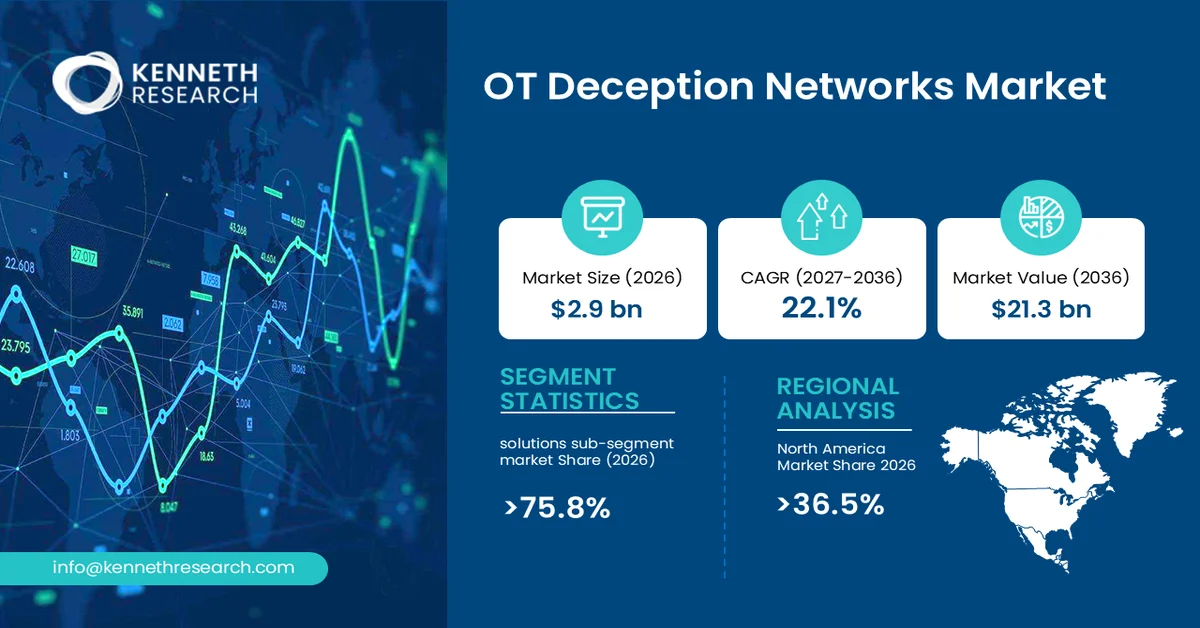
OT Deception Networks Market size was valued at USD 2.9 billion in 2026 and is projected to reach USD 21.3 billion by the end of 2036, rising at a CAGR of 22.1% during the forecast period, i.e., 2027–2036. In 2027, the industry size of the global OT deception networks market is estimated at USD 3.5 billion.
The primary growth driver is the expanding exposure of operational technology as organizations connect OT environments with IT networks and remote-access capabilities. This convergence increases cybersecurity complexity and creates demand for deception networks that can improve visibility, detect unauthorized activity, and help security teams protect safety-critical and production-oriented industrial systems.
The OT deception networks market comprises cybersecurity technologies and services that deploy deceptive assets, environments, credentials, network elements, or simulated operational-technology resources to attract, identify, and analyze unauthorized activity within OT environments. These capabilities are designed to create realistic decoys while minimizing interference with live industrial processes. Key characteristics include OT-aware deception, controlled interaction with suspected adversaries, monitoring of network behavior, and integration with broader security operations and incident-response workflows.
The market is relevant to industrial organizations because OT systems directly monitor or control physical processes and therefore operate under requirements for reliability, availability, performance, and safety. NIST describes OT as programmable systems and devices that interact with the physical environment, including industrial control systems, building automation, transportation, and physical-access systems. Deception technologies complement conventional protective controls by adding a detection-oriented layer intended to expose suspicious behavior that may otherwise remain difficult to distinguish from legitimate operational activity.
Key OT Deception Networks Market Insights Summary:
Key Takeaways: Market Trends & Insights
- The global ot deception networks market is valued at USD 2.9 billion in 2026
- The ot deception networks market is projected to reach USD 21.3 billion by 2036
- The market is expected to expand at a CAGR of 22.1% from 2027 to 2036
- Solutions account for 75.8% market share in 2026, making them the leading component segment
Market Drivers
- Government-led OT cybersecurity modernization
- Growing IT-OT convergence and industrial connectivity
- Expansion of remote and distributed industrial operations
- Increasing adoption of proactive threat detection and deception-based defense
Challenges
- Integration complexity across legacy OT environments
- Limited OT cybersecurity expertise and operational risk concerns
OT Deception Networks Market Overview & Supply Chain
Global adoption of OT deception networks is increasing as industrial environments become more connected, automated, and dependent on digitally managed infrastructure. IT/OT convergence, remote connectivity, distributed energy resources, industrial IoT, and modernization of legacy control systems are expanding the number of pathways that organizations must monitor.
The industry value chain for OT deception networks begins with technology inputs, including computing infrastructure, networking components, virtualization capabilities, software development frameworks, threat intelligence, and OT-specific protocols and data models. Solution providers then design, develop, test, and integrate deception platforms capable of emulating industrial assets, services, credentials, network paths, or control-system environments. Production involves software engineering, cybersecurity testing, interoperability validation, and deployment preparation rather than conventional physical manufacturing alone. Distribution occurs through direct enterprise sales, cybersecurity integrators, managed security providers, technology partnerships, and specialized industrial cybersecurity channels. End users include manufacturers, utilities, energy producers, transportation operators, and other organizations operating critical or industrial infrastructure.
OT Deception Networks Market: Growth Drivers & Challenges
Growth Drivers
- Increasing government-led ot cybersecurity investment: The expansion of cybersecurity programs across critical infrastructure is strengthening demand for technologies that can improve OT visibility, detection, and threat response. Deception networks can support this requirement by introducing controlled decoy assets and environments that help security teams identify suspicious activity without interfering with production systems.
- Growing it-ot convergence and industrial connectivity: The increasing convergence of enterprise IT environments with operational networks is expanding the attack surface that industrial organizations must monitor and protect. Connected production equipment, remote-access technologies, distributed assets, cloud-connected platforms, and digitally enabled control systems create additional pathways through which unauthorized activity can move toward operational environments.
Challenges
- Integration complexity across legacy ot environments: A major restraint is the technical complexity of integrating deception capabilities into heterogeneous OT environments built around legacy industrial control systems, proprietary protocols, and equipment with long operational lifecycles. Unlike conventional IT networks, OT environments often prioritize availability and deterministic operations, making security teams cautious about introducing technologies that could affect traffic patterns, device behavior, or production processes.
- Limited ot cybersecurity expertise and operational risk concerns: A second restraint is the shortage of personnel who simultaneously understand industrial operations, control-system architectures, and advanced cybersecurity practices. Deception networks require carefully designed decoys that resemble legitimate OT assets and generate meaningful security signals without creating confusion for operators or security teams. Organizations without sufficient OT expertise may therefore struggle to determine where deception assets should be positioned, how alerts should be interpreted, and how simulated environments should be maintained as production systems change.
OT Deception Networks Market Size and Forecast:
| Report Attribute | Details |
|---|---|
| Base Year |
2026 |
| Forecast Period |
2027-2036 |
| CAGR |
22.1% |
| Base Year Market Size (2026) |
USD 2.9 Billion |
| Forecast Year Market Size (2036) |
USD 21.3 Billion |
| Regional Scope |
|
OT Deception Networks Market Segmentation Analysis:
Component Segment Analysis
In the component segment, solutions sub-segment is anticipated to capture the largest market share of 75.8% by the end of 2026.
The solutions segment dominates because industrial organizations increasingly require deployable technologies that provide continuous visibility, detection, and response capabilities across OT environments. Demand is being supported by the digitization of industrial infrastructure, greater IT-OT connectivity, and the need to identify suspicious activity without disrupting operational processes. Government-backed cybersecurity programs are also encouraging adoption of technology-based protections. In 2024, the U.S. Department of Energy reported that its Risk Management Tools and Technologies program had transitioned more than 80 products, tools, and technologies to reduce cybersecurity risk in the energy sector, while more than 1,500 utilities across all 50 states had purchased products developed through the research program.
Organization Size Segment Analysis
The large enterprises is projected to grow as the second-largest segment in the OT deception networks market due to four converging demand drivers.
Large enterprises are projected to grow rapidly because their extensive operational footprints, interconnected facilities, and larger IT-OT environments create stronger requirements for continuous threat detection and controlled security monitoring. The expansion of digitally enabled production and remote operational access is increasing the number of assets and pathways that security teams must protect, making deception capabilities increasingly relevant for identifying reconnaissance and lateral movement. Eurostat reported that 91% of large EU enterprises reached at least a basic level of digital intensity in 2023, compared with 58% of SMEs, indicating a substantially more technology-intensive operating environment among larger organizations. This deeper digitalization can increase demand for specialized OT security capabilities that complement conventional monitoring and prevention tools.
Our in-depth analysis of the ot deception networks market includes the following segments:
|
Segment |
Sub-segment |
|
Component |
|
|
Deployment Mode |
|
|
Organization Size |
|
|
End-User |
|
OT Deception Networks Market Regional Insights:
North America Market Trends & Insights:
North America OT deception networks is projected to hold the largest revenue share of 36.5% by the end of 2026.
It is supported by substantial cybersecurity investment across critical infrastructure, energy, manufacturing, utilities, and other operational environments. The region benefits from mature OT security ecosystems, established cybersecurity vendors, high enterprise technology adoption, and regulatory initiatives encouraging stronger protection of industrial systems.
The United States represents the principal market within the region, supported by federal cybersecurity initiatives and extensive deployment of connected industrial infrastructure.
Canada also contributes to regional demand as organizations increase cybersecurity preparedness alongside broader digitalization. The combination of technology adoption, critical-infrastructure protection priorities, and enterprise cybersecurity investment should sustain North America's role as a major demand center for OT deception solutions.
Europe Market Trends & Insights:
Europe presents sustained demand for OT cybersecurity as energy, manufacturing, transportation, utilities, and other critical industries continue to digitize operational environments. Industrial activity across the region is increasingly connected, creating greater requirements for technologies that can identify unauthorized reconnaissance and lateral movement while minimizing disruption to production systems.
Germany has a substantial industrial base spanning manufacturing, automation, energy, and engineering, creating demand for specialized OT protection. Its BSI has specifically issued guidance on attack-detection systems for critical-infrastructure operators, supporting earlier identification of cyberattacks.
France is likewise strengthening protection of critical information systems through ANSSI and the wider NIS2 framework. ANSSI's 2024 threat assessment highlights persistent risks to critical information systems, reinforcing the need for advanced detection and resilience capabilities.
Leading Companies Operating in the Global OT Deception Networks Market :
Here is a list of upstream, downstream, and key players operating in ot deception networks market competitive ecosystem:
- Acalvio Technologies (United States)
- Company Overview
- Business Strategy
- Key Product Offerings
- Financial Performance
- Key Performance Indicators
- Risk Analysis
- Recent Development
- Regional Presence
- SWOT Analysis
- Fortinet (United States)
- Fidelis Security (United States)
- CounterCraft (Spain)
Recent Developments
- In July 2026, Acalvio Technologies published research on how deception technology counters autonomous AI agents in OT environments. The company's three-vector framework—Fake Looks Real, Real Looks Fake, and Intentionally Suspicious—seeds deceptive credentials, decoys, and HoneyPaths to corrupt the machine-readable map an agent builds during reconnaissance, turning the agent's tireless enumeration into a mechanism of accelerated exposure.
Frequently Asked Question
In 2026, the ot deception networks market exceeded USD 2.9 billion.
The ot deception networks market is projected to reach USD 21.3 billion by the end of 2036, expanding at a CAGR of 22.1% over the forecast period (2027-2036).
The major players in the market are Acalvio Technologies, Fortinet, Fidelis Security, CounterCraft, and others.
In the Component segment, the Solutions sub-segment is anticipated to capture the largest market share of 75.8% in the future and exhibit lucrative growth opportunities during 2027-2036. This growth trajectory is largely attributed to increasing demand for deployable OT security capabilities that support continuous threat detection and monitoring.
North America is projected to hold the largest market share of 36.5% by the end of 2036 and provide more business opportunities in the future. Continuous investments in OT cybersecurity, critical infrastructure protection, and industrial security across the United States and Canada are fostering the region's dominance.
Why Choose Kenneth Research ?
-
Insight with Impact : We don’t just gather data — we uncover stories, trends, and opportunities that fuel business growth.
-
Experts Who Get It : Our team speaks your industry’s language and knows what really matters to your customers and market.
-
Custom-Built for You : Forget one-size-fits-all. We craft research and consulting solutions as unique as your business vision.
-
Partners, Not Just Providers : We work with you, not for you — collaborating closely to turn insights into smart, strategic moves.
-
Results That Speak : Our work powers brands, startups, and industry leaders alike — with a track record of ideas that work in the real world.
Report ID: 1466 |
Published Date: 28 Sep 2026 |
Report Format: |
Delivery Timeline: 48-72 Business Hours

Copyright © 2025 Kenneth Research. All rights reserved. Terms of Use | Privacy Policy
