Report ID: 1035 |
Published Date: 28 Jul 2026 |
Report Format: |
Delivery Timeline: 48-72 Business Hours
Orthopedic Surgical Robots Market Size and Forecast:
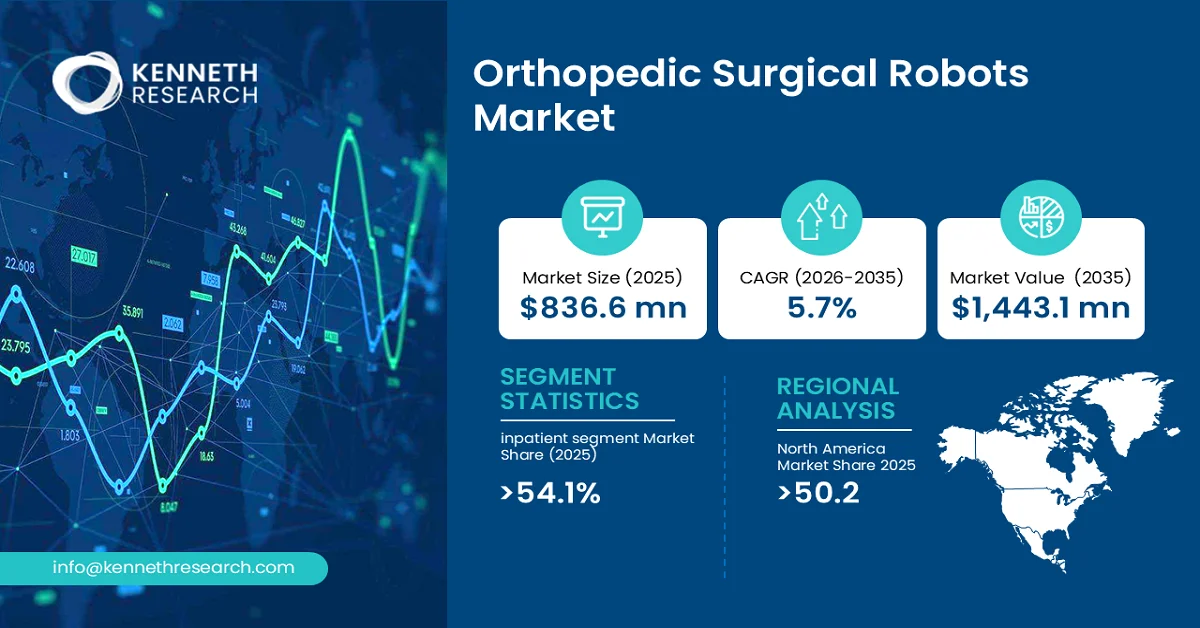
Orthopedic Surgical Robots Market size was valued at USD 836.6 million in 2025 and is projected to reach USD 1,443.1 million by the end of 2035, rising at a CAGR of 5.7% during the forecast period, i.e., 2026–2035. In 2026, the industry size of the orthopedic surgical robots is estimated at USD 884.4 million.
Growing demand for highly precise, technology-assisted orthopedic procedures is the primary driver of the orthopedic surgical robots market. Hospitals are increasingly adopting robot-assisted platforms to improve surgical planning, implant positioning, workflow standardization, and minimally invasive capabilities, while regulatory support for computer-assisted surgical systems continues to strengthen clinical confidence.
The orthopedic surgical robots market comprises robotic-assisted platforms, navigation software, imaging integration systems, planning applications, and related accessories designed to support orthopedic surgeons during musculoskeletal procedures. These systems assist with preoperative planning, intraoperative guidance, and accurate execution of bone preparation and implant placement while remaining under the direct control of trained surgeons. According to the U.S. Food and Drug Administration (FDA), robotically assisted surgical devices are a category of computer-assisted surgical systems that use computer and software technologies to support surgical instrument movement during procedures rather than operating autonomously.
Orthopedic surgical robots are primarily deployed across joint replacement procedures, spinal interventions, and selected trauma-related applications where procedural precision is clinically important. Their key characteristics include three-dimensional planning capabilities, real-time navigation, image-guided workflow integration, and enhanced reproducibility of surgical execution. Industrially, the market is an important component of the broader medical device ecosystem, supporting healthcare providers in advancing digital surgery initiatives, improving procedural consistency, facilitating surgeon training, and complementing innovations in orthopedic implants, medical imaging, artificial intelligence, and computer-assisted navigation technologies.
Key Orthopedic Surgical Robots Market Insights Summary:
Key Takeaways: Market Trends & Insights
- The orthopedic surgical robots market was valued at USD 836.6 million in 2025 and is projected to reach USD 1,443.1 million by 2035, registering a 5.7% CAGR during the 2026–2035 forecast period
- The Inpatient end-use segment led the market with 54.1% share in 2025, supported by the concentration of robotic-assisted orthopedic procedures in hospitals with advanced surgical infrastructure
- North America accounted for the largest regional share of 50.2% in 2025, driven by strong adoption of robotic-assisted surgery, established healthcare systems, and continued investments across the United States and Canada
- The Knee application segment is expected to witness robust growth as hospitals increasingly adopt robotic platforms to improve precision, implant alignment, and workflow standardization in knee arthroplasty procedures
- Technological advancements in robotic platforms, navigation software, artificial intelligence-assisted surgical planning, and digital operating room integration are expected to remain the primary factors supporting long-term market expansion
Market Drivers
- Expansion of ambulatory surgery centers performing orthopedic procedures
- Increasing prevalence of degenerative musculoskeletal disorders requiring surgical intervention
- Growing investments in smart operating rooms and healthcare digitalization
- Advancements in artificial intelligence-enabled surgical planning and navigation
Challenges
- High Capital Investment and Long Procurement Cycles
- Limited Clinical Standardization and Skilled Workforce Requirements
Orthopedic Surgical Robots Market Overview & Supply Chain
The global adoption of orthopedic surgical robots is accelerating as healthcare providers seek greater procedural precision, standardized implant positioning, and digitally enabled surgical workflows. Advancements in computer-assisted navigation, three-dimensional preoperative planning, intraoperative imaging, and robotic guidance are improving the reproducibility of complex orthopedic procedures while supporting minimally invasive techniques. Regulatory agencies have also established dedicated pathways for evaluating robotically assisted surgical systems, encouraging clinical adoption through safety and performance oversight. The industry's relevance is reinforced by the growing demand for joint replacement procedures. According to the U.S. Centers for Medicare & Medicaid Services (CMS), more than 1.2 million total knee and hip replacements are performed annually in the United States, highlighting the substantial procedural base that supports continued investment in robotic orthopedic technologies. This expanding surgical volume, combined with healthcare digitalization initiatives and hospital modernization strategies, continues to strengthen the long-term outlook for orthopedic robotic platforms.
The orthopedic surgical robots industry begins with the procurement of high-value inputs including medical-grade metals, polymers, semiconductors, optical sensors, robotic actuators, imaging components, embedded electronics, and specialized software algorithms sourced from advanced component manufacturers. These inputs are integrated by robotic system manufacturers through precision engineering, software development, quality assurance, and regulatory compliance processes before undergoing extensive validation and certification. Distribution occurs through direct sales organizations, regional distributors, and strategic partnerships with hospitals and integrated healthcare networks, supported by installation, training, maintenance, and software upgrade services. Primary end users include hospitals, specialty orthopedic centers, ambulatory surgery centers, and academic medical institutions performing joint reconstruction and spine procedures. Major stakeholders across the value chain include component suppliers, robotic platform developers, orthopedic implant manufacturers, imaging technology providers, software developers, regulatory authorities, healthcare providers, surgeons, procurement organizations, and after-sales service providers, all contributing to the commercialization and sustained utilization of robotic-assisted orthopedic surgery solutions.
Orthopedic Surgical Robots Market: Growth Drivers & Challenges
Growth Drivers:
- Continuous Innovation in Robotic Platforms and Regulatory Clearances: Technological innovation and regulatory approvals are accelerating the commercialization of orthopedic surgical robots across developed and emerging healthcare markets. Manufacturers are introducing compact robotic platforms, advanced navigation software, artificial intelligence-enabled planning tools, and expanded implant compatibility to improve procedural efficiency and surgeon flexibility. These advancements reduce workflow complexity while increasing the accessibility of robotic-assisted orthopedic procedures across hospitals and specialty centers. Regulatory clearances further strengthen clinician confidence by validating device safety and performance for clinical use. A notable example is the U.S. Food and Drug Administration's 510(k) clearance of THINK Surgical's TMINI™ miniature robotic system in 2023, enabling broader commercialization of a compact robotic platform for total knee replacement procedures. As product innovation continues and vendors expand platform capabilities through software upgrades and implant partnerships, competition is expected to intensify, supporting wider adoption and long-term technological advancement.
- Expanding Digital Transformation Across Orthopedic Care: Healthcare providers are increasingly integrating digital technologies into orthopedic care to improve surgical planning, intraoperative decision-making, and postoperative outcomes. Orthopedic surgical robots complement this transformation by integrating imaging systems, navigation technologies, digital workflows, and data-driven planning into a unified surgical environment. Hospitals are investing in digital operating rooms to improve procedural consistency, reduce variability between surgeons, and strengthen quality management initiatives. These platforms also facilitate surgeon training through simulation-based planning and standardized execution, making robotic systems attractive for both established healthcare institutions and newly developed specialty centers. Looking ahead, greater interoperability with artificial intelligence, cloud-based analytics, connected imaging platforms, and digital hospital ecosystems is expected to enhance procedural efficiency and create new opportunities for software-driven service models, expanding the strategic importance of orthopedic surgical robotics within modern healthcare infrastructure.
Challenges:
- High Capital Investment and Long Procurement Cycles: Orthopedic surgical robots require substantial upfront investment that extends beyond the robotic platform itself to include imaging integration, software licensing, operating room modifications, maintenance contracts, and comprehensive surgeon training. Hospitals must also evaluate compatibility with existing orthopedic implant portfolios and digital infrastructure before committing to procurement. These factors lengthen purchasing cycles and make investment decisions subject to detailed financial justification, particularly in budget-constrained healthcare systems. For manufacturers, extended sales cycles increase customer acquisition costs and create uncertainty in revenue realization. Smaller healthcare facilities and independent surgical centers often postpone adoption because the expected operational and clinical benefits may not immediately offset the total cost of ownership. Over the long term, vendors will need to offer flexible financing models, modular platform configurations, and value-based service agreements to broaden market accessibility and reduce commercial barriers.
- Limited Clinical Standardization and Skilled Workforce Requirements: The successful implementation of orthopedic surgical robots depends on specialized clinical expertise, standardized surgical protocols, and multidisciplinary coordination among surgeons, operating room personnel, and biomedical engineering teams. Variations in institutional workflows, surgeon preferences, and training practices can lead to inconsistent utilization of robotic capabilities, limiting the realization of expected efficiency gains. Manufacturers must therefore invest heavily in education, certification programs, and ongoing technical support, increasing operational costs throughout the product lifecycle. Healthcare providers may also delay deployment until sufficient staff competency and procedural confidence are established, slowing technology integration across facilities. Commercially, inconsistent utilization reduces repeat purchasing opportunities and may affect long-term customer satisfaction. Looking ahead, broader adoption will depend on scalable training ecosystems, improved software usability, workflow automation, and standardized clinical implementation frameworks that simplify integration into routine orthopedic practice.
Orthopedic Surgical Robots Market Size and Forecast:
| Report Attribute | Details |
|---|---|
| Base Year |
2025 |
| Forecast Year |
2026-2035 |
| CAGR |
5.7% |
| Base Year Market Size (2025) |
USD 836.6 million |
| Forecast Year Market Size (2035) |
USD 1,443.1 million |
| Regional Scope |
|
Orthopedic Surgical Robots Market Segmentation Analysis:
End Use Segment Analysis
In the end use segment, the inpatient sub-segment is anticipated to capture the largest market share of 54.1% by the end of 2025.
The inpatient segment dominates the orthopedic surgical robots market because most robot-assisted orthopedic procedures are performed in hospital environments equipped with advanced operating rooms, integrated imaging systems, and multidisciplinary surgical teams. Complex joint replacement and spine procedures frequently require sophisticated perioperative support, making inpatient hospitals the preferred setting for adopting robotic platforms. Demand is further driven by hospitals' focus on improving surgical precision, standardizing clinical workflows, and supporting high-acuity orthopedic interventions through digital technologies. From the supply side, manufacturers prioritize hospital customers by offering integrated robotic systems, installation services, clinical training, software upgrades, and long-term maintenance agreements, reinforcing the segment's leadership. The U.S. Centers for Medicare & Medicaid Services (CMS) also recognizes hip, knee, and ankle replacements within its Comprehensive Care for Joint Replacement (CJR) Model, which is designed to improve quality and care coordination for these procedures across inpatient and outpatient settings, reflecting the strategic importance of hospitals in orthopedic care delivery. Looking ahead, continued investments in smart operating rooms, robotic surgery programs, and hospital modernization are expected to sustain inpatient leadership while expanding the clinical capabilities of orthopedic robotic platforms.
Application Segment Analysis
The knee segment is projected to grow as the second-largest segment in the orthopedic surgical robots market due to four converging demand drivers.
The knee application segment is projected to experience strong growth as healthcare providers increasingly adopt robotic assistance to improve implant positioning, surgical planning, and procedural consistency during total and partial knee arthroplasty. Knee replacement remains one of the most frequently performed orthopedic procedures, making it a priority application for robotic platform developers seeking to expand clinical adoption. Hospitals are integrating robotic technologies into orthopedic programs to enhance workflow standardization, facilitate surgeon training, and support personalized surgical planning using patient-specific anatomical data. On the supply side, manufacturers continue to prioritize knee applications through dedicated robotic systems, software enhancements, expanded implant compatibility, and strategic collaborations with orthopedic implant companies. Demand is further supported by the growing burden of osteoarthritis. According to the U.S. Centers for Disease Control and Prevention (CDC), about 33 million U.S. adults have osteoarthritis, with the condition commonly affecting the knees, underscoring the sustained need for advanced knee intervention technologies. Looking ahead, continued innovation in image-guided navigation, artificial intelligence-assisted planning, and robotic workflow integration is expected to reinforce the segment's long-term expansion.
Our in-depth analysis of the global orthopedic surgical robots market includes the following segments:
|
Segment |
Sub-segment |
|
Application |
|
|
End-Use |
|
Orthopedic Surgical Robots Market Regional Insights:
North America Market Trends & Insights:
North America orthopedic surgical robots market is projected to hold the largest revenue share of 50.2% by the end of 2025.
North America accounted for 50.2% of the orthopedic surgical robots market in 2025, reflecting the region's leadership in the adoption of advanced surgical technologies, sophisticated healthcare infrastructure, and continuous investment in digital operating rooms. The region benefits from the presence of major robotic system developers, established orthopedic implant manufacturers, and healthcare providers that actively integrate robotics into joint replacement and spine procedures. A supportive regulatory environment, robust reimbursement frameworks, and ongoing investments in clinical innovation further reinforce market leadership. Demand is also sustained by a high volume of orthopedic procedures and the widespread adoption of computer-assisted surgical technologies within leading hospitals.
The United States serves as the regional growth engine through its concentration of medical technology innovators, extensive network of high-volume orthopedic centers, and early adoption of robotic-assisted surgery across academic and community hospitals. Continuous product innovation, surgeon training programs, and collaboration between robotic platform developers and implant manufacturers support sustained commercialization.
Canada complements regional growth through progressive adoption of advanced orthopedic technologies within publicly funded healthcare systems. Investments in joint replacement capacity, increasing use of digital surgical platforms, and expanding clinical experience with robotic-assisted procedures are strengthening adoption across major provincial healthcare networks. Together, these countries provide a mature ecosystem for innovation, regulatory advancement, clinical research, and technology deployment, reinforcing North America's position as the leading regional market.
Asia Pacific Market Trends & Insights:
Asia Pacific is emerging as a high-growth region for the orthopedic surgical robots market, supported by expanding healthcare infrastructure, rising adoption of advanced surgical technologies, and increasing investments in orthopedic care. Healthcare providers across the region are modernizing operating rooms with digital imaging, navigation systems, and robot-assisted surgical platforms to improve procedural precision and clinical efficiency. Governments are encouraging healthcare innovation through initiatives focused on medical technology development, hospital modernization, and the integration of intelligent healthcare solutions. In parallel, manufacturers are expanding regional footprints through local production, strategic partnerships, clinical training programs, and distributor networks to address growing demand. The region also offers substantial opportunities for vendors to broaden access to robotic-assisted orthopedic procedures as healthcare systems continue to invest in specialized surgical capabilities, digital transformation, and advanced medical device adoption.
China represents the largest growth opportunity in the region, driven by rapid expansion of tertiary hospitals, increasing investment in domestically developed medical technologies, and supportive policies encouraging innovation in high-end medical devices. The country's emphasis on intelligent healthcare, coupled with a growing ecosystem of robotics developers and orthopedic device manufacturers, is strengthening the commercialization of robotic surgical systems.
Japan remains a technologically advanced market characterized by strong clinical expertise, sophisticated hospital infrastructure, and early adoption of precision medical technologies. Continuous investment in robotic-assisted surgery, collaboration between healthcare institutions and technology companies, and a focus on improving surgical quality and operational efficiency position Japan as a key contributor to regional market development. Together, China and Japan are expected to remain central to the expansion of orthopedic surgical robotics across Asia Pacific.
Leading Companies Operating in the Global Orthopedic Surgical Robots Market:
Here is a list of upstream, downstream, and key players operating in the global orthopedic surgical robots market competitive ecosystem:
- Zimmer Biomet Holdings, Inc. (United States)
- Company Overview
- Business Strategy
- Key Product Offerings
- Financial Performance
- Key Performance Indicators
- Risk Analysis
- Recent Development
- Smith & Nephew plc (United Kingdom)
- Globus Medical, Inc. (United States)
- THINK Surgical, Inc. (United States)
- Corin Group (United Kingdom)
- Curexo, Inc. (South Korea)
Recent Developments
- In November 2025, Zimmer Biomet received U.S. FDA 510(k) clearance for its ROSA® Knee with OptimiZe™ system, an enhanced version of its ROSA Knee robotic platform. The system features OptimiZe Planning™, which creates customized surgical plans and reduces planning time by an average of 46%, alongside new positioning, tracking, and alignment tools to improve accuracy and reduce user variability in total knee replacement procedures.
- In October 2025, Zimmer Biomet completed the acquisition of Monogram Technologies Inc., an AI-driven orthopedic robotics company. The acquisition adds Monogram's CT-based, semi-autonomous AI-navigated total knee arthroplasty robotic technology (FDA-cleared in March 2025) and a fully autonomous robotic system currently in clinical studies, positioning Zimmer Biomet to offer the industry's first fully autonomous robotic solution for orthopedic procedures.
Frequently Asked Question
In 2025, the orthopedic surgical robots market exceeded USD 836.6 million.
The orthopedic surgical robots market is projected to reach USD 1,443.1 million by the end of 2035, expanding at a CAGR of 5.7% over the forecast period (2026–2035).
The major players in the market are Zimmer Biomet Holdings, Inc. (United States), Smith & Nephew plc (United Kingdom), Globus Medical, Inc. (United States), THINK Surgical, Inc. (United States), Corin Group (United Kingdom), Curexo, Inc. (South Korea), and others.
In the end-use segment, the Inpatient sub-segment is anticipated to capture the largest market share of 54.1% in the future and exhibit lucrative growth opportunities during 2026–2035. This growth trajectory is largely attributed to increasing adoption of robotic-assisted orthopedic procedures in hospitals supported by advanced surgical infrastructure and integrated digital operating rooms.
North America is projected to hold the largest market share of 50.2% by the end of 2035 and provide more business opportunities in the future. Continuous investments in advanced orthopedic technologies, strong adoption across the United States and Canada, and well-established healthcare infrastructure are fostering the region's dominance.
Why Choose Kenneth Research ?
-
Insight with Impact : We don’t just gather data — we uncover stories, trends, and opportunities that fuel business growth.
-
Experts Who Get It : Our team speaks your industry’s language and knows what really matters to your customers and market.
-
Custom-Built for You : Forget one-size-fits-all. We craft research and consulting solutions as unique as your business vision.
-
Partners, Not Just Providers : We work with you, not for you — collaborating closely to turn insights into smart, strategic moves.
-
Results That Speak : Our work powers brands, startups, and industry leaders alike — with a track record of ideas that work in the real world.
Report ID: 1035 |
Published Date: 28 Jul 2026 |
Report Format: |
Delivery Timeline: 48-72 Business Hours

Copyright © 2025 Kenneth Research. All rights reserved. Terms of Use | Privacy Policy
