Report ID: 1021 |
Published Date: 29 Jul 2026 |
Report Format: |
Delivery Timeline: 48-72 Business Hours
Orthopedic Prosthetics Market Outlook:
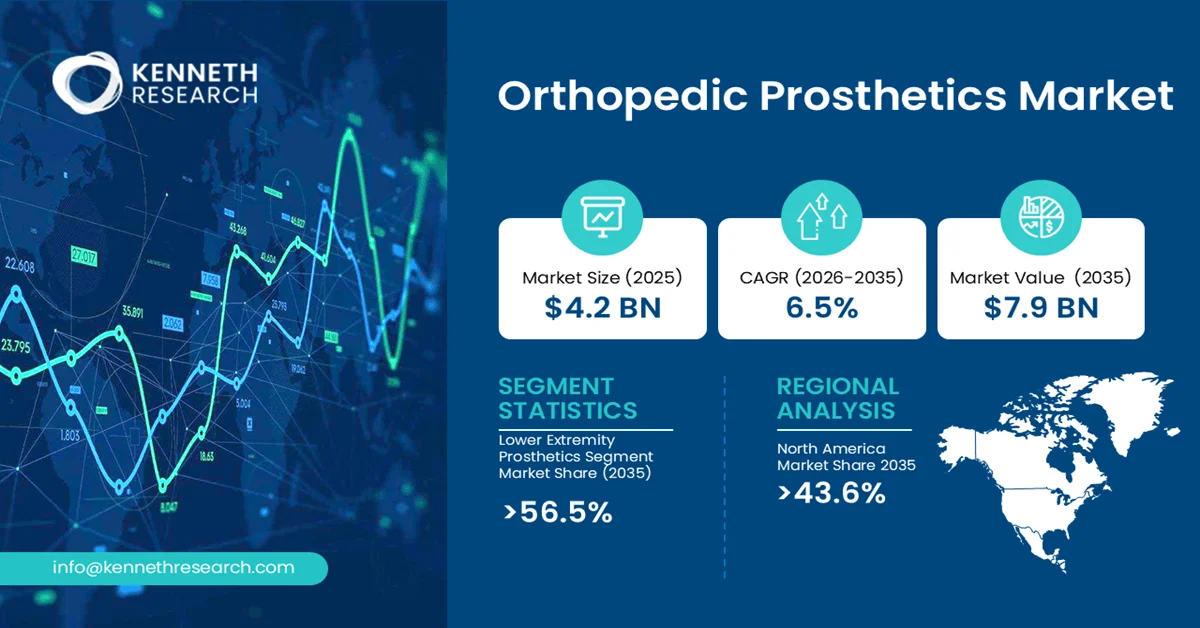
Orthopedic Prosthetics Market size was valued at USD 4.2 billion in 2025 and is projected to reach USD 7.9 billion by the end of 2035, rising at a CAGR of 6.5% during the forecast period, i.e., 2026-2035. In 2026, the industry size of orthopedic prosthetics is estimated at USD 4.5 billion.
The primary growth driver for the orthopedic prosthetics market is the rising incidence of limb loss caused by trauma, diabetes, vascular diseases, and musculoskeletal disorders. Continuous advancements in prosthetic materials, socket design, biomechanical engineering, and patient-specific customization are improving mobility, comfort, and long-term rehabilitation outcomes, accelerating global adoption.
The orthopedic prosthetics market comprises the development, manufacturing, and commercialization of artificial limb devices designed to replace missing upper or lower extremities and restore mobility, functionality, and independence for individuals with limb loss. The market includes prosthetic limbs, liners, sockets, suspension systems, joints, feet, knees, hands, and associated components that are customized to meet patient-specific clinical and functional requirements. The market is characterized by continuous innovation in lightweight materials, biomechanical engineering, digital design, and advanced manufacturing technologies that improve prosthetic performance, durability, comfort, and adaptability.
Key Orthopedic Prosthetics Market Insights Summary:
Key Takeaways: Market Trends & Insights
- In the product segment, the lower extremity prosthetics sub-segment is anticipated to capture the revenue share of 56.5% during 2026-2035
- North America orthopedic prosthetics market is projected to hold the largest revenue share of 43.6% by the end of 2035
- In the end use segment, hospitals captured 60.3% of the orthopedic prosthetics market in 2025.
Market Drivers
- Rising Burden of Limb Amputations and Rehabilitation Needs
- Technological Advancements in Prosthetic Design and Personalization
- Expanding healthcare expenditure and improved access to rehabilitation services.
- Growing adoption of lightweight materials and patient-specific prosthetic solutions.
Challenges
- High cost of advanced prosthetic devices and limited reimbursement
- Shortage of skilled prosthetists and complex patient fitting requirements
Orthopedic Prosthetics Market Overview & Supply Chain
Global adoption of orthopedic prosthetics is increasing due to the rising incidence of limb loss associated with diabetes, vascular diseases, trauma, and congenital conditions, alongside continuous advancements in prosthetic engineering and rehabilitation technologies. Innovations such as lightweight composite materials, digital socket design, microprocessor-assisted components, and additive manufacturing are improving patient mobility, comfort, and functional outcomes. Healthcare systems are also strengthening rehabilitation services and expanding access to prosthetic care through supportive reimbursement policies and multidisciplinary treatment approaches.
The orthopedic prosthetics value chain begins with the procurement of advanced raw materials, including carbon fiber composites, titanium alloys, aluminum, thermoplastics, silicone, polyurethane, and electronic components used in specialized prosthetic systems. These materials are integrated through precision engineering, computer-aided design and manufacturing (CAD/CAM), digital scanning, and quality-controlled production processes to manufacture prosthetic sockets, knees, feet, liners, suspension systems, and complete limb solutions. End users include individuals with limb loss resulting from trauma, vascular diseases, diabetes, cancer, or congenital limb deficiencies.
Orthopedic Prosthetics Market: Growth Drivers & Challenges
Growth Drivers:
- Rising Burden of Limb Amputations and Rehabilitation Needs: The increasing number of limb amputations resulting from diabetes, peripheral vascular disease, trauma, and musculoskeletal disorders is a primary driver of the orthopedic prosthetics market. As healthcare systems place greater emphasis on restoring mobility and improving quality of life, demand for customized prosthetic devices continues to grow across hospitals, rehabilitation centers, and specialized prosthetic clinics. Technological improvements in socket design, lightweight materials, and biomechanical engineering are further enhancing patient outcomes and expanding prosthetic adoption. According to the World Health Organization (WHO), 830 million people were living with diabetes in 2022, and diabetes is a major cause of lower-limb amputation, reinforcing the growing need for advanced orthopedic prosthetic solutions and long-term rehabilitation services.
- Technological Advancements in Prosthetic Design and Personalization: Continuous innovation in prosthetic technologies is accelerating market growth by improving device functionality, patient comfort, and long-term clinical outcomes. Advances in digital limb scanning, computer-aided design and manufacturing (CAD/CAM), lightweight composite materials, 3D printing, and biomechanical engineering have enabled the production of highly customized prosthetic solutions tailored to individual patient requirements. These technologies reduce fitting time, improve socket precision, and enhance mobility while increasing patient satisfaction and rehabilitation success. Manufacturers are also integrating smart components, advanced suspension systems, and durable materials to improve reliability and daily performance.
Challenges:
- High cost of advanced prosthetic devices and limited reimbursement: One of the principal restraints in the orthopedic prosthetics market is the high cost of advanced prosthetic devices, particularly those incorporating microprocessor-controlled components, premium lightweight materials, and customized fittings. The need for individualized fabrication, repeated adjustments, ongoing maintenance, and periodic component replacement significantly increases the overall cost of ownership. In many countries, reimbursement policies do not fully cover advanced prosthetic technologies, creating affordability barriers for patients and limiting access to premium solutions. Commercially, manufacturers face challenges in expanding adoption across cost-sensitive healthcare systems while maintaining product quality and technological innovation.
- Shortage of skilled prosthetists and complex patient fitting requirements: The successful use of orthopedic prosthetics depends on accurate clinical assessment, customized fitting, alignment, and long-term rehabilitation, all of which require highly trained prosthetists and multidisciplinary rehabilitation teams. Many regions continue to experience shortages of qualified professionals, resulting in delayed fittings, inconsistent patient outcomes, and limited access to specialized prosthetic care. Variations in patient anatomy, activity levels, and residual limb conditions further increase the complexity of device customization and rehabilitation planning. From a commercial perspective, these workforce constraints can slow product adoption and restrict market expansion, particularly in underserved areas.
Orthopedic Prosthetics Market Size and Forecast:
| Report Attribute | Details |
|---|---|
| Base Year |
2025 |
| Forecast Year |
2026-2035 |
| CAGR |
6.5% |
| Base Year Market Size (2025) |
USD 4.2 billion |
| Forecast Year Market Size (2035) |
USD 7.9 billion |
| Regional Scope |
|
Orthopedic Prosthetics Market Segmentation Analysis:
Product Segment Analysis
The lower extremity prosthetics segment is projected to dominate the Orthopedic Prosthetics Market, accounting for 56.5% of the market by 2035.
Its leadership is driven by the high incidence of lower-limb amputations associated with diabetes, peripheral vascular disease, traumatic injuries, and age-related conditions. Demand continues to increase as healthcare providers prioritize early mobility restoration and long-term rehabilitation to improve patient independence and quality of life. Clinical adoption is further supported by advancements in prosthetic feet, knees, socket technologies, and lightweight composite materials that enhance comfort, durability, and gait performance. According to the U.S. Centers for Disease Control and Prevention (CDC), 80% of lower-limb amputations are the result of complications from diabetes, underscoring the significant clinical need for lower extremity prosthetic solutions.
Technology Segment Analysis
The conventional systems segment is projected to experience sustained growth in the orthopedic prosthetics market due to its affordability, clinical reliability, and widespread accessibility across both developed and emerging healthcare systems. Conventional prosthetic technologies remain the preferred choice for many patients because they provide dependable functional performance while requiring less maintenance and lower acquisition costs than advanced microprocessor-controlled alternatives. Healthcare providers and rehabilitation centers continue to adopt these systems for routine mobility restoration, particularly among elderly patients and individuals with limited reimbursement coverage.
Our in-depth analysis of the global orthopedic prosthetics market includes the following segments:
|
Segment |
Sub-segment |
|
Product |
|
|
Technology |
|
|
End Use |
|
Orthopedic Prosthetics Market Regional Insights:
North America Market Trends & Insights:
North America is projected to account for 43.6% of the global orthopedic prosthetics market by 2035, maintaining its position as the leading regional market. The region's dominance is supported by a well-established healthcare infrastructure, high adoption of technologically advanced prosthetic devices, favorable reimbursement frameworks, and strong investment in rehabilitation services. Manufacturers benefit from extensive research and development capabilities, early commercialization of innovative prosthetic technologies, and close collaboration with rehabilitation hospitals and prosthetic clinics. Regulatory oversight encourages the availability of safe and high-performance prosthetic solutions, while increasing awareness of mobility restoration and patient-centered rehabilitation continues to strengthen demand.
The United States remains the largest contributor to regional growth owing to its advanced rehabilitation ecosystem, strong prosthetics research, broad insurance coverage for eligible patients, and continuous innovation in personalized prosthetic technologies. Extensive collaboration among healthcare providers, universities, and manufacturers further accelerates product development and clinical adoption.
Canada complements regional expansion through universal healthcare access, growing investment in rehabilitation services, and increasing adoption of customized prosthetic solutions supported by specialized prosthetic clinics and academic research institutions.
Asia Pacific Market Trends & Insights:
Asia Pacific is expected to emerge as the fastest-growing region in the orthopedic prosthetics market, driven by the expanding prevalence of diabetes, traumatic injuries, and age-related mobility disorders across densely populated countries. Rising healthcare expenditure, improving access to rehabilitation services, and growing awareness of prosthetic technologies are accelerating market demand throughout the region. Industrial activity is strengthening as domestic and international manufacturers expand production capabilities, invest in advanced materials, and introduce cost-effective prosthetic solutions tailored to local healthcare requirements. Government initiatives focused on disability inclusion, rehabilitation infrastructure, and improved access to assistive technologies are further supporting market development.
China represents the largest market within the region due to its extensive manufacturing ecosystem, growing orthopedic device industry, expanding rehabilitation network, and increasing investments in advanced medical technologies. Government support for domestic medical device innovation and healthcare modernization continues to encourage adoption of high-quality prosthetic solutions.
Japan remains an important contributor through its technologically advanced healthcare system, strong expertise in precision engineering, and emphasis on improving mobility for its rapidly aging population. Continuous innovation in lightweight materials, prosthetic design, robotics, and patient-centered rehabilitation is enabling wider adoption of high-performance orthopedic prosthetics
Leading Companies Operating in the Global Orthopedic Prosthetics Market:
Here is a list of upstream, downstream, and key players operating in the global orthopedic prosthetics market competitive ecosystem:
- Ottobock (Germany)
- Company Overview
- Business Strategy
- Key Product Offerings
- Financial Performance
- Key Performance Indicators
- Risk Analysis
- Recent Development
- Össur (Iceland)
- Blatchford (United Kingdom)
- Fillauer (United States)
Recent Developments
- In 2025, Ottobock expanded its digital ecosystem with updates to the connectgo.pro application, enabling easier setup and programming support for selected microprocessor prosthetic knees. The development highlights the growing importance of digital tools in prosthetic care by improving clinician workflows, device personalization, and patient management capabilities.
- In April 2025, Ottobock launched the Genium X4 microprocessor knee, introducing a next-generation lower-limb prosthetic solution designed to enhance mobility, user adaptability, and functional performance. The launch strengthens Ottobock’s position in advanced prosthetic technologies by expanding its portfolio of intelligent mobility solutions and reinforcing competition in premium microprocessor-controlled prosthetic systems.
- In 2024, PROTEOR acquired Filament Innovations, a company focused on 3D printing technologies for the orthotics and prosthetics industry, including digital manufacturing solutions for customized devices. The acquisition enhances PROTEOR’s digital prosthetics capabilities by integrating advanced additive manufacturing technologies, supporting faster customization and more efficient production workflows.
Frequently Asked Question
In 2025, the orthopedic prosthetics market exceeded USD 4.2 billion.
The orthopedic prosthetics market is projected to reach USD 7.9 billion by the end of 2035, expanding at a CAGR of 6.5% over the forecast period (2026-2035).
The major players in the market are Ottobock, Össur, Blatchford, Fillauer, PROTEOR, WillowWood Global LLC, and others.
In the Product segment, the Lower Extremity Prosthetics sub-segment is anticipated to capture the largest market share of 56.5% in the future and exhibit lucrative growth opportunities during 2026-2035. This growth trajectory is largely attributed to the rising prevalence of limb loss caused by diabetes, vascular diseases, trauma, and increasing demand for mobility restoration solutions.
North America is projected to hold the largest market share of 43.6% by the end of 2035 and provide more business opportunities in the future. Strong healthcare infrastructure, advanced rehabilitation networks, and continuous investments in prosthetic technologies across the U.S. and Canada are fostering the region's dominance.
Why Choose Kenneth Research ?
-
Insight with Impact : We don’t just gather data — we uncover stories, trends, and opportunities that fuel business growth.
-
Experts Who Get It : Our team speaks your industry’s language and knows what really matters to your customers and market.
-
Custom-Built for You : Forget one-size-fits-all. We craft research and consulting solutions as unique as your business vision.
-
Partners, Not Just Providers : We work with you, not for you — collaborating closely to turn insights into smart, strategic moves.
-
Results That Speak : Our work powers brands, startups, and industry leaders alike — with a track record of ideas that work in the real world.
Report ID: 1021 |
Published Date: 29 Jul 2026 |
Report Format: |
Delivery Timeline: 48-72 Business Hours

Copyright © 2025 Kenneth Research. All rights reserved. Terms of Use | Privacy Policy
