Report ID: 1464 |
Published Date: 28 Sep 2026 |
Report Format: |
Delivery Timeline: 48-72 Business Hours
Order Consolidation Robots Market Outlook:
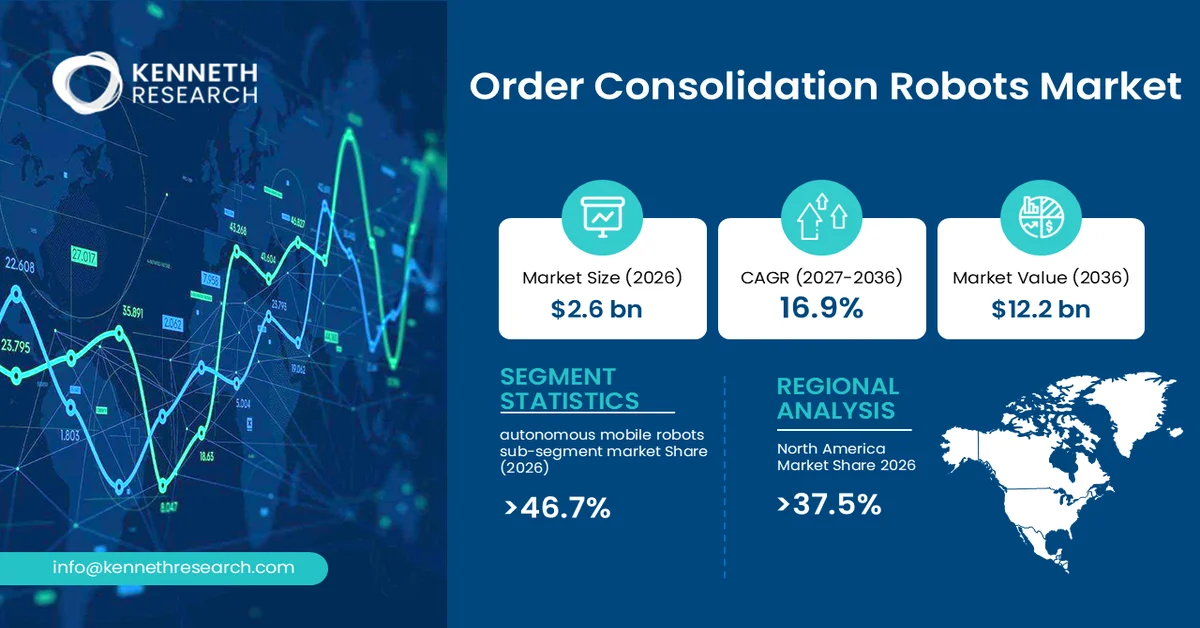
Order Consolidation Robots Market size was valued at USD 2.6 billion in 2026 and is projected to reach USD 12.2 billion by the end of 2036, rising at a CAGR of 16.9% during the forecast period, i.e., 2027–2036. In 2027, the industry size of the order consolidation robots market is estimated at USD 3 billion.
The primary growth driver for the order consolidation robots market is the rising need for automated, high-throughput order fulfilment.
The order consolidation robots market comprises robotic systems designed to automate the movement, grouping, sequencing, and consolidation of products or orders within warehouses, fulfillment centers, distribution facilities, and other logistics environments. These robots help coordinate items from different picking or storage locations into consolidated orders before packing, shipping, or downstream processing.
Key characteristics include autonomous navigation, machine vision, sensors, fleet-management software, dynamic routing, and integration with warehouse management and warehouse control systems. Autonomous mobile robots represent an important product category because they can navigate changing warehouse environments without requiring fixed conveyor infrastructure throughout the facility.
Key Order Consolidation Robots Market Insights Summary:
Key Takeaways: Market Trends & Insights
- Order Consolidation Robots Market projected to grow from USD 2.6 billion in 2026 to USD 12.2 billion by 2036 at a 16.9% CAGR
- North America accounted for the largest regional share at 37.5% in 2026, driven by advanced logistics infrastructure, extensive fulfillment networks, and continued investment in warehouse automation
- Autonomous Mobile Robots are expected to remain the leading Product Type segment with a 46.7% market share in 2026, supported by increasing demand for flexible and scalable robotic material-handling solutions
- Third-party Logistics Providers will continue to witness strong growth due to rising demand for flexible fulfillment operations, automated material movement, and scalable logistics services across diverse customer requirements
Market Drivers
- Expansion of e-commerce and warehouse automation
- Increasing adoption of flexible robotic material handling
- Rising demand for faster and more scalable order fulfillment
- Integration of autonomous navigation, fleet-management software, and warehouse-management systems
Challenges
- High Initial Investment and Integration Complexity
- Operational Complexity and Technology Reliability
Order Consolidation Robots Market Overview & Supply Chain
The adoption of order consolidation robots is increasing as retailers, fulfilment operators, and logistics companies seek to handle increasingly complex order flows while maintaining speed and operational consistency. The expansion of e-commerce is strengthening the need for automated movement, sorting, staging, and consolidation within fulfilment environments. Order consolidation robots also support flexible warehouse layouts by reducing dependence on fixed material-handling infrastructure and enabling automated coordination between picking, storage, sorting, packing, and shipping activities.
The supply chain for the order consolidation robots market begins with suppliers of structural materials, batteries, motors, sensors, cameras, navigation components, computing hardware, communications equipment, and robotic control technologies. Robot manufacturers integrate these inputs with autonomous navigation systems, drive mechanisms, safety systems, fleet-management software, and warehouse-interface technologies to produce finished robotic platforms.
Order Consolidation Robots Market: Growth Drivers & Challenges
Growth Drivers
- Expansion of e-commerce and warehouse automation: The continued expansion of e-commerce and distribution activity is increasing the need for faster, more scalable order-fulfillment operations, supporting demand for order consolidation robots. As order volumes become more variable and fulfillment networks handle larger product assortments, robots can automate repetitive movement and consolidation activities between picking, sorting, staging, and packing areas. This allows operators to improve throughput while reducing dependence on manual material handling. Continued investments in automated fulfillment infrastructure are expected to encourage deployments of mobile robotic platforms, particularly in facilities requiring flexible layouts and scalable capacity.
- Increasing adoption of flexible robotic material handling: The growing adoption of flexible robotic material-handling systems is another important growth driver. Unlike highly fixed automation infrastructure, autonomous robots can dynamically navigate warehouse environments and adjust routes according to changing workflows, inventory locations, and order priorities. This flexibility is particularly valuable for fulfillment centers managing seasonal demand, multiple order profiles, and frequent layout changes.
Challenges
- High initial investment and integration complexity: The deployment of order consolidation robots can require substantial upfront investment in robotic hardware, charging infrastructure, software platforms, sensors, safety systems, system integration, and facility modifications. Integration can become particularly complex when robots must communicate with existing warehouse management, warehouse control, inventory, and order-management systems. Operators may also need to redesign workflows and establish new operating procedures before achieving the expected productivity benefits. These requirements can lengthen implementation timelines and create additional costs for facilities with legacy infrastructure.
- Operational complexity and technology reliability: Order consolidation robots operate within dynamic environments where inventory movement, human workers, other automated equipment, and changing order priorities must be coordinated continuously. Navigation failures, communication interruptions, software errors, battery limitations, or integration problems can disrupt material flow and reduce operational efficiency. Maintaining reliable performance across large robotic fleets also requires effective monitoring, preventive maintenance, software management, and technical support. Facilities may need specialized personnel capable of managing robotic systems and troubleshooting interactions between automation technologies and existing infrastructure.
Order Consolidation Robots Market Size and Forecast:
| Report Attribute | Details |
|---|---|
| Base Year |
2026 |
| Forecast Period |
2027-2036 |
| CAGR |
16.9% |
| Base Year Market Size (2026) |
USD 2.6 billion |
| Forecast Year Market Size (2036) |
USD 12.2 billion |
| Regional Scope |
|
Order Consolidation Robots Market Segmentation Analysis:
Product Type Segment Analysis
In the product type segment, the autonomous mobile robots sub-segment is anticipated to capture the largest market share of 46.7% in 2026.
Its dominance is supported by the ability to move independently through warehouse environments and dynamically coordinate material movement between picking, sorting, consolidation, staging, and packing areas. Autonomous mobile robots can also be deployed with comparatively greater flexibility than fixed automation, making them suitable for fulfillment facilities where layouts, inventory positions, and order volumes change frequently.
From the supply side, manufacturers are expanding robotic capabilities around autonomous navigation, collaborative operation, charging efficiency, and software interoperability. Future demand is expected to remain strong as warehouses pursue scalable automation capable of improving material flow and supporting increasingly complex fulfillment operations.
End User Type Segment Analysis
In the end user segment, the third-party logistics providers sub-segment is projected to witness strong growth as logistics companies increasingly adopt automation to manage diverse customer requirements, improve warehouse productivity, and provide scalable fulfillment services. Third-party logistics providers operate across multiple customer accounts and therefore benefit from flexible robotic systems that can be reconfigured as inventory profiles, order volumes, and fulfillment workflows change.
Robotic adoption can help 3PLs coordinate picking, movement, sorting, staging, and order consolidation while reducing dependence on repetitive manual handling. Flexible autonomous systems are particularly relevant because 3PL contracts and customer requirements can change over time, making scalable automation more practical than highly fixed infrastructure.
Our in-depth analysis of the global order consolidation robots market includes the following segments:
|
Segment |
Sub-segment |
|
Product Type |
|
|
Application |
|
|
Payload Capacity |
|
|
End User |
|
Order Consolidation Robots Market Regional Insights:
North America Market Trends & Insights:
North America is the dominant region in the order consolidation robots market, accounting for 37.5% in 2026.
Regional leadership is supported by the concentration of advanced warehouses, large fulfillment networks, sophisticated logistics infrastructure, and continued investment in warehouse automation across the U.S. and Canada. The region also benefits from strong integration between e-commerce, retail distribution, third-party logistics, and technology providers, creating favorable conditions for autonomous robotic deployment.
In the U.S., extensive distribution-center networks, high fulfillment requirements, and investments in warehouse automation support adoption of autonomous mobile robots for material movement and order consolidation. The country also has a broad ecosystem of robotics manufacturers, integrators, software providers, and logistics operators.
Canada is developing its robotics capabilities across industrial and logistics applications. Statistics Canada reported that 2.0% of Canadian enterprises covered by its 2022 Survey of Advanced Technology had adopted robotics technologies, while transportation and warehousing recorded a 0.9% adoption rate.
Asia-Pacific Market Trends & Insights:
Asia-Pacific is emerging as an important market for order consolidation robots, supported by expanding e-commerce, manufacturing activity, logistics modernization, and increasing adoption of warehouse automation. The region presents significant opportunities for robotic solutions that can improve material movement, order handling, and fulfillment efficiency across large distribution networks.
In Japan, an established robotics industry, sophisticated logistics infrastructure, and persistent labor-availability challenges are encouraging greater consideration of automation across logistics operations. Government initiatives focused on autonomous delivery and logistics efficiency can further support technology adoption.
In China, extensive manufacturing capacity, large distribution networks, and expanding cross-border e-commerce are creating substantial requirements for efficient warehouse and fulfillment operations.
Leading Companies Operating in the Global Order Consolidation Robots Market:
Here is a list of upstream, downstream, and key players operating in the global order consolidation robots market competitive ecosystem:
- Locus Robotics (U.S)
- Company Overview
- Business Strategy
- Key Product Offerings
- Financial Performance
- Key Performance Indicators
- Risk Analysis
- Recent Development
- Regional Presence
- SWOT Analysis
- Dematic (Germany)
- GreyOrange (Singapore)
- Daifuku (Japan)
- Ocado Group (United Kingdom)
Recent Developments
- April 2026 —Dematic announced a strategic partnership with GreyOrange to integrate the GreyMatter AI-powered orchestration platform into Dematic’s software ecosystem.
- May 2026- Locus Robotics acquired Nexera Robotics to expand its autonomous mobile manipulation capabilities through Nexera’s patented NeuraGrasp technology. The acquisition is intended to enhance Locus Array’s capabilities and broaden autonomous fulfillment beyond conventional mobile transport.
Frequently Asked Question
In 2026, the order consolidation robots market exceeded USD 2.6 billion.
The order consolidation robots market is projected to reach USD 12.2 billion by the end of 2036, expanding at a CAGR of 16.9% over the forecast period (2027–2036).
The major players in the market are KUKA, Zebra Technologies, Dematic, Locus Robotics, GreyOrange, and others.
In the product type segment, the autonomous mobile robots sub-segment is anticipated to capture the largest market share of 46.7% in 2026 and exhibit lucrative growth opportunities during 2027–2036.
North America is projected to hold the largest market share of 37.5% by the end of 2036 and provide more business opportunities in the future.
Why Choose Kenneth Research ?
-
Insight with Impact : We don’t just gather data — we uncover stories, trends, and opportunities that fuel business growth.
-
Experts Who Get It : Our team speaks your industry’s language and knows what really matters to your customers and market.
-
Custom-Built for You : Forget one-size-fits-all. We craft research and consulting solutions as unique as your business vision.
-
Partners, Not Just Providers : We work with you, not for you — collaborating closely to turn insights into smart, strategic moves.
-
Results That Speak : Our work powers brands, startups, and industry leaders alike — with a track record of ideas that work in the real world.
Report ID: 1464 |
Published Date: 28 Sep 2026 |
Report Format: |
Delivery Timeline: 48-72 Business Hours

Copyright © 2025 Kenneth Research. All rights reserved. Terms of Use | Privacy Policy
