Report ID: 1465 |
Published Date: 28 Sep 2026 |
Report Format: |
Delivery Timeline: 48-72 Business Hours
Optical Power Monitor Chip Market Outlook:
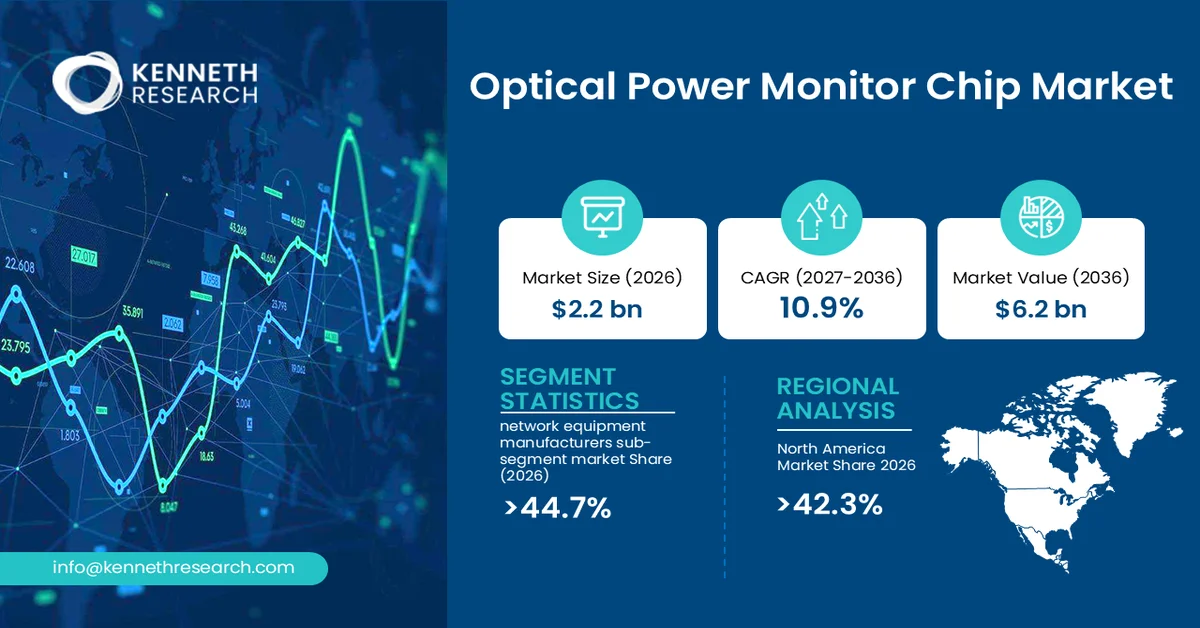
Optical Power Monitor Chip Market size was valued at USD 2.2 billion in 2026 and is projected to reach USD 6.2 billion by the end of 2036, rising at a CAGR of 10.9% during the forecast period, i.e., 2027–2036. In 2027, the industry size of the global optical power monitor chip market is estimated at USD 2.4 billion.
Key Optical Power Monitor Chip Market Insights Summary:
Key Takeaways: Market Trends & Insights
- 2.2 billion in 2026, 2.4 billion in 2027, and 6.2 billion by 2036, reflecting sustained expansion of the optical power monitor chip market
- 10.9% CAGR from 2027 to 2036, highlighting strong projected growth over the forecast period
- Network Equipment Manufacturers account for 44.7% market share in 2026, making them the leading end-user segment
- 850 nm is identified as the second and fastest analysis segment within the wavelength range category
- North America holds 42.3% market share in 2026, establishing it as the dominant regional market, with the United States and Canada as key country markets
Market Drivers
- Expansion of fiber-optic communication infrastructure
- Growing need for real-time optical network monitoring
- Increasing deployment of high-capacity broadband networks
- Greater integration of optical monitoring functions into networking equipment
Challenges
- High integration and manufacturing complexity
- Compatibility and standardization constraints
Optical Power Monitor Chip Market Overview & Supply Chain
Adoption of the optical power monitor chip market is increasing globally as telecommunications and digital infrastructure continues transitioning toward fiber-based connectivity. Optical power monitoring enables network equipment to detect signal degradation, identify abnormal operating conditions, and support maintenance and performance management across fiber-optic systems. Its relevance extends across broadband access, telecommunications transport, data centers, and high-capacity enterprise networks, where dependable optical transmission is increasingly important.
The optical power monitor chip market value chain begins with semiconductor and optoelectronic input materials, including silicon wafers, sensing components, metals, substrates, packaging materials, and electronic materials. Chip developers and semiconductor manufacturers transform these inputs through circuit design, wafer fabrication, component integration, packaging, calibration, testing, and quality assurance. Specialized foundries, photonics suppliers, and semiconductor packaging providers support production by supplying fabrication and assembly capabilities. Distribution channels then connect chip manufacturers with optical-module producers, transceiver manufacturers, and networking-equipment companies. Original equipment manufacturers integrate monitoring chips into optical transceivers, switches, routers, optical line systems, broadband equipment, and other communications platforms. End users include telecommunications operators, data-center operators, enterprise-network providers, and infrastructure organizations.
Optical Power Monitor Chip Market: Growth Drivers & Challenges
Growth Drivers
- Increasing deployment of fiber-optic communication infrastructure: The expansion of fiber-optic communication infrastructure is increasing demand for components that can continuously monitor optical signal conditions. Optical power monitor chips enable networking equipment to measure received or transmitted optical power, helping identify signal degradation, abnormal operating conditions, and potential equipment faults. Their integration into optical modules and communication equipment supports more efficient network maintenance and improves operational visibility without requiring continuous external measurement.
- Growing need for real-time optical network monitoring: The increasing complexity of optical communication systems is strengthening the need for real-time monitoring capabilities within network equipment. Higher-capacity networks incorporate sophisticated optical components and architectures that require continuous visibility into signal conditions to support troubleshooting, preventive maintenance, and operational management. Optical power monitor chips provide a compact means of embedding measurement capabilities into transceivers, optical line equipment, switches, and other communication platforms.
Challenges
- High integration and manufacturing complexity: Optical power monitor chips require precise coordination between optical sensing elements, semiconductor circuitry, packaging, calibration, and signal-processing functions. The root challenge is maintaining consistent optical sensitivity and electrical performance while integrating components into increasingly compact networking equipment. Variations in semiconductor fabrication, photodiode characteristics, packaging alignment, and temperature behavior can complicate production and quality control.
- Compatibility and standardization constraints: The optical power monitor chip market faces compatibility challenges because optical networking equipment can differ in wavelength requirements, architectures, interfaces, operating conditions, and monitoring methodologies. The root cause is the diversity of network platforms and the need for monitoring components to operate reliably within specific equipment designs. This can increase engineering work for chip suppliers and equipment manufacturers because a monitoring solution optimized for one platform may require modification or additional qualification for another.
Optical Power Monitor Chip Market Size and Forecast:
| Report Attribute | Details |
|---|---|
| Base Year |
2026 |
| Forecast Period |
2027-2036 |
| CAGR |
10.9% |
| Base Year Market Size (2026) |
USD 2.2 Billion |
| Forecast Year Market Size (2036) |
USD 6.2 Billion |
| Regional Scope |
|
Optical Power Monitor Chip Market Segmentation Analysis:
End-User Segment Analysis
In the end-user segment, network equipment manufacturers sub-segment is anticipated to capture the largest market share of 44.7% by the end of 2026.
The network equipment manufacturers segment leads the optical power monitor chip market because optical monitoring is increasingly embedded directly into the equipment responsible for managing fiber-based connectivity. Optical power monitoring enables manufacturers to incorporate signal-level measurement, fault identification, diagnostics, and performance supervision into optical line terminals, optical network terminals, switches, routers, and related platforms. Government-backed broadband programs are reinforcing demand for this equipment ecosystem. The U.S. National Telecommunications and Information Administration identifies optical line terminals, optical network terminals, and passive optical networking equipment as core components in federally supported fiber deployments, while its infrastructure programs continue supporting expansion of fiber-based networks.
Wavelength Range Segment Analysis
The 850 nm is projected to grow as the second-largest segment in the optical power monitor chip market due to four converging demand drivers.
The 850 nm wavelength segment is positioned for continued growth because it is closely associated with multimode-fiber connectivity used in datacom and enterprise environments. ITU-T identifies 850 nm as a key operating wavelength for multimode-fiber systems and notes its use with Ethernet transceivers in access-network and enterprise-building applications. Demand is further supported by the continued development of high-capacity optical interconnects for data-intensive computing environments, where compact optical modules require integrated monitoring of transmitted and received power. On the supply side, established multimode-fiber specifications and widely deployed 850 nm transceiver architectures provide component manufacturers with a mature ecosystem for developing compatible optical monitoring solutions.
Our in-depth analysis of the optical power monitor chip market includes the following segments:
|
Segment |
Sub-segment |
|
Product Type |
|
|
Application |
|
|
Wavelength Range |
|
|
End-User |
|
Optical Power Monitor Chip Market Regional Insights:
North America Market Trends & Insights:
North America optical power monitor chip is projected to hold the largest revenue share of 42.3% by the end of 2026.
Its supported by extensive fiber-network deployment, advanced telecommunications infrastructure, established optical-component manufacturing capabilities, and sustained investment in broadband connectivity. The region benefits from a mature ecosystem spanning network operators, optical equipment manufacturers, semiconductor suppliers, data-center companies, and technology providers.
The United States represents the principal country within the region, supported by federal broadband programs, telecommunications investment, and a substantial installed base of optical infrastructure.
Canada provides an additional demand center through government-supported connectivity expansion. Canada's High-Speed Internet Access Dashboard reports that 97.4% of Canadian households had high-speed internet availability in 2024, reflecting continued development of the country's broadband infrastructure. Together, these markets support continued adoption of integrated optical monitoring technologies.
Asia Pacific Market Trends & Insights:
Asia Pacific is an important regional market for optical power monitoring components, supported by extensive telecommunications infrastructure, expanding fiber connectivity, data-center development, and continued investment in high-capacity digital networks. Governments across the region are prioritizing broadband modernization and next-generation information infrastructure, creating a favorable environment for optical components used in network equipment.
China represents a major demand center because of its extensive fiber infrastructure, large telecommunications ecosystem, and continued investment in gigabit optical networks, 5G, and computing infrastructure. Government policy also supports broader deployment of high-performance optical networks and regional connectivity.
Japan provides another important market through its mature telecommunications infrastructure, advanced electronics industry, and established optical-technology capabilities. Demand opportunities are associated with network modernization, data-intensive applications, and continued requirements for reliable optical transmission and monitoring across communications equipment.
Leading Companies Operating in the Global Optical Power Monitor Chip Market:
Here is a list of upstream, downstream, and key players operating in optical power monitor chip market competitive ecosystem:
- Analog Devices Inc. (United States)
- Company Overview
- Business Strategy
- Key Product Offerings
- Financial Performance
- Key Performance Indicators
- Risk Analysis
- Recent Development
- Regional Presence
- SWOT Analysis
- Scientech Inc. (United States)
- OptoTest Corporation (United States)
- Thorlabs Inc. (United States)
Recent Developments
- Thorlabs Inc. released the PM100D3 Optical Power and Energy Meter Console, featuring a 3.5-inch touchscreen display, 8 GB internal storage, wireless charging, and Bluetooth connectivity. The console is compatible with more than 40 Thorlabs sensors including photodiode, thermal, and pyroelectric sensors. It offers four versatile measurement screen options: numerical display with bargraph, simulated analog needle, statistics, and data logging.
Frequently Asked Question
In 2026, the optical power monitor chip market exceeded USD 2.2 billion.
The optical power monitor chip market is projected to reach USD 6.2 billion by the end of 2036, expanding at a CAGR of 10.9% over the forecast period (2027-2036).
The major players in the market are Analog Devices Inc., Scientech Inc., OptoTest Corporation, Thorlabs Inc., and others.
In the End-User segment, the Network Equipment Manufacturers sub-segment is anticipated to capture the largest market share of 44.7% in the future and exhibit lucrative growth opportunities during 2027-2036. This growth trajectory is largely attributed to increasing deployment of fiber-optic communication infrastructure.
North America is projected to hold the largest market share of 42.3% by the end of 2036 and provide more business opportunities in the future. Continuous investments in fiber infrastructure, broadband connectivity, and optical networking equipment are fostering the region's dominance.
Why Choose Kenneth Research ?
-
Insight with Impact : We don’t just gather data — we uncover stories, trends, and opportunities that fuel business growth.
-
Experts Who Get It : Our team speaks your industry’s language and knows what really matters to your customers and market.
-
Custom-Built for You : Forget one-size-fits-all. We craft research and consulting solutions as unique as your business vision.
-
Partners, Not Just Providers : We work with you, not for you — collaborating closely to turn insights into smart, strategic moves.
-
Results That Speak : Our work powers brands, startups, and industry leaders alike — with a track record of ideas that work in the real world.
Report ID: 1465 |
Published Date: 28 Sep 2026 |
Report Format: |
Delivery Timeline: 48-72 Business Hours

Copyright © 2025 Kenneth Research. All rights reserved. Terms of Use | Privacy Policy
