Report ID: 1177 |
Published Date: 26 Aug 2026 |
Report Format: |
Delivery Timeline: 48-72 Business Hours
Optical Network Controller Market Outlook:
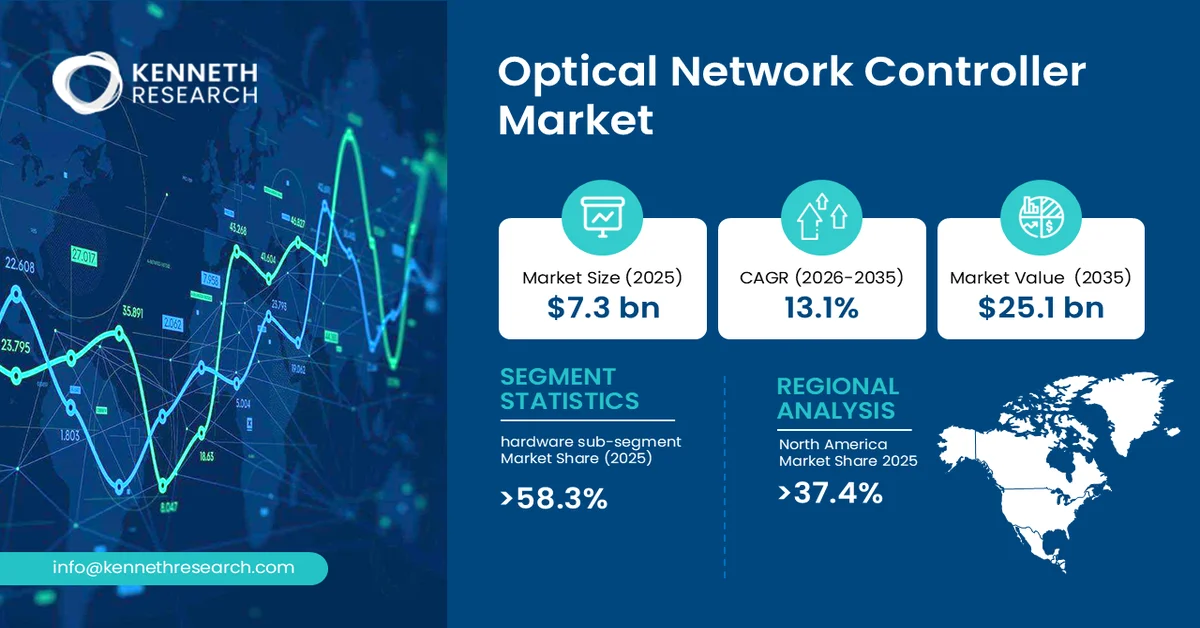
Optical Network Controller Market size was valued at USD 7.3 billion in 2025 and is projected to reach USD 25.1 billion by the end of 2035, rising at a CAGR of 13.1% during the forecast period, i.e., 2026-2035. In 2026, the industry size of the optical network controller is estimated at USD 8.3 billion.
The primary growth driver for the optical network controller market is the rapid expansion of high-bandwidth digital infrastructure. Growing cloud computing, 5G networks, and AI workloads are increasing requirements for scalable optical transport, automated network management, and efficient traffic optimization, accelerating adoption of intelligent optical network controllers.
The optical network controller market comprises software and hardware-enabled control technologies used to manage, automate, optimize, and orchestrate optical communication networks. These controllers coordinate optical network elements, configure transmission resources, monitor network performance, and dynamically manage wavelengths, routes, bandwidth, and connectivity across complex fiber-optic infrastructures.
Key characteristics include centralized or distributed network control, automated provisioning, real-time monitoring, topology discovery, fault management, traffic engineering, wavelength optimization, and interoperability with software-defined networking architectures.
Key Optical Network Controller Market Insights Summary:
Key Takeaways: Market Trends & Insights
- Optical Network Controller Market projected to grow from USD 7.3 billion in 2025 to USD 25.1 billion by 2035 at a 13.1% CAGR.
- North America accounted for the largest regional share at 37.4% in 2025, supported by advanced fiber infrastructure, data-center expansion, and strong investment in high-capacity telecommunications networks.
- Hardware is the leading Component segment with a 58.3% share in 2025, driven by continued deployment and upgrading of optical transmission, switching, and networking infrastructure.
- Wavelength Division Multiplexing is expected to witness strong growth as operators seek to maximize fiber capacity, support bandwidth-intensive applications, and enable efficient management of optical resources.
Market Drivers
- Rising fiber infrastructure and high-bandwidth connectivity demand.
- Increasing automation of optical network operations.
- Growing data-center interconnection and cloud infrastructure deployment.
- Increasing adoption of 5G and next-generation telecommunications networks.
Challenges
- Legacy infrastructure and multi-vendor integration.
- High implementation complexity and specialized expertise.
Optical Network Controller Market Overview & Supply Chain
Adoption of optical network controllers is increasing globally as telecommunications operators, cloud providers, data centers, and enterprises expand high-capacity fiber infrastructure to support bandwidth-intensive digital services. The growth of fiber connectivity, 5G backhaul, cloud computing, artificial intelligence, and data-center interconnection is increasing the need for automated network orchestration, dynamic traffic management, and efficient utilization of optical resources. The OECD reported that fiber accounted for 47% of total fixed broadband subscriptions across OECD economies by the end of 2024, highlighting the continuing transition toward fiber-based connectivity infrastructure.
The optical network controller value chain begins with component and technology providers supplying optical transceivers, switches, routers, wavelength-management equipment, processors, networking hardware, and software platforms. Optical equipment manufacturers integrate these technologies into transmission systems and programmable network infrastructure, while controller developers create software and hardware platforms capable of configuring, monitoring, and orchestrating optical network resources. System integrators and telecommunications technology providers subsequently deploy and customize controllers according to network architecture, interoperability, automation, and performance requirements. Distribution occurs through direct sales, technology partnerships, specialized networking integrators, and managed infrastructure agreements.
Optical Network Controller Market: Growth Drivers & Challenges
Growth Drivers:
- Rising fiber infrastructure and high-bandwidth connectivity demand: The rapid expansion of fiber-based connectivity is increasing the need for optical network controllers that can automate provisioning, optimize traffic, and manage increasingly complex transport infrastructure. Telecom operators and infrastructure providers are deploying higher-capacity optical networks to support cloud services, data centers, 5G connectivity, enterprise applications, and bandwidth-intensive digital services. The Indian Department of Telecommunications reported that more than 6.9 lakh kilometers of optical fiber cable had been laid by June 2024, illustrating the scale of ongoing fiber infrastructure development.
- Increasing automation of optical network operations: The growing complexity of optical transport networks is accelerating the shift from manually managed infrastructure toward software-defined and automated network operations. Operators increasingly require real-time visibility into network conditions, automated service provisioning, predictive fault management, and intelligent traffic optimization to maintain performance while controlling operational complexity. Optical network controllers provide a centralized control layer that can coordinate multiple network elements and dynamically allocate available resources according to traffic requirements. Integration with artificial intelligence and machine learning is further enabling predictive maintenance, automated troubleshooting, and closed-loop optimization.
Challenges:
- Legacy infrastructure and multi-vendor integration: A major restraint is the difficulty of integrating optical network controllers with legacy equipment and heterogeneous multi-vendor infrastructure. Telecom operators often operate networks containing equipment from different generations and manufacturers, each with distinct management interfaces, protocols, and control mechanisms. This complicates centralized orchestration, automated provisioning, and end-to-end visibility. Modern optical architectures increasingly require coordination across IP, optical transport, and wavelength layers, while legacy environments can limit interoperability and automation.
- High implementation complexity and specialized expertise: Optical network controllers require sophisticated technical capabilities spanning network engineering, optical transmission, software-defined networking, automation, and performance management. Deploying controllers across complex optical environments can therefore require specialized personnel, extensive testing, and careful integration with existing operational-support systems. The challenge becomes more pronounced as operators move toward autonomous and AI-enabled network management, where reliable data, interoperability and operational trust are essential.
Optical Network Controller Market Size and Forecast:
| Report Attribute | Details |
|---|---|
| Base Year |
2025 |
| Forecast Year |
2026-2035 |
| CAGR |
13.1% |
| Base Year Market Size (2025) |
USD 7.3 billion |
| Forecast Year Market Size (2035) |
USD 25.1 billion |
| Regional Scope |
|
Optical Network Controller Market Segmentation Analysis:
Component Segment Analysis
In the component segment, the hardware sub-segment is anticipated to capture the largest market share of 58.3% in 2025.
Its dominance is supported by continued investment in fiber-optic transmission infrastructure, optical switching equipment, transponders, amplifiers, and related networking hardware required to build and expand high-capacity optical networks. Increasing data traffic from cloud computing, data centers, 5G connectivity, and enterprise digitization is encouraging network operators to upgrade physical optical infrastructure while incorporating greater programmability and automation. The U.S. Federal Communications Commission reported that residential fiber-to-the-premises connections increased from 24.4 million to 28 million between December 2022 and December 2023, demonstrating continued expansion of fiber-based connectivity infrastructure
Network Type Segment Analysis
In the network type segment, the wavelength division multiplexing sub-segment is projected to grow strongly as network operators seek to increase fiber capacity while efficiently utilizing existing optical infrastructure. WDM enables multiple optical channels to operate over the same fiber, supporting scalable bandwidth expansion for telecommunications, data centers, enterprise connectivity, and high-capacity backhaul networks. Adoption is also supported by increasing requirements for flexible wavelength allocation and automated optical network management, which strengthen the role of network controllers in configuring and optimizing WDM resources. India's Telecommunication Engineering Centre identifies WDM-based technologies among the fixed-access and transport technologies supporting broadband, 5G backhaul and fronthaul, and data-center interconnection applications.
Our in-depth analysis of the global optical network controller market includes the following segments:
|
Segment |
Sub-segment |
|
Component |
|
|
Network Type |
|
|
Application |
|
|
Organization Size |
|
|
End User |
|
Optical Network Controller Market Regional Insights:
North America Market Trends & Insights:
North America accounted for 37.4% of the optical network controller market in 2025, maintaining its leading position due to extensive fiber infrastructure, advanced telecommunications networks, large-scale data-center ecosystems, and strong investment in high-capacity connectivity.
The U.S. remains the principal regional market, supported by major telecommunications operators, hyperscale cloud providers, and extensive investment in next-generation connectivity infrastructure. Federal broadband programs are also supporting continued high-speed network deployment.
Canada complements regional growth through expanding fiber connectivity and regulatory initiatives encouraging continued investment in high-speed networks. The CRTC has specifically emphasized expanding access to existing fiber infrastructure while maintaining incentives for further network investment.
Europe Market Trends & Insights:
Asia Pacific is emerging as a major growth region for the optical network controller market, supported by rapid fiber deployment, 5G expansion, cloud computing, data-center development, and increasing demand for high-capacity digital connectivity. Governments across the region are prioritizing next-generation communications infrastructure, creating opportunities for automated optical network management and orchestration.
Japan represents a technologically advanced market with sophisticated telecommunications infrastructure and strong demand for reliable, high-capacity connectivity. Continued cloud adoption, data-center expansion, and 5G development create opportunities for programmable optical networking and intelligent control platforms. Network operators are increasingly focused on improving operational efficiency and managing complex multi-layer infrastructure.
China offers significant opportunities because of its large-scale fiber deployment, expanding 5G infrastructure, data-center investment, and government emphasis on digital infrastructure. The country's continued development of high-speed optical networks should encourage adoption of controllers supporting automated provisioning, traffic optimization, monitoring, and multi-vendor network orchestration.
Leading Companies Operating in the Global Optical Network Controller Market:
Here is a list of upstream, downstream, and key players operating in the global optical network controller market competitive ecosystem:
- Nokia(Finland)
- Company Overview
- Business Strategy
- Key Product Offerings
- Financial Performance
- Key Performance Indicators
- Risk Analysis
- Recent Development
- Regional Presence
- SWOT Analysis
- Ciena(United States)
- Cisco(United States)
- Huawei(China)
Recent Developments
- February 2025 –The European Commission approved Nokia’s acquisition of Infinera without conditions, clearing the way for the transaction to strengthen Nokia’s optical networking portfolio.
- 2025 –Ciena continued advancing its optical networking portfolio around high-capacity connectivity and network automation, including its Navigator Network Control Suite for multi-layer, multi-vendor network control.
Frequently Asked Question
In 2025, the optical network controller market exceeded USD 7.3 billion.
The optical network controller market is projected to reach USD 25.1 billion by the end of 2035, expanding at a CAGR of 13.1% over the forecast period (2026-2035).
The major players in the market are Ciena, Cisco, Nokia, Huawei, Juniper Networks, and others.
In the Component segment, the Hardware sub-segment is anticipated to capture the largest market share of 58.3% in the future and exhibit lucrative growth opportunities during 2026–2035.
North America is projected to hold the largest market share of 37.4% by the end of 2025 and provide more business opportunities in the future.
Why Choose Kenneth Research ?
-
Insight with Impact : We don’t just gather data — we uncover stories, trends, and opportunities that fuel business growth.
-
Experts Who Get It : Our team speaks your industry’s language and knows what really matters to your customers and market.
-
Custom-Built for You : Forget one-size-fits-all. We craft research and consulting solutions as unique as your business vision.
-
Partners, Not Just Providers : We work with you, not for you — collaborating closely to turn insights into smart, strategic moves.
-
Results That Speak : Our work powers brands, startups, and industry leaders alike — with a track record of ideas that work in the real world.
Report ID: 1177 |
Published Date: 26 Aug 2026 |
Report Format: |
Delivery Timeline: 48-72 Business Hours

Copyright © 2025 Kenneth Research. All rights reserved. Terms of Use | Privacy Policy
