Report ID: 1185 |
Published Date: 26 Aug 2026 |
Report Format: |
Delivery Timeline: 48-72 Business Hours
Optical Fiber Connector Market Outlook:
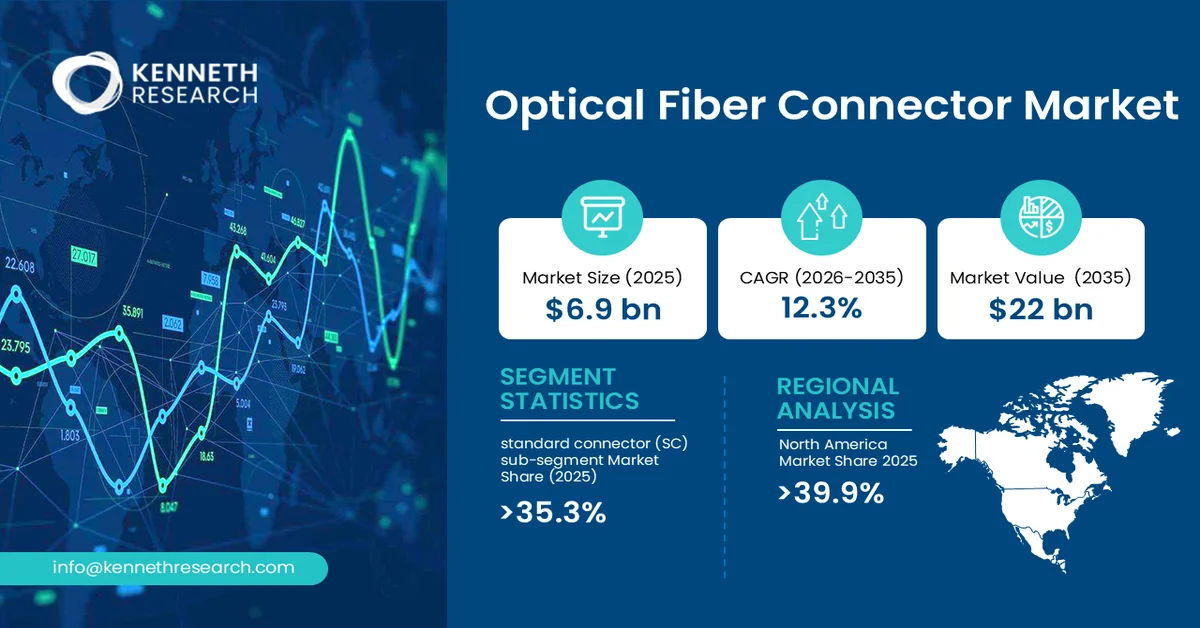
Optical Fiber Connector Market size was valued at USD 6.9 billion in 2025 and is projected to reach USD 22 billion by the end of 2035, rising at a CAGR of 12.3% during the forecast period, i.e., 2026-2035. In 2026, the industry size of the optical fiber connector is estimated at USD 7.7 billion.
The primary growth driver is expanding fixed-broadband infrastructure and the continuing shift toward fiber-based connectivity. ITU reports that fixed-broadband subscriptions grew at an average rate of 6.7% per year through 2023, supporting sustained deployment of optical networks and increasing requirements for high-performance fiber interconnection components across telecom and data networks.
The optical fiber connector market comprises the products and associated solutions used to mechanically and optically join, terminate, disconnect, and reconnect optical fibers within fiber-optic communication systems. These components establish precise alignment between fiber ends so that optical signals can pass between cables, network equipment, modules, panels, and other transmission infrastructure with controlled insertion and return losses.
Key products include single-fiber and multi-fiber connector configurations, with designs differentiated by connector type, fiber mode, interface geometry, termination method, and application environment. Common connector architectures are engineered for repeatable mating, physical protection, installation efficiency, and compatibility with optical transmission equipment. The market therefore encompasses connector bodies, ferrules, sleeves, adapters, housings, and related assemblies used across network architectures.
Key Optical Fiber Connector Market Insights Summary:
Key Takeaways: Market Trends & Insights
- Optical fiber connector market reached USD 6.9 billion in 2025
- Optical fiber connector market is projected to reach USD 22.0 billion by 2035 at a CAGR of 12.3% during 2026-2035
- Standard Connector (SC) segment accounted for 35.3% market share in 2025
- North America dominated the optical fiber connector market with a 39.9% market share in 2025
- Multi-mode Fiber Optic Connectors represent the second or fastest analysis segment within the Fiber Mode category
Market Drivers
- Fiber-based broadband infrastructure expansion
- Higher network density and data-intensive connectivity
- Data-center and cloud infrastructure expansion
- Deployment of next-generation telecommunications networks
Challenges
- Connector performance sensitivity and installation quality
- Interoperability and standardization complexity
Optical Fiber Connector Market Overview & Supply Chain
Adoption of optical fiber connectors is increasing as telecom operators, enterprises, and data-intensive industries transition toward higher-capacity, future-proof network infrastructure. Fiber provides the physical connectivity foundation for broadband access, data-center interconnection, enterprise networks, and the backhaul required to support advanced mobile networks.
The Optical Fiber Connector Market value chain begins with raw-material and component suppliers providing optical-grade glass, ceramics, polymers, metals, precision-machined components, adhesives, and packaging materials. These inputs move to specialized manufacturers that produce ferrules, connector housings, adapters, sleeves, boots, and complete connector assemblies through molding, machining, polishing, alignment, assembly, and quality-control processes. Component and finished-product manufacturers supply telecom equipment makers, cable and fiber-assembly companies, distributors, system integrators, and specialized networking suppliers. Distribution channels include direct sales, authorized distributors, electrical and communications equipment suppliers, and project-based procurement for large network deployments.
Optical Fiber Connector Market: Growth Drivers & Challenges
Growth Drivers:
- Fiber-based broadband infrastructure expansion: Government-backed broadband programs are accelerating deployment of fiber infrastructure, creating a direct requirement for reliable optical interconnection components. The mechanism extends beyond initial construction: fiber networks require connectorized interfaces for commissioning, testing, maintenance, equipment replacement, and incremental capacity additions. Government emphasis on resilient broadband infrastructure therefore supports recurring demand for connector products alongside cable and active optical equipment.
- Higher network density and data-intensive connectivity: Increasing network complexity is strengthening demand for optical connectors that provide compact, repeatable, and serviceable fiber interconnections. Data centers, enterprise networks, telecom aggregation facilities, and high-capacity access infrastructure increasingly require dense optical distribution architectures in which numerous fibers must be terminated and managed within constrained physical spaces. This favors connector designs that simplify installation, improve port density, support modular upgrades, and enable technicians to isolate or replace network elements without disrupting an entire fiber route. The growth mechanism is therefore tied not only to new fiber deployment but also to the increasing number of connection points within each network architecture. For manufacturers, this encourages innovation in multi-fiber interfaces, higher-density assemblies, improved alignment, and connector systems optimized for automated or repeatable installation.
Challenges:
- Connector performance sensitivity and installation quality: Optical fiber connectors require highly controlled end-face cleanliness, alignment, polishing, and mating conditions because small physical imperfections can impair optical transmission. The root cause is the tight interface between fiber cores, where contamination, scratches, poor termination, or misalignment can introduce insertion loss and reflection. This creates commercial pressure across manufacturing, installation, commissioning, and maintenance because connector performance depends not only on component quality but also on handling practices and technician execution. Network operators may consequently face additional inspection, cleaning, testing, rework, and service requirements, increasing the operational burden associated with connectorized deployments. The challenge becomes more significant as networks become denser and performance margins tighten.
- Interoperability and product standardization complexity: The market faces complexity from the coexistence of multiple connector architectures, fiber configurations, polishing approaches, equipment interfaces, and application-specific performance requirements. The root cause is the heterogeneous installed base spanning legacy telecommunications infrastructure, modern data centers, enterprise networks, and specialized industrial environments. This fragmentation can complicate procurement because operators and integrators must match connector assemblies with existing cables, adapters, transceivers, panels, and optical equipment while maintaining compatibility and performance. Commercially, manufacturers must support broader product portfolios, maintain tighter quality controls, and manage inventory across multiple configurations, while customers can face higher qualification and replacement costs.
Optical Fiber Connector Market Size and Forecast:
| Report Attribute | Details |
|---|---|
| Base Year |
2025 |
| Forecast Year |
2026-2035 |
| CAGR |
12.3% |
| Base Year Market Size (2025) |
USD 6.9 billion |
| Forecast Year Market Size (2035) |
USD 22 billion |
| Regional Scope |
|
Optical Fiber Connector Market Segmentation Analysis:
Connector Type Segment Analysis
In the connector type segment, the standard connector (SC) sub-segment is anticipated to capture the largest market share of 35.3% by the end of 2025.
Standard Connector (SC) leads the connector-type segment because its established design, straightforward push-pull mating mechanism, broad equipment compatibility, and suitability for telecom and fiber-access installations make it a practical choice across established and expanding optical networks. Demand is reinforced by continued fiber adoption in broadband infrastructure and by replacement, maintenance, and network-extension requirements where compatibility with existing installations is commercially important. This installed-base expansion supports demand for standardized connector interfaces used in network termination and interconnection. On the supply side, mature SC manufacturing processes, established component ecosystems, and widespread installer familiarity support availability and procurement efficiency.
Fiber Mode Segment Analysis
The Multi-mode Fiber Optic Connectors is projected to grow as the second-largest segment in the optical fiber connector market due to four converging demand drivers.
Multi-mode fiber optic connectors are positioned for continued growth as short-reach, high-density optical links expand within data centers, enterprise networks, and computing environments. Their suitability for relatively short-distance connections, combined with compatibility with established multimode infrastructure and cost-conscious optical transceiver architectures, supports adoption where high bandwidth and practical deployment economics must be balanced. Demand is being reinforced by the rapid expansion of computing infrastructure. The U.S. Department of Energy reported that U.S. data centers consumed approximately 176 TWh of electricity in 2023, underscoring the scale and continuing industrialization of data-center infrastructure that relies on dense internal connectivity. Supply-side conditions also favor the segment because multimode connector ecosystems are mature, standardized, and supported by established fiber, transceiver, cabling, and termination suppliers.
Our in-depth analysis of the global optical fiber connector market includes the following segments:
|
Segment |
Sub-segment |
|
Connector Type |
|
|
Fiber Mode |
|
|
Distribution Channel |
|
|
End Use Industry |
|
Optical Fiber Connector Market Regional Insights:
North America Market Trends & Insights:
North America optical fiber connector market is projected to hold the largest revenue share of 39.9% by the end of 2025.
Regional leadership is supported by extensive fiber-network deployment, strong telecommunications infrastructure, high enterprise connectivity requirements, and sustained investment in broadband modernization. The United States remains a major demand center as operators, data centers, enterprises, and public-sector networks continue expanding high-speed fiber infrastructure. Government-backed broadband programs and domestic manufacturing policies are also strengthening the regional ecosystem for optical fiber components and connectivity equipment.
The United States represents the region’s principal market, supported by large-scale broadband expansion, hyperscale data-center development, telecommunications upgrades, and federal infrastructure initiatives. Policy support is encouraging further fiber deployment while strengthening domestic supply chains for optical networking equipment.
Canada complements regional growth through continued expansion of high-speed broadband coverage and communications infrastructure. Together, the two markets provide a strong combination of infrastructure investment, technology adoption, and regulatory support, reinforcing North America’s position as the leading regional market for optical fiber connectors.
Asia Pacific Market Trends & Insights:
Asia Pacific represents a significant opportunity for the optical fiber connector market, supported by expanding telecommunications infrastructure, digital transformation, data-center development, and increasing demand for high-capacity connectivity across residential and industrial applications.
China remains a key regional market because of its large telecommunications ecosystem, industrial base, and policy emphasis on upgrading optical networks toward ultra-high-speed and intelligent infrastructure. The country's focus on integrating optical connectivity with factories, industrial parks, and advanced digital applications can broaden demand across multiple deployment environments.
Japan offers complementary opportunities through continued fiber-network maintenance, digital infrastructure expansion, data-center development, and research into next-generation optical communications.
Leading Companies Operating in the Global Optical Fiber Connector Market:
Here is a list of upstream, downstream, and key players operating in the global optical fiber connector market competitive ecosystem:
- Amphenol Corporation (United States)
- Company Overview
- Business Strategy
- Key Product Offerings
- Financial Performance
- Key Performance Indicators
- Risk Analysis
- Recent Development
- Regional Presence
- SWOT Analysis
- Molex Incorporated (United States)
- Corning Incorporated (United States)
- TE Connectivity Ltd. (Switzerland/United States)
- CommScope (United States)
Recent Developments
- In March 2026, TE Connectivity showcased end-to-end optical infrastructure solutions at OFC 2026, featuring breakthrough high-density fiber array units enabled by its acquisition of RAM Photonics, which delivers industry-leading density and lower insertion loss through advanced active alignment and automated fusion splicing. The company demonstrated 1.6T Linear Receive Optics with ultra-high-density connectors alongside 3.2T CPO integration.
- In March 2026, Molex introduced the VersaBeam EBO Backplane Connector consolidating up to 192 fibers into a single compact interface, along with the High-Radix Optical Circuit Switch Platform for dynamic, low-power optical reconfiguration in AI clusters. The company also enhanced its Co-Packaged Optics toolkit with a Versatile Format Interconnect offering up to 50% density boost and External Laser Source Small Form Factor Pluggable connectors to improve CPO reliability.
Frequently Asked Question
In 2025, the optical fiber connector market exceeded USD 6.9 billion.
The optical fiber connector market is projected to reach USD 22.0 billion by the end of 2035, expanding at a CAGR of 12.3% over the forecast period (2026-2035).
The major players in the market are Amphenol Corporation, Molex Incorporated, Corning Incorporated, TE Connectivity Ltd., CommScope, and others.
In the connector type segment, the standard connector (sc) sub-segment is anticipated to capture the largest market share of 35.3% in the future and exhibit lucrative growth opportunities during 2026-2035. This growth trajectory is largely attributed to expanding telecommunications and fiber-network infrastructure.
North America is projected to hold the largest market share of 39.9% by the end of 2035 and provide more business opportunities in the future. Continuous investments in broadband expansion, data-center development, telecommunications upgrades, and fiber infrastructure across the United States and Canada are fostering the region's dominance.
Why Choose Kenneth Research ?
-
Insight with Impact : We don’t just gather data — we uncover stories, trends, and opportunities that fuel business growth.
-
Experts Who Get It : Our team speaks your industry’s language and knows what really matters to your customers and market.
-
Custom-Built for You : Forget one-size-fits-all. We craft research and consulting solutions as unique as your business vision.
-
Partners, Not Just Providers : We work with you, not for you — collaborating closely to turn insights into smart, strategic moves.
-
Results That Speak : Our work powers brands, startups, and industry leaders alike — with a track record of ideas that work in the real world.
Report ID: 1185 |
Published Date: 26 Aug 2026 |
Report Format: |
Delivery Timeline: 48-72 Business Hours

Copyright © 2025 Kenneth Research. All rights reserved. Terms of Use | Privacy Policy
