Report ID: 1055 |
Published Date: 05 Aug 2026 |
Report Format: |
Delivery Timeline: 48-72 Business Hours
Oncology Drugs Market Outlook:
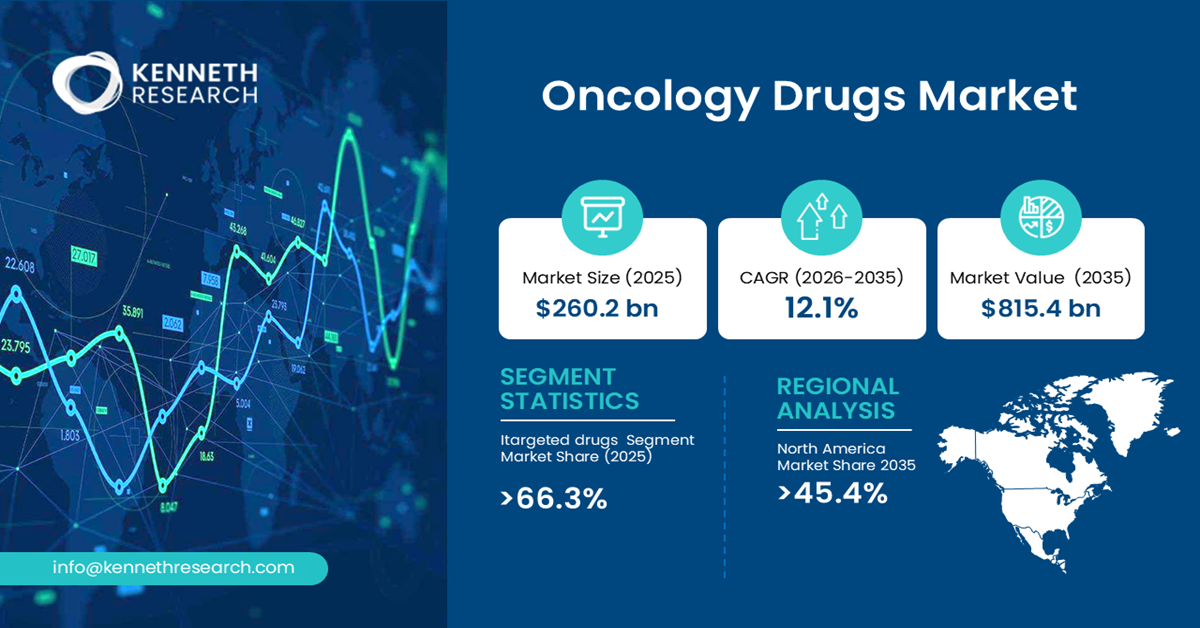
Oncology Drugs Market size was valued at USD 260.2 billion in 2025 and is projected to reach USD 815.4 billion by the end of 2035, rising at a CAGR of 12.1% during the forecast period, i.e., 2026-2035. In 2026, the industry size of the oncology drugs is estimated at USD 291.7 billion.
The rising global cancer burden is the primary growth driver for the oncology drugs market, increasing demand for effective systemic therapies across cancer types. Growing diagnosis rates, persistent treatment needs, and expanding access to oncology care are encouraging pharmaceutical companies to develop innovative targeted, immunological, hormonal, and cytotoxic therapies. WHO and IARC reported that cancer remains a major global health burden, reinforcing the need for improved treatment availability.
The oncology drugs market comprises pharmaceutical products developed, manufactured, and commercialized for the prevention, treatment, control, or management of cancer and associated complications. The market encompasses multiple therapeutic classes, including targeted therapies, chemotherapy agents, hormonal therapies, immunotherapies, and other systemic treatments used according to cancer type, disease stage, molecular characteristics, and patient requirements.
A key characteristic of oncology drugs is their increasingly personalized approach to treatment. Modern therapies can be designed to act against specific molecular pathways, cancer-cell characteristics, or immune mechanisms, alongside conventional treatments that directly inhibit or destroy malignant cells. Treatment selection commonly depends on accurate cancer diagnosis and clinical assessment, with systemic therapy used independently or alongside surgery and radiotherapy. WHO identifies chemotherapy, hormonal treatments, targeted biological therapies, surgery, and radiotherapy among the principal approaches used in cancer treatment.
Key Oncology Drugs Market Insights Summary:
Key Takeaways: Market Trends & Insights
- Oncology drugs market projected to grow from USD 260.2 billion in 2025 to USD 815.4 billion by 2035 at a 12.1% CAGR
- North America is projected to account for the largest regional share at 45.4% in 2035, supported by advanced oncology infrastructure, pharmaceutical R&D capabilities, and strong cancer research ecosystems across the U.S. and Canada
- Targeted drugs is expected to remain the leading drug class segment with a 66.3% market share in 2025, supported by increasing adoption of precision oncology, biomarker-driven treatment, and molecularly targeted therapies
- Hospital pharmacies are positioned for continued growth within the distribution channel segment, supported by the increasing use of specialized oncology medicines requiring clinical oversight, controlled handling, and integration with hospital-based cancer care
- The market is benefiting from expanding adoption of precision medicine, targeted therapies, immuno-oncology, biomarker-based treatment, and advanced cancer medicines, alongside continued pharmaceutical innovation and investment in oncology drug development.
Market Drivers
- Expansion of precision and targeted oncology therapies
- Increasing adoption of advanced cancer therapies
- Growing integration of biomarker-based diagnosis and personalized treatment
- Expansion of innovative immuno-oncology and cellular therapy pipelines
Challenges
- High development complexity and regulatory burden
- Pricing pressure and uneven patient access
Oncology Drugs Market Overview & Supply Chain
Global adoption of oncology drugs is increasing as healthcare systems respond to a substantial and evolving cancer burden while treatment approaches become more specialized. Advances in precision medicine, biomarker-based treatment selection, targeted therapies, immuno-oncology, and biologic medicines are strengthening the role of pharmaceuticals in cancer management. Regulatory systems are also adapting to increasingly sophisticated treatment modalities, while governments and international health organizations continue emphasizing access to safe, effective, quality-assured cancer medicines. The industrial relevance is reinforced by the WHO’s essential-medicines framework, which supports evidence-based selection, procurement, and distribution of medicines. In its 2023 update process, the WHO expert committee considered 85 applications proposing additions, changes, or deletions of medicines, medicine classes, and formulations, demonstrating the continuing regulatory and clinical evaluation of pharmaceutical treatments.
The oncology drugs market value chain begins with specialized raw materials and inputs, including active pharmaceutical ingredients, biological materials, excipients, solvents, cell-culture components, and packaging materials sourced from qualified suppliers. Pharmaceutical and biotechnology manufacturers then undertake drug discovery, formulation, synthesis or biological production, purification, quality testing, filling, packaging, and regulatory-compliant release. For advanced oncology products, manufacturing may require specialized facilities, controlled environments, sophisticated analytical systems, and validated processes. Finished medicines move through wholesalers, distributors, specialty pharmacies, hospital pharmacies, and other authorized channels before reaching hospitals, oncology centers, clinics, and patients. Major stakeholders include pharmaceutical and biotechnology companies, contract development and manufacturing organizations, raw-material suppliers, regulatory authorities, healthcare providers, procurement agencies, insurers, distributors, pharmacists, and patients. Effective coordination across these participants is essential for maintaining product quality, regulatory compliance, supply continuity, appropriate storage, and timely patient access.
Oncology Drugs Market: Growth Drivers & Challenges
Growth Drivers:
- Expansion of precision and targeted oncology therapies: The shift toward precision oncology is accelerating demand for targeted drugs by enabling treatment decisions based on specific molecular characteristics of tumors. Biomarker testing and companion diagnostics increasingly help identify patients who are more likely to benefit from therapies directed at defined genetic mutations, receptors, or signaling pathways. This improves the clinical positioning of targeted medicines and encourages pharmaceutical companies to invest in differentiated oncology pipelines. The FDA’s 2024 oncology review illustrates this innovation trajectory: the agency reported approval of 17 novel cancer drugs by its Office of Oncologic Diseases, spanning multiple cancer types and therapeutic areas. The same review also documented approvals involving companion diagnostics, reinforcing the linkage between molecular testing and drug selection. As precision medicine becomes more integrated into oncology practice, targeted therapies should continue gaining clinical relevance, supporting pharmaceutical innovation, premium treatment opportunities, and expansion of personalized cancer care.
- Increasing adoption of advanced cancer therapies: The oncology treatment landscape is moving beyond conventional cytotoxic approaches toward therapies that use highly specific biological mechanisms, immune activation, and cellular engineering. This transition is expanding the range of treatment options available to patients with difficult-to-treat or previously limited-treatment cancers. Pharmaceutical manufacturers are consequently prioritizing differentiated mechanisms, combination regimens, and therapies capable of addressing specific disease characteristics. Regulatory pathways that facilitate evaluation of innovative treatments can further accelerate their movement from clinical development into healthcare systems. The resulting innovation cycle encourages investment across pharmaceutical research, biotechnology, clinical development, manufacturing, and specialized distribution. Over the longer term, continued advances in immuno-oncology, antibody-based medicines, cellular therapies, and other biologically sophisticated approaches are expected to broaden the therapeutic landscape. This should support continued demand for innovative oncology medicines while increasing the importance of specialized manufacturing capabilities, clinical evidence generation, biomarker strategies, and regulatory expertise across the industry.
Challenges:
- High development complexity and regulatory burden: The development of oncology drugs involves extensive preclinical research, complex clinical trial designs, biomarker validation, long development timelines, and rigorous regulatory evaluation. Modern oncology therapies increasingly target narrow patient populations, requiring precision-based trial enrollment and sophisticated diagnostic integration. These factors substantially increase research costs and operational complexity while raising the risk of clinical failure during development. Commercially, manufacturers must balance innovation with regulatory compliance, manufacturing scalability, pharmacovigilance obligations, and reimbursement expectations across different healthcare systems. The need to continuously generate post-marketing evidence and adapt to evolving regulatory requirements further adds to lifecycle management costs. Looking ahead, as oncology therapies become increasingly personalized and technologically advanced, companies with strong clinical development capabilities, regulatory expertise, and integrated diagnostic partnerships are likely to be better positioned to navigate these challenges and sustain long-term competitiveness.
- Pricing pressure and uneven patient access: Although oncology drug innovation continues to advance, commercial success is increasingly influenced by affordability, reimbursement policies, and healthcare budget constraints. Many healthcare systems carefully evaluate the clinical value and economic impact of newly introduced therapies before granting reimbursement or formulary inclusion. Differences in national reimbursement frameworks, procurement processes, and healthcare infrastructure can delay or limit patient access to innovative medicines despite regulatory approval. Pharmaceutical manufacturers therefore face increasing pressure to demonstrate not only therapeutic effectiveness but also long-term value through health-economic evidence and real-world outcomes. These commercial dynamics influence pricing strategies, market entry sequencing, and lifecycle planning. Over time, broader adoption of value-based healthcare models and increasing scrutiny of pharmaceutical expenditures are expected to intensify pricing negotiations, making market access strategy as important as scientific innovation for sustained growth.
Oncology Drugs Market Size and Forecast:
| Report Attribute | Details |
|---|---|
| Base Year |
2025 |
| Forecast Year |
2026-2035 |
| CAGR |
12.1% |
| Base Year Market Size (2025) |
USD 260.2 billion |
| Forecast Year Market Size (2035) |
USD 815.4 billion |
| Regional Scope |
|
Oncology Drugs Market Segmentation Analysis:
Targeted Drugs Segment Analysis
In the drug class segment, the targeted drugs sub-segment is anticipated to capture the largest market share of 66.3% in 2025.
In the drug class segment, targeted drugs dominate the oncology drugs market because cancer treatment is increasingly shifting toward therapies designed around specific molecular abnormalities and tumor biology. Targeted medicines can selectively interfere with proteins or pathways involved in cancer-cell growth, division, and survival, supporting more personalized treatment strategies. The U.S. National Cancer Institute identifies targeted therapy as a foundation of precision medicine and notes that treatment selection commonly requires biomarker testing to determine whether a tumor contains an actionable target.
Demand is further supported by the expansion of companion diagnostics and molecular profiling. In 2024, the FDA approved the true sight oncology comprehensive test, which detects variants across 517 genes and is intended to identify patients who may benefit from specified targeted therapies. This diagnostic–drug integration strengthens adoption by enabling more precise patient selection. On the supply side, pharmaceutical developers continue expanding targeted pipelines across biomarker-defined cancers and tissue-agnostic indications. Going forward, broader genomic testing, improved biomarker identification, and increasingly personalized treatment pathways should reinforce the segment's leadership.
Hospital Pharmacies Segment Analysis
In the distribution channel segment, hospital pharmacies are projected to expand as oncology treatment increasingly depends on medicines requiring specialist oversight, controlled dispensing, and coordination with multidisciplinary care teams. Hospital pharmacies are particularly important for injectable antineoplastic medicines, supportive-care therapies, dose adjustments, treatment protocols, and medicines administered within oncology departments. Their integration with hospital information systems and clinical pharmacy services also supports medication verification, inventory management, and pharmacovigilance.
Demand is reinforced by the continued concentration of cancer treatment within specialized healthcare facilities. According to the U.S. National Cancer Institute, more than 1.9 million people were expected to be diagnosed with cancer in the United States in 2024, sustaining the need for structured oncology medicine distribution and treatment services.
On the supply side, hospitals are strengthening pharmacy infrastructure, cold-chain capabilities, computerized medication management, and specialist handling procedures for increasingly complex oncology medicines. Hospital pharmacies also provide manufacturers and healthcare systems with an important controlled channel for high-value and specialized therapies. Going forward, increasing treatment complexity, multidisciplinary oncology care, and demand for safe medication management should support continued expansion of this channel.
Our in-depth analysis of the global oncology drugs market includes the following segments:
|
Segment |
Sub-segment |
|
Drug Class |
|
|
Cancer Type |
|
|
Route of Administration |
|
|
Distribution Channel |
|
|
End User |
|
Oncology Drugs Market Regional Insights:
North America Market Trends & Insights:
North America is the dominant regional market, accounting for 45.4% in 2035, supported by a mature oncology ecosystem, high treatment adoption, sophisticated healthcare infrastructure, and substantial pharmaceutical R&D activity.
The region benefits from strong demand for innovative cancer medicines, established reimbursement and regulatory frameworks, specialized oncology centers, and extensive clinical research capabilities. The U.S. also provides a major commercial and innovation base for oncology drug developers, supported by the National Cancer Institute and broader federal cancer-research infrastructure. The latest NCI data show that the U.S. cancer incidence rate was 445.8 per 100,000 people per year, based on cases from 2018–2022, illustrating the substantial underlying treatment requirement supporting regional pharmaceutical demand.
The U.S. remains the principal country within North America because of its advanced cancer-care infrastructure, strong pharmaceutical innovation ecosystem, extensive clinical research network, and established pathways for introducing novel oncology therapies. Federal programs such as NCI and SEER also provide extensive cancer surveillance and research infrastructure.
Canada contributes through its publicly funded healthcare system, national cancer surveillance capabilities, specialized treatment centers, and pharmaceutical access infrastructure. Government-supported Canadian Cancer Statistics provide systematic monitoring of cancer incidence, mortality, survival, and prevalence, supporting evidence-based cancer-care planning.
Europe Market Trends & Insights:
Asia Pacific is emerging as an important growth region for the oncology drugs market, supported by increasing cancer-care requirements, expanding healthcare infrastructure, and rising availability of advanced pharmaceutical treatments. Demand is being strengthened by greater adoption of modern oncology therapies, improvements in diagnostic capabilities, and the gradual expansion of specialized cancer centers across the region. Industrial activity is also developing as pharmaceutical manufacturers and biotechnology companies expand local research, clinical development, manufacturing, licensing, and distribution capabilities. Governments are strengthening cancer-control programs, improving screening and early-detection infrastructure, and supporting broader access to cancer diagnosis and treatment. These initiatives create favorable conditions for pharmaceutical adoption while encouraging investment in local oncology ecosystems. Future opportunities are expected from broader access to precision medicines, development of domestic pharmaceutical capabilities, expansion of specialty-care networks, and increasing collaboration between global drug developers and regional healthcare stakeholders.
Japan represents a mature oncology market characterized by sophisticated healthcare infrastructure, advanced diagnostic capabilities, strong pharmaceutical research expertise, and established regulatory systems. Continued development of precision medicine and innovative cancer treatments provides opportunities for pharmaceutical companies, particularly in specialized and targeted therapies.
China offers substantial opportunities through its expanding healthcare infrastructure, growing pharmaceutical manufacturing capabilities, increasing clinical research activity, and strengthening focus on innovative medicines. Regulatory reforms and greater emphasis on domestic drug innovation are also supporting the development and commercialization of oncology therapies.
Leading Companies Operating in the Global Oncology Drugs Market:
Here is a list of upstream, downstream, and key players operating in the global oncology drugs market competitive ecosystem:
- Merck & Co., Inc.(United States)
- Company Overview
- Business Strategy
- Key Product Offerings
- Financial Performance
- Key Performance Indicators
- Risk Analysis
- Recent Development
- Regional Presence
- SWOT Analysis
- Roche(Switzerland)
- Pfizer Inc.(United States)
- Novartis AG(Switzerland)
Recent Developments
- June 2026 : The U.S. FDA approved KEYTRUDA (pembrolizumab) and KEYTRUDA QLEX in combination with Trodelvy (sacituzumab govitecan-hziy) as first-line treatment for certain patients with PD-L1-positive advanced triple-negative breast cancer.
- February 2026 : The U.S. FDA granted full approval to Pfizer's BRAFTOVI (encorafenib) combination regimen with cetuximab and fluorouracil-based chemotherapy for adults with BRAF V600E-mutated metastatic colorectal cancer
Frequently Asked Question
In 2025, the oncology drugs market exceeded USD 260.2 billion.
The oncology drugs market is projected to reach USD 815.4 billion by the end of 2035, expanding at a CAGR of 12.1% over the forecast period (2026-2035).
The major players in the market are Merck & Co., Inc., Roche, Pfizer Inc., Novartis AG, and Bristol Myers Squibb, and others.
In the drug class segment, the targeted drugs sub-segment is anticipated to capture the largest market share of 66.3% in the future and exhibit lucrative growth opportunities during 2026-2035. This growth trajectory is largely attributed to the increasing adoption of precision medicine and biomarker-based cancer treatment.
North America is projected to hold the largest market share of 45.4% by the end of 2035 and provide more business opportunities in the future. Continued investments in advanced cancer-care infrastructure, pharmaceutical research, and innovative oncology therapies across the U.S. and Canada are fostering the region's dominance.
Why Choose Kenneth Research ?
-
Insight with Impact : We don’t just gather data — we uncover stories, trends, and opportunities that fuel business growth.
-
Experts Who Get It : Our team speaks your industry’s language and knows what really matters to your customers and market.
-
Custom-Built for You : Forget one-size-fits-all. We craft research and consulting solutions as unique as your business vision.
-
Partners, Not Just Providers : We work with you, not for you — collaborating closely to turn insights into smart, strategic moves.
-
Results That Speak : Our work powers brands, startups, and industry leaders alike — with a track record of ideas that work in the real world.
Report ID: 1055 |
Published Date: 05 Aug 2026 |
Report Format: |
Delivery Timeline: 48-72 Business Hours

Copyright © 2025 Kenneth Research. All rights reserved. Terms of Use | Privacy Policy
