Report ID: 1410 |
Published Date: 25 Sep 2026 |
Report Format: |
Delivery Timeline: 48-72 Business Hours
Oil-Free Screw Compressor Market Outlook:
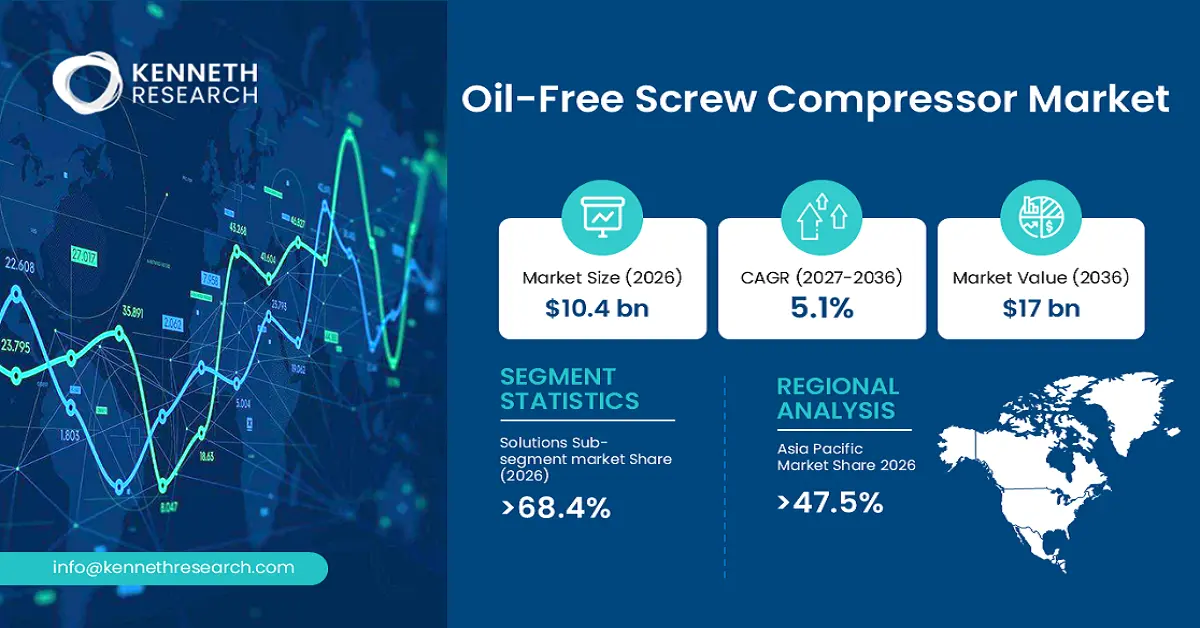
Oil-Free Screw Compressor Market size was valued at USD 10.4 billion in 2026 and is projected to reach USD 17 billion by the end of 2036, rising at a CAGR of 5.1% during the forecast period, i.e., 2027–2036. In 2027, the industry size of the Oil-Free Screw Compressor Market is estimated at USD 10.9 billion.
The primary growth driver for the oil-free screw compressor market is the increasing requirement for energy-efficient compressed-air systems that can deliver contaminant-free air in critical industrial processes.
The oil-free screw compressor market comprises rotary screw compressors designed to produce compressed air without introducing lubricating oil into the compression chamber. The market includes dry screw compressors, water-injected screw compressors, single-stage and two-stage configurations, fixed-speed and variable-speed systems, and associated air-treatment and control solutions.
Oil-free screw compressors use intermeshing rotors to compress air while employing specialized coatings, seals, bearings, cooling arrangements, or water injection instead of oil lubrication within the compression process. The technology is used where clean compressed air is essential, including pharmaceutical production, food and beverage processing, semiconductor and electronics manufacturing, chemical processing, textiles, and other industrial operations.
Key Oil-Free Screw Compressor Market Insights Summary:
Key Takeaways: Market Trends & Insights
- The Oil-Free Screw Compressor Market is projected to grow from USD 10.4 billion in 2026 to USD 17 billion by 2036, expanding at a 5.1% CAGR during 2027–2036.
- Asia-Pacific is projected to account for the largest market share at 47.5% in 2026, supported by strong industrial manufacturing activity and investments in advanced production infrastructure.
- Dry Type is the leading segment, accounting for 68.4% in 2026, driven by demand for contamination-free compressed air across pharmaceutical, food, electronics, chemical, and other sensitive industrial applications.
- Two-Stage compressors represent an important growth opportunity as industrial users seek higher-pressure, energy-efficient, and reliable compressed-air systems for continuous production environments.
Market Drivers
- Rising demand for energy-efficient and oil-free industrial compression
- Expansion of contamination-sensitive manufacturing
- Increasing adoption of automated and digitally monitored production systems
- Growing emphasis on compressed-air quality, lifecycle efficiency, and sustainable industrial operations
Challenges
- Higher Initial Investment and Advanced System Requirements
- Technical Complexity and Performance Maintenance
Oil-Free Screw Compressor Market: Overview & Supply Chain
Adoption of oil-free screw compressors is increasing globally as manufacturers seek reliable compressed-air systems that support contamination-sensitive production while improving energy and operational efficiency. The technology is particularly relevant to pharmaceuticals, food and beverage, electronics, chemicals, automotive manufacturing, and other industries where compressed air can directly or indirectly influence production quality.
The industry value chain of the oil-free screw compressor market begins with specialized materials and components, including cast or machined compressor housings, precision rotors, bearings, seals, coatings, motors, variable-speed drives, controllers, cooling systems, and air-treatment components. Manufacturers engineer and assemble these components into single-stage or two-stage oil-free screw compressor systems, followed by testing for pressure, flow, efficiency, noise, temperature, and reliability.
Oil-Free Screw Compressor Market: Growth Drivers & Challenges
Growth Drivers
- Rising Demand for Energy-Efficient and Oil-Free Industrial Compression: The transition toward energy-efficient industrial equipment is a major growth driver for the oil-free screw compressor market. Compressed-air systems can represent a significant operating expense in manufacturing facilities, making energy efficiency increasingly important as companies seek to reduce electricity consumption and operating costs. Oil-free screw compressors address this requirement while simultaneously eliminating the risk of lubricant contamination in the compressed-air stream. Government-backed technology development is also supporting innovation in oil-free compression.
- Expansion of Contamination-Sensitive Manufacturing: The increasing scale of contamination-sensitive manufacturing is creating sustained demand for oil-free compressed-air systems. Pharmaceutical production, food and beverage processing, electronics manufacturing, semiconductor fabrication, and specialized chemical operations require compressed air that does not introduce oil into production environments. Oil-free screw compressors are therefore increasingly integrated into facilities where air quality is directly linked to product integrity, process reliability, and regulatory compliance.
Challenges
- Higher Initial Investment and Advanced System Requirements: Oil-free screw compressors generally require more sophisticated engineering than conventional lubricated screw compressors because the compression process must operate without oil lubrication between the rotors. Specialized rotor coatings, precision manufacturing, sealing arrangements, cooling systems, bearings, and control technologies can increase equipment complexity and initial acquisition costs. Customers must also consider downstream air-treatment, cooling, installation, and monitoring requirements when evaluating a complete system.
- Technical Complexity and Performance Maintenance: Maintaining consistent performance in oil-free screw compressors can be technically demanding because the compression chamber cannot rely on conventional oil lubrication to control friction and temperature. Rotor clearances, coatings, bearings, cooling arrangements, and operating conditions must remain within tightly controlled parameters to preserve efficiency and prevent premature wear. Changes in ambient temperature, humidity, operating load, or maintenance quality can affect system performance. These requirements increase the importance of preventive maintenance, skilled technicians, condition monitoring, and correct system sizing.
Oil-Free Screw Compressor Market Size and Forecast:
| Report Attribute | Details |
|---|---|
| Base Year |
2026 |
| Forecast Year |
2026-2036 |
| CAGR |
5.1% |
| Base Year Market Size (2026) |
USD 10.4 billion |
| Forecast Year Market Size (2037) |
USD 10.9 billion |
| Regional Scope |
|
Oil-Free Screw Compressor Market Segmentation Analysis:
Compression Type Segment Analysis
In the compression type segment, the Dry Type sub-segment is anticipated to capture the largest market share of 68.4% by the end of 2026.
Its dominance is supported by demand for compressed air that eliminates the risk of oil contamination in sensitive production environments, particularly pharmaceuticals, food and beverage, electronics, chemicals, and advanced manufacturing. Dry oil-free screw technology also aligns with industrial efforts to improve energy efficiency and reduce lifecycle operating costs. Manufacturers are increasingly integrating variable-speed drives, advanced controls, energy recovery, and optimized compressor elements to improve performance under fluctuating air demand. On the supply side, continued development of rotor coatings, precision components, cooling systems, and digital monitoring is improving the reliability and efficiency of dry compression.
Number of Stages Segment Analysis
In the by number of stages segment, the two-stage sub-segment is projected to grow as industrial users seek higher compression efficiency, stable pressure delivery, and lower energy consumption across continuous manufacturing operations. Two-stage oil-free screw compressors divide compression between two airends, allowing interstage cooling and improved compression efficiency compared with forcing the complete pressure increase through a single compression stage. This configuration is particularly suitable for applications requiring higher capacities and continuous operation, including pharmaceuticals, electronics, food processing, chemicals, and general manufacturing. These developments should support continued adoption of two-stage configurations as industrial users prioritize clean compressed air alongside energy efficiency and reliable high-capacity operation.
Our in-depth analysis of the global oil-free screw compressor market includes the following segments:
|
Segment |
Sub-segment |
|
Compression Type |
|
|
By Number of Stages |
|
|
Application |
|
Oil-Free Screw Compressor Market Regional Insights:
Asia-Pacific Market Trends & Insights:
The Asia-Pacific region is anticipated to dominate the oil-free screw compressor market, accounting for 47.5% in 2026.
Regional leadership is supported by extensive manufacturing activity, expanding electronics and semiconductor production, machinery investment, and increasing demand for reliable compressed-air infrastructure.
Japan represents a technologically mature market supported by advanced manufacturing, electronics, automotive production, pharmaceuticals, and precision machinery. Its established industrial base creates sustained demand for oil-free compressors in applications where compressed-air purity and dependable operation are important.
China is a major growth center because of its extensive manufacturing ecosystem and continued investment in equipment and high-technology industries.
North America Market Trends & Insights:
North America represents an important market for oil-free screw compressors due to its established manufacturing base, advanced process industries, pharmaceutical production, food and beverage facilities, electronics manufacturing, and large-scale infrastructure investments. Industrial operators increasingly prioritize compressed-air systems that combine contamination control with energy efficiency and digital monitoring.
The U.S. has a diversified industrial base spanning pharmaceutical, food processing, chemicals, electronics, aerospace, automotive, and general manufacturing. Demand for oil-free compressors is supported by facilities where air quality is critical to production and by modernization programs focused on efficient utility systems.
Canada offers opportunities through its food and beverage, pharmaceutical, chemical, automotive, electronics, and general manufacturing industries. Industrial modernization and energy-efficiency initiatives support replacement of older compressed-air equipment with cleaner and more efficient systems.
Leading Companies Operating in the Oil-Free Screw Compressor Market:
Here is a list of upstream, downstream, and key players operating in the global oil-free screw compressor market competitive ecosystem:
- Atlas Copco (Sweden)
- Company Overview
- Business Strategy
- Key Product Offerings
- Financial Performance
- Key Performance Indicators
- Risk Analysis
- Recent Development
- Regional Presence
- SWOT Analysis
- Ingersoll Rand (U.S)
- Kobelco Compressors (Japan)
- KAESER KOMPRESSOREN (Germany)
- Hitachi Industrial Equipment Systems (Japan)
- Sullair (United States)
Recent Developments
- In March 2022, Atlas Copco introduced the ZE 3S low-pressure oil-free rotary screw compressor, expanding its oil-free compressor portfolio for pneumatic conveying and applications in cement, gypsum, food and beverage, pharmaceuticals, and glass.
Frequently Asked Question
In 2026, the oil-free screw compressor market exceeded USD 10.4 billion.
The oil-free screw compressor market is projected to reach USD 17 billion by the end of 2036, expanding at a CAGR of 5.1% over the forecast period (2027–2036).
The major players in the market are Atlas Copco, Ingersoll Rand, Kaeser Kompressoren, Kobelco Compressors, and others.
In the Compression Type segment, the Dry Type sub-segment is anticipated to capture the largest market share of 68.4% in the future and exhibit lucrative growth opportunities during 2027–2036.
Asia-Pacific is projected to hold the largest market share of 47.5% by the end of 2026 and provide more business opportunities in the future.
Why Choose Kenneth Research ?
-
Insight with Impact : We don’t just gather data — we uncover stories, trends, and opportunities that fuel business growth.
-
Experts Who Get It : Our team speaks your industry’s language and knows what really matters to your customers and market.
-
Custom-Built for You : Forget one-size-fits-all. We craft research and consulting solutions as unique as your business vision.
-
Partners, Not Just Providers : We work with you, not for you — collaborating closely to turn insights into smart, strategic moves.
-
Results That Speak : Our work powers brands, startups, and industry leaders alike — with a track record of ideas that work in the real world.
Report ID: 1410 |
Published Date: 25 Sep 2026 |
Report Format: |
Delivery Timeline: 48-72 Business Hours

Copyright © 2025 Kenneth Research. All rights reserved. Terms of Use | Privacy Policy
