Report ID: 1403 |
Published Date: 25 Sep 2026 |
Report Format: |
Delivery Timeline: 48-72 Business Hours
Offshore Wind Power Market Outlook:
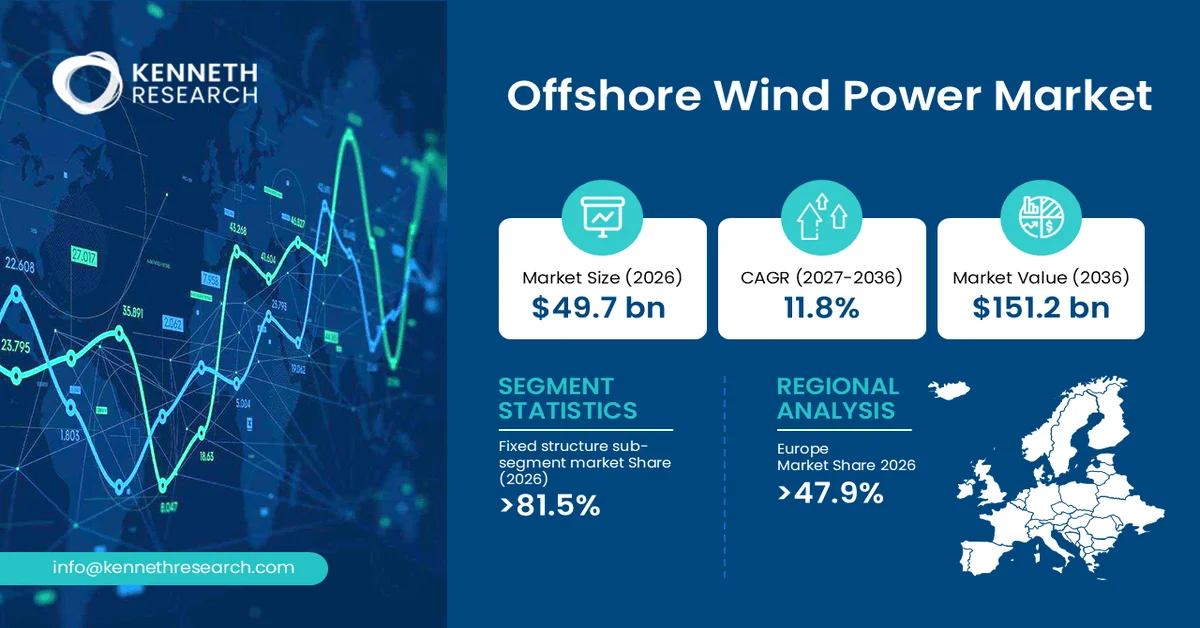
Offshore Wind Power Market size was valued at USD 49.7 billion in 2026 and is projected to reach USD 151.2 billion by the end of 2036, rising at a CAGR of 11.8% during the forecast period, i.e., 2027-2036. In 2027, the industry size of the offshore wind power is estimated at USD 55.4 billion.
Policy support for renewable energy and energy security is accelerating offshore wind deployment as governments seek to reduce fossil-fuel dependence and strengthen clean-power capacity. The IEA reports that global offshore wind capacity growth is expected to reach 212 GW by 2030, reflecting stronger policy momentum and expanding national commitments to renewable electricity.
The offshore wind power market comprises the development, manufacture, installation, operation, and maintenance of wind-power systems located in marine environments for electricity generation. It encompasses turbines, foundations, subsea cables, electrical infrastructure, vessels, engineering services, project development, construction, and long-term operations and maintenance.
A defining characteristic of offshore wind is its use of stronger and more consistent marine wind resources, enabling large-scale electricity generation away from densely populated land areas. Projects may employ fixed-bottom structures in relatively shallow waters or floating systems that enable deployment in deeper offshore locations. The industry therefore integrates renewable-energy generation with specialized marine construction, power transmission, environmental assessment, and offshore engineering capabilities.
Key Offshore Wind Power Market Insights Summary:
Key Takeaways: Market Trends & Insights
- 49.7 billion in 2026 highlights a strong market base for global offshore wind power
- 151.2 billion by 2036 reflects substantial long-term market expansion
- 11.8% CAGR from 2027 to 2036 indicates strong growth momentum
- Fixed Structure held an 81.5% share of the Installation segment in 2026
- Europe led with a 47.9% market share in 2026
Market Drivers
- Policy support and renewable-energy procurement
- Expansion of clean-energy employment and industrial ecosystems
- Larger turbines and advancing offshore engineering
- Development of floating wind and deeper-water deployment
Challenges
- High project costs and supply-chain constraints
- Lengthy permitting and grid-connection processes
Offshore Wind Power Market Overview & Supply Chain
The offshore wind power market is gaining adoption as governments pursue energy security, electricity-system decarbonization, and greater renewable generation while technological advances enable larger turbines and more efficient offshore projects. Offshore wind is particularly relevant to industrial policy because its deployment connects power generation with turbine manufacturing, marine engineering, port infrastructure, subsea transmission, construction, and specialized vessel services. Regulatory frameworks, competitive procurement mechanisms, grid-development initiatives, and public investment are also improving the conditions for project development.
The offshore wind power market value chain begins with raw materials and industrial inputs, including steel, copper, composites, electrical equipment, concrete, specialty coatings, and components used in turbines, foundations, cables, and substations. Manufacturing converts these inputs into blades, nacelles, towers, monopiles, jackets, floating foundations, subsea cables, transformers, and other balance-of-plant equipment. Project developers and engineering, procurement, and construction contractors coordinate component sourcing, logistics, port staging, offshore installation, and grid connection. Specialized ports provide marshalling, pre-assembly, manufacturing, and vessel-support functions, while installation and service vessels transport and deploy major components offshore. Electricity generated by completed projects is transmitted through offshore and onshore networks to utilities, industrial consumers, commercial customers, and other electricity-market participants.
Offshore Wind Power Market: Growth Drivers & Challenges
Growth Drivers:
- Expansion of clean-energy employment and industrial ecosystems: The expansion of offshore wind projects is stimulating demand across engineering, manufacturing, construction, marine services, grid infrastructure, and specialized technical occupations. As governments pursue energy-transition objectives, offshore wind development increasingly functions as an industrial-policy instrument rather than solely as a power-generation technology. This creates a reinforcing growth mechanism: project pipelines encourage investment in ports, vessels, component manufacturing, engineering capabilities, and workforce development, which in turn improves local supply-chain readiness for additional projects.
- Larger turbines and advancing offshore engineering: Technological advancement is enabling offshore wind developers to pursue higher-capacity turbines, improved foundations, more sophisticated electrical systems, and installation approaches designed for challenging marine environments. Larger turbine platforms can increase electricity production from individual project sites while potentially reducing the number of units, foundations, cables, and maintenance interventions required for a given development. Improvements in blade design, digital monitoring, predictive maintenance, subsea engineering, and vessel capabilities are also expanding operational efficiency.
Challenges:
- High project costs and supply-chain constraints: The offshore wind industry faces a structural cost challenge because projects require specialized turbines, foundations, subsea cables, installation vessels, ports, and marine engineering capabilities, while procurement often occurs years before commercial operation. Volatility in steel, equipment, transportation, and financing costs can therefore undermine the economics established when projects enter auctions or sign offtake agreements. The U.S. Department of Energy has identified supply-chain constraints, higher commodity prices, and rising interest rates as important contributors to offshore wind cost increases.
- Lengthy permitting and grid-connection processes: Offshore wind projects require coordination across maritime spatial planning, environmental assessment, seabed rights, construction approvals, transmission planning, and grid interconnection. The complexity arises because multiple public authorities and infrastructure stakeholders must assess projects that span marine ecosystems, coastal communities, shipping routes, fisheries, defense interests, and electricity networks.
Offshore Wind Power Market Size and Forecast:
| Report Attribute | Details |
|---|---|
| Base Year |
2026 |
| Forecast Period |
2027-2036 |
| CAGR |
11.8% |
| Base Year Market Size (2026) |
USD 49.7 billion |
| Forecast Year Market Size (2036) |
USD 151.2 billion |
| Regional Scope |
|
Offshore Wind Power Market Segmentation Analysis:
Installation Segment Analysis
In the installation segment, fixed structure sub-segment is anticipated to capture the largest market share of 81.5% by the end of 2026.
The fixed-structure segment leads because bottom-fixed foundations remain the most established technology for offshore wind projects in shallow and intermediate water depths. Their commercial maturity provides developers with proven engineering methods, established fabrication capabilities, experienced installation contractors, and a broader base of supporting vessels and equipment. Government-backed evidence also confirms the technology’s continuing importance: the U.S. Department of Energy reported that fixed-bottom technologies accounted for 59,009 MW of global operating offshore wind substructure capacity in 2022, while monopiles represented the most widely deployed individual substructure type. Demand is supported by continued development in regions where seabed conditions favor fixed foundations, while supply-chain familiarity helps reduce technical and execution risks. Larger offshore turbines are nevertheless increasing foundation-design requirements, encouraging innovation in monopiles, jackets, fabrication, and installation methods.
Capacity Segment Analysis
The above 5 mw is projected to grow as the second-largest segment in the offshore wind power market due to four converging demand drivers.
The above 5 MW capacity segment is positioned for strong growth as offshore developers increasingly favor higher-capacity turbines to extract more electricity from individual project sites while limiting the number of turbines, foundations, inter-array connections, and installation operations required. Larger machines are particularly attractive where offshore construction, seabed preparation, and maintenance represent significant project costs. The U.S. Department of Energy reported that the global offshore wind fleet exceeded 13,096 operating turbines in 2023, providing evidence of a large installed base in which turbine upscaling can progressively influence future replacement and new-project specifications. Technological progress in blades, generators, towers, foundations, controls, and installation vessels is improving the feasibility of larger offshore machines. Manufacturers and developers are consequently adapting ports, cranes, vessels, and component-production facilities to accommodate increasing turbine dimensions.
Our in-depth analysis of the global offshore wind power market includes the following segments:
|
Segment |
Sub-segment |
|
Installation |
|
|
Capacity |
|
|
Water Depth |
|
Offshore Wind Power Market Regional Insights:
Europe Market Trends & Insights:
Europe offshore wind power market is projected to hold the largest revenue share of 47.9% by the end of 2026.
It is supported by an established project ecosystem, mature offshore engineering capabilities, extensive North Sea infrastructure, and strong policy backing. The region combines substantial offshore wind deployment with manufacturing, port, grid, and maritime capabilities, creating an integrated environment for project development and investment.
Germany is a key regional market, supported by extensive North Sea development, industrial capabilities, and government-backed expansion objectives.
The UK is another major center, with established offshore expertise, a large project pipeline, competitive procurement mechanisms, and strong investment incentives.
Asia Pacific Market Trends & Insights:
Asia Pacific is emerging as a major offshore wind development region, supported by rising electricity demand, coastal industrialization, energy-security priorities, and government-led renewable-energy programs. The region benefits from extensive coastlines, established maritime industries, growing turbine and component manufacturing capabilities, and increasing investment in offshore transmission and port infrastructure.
China remains the principal country in the region, combining large-scale deployment with a highly developed domestic manufacturing and marine-engineering base.
India represents an earlier-stage but strategically important opportunity. Its Ministry of New and Renewable Energy has identified substantial offshore wind potential along the Gujarat and Tamil Nadu coasts and introduced a revised development strategy and viability-gap-funding framework to support project commercialization.
Leading Companies Operating in the Global Offshore Wind Power Market:
Here is a list of upstream, downstream, and key players operating in global offshore wind power market competitive ecosystem:
- Vestas (Denmark)
- Company Overview
- Business Strategy
- Key Product Offerings
- Financial Performance
- Key Performance Indicators
- Risk Analysis
- Recent Development
- Regional Presence
- SWOT Analysis
- Siemens Gamesa (Siemens Energy AG) (Spain/Germany)
- Mingyang Smart Energy Group (China)
- Envision Energy (China)
Recent Developments
- In February 2026, Vestas announced a firm order for RWE's 1,380 MW Vanguard West offshore wind project in the United Kingdom.
The order includes 92 Vestas V236-15.0 MW wind turbines, with Vestas responsible for supply, delivery, and commissioning. Upon completion, Vestas will also service the assets under a five-year comprehensive service agreement followed by a long-term operational support agreement. The project site is located around 47 km off the coast of Norfolk in East Anglia, with commissioning expected in 2029. - In February 2026, Siemens Gamesa announced that serial production of its SG 15-236 offshore wind turbine is planned for 2028.
By increasing the rotor diameter to 236 meters, the SG 15-236 delivers more than 30% Annual Energy Production (AEP) compared to the SG 11.0-200. The company states that standardized processes and a fully developed supply chain enable high volume production at low risk.
Frequently Asked Question
In 2026, the offshore wind power market exceeded USD 49.7 billion.
The offshore wind power market is projected to reach USD 151.2 billion by the end of 2036, expanding at a CAGR of 11.8% over the forecast period (2027-2036).
The major players in the market are Vestas, Siemens Gamesa (Siemens Energy AG), Mingyang Smart Energy Group, Envision Energy, and others.
In the installation segment, the fixed structure sub-segment is anticipated to capture the largest market share of 81.5% in the future and exhibit lucrative growth opportunities during 2027-2036. This growth trajectory is largely attributed to the continued development of offshore wind projects supported by mature fixed-bottom technology and established installation capabilities.
Europe is projected to hold the largest market share of 47.9% by the end of 2026 and provide more business opportunities in the future. Continuous offshore wind investments and established project development capabilities in Germany and the United Kingdom are fostering the region's dominance.
Why Choose Kenneth Research ?
-
Insight with Impact : We don’t just gather data — we uncover stories, trends, and opportunities that fuel business growth.
-
Experts Who Get It : Our team speaks your industry’s language and knows what really matters to your customers and market.
-
Custom-Built for You : Forget one-size-fits-all. We craft research and consulting solutions as unique as your business vision.
-
Partners, Not Just Providers : We work with you, not for you — collaborating closely to turn insights into smart, strategic moves.
-
Results That Speak : Our work powers brands, startups, and industry leaders alike — with a track record of ideas that work in the real world.
Report ID: 1403 |
Published Date: 25 Sep 2026 |
Report Format: |
Delivery Timeline: 48-72 Business Hours

Copyright © 2025 Kenneth Research. All rights reserved. Terms of Use | Privacy Policy
