Report ID: 1404 |
Published Date: 25 Sep 2026 |
Report Format: |
Delivery Timeline: 48-72 Business Hours
Offshore Wind Construction Vessels Market Outlook:
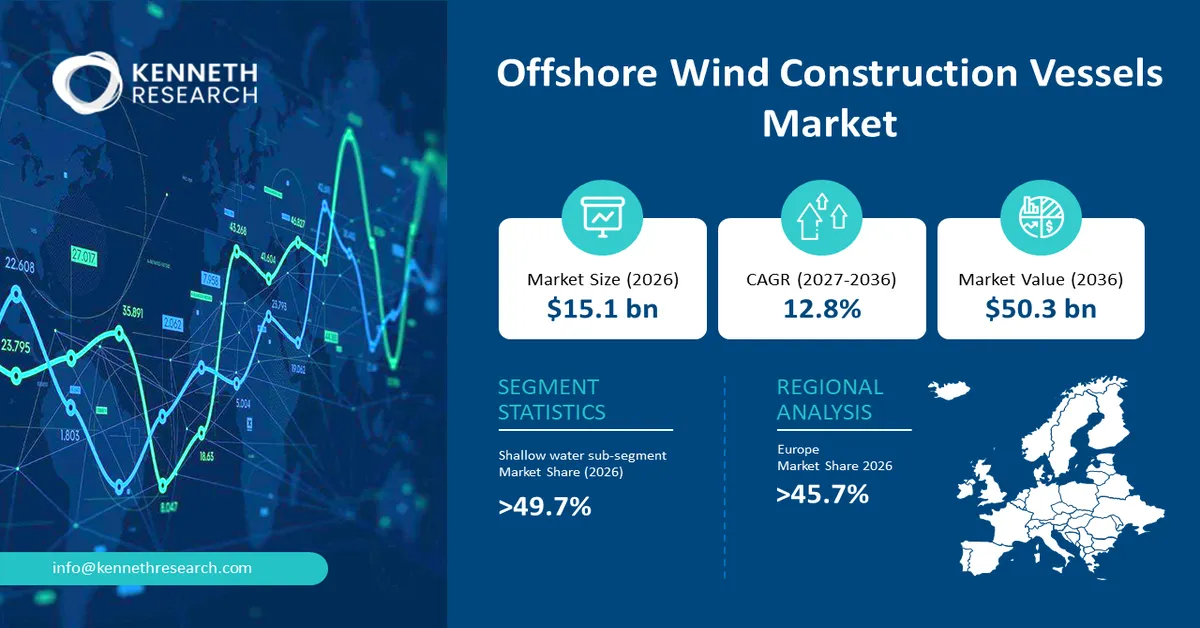
Offshore Wind Construction Vessels Market size was valued at USD 15.1 billion in 2026 and is projected to reach USD 50.3 billion by the end of 2036, rising at a CAGR of 12.8% during the forecast period, i.e., 2027-2036. In 2027, the industry size of the offshore wind construction vessels is estimated at USD 17.0 billion.
A major growth driver is government-backed offshore wind deployment targets. The North Seas Energy Cooperation states that participating countries agreed in 2023 to reach at least 300 GW of offshore wind energy by 2050. This long-term pipeline supports demand for specialised installation, foundation, transport, heavy-lift, and maintenance vessels across Europe.
Offshore wind construction vessels are specialised marine assets used to transport, lift, install, support, and commission equipment required to develop offshore wind farms. The market encompasses vessel types such as jack-up installation vessels, heavy-lift vessels, construction support vessels, cable-laying vessels, barges, and other purpose-built or adapted marine units.
These vessels are engineered for demanding offshore conditions and are typically equipped with high-capacity cranes, lifting systems, dynamic positioning or jacking capabilities, deck space for oversized components, and systems that support safe marine operations. Their configuration varies according to project requirements, including turbine size, foundation technology, water depth, seabed conditions, distance from shore, and installation methodology.
Key Offshore Wind Construction Vessels Market Insights Summary:
Key Takeaways: Market Trends & Insights
- The offshore wind construction vessels market is valued at USD 15.1 Billion in 2026 and is projected to reach USD 50.3 Billion by 2036
- The market is expected to expand at a CAGR of 12.8% during 2027-2036
- Shallow water is the leading water-depth segment with a 49.7% market share in 2026
- Europe is the dominant regional market with a 45.7% market share in 2026
- Turbine installation is projected to be the second and fastest-growing analysis segment, supported by increasing demand for specialized offshore installation vessels
Market Drivers
- Expansion of floating offshore wind projects
- Increasing complexity of offshore turbine installation
- Growth in offshore wind port and marine infrastructure
- Fleet modernization and demand for specialized installation vessels
Challenges
- High capital intensity and vessel investment risk
- Port and marine infrastructure constraints
Offshore Wind Construction Vessels Market Overview & Supply Chain
Adoption of offshore wind construction vessels is increasing as governments expand offshore renewable-energy deployment, strengthen energy security, and develop integrated marine infrastructure. The technology is particularly relevant to the energy transition because offshore wind projects require specialised vessels for foundation installation, turbine erection, subsea cable deployment, heavy lifting, component transport, and construction support. Increasing turbine dimensions, deeper-water projects, floating wind development, and greater distances from shore are also raising requirements for technically capable vessels with higher lifting capacity, larger deck space, enhanced positioning systems, and improved operational efficiency.
The value chain for offshore wind construction vessels begins with raw-material and equipment suppliers providing marine-grade steel, propulsion systems, engines, generators, hydraulic equipment, cranes, jacking systems, dynamic-positioning equipment, electrical systems, navigation technologies, and specialised offshore components. Shipyards and marine engineering companies then integrate these inputs into purpose-built or converted vessels, undertaking hull fabrication, equipment installation, system integration, testing, and certification. Distribution occurs primarily through shipowners, vessel operators, chartering companies, brokers, and project logistics providers that position assets near offshore wind development zones. End users include offshore wind developers, engineering, procurement and construction contractors, turbine manufacturers, foundation contractors, subsea cable companies, and marine construction specialists.
Offshore Wind Construction Vessels Market: Growth Drivers & Challenges
Growth Drivers:
- Expansion of floating offshore wind infrastructure: The expansion of floating offshore wind is creating new demand for specialized construction vessels capable of supporting component assembly, towing, installation, anchoring, and offshore commissioning. Floating projects generally require more complex marine logistics than fixed-bottom developments, increasing the importance of vessels with heavy-lift, positioning, towing, and accommodation capabilities.
- Increasing complexity of offshore turbine installation: The increasing size and technical complexity of offshore wind turbines is driving demand for advanced construction vessels with greater lifting capability, deck capacity, stability, and offshore operating flexibility. As turbine components become larger, installation contractors require vessels that can safely transport and position heavy equipment under challenging marine conditions. This trend also raises the value of dynamic positioning, sophisticated cranes, specialized lifting systems, and integrated marine engineering capabilities.
Challenges:
- High capital intensity and vessel investment risk: Offshore wind construction vessels require substantial capital because their equipment must accommodate increasingly demanding installation tasks, while utilization depends heavily on the timing and geographic concentration of wind-farm projects. The root cause is the specialized nature of the fleet: purpose-built installation vessels have limited alternative uses, making owners more exposed to project delays, contracting gaps, and uncertain charter visibility.
- Port and marine infrastructure constraints: Insufficient port infrastructure can restrict the deployment of offshore wind construction vessels by limiting where oversized turbine components can be assembled, marshalled, stored, and transferred to installation fleets. The root cause is the mismatch between conventional port capabilities and the increasing requirements for deeper berths, stronger quaysides, larger laydown areas, and heavy-lift operations.
Offshore Wind Construction Vessels Market Size and Forecast:
| Report Attribute | Details |
|---|---|
| Base Year |
2026 |
| Forecast Period |
2027-2036 |
| CAGR |
12.8% |
| Base Year Market Size (2026) |
USD 15.1 billion |
| Forecast Year Market Size (2036) |
USD 50.3 billion |
| Regional Scope |
|
Offshore Wind Construction Vessels Market Segmentation Analysis:
Depth Water Segment Analysis
In the depth water segment, shallow water sub-segment is anticipated to capture the largest market share of 49.7% by the end of 2026.
Shallow water remains the leading depth water segment because fixed-bottom offshore wind projects are generally easier to engineer, install, and maintain than developments in deeper environments. Demand is supported by established monopile and jacket technologies, mature installation procedures, and the availability of vessels already configured for fixed-bottom foundation and turbine work. Industry adoption is also reinforced by the extensive installed base in European waters, where developers have accumulated operational and construction experience in relatively accessible seabed conditions. A UK government-hosted offshore wind report recorded 14.7 GW of operational offshore wind capacity across 45 offshore wind farms in 2023, demonstrating the scale of the established project base that supports continued vessel utilization.
Application Segment Analysis
The turbine installation is projected to grow as the second-largest segment in the offshore wind construction vessels market due to four converging demand drivers.
The turbine installation segment is projected to grow as offshore projects increasingly require specialized vessels capable of handling larger turbine components, greater lifting heights, and more demanding installation conditions. Current demand is supported by continued offshore wind deployment and the increasing scale of individual turbines, which raises requirements for crane capacity, deck space, stability, and vessel positioning systems. Industry adoption is consequently shifting toward purpose-built installation vessels rather than relying on general-purpose offshore assets. Supply-side constraints are also reinforcing investment: a UK government supply-chain assessment identifies significant shortages of larger turbine-installation vessel categories through the near-term deployment period, creating a strong incentive for fleet expansion and modernization.
Our in-depth analysis of the offshore wind construction vessels market includes the following segments:
|
Segment |
Sub-segment |
|
Vessel Type |
|
|
Depth Water |
|
|
Application |
|
Offshore Wind Construction Vessels Market Regional Insights:
Europe Market Trends & Insights:
Europe offshore wind construction vessels market is projected to hold the largest revenue share of 45.7% by the end of 2026.
Europe is the dominant region for the offshore wind construction vessels market, supported by its mature offshore wind ecosystem, extensive North Sea activity, established marine engineering capabilities, and sustained policy support for renewable-energy deployment. Its leadership is reinforced by continued investment in offshore generation, transmission infrastructure, ports, and specialized marine services.
Germany remains a key European market because of its substantial offshore wind operating base, strong industrial capabilities, and continued project development in the North Sea.
The United Kingdom is another major demand center, supported by ambitious offshore wind deployment policies, established vessel and marine-services capabilities, and substantial investment visibility. Government policy continues to position offshore wind as a central component of the country's future electricity system. Together, Germany and the United Kingdom should sustain regional demand for installation, foundation, transportation, and other specialized construction vessels as European offshore projects progress.
Asia Pacific Market Trends & Insights:
Asia Pacific is becoming an increasingly important demand center for offshore wind construction vessels, supported by large-scale project pipelines, expanding domestic manufacturing capabilities, and government-led offshore renewable-energy programs. Industrial activity is increasingly extending beyond conventional nearshore developments toward deeper-water and far-offshore projects, creating opportunities for heavy-lift installation vessels, transport vessels, cable-laying assets, and specialized support fleets.
China is the region's major industrial hub, benefiting from extensive offshore wind manufacturing capabilities, domestic project execution expertise, and coordinated government and provincial development programs.
Japan represents a strategically important emerging market, with regulatory reforms designed to expand offshore wind development beyond territorial waters and encourage deeper-water deployment. Together, China and Japan should support long-term demand for specialized construction vessels and related marine services as offshore wind development expands across Asia Pacific.
Leading Companies Operating in the Offshore Wind Construction Vessels Market:
Here is a list of upstream, downstream, and key players operating in offshore wind construction vessels market competitive ecosystem:
- DEME Offshore (Belgium)
- Company Overview
- Business Strategy
- Key Product Offerings
- Financial Performance
- Key Performance Indicators
- Risk Analysis
- Recent Development
- Regional Presence
- SWOT Analysis
- Seaway7 (Netherlands)
- Jan De Nul Group (Luxembourg)
- Van Oord (Netherlands)
- Cadeler A/S (Denmark)
Recent Developments
- In April 2026, Van Oord announced the industry-first completion of silent monopile installations using its new offshore wind installation vessel Boreas. The company successfully installed three monopile foundations using GBM Works' jetting solution in combination with CAPE's vibro lifting tool at commercial scale at Ecowende's Hollandse Kust West wind farm. The VibroJet® technology combines vibrations with controlled water jets inside the monopile to fluidise the soil and reduce resistance, significantly reducing underwater noise and minimising impact on marine life.
- In July 2026, DEME announced it was awarded a substantial contract for the transport and installation of foundations for phase 1 of the Zeevonk offshore wind project in the Netherlands. Under the contract, DEME will be responsible for intermediate transport of monopiles, marshalling services for primary and secondary steel, plus transport and installation of 69 monopile foundations as well as the installation of a filter layer for scour protection.
Frequently Asked Question
In 2026, the offshore wind construction vessels market exceeded USD 15.1 billion.
The offshore wind construction vessels market is projected to reach USD 50.3 billion by the end of 2036, expanding at a CAGR of 12.8% over the forecast period (2027-2036).
The major players in the market are DEME Offshore, Seaway7, Jan De Nul Group, Van Oord, and Cadeler A/S and others.
In the Depth Watersegment, the Shallow Water sub-segment is anticipated to capture the largest market share of 49.7% in the future and exhibit lucrative growth opportunities during 2027-2036. This growth trajectory is largely attributed to established fixed-bottom installation technologies and mature offshore wind project infrastructure.
Europe is projected to hold the largest market share of 45.7% by the end of 2026 and provide more business opportunities in the future. Continuous offshore wind development and investments across Germany and the United Kingdom are fostering the region's dominance.
Why Choose Kenneth Research ?
-
Insight with Impact : We don’t just gather data — we uncover stories, trends, and opportunities that fuel business growth.
-
Experts Who Get It : Our team speaks your industry’s language and knows what really matters to your customers and market.
-
Custom-Built for You : Forget one-size-fits-all. We craft research and consulting solutions as unique as your business vision.
-
Partners, Not Just Providers : We work with you, not for you — collaborating closely to turn insights into smart, strategic moves.
-
Results That Speak : Our work powers brands, startups, and industry leaders alike — with a track record of ideas that work in the real world.
Report ID: 1404 |
Published Date: 25 Sep 2026 |
Report Format: |
Delivery Timeline: 48-72 Business Hours

Copyright © 2025 Kenneth Research. All rights reserved. Terms of Use | Privacy Policy
