Report ID: 1429 |
Published Date: 25 Sep 2026 |
Report Format: |
Delivery Timeline: 48-72 Business Hours
Nuclear Decommissioning Market Outlook:
Nuclear Decommissioning Market size was valued at USD 8.6 billion in 2026 and is projected to reach USD 12.7 billion by the end of 2036, rising at a CAGR of 4.0% during the forecast period, i.e., 2027–2036. In 2027, the industry size of the global nuclear decommissioning market is estimated at USD 8.9 billion.
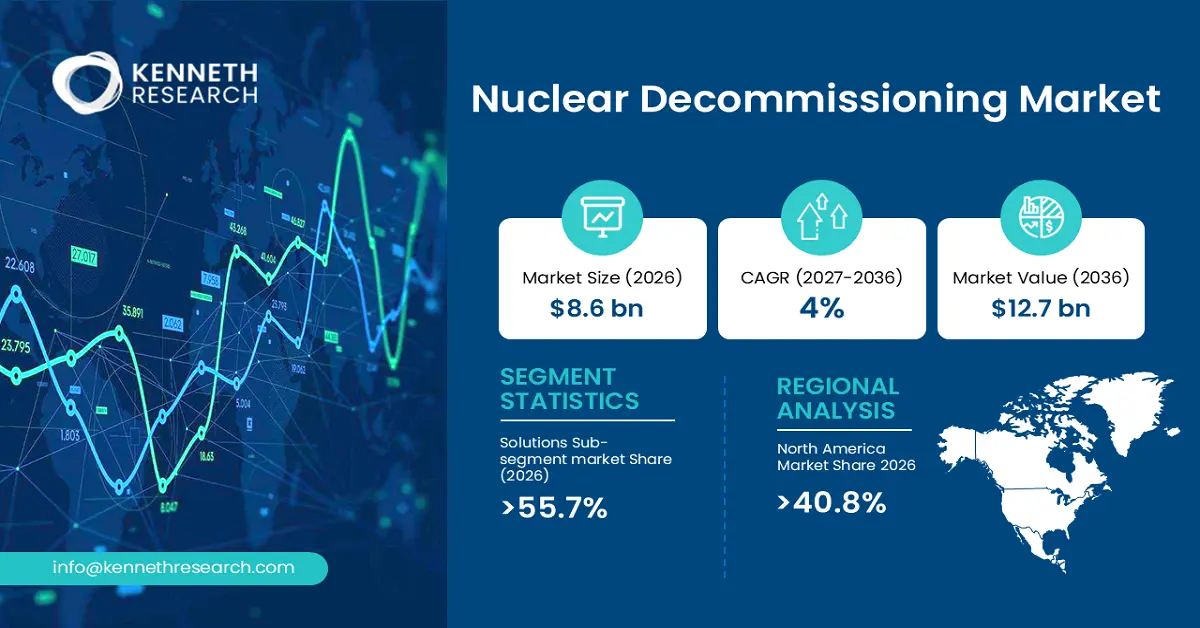
A primary growth driver is the strengthening of regulatory and public-sector programs focused on safely dismantling retired nuclear facilities, managing radioactive waste, reducing radiological risks, and restoring sites. Government-backed decommissioning initiatives are increasingly emphasizing physical dismantling, structured waste management, safety assurance, knowledge transfer, and long-term site remediation, supporting sustained demand for specialized services and technologies.
The nuclear decommissioning market encompasses the specialized services, technologies, equipment, engineering activities, project-management capabilities, and waste-management solutions used to safely retire nuclear facilities and progressively release sites from regulatory controls. Decommissioning involves administrative and technical measures that reduce residual radionuclides, protect workers and the public, manage radioactive materials, dismantle contaminated equipment and structures, and ultimately achieve an approved site end state.
Key characteristics include facility characterization, decontamination, dismantling, radioactive-waste segregation and treatment, material handling, radiation protection, environmental monitoring, regulatory compliance, and site remediation. Decommissioning strategies are selected according to facility characteristics, regulatory requirements, waste-management arrangements, safety considerations, and the desired end state. Government programs also increasingly emphasize knowledge sharing and the application of established technical expertise across projects.
Key Nuclear Decommissioning Market Insights Summary:
Key Takeaways: Market Trends & Insights
- Global nuclear decommissioning market value is projected to rise from USD 8.6 billion in 2026 to USD 12.7 billion by 2036
- The nuclear decommissioning market is expected to expand at a CAGR of 4.0% during 2027–2036
- Immediate Dismantling (DECON) leads the Decommissioning Strategy segment with a 55.7% market share in 2026
- Europe dominates the nuclear decommissioning market with a 40.8% market share in 2026
- Pressurized Water Reactor (PWR) is identified as the second and fastest analysis segment, supported by established PWR fleets and growing decommissioning requirements
Key Takeaways: Market Trends & Insights
- Global nuclear decommissioning market value is projected to rise from USD 8.6 billion in 2026 to USD 12.7 billion by 2036
- The nuclear decommissioning market is expected to expand at a CAGR of 4.0% during 2027–2036
- Immediate Dismantling (DECON) leads the Decommissioning Strategy segment with a 55.7% market share in 2026
- Europe dominates the nuclear decommissioning market with a 40.8% market share in 2026
- Pressurized Water Reactor (PWR) is identified as the second and fastest analysis segment, supported by established PWR fleets and growing decommissioning requirements
Challenges
- Complex Regulatory and Waste-Management Requirements
- Shortage of Specialized Nuclear Decommissioning Skills
Nuclear Decommissioning Market Overview & Supply Chain
Adoption of nuclear decommissioning services is increasing globally as governments address aging nuclear infrastructure, permanent reactor shutdowns, radioactive-waste obligations, site remediation, and stringent safety requirements. The sector is also becoming more technology-intensive, with remote operations, robotics, radiation monitoring, waste characterization, and specialized dismantling systems supporting safer and more efficient project execution.
The nuclear decommissioning value chain begins with specialized inputs, including radiation-protection equipment, structural materials, remote-handling systems, robotics, monitoring instruments, containment technologies, waste containers, and treatment systems. Engineering and technology providers then integrate these inputs into characterization, decontamination, dismantling, material-segregation, waste-treatment, and site-remediation solutions tailored to individual facilities. Distribution typically occurs through qualified nuclear-industry suppliers, specialist contractors, framework agreements, and project-based procurement channels because equipment and services require stringent technical qualification and regulatory compliance. End users include nuclear utilities, government agencies, decommissioning authorities, research institutions, defense-related facilities, and site operators.
Nuclear Decommissioning Market: Growth Drivers & Challenges
Growth Drivers
- Advanced Robotics and Remote-Handling Technologies: The increasing deployment of robotics, autonomous systems, remote sensing, digital twins, and advanced radiation-detection technologies is supporting market growth by enabling operators to perform hazardous inspection, characterization, retrieval, dismantling, and waste-handling activities with greater distance from radioactive environments. These technologies can improve worker protection while enabling more precise and repeatable execution in complex facilities.
- Growing Complexity of Radioactive-Waste Management: The increasing complexity of radioactive-waste management is supporting demand for specialized decommissioning services across characterization, segregation, treatment, packaging, storage, transportation, and disposal. Decommissioning projects generate diverse material streams requiring different handling and regulatory pathways, making waste minimization and accurate characterization central to project execution.
Challenges
- Complex Regulatory and Waste-Management Requirements: A major restraint is the fragmented regulatory environment surrounding nuclear facility dismantling, radioactive-material handling, site release, and waste disposal. Decommissioning projects must satisfy multiple safety, environmental, licensing, transportation, and waste-management requirements, while legacy facilities can contain poorly characterized materials and uncertain disposal pathways.
- Shortage of Specialized Nuclear Decommissioning Skills: The limited availability of specialized engineering, nuclear safety, radiation-protection, project-management, and technical personnel represents another structural restraint. Decommissioning requires expertise that combines nuclear operations knowledge with dismantling, waste management, radiological protection, regulatory compliance, and specialized technology deployment.
Nuclear Decommissioning Market Size and Forecast:
| Report Attribute | Details |
|---|---|
| Base Year |
2026 |
| Forecast Year |
2027-2036 |
| CAGR |
4.0% |
| Base Year Market Size (2026) |
USD 8.6 Billion |
| Forecast Year Market Size (2037) |
USD 12.7 Billion |
| Regional Scope |
|
Nuclear Decommissioning Market Segmentation Analysis
Decommissioning Strategy Segment Analysis
In the decommissioning strategy segment, immediate dismantling (DECON) sub-segment is anticipated to capture the largest market share of 55.7% by the end of 2026.
Immediate dismantling (DECON) dominates the decommissioning strategy segment because it enables operators to begin dismantling, decontamination, waste management, and site restoration soon after permanent shutdown rather than maintaining facilities for prolonged periods. The approach is supported by accumulated technical experience, workforce-retention benefits, and the objective of reducing long-term liabilities associated with inactive nuclear assets. The IAEA states that more than three-quarters of permanently shut-down light-water reactors have selected immediate dismantling, reflecting substantial industry experience and the availability of established waste-management infrastructure. Supply-side capabilities are also expanding as specialist contractors, robotics providers, engineering companies, waste-management organizations, and nuclear operators develop increasingly standardized tools and procedures for dismantling activities.
Reactor Type Segment Insights
The pressurized water reactor (PWR) is projected to grow as the second-largest segment in the nuclear decommissioning market due to four converging demand drivers.
The Pressurized Water Reactor (PWR) segment is projected to grow as established PWR fleets progress toward shutdown preparation, defueling, dismantling, radioactive-waste management, and eventual site remediation. Demand is supported by the need for reactor-specific engineering, decontamination, radiation monitoring, waste characterization, remote handling, and dismantling expertise. The UK Government identifies Sizewell B as its only PWR and states that the reactor is scheduled to enter decommissioning in 2035, creating a defined future requirement for PWR-specific decommissioning capabilities. Government inventory data also confirms that Sizewell B has dedicated decommissioning waste streams covering stainless steel, mild steel, concrete, and secondary materials, demonstrating the breadth of specialized services required throughout the PWR decommissioning lifecycle.
Our in-depth analysis of the Nuclear Decommissioning market includes the following segments:
|
Segment |
Sub-segment |
|
Reactor Type |
|
|
Decommissioning Strategy |
|
|
Process Stage |
|
|
Service Provider |
|
Nuclear Decommissioning Market Regional Insights:
Europe Market Trends & Insights:
Europe nuclear decommissioning market is projected to hold the largest revenue share of 40.8% by the end of 2026.
Its leadership reflects Europe’s large installed base of nuclear facilities, mature regulatory institutions, established radioactive-waste infrastructure, and sustained public investment in legacy-site cleanup.
Germany remains strategically important because its nuclear phase-out has transitioned operating assets toward dismantling, waste management, and site remediation. The transfer of radioactive-waste and spent-fuel liabilities to the federal state has also created a clearly defined public-sector framework for managing decommissioning obligations.
The United Kingdom represents another major European demand center, supported by the Nuclear Decommissioning Authority’s extensive legacy-site portfolio. Its 2024 sustainability report describes an active program spanning decommissioning, radioactive-waste management, land remediation, technology investment, and supply-chain development.
North America Market Trends & Insights:
North America represents a significant secondary market, supported by an established nuclear operating base, a mature regulatory framework, specialized engineering capabilities, and ongoing cleanup of retired nuclear facilities. In the United States, decommissioning activity extends beyond commercial power reactors to research facilities, fuel-cycle installations, uranium-recovery sites, and complex contaminated-material locations.
The United States remains the principal demand center in North America, with a broad pipeline of power-reactor and non-power-facility decommissioning activities. The NRC maintains dedicated oversight and project-management structures for facilities undergoing decommissioning, supporting continued procurement of specialized services and technologies.
Canada offers opportunities through its established radioactive-waste and decommissioning framework. Federal policy emphasizes integrated management of radioactive waste and decommissioning, while the Canadian Nuclear Safety Commission provides regulatory oversight. This creates a structured environment for specialist contractors, waste-management providers, engineering firms, and technology suppliers.
Leading Companies Operating in the Nuclear Decommissioning Market:
Here is a list of upstream, downstream, and key players operating in nuclear decommissioning market competitive ecosystem:
- EnergySolutions (United States)
- Company Overview
- Business Strategy
- Key Product Offerings
- Financial Performance
- Key Performance Indicators
- Risk Analysis
- Recent Development
- Regional Presence
- SWOT Analysis
- Amentum (United States)
- Orano SA (France)
- Jacobs Solutions Inc. (United States)
- Bechtel Corporation (United States)
Recent Developments
- In March 2025, EnergySolutions announced the appointment of Laszlo von Lazar as Vice President of Operations.
- Laszlo will focus on strategic initiatives for both new and existing projects in decommissioning and decontamination (D&D) and in new nuclear sectors. He brings extensive experience in managing complex operations in the power sector including projects in solar, gas, offshore wind, and nuclear, having previously served as President E&PI and Member of the Board at Black and Veatch, and held significant roles in large power project management at General Electric and Bechtel.
- In November 2025, Orano SA presented its latest innovations and signed multiple strategic partnerships at the World Nuclear Exhibition (WNE 2025) in Paris.
- The company unveiled Hoxo, the first smart humanoid robot for the nuclear industry, deployed by Capgemini and Orano. Orano also signed partnerships for its Back End of the Future program with Ametra, Assystem, and Vulcain for a five-year period, and announced collaboration with Polish companies Synthos Green Energy and Orlen Synthos Green Energy for SMR deployment in Central and Eastern Europe.
Frequently Asked Question
In 2026, the nuclear decommissioning market market exceeded USD 8.6 billion.
The nuclear decommissioning market market is projected to reach USD 12.7 billion by the end of 2036, expanding at a CAGR of 4.0% over the forecast period (2027-2036).
The major players in the market are EnergySolutions (United States), Amentum (United States), Orano SA (France), Jacobs Solutions Inc. (United States), Bechtel Corporation (United States) and others.
In the Decommissioning Strategy segment, the Immediate Dismantling (DECON) sub-segment is anticipated to capture the largest market share of 55.7% in the future and exhibit lucrative growth opportunities during 2027-2036. This growth trajectory is largely attributed to operators prioritizing earlier risk reduction and faster progress toward site release.
Europe is projected to hold the largest market share of 40.8% by the end of 2036 and provide more business opportunities in the future. Established nuclear infrastructure and continuous decommissioning activity in Germany and the United Kingdom are fostering the region's dominance.
Why Choose Kenneth Research ?
-
Insight with Impact : We don’t just gather data — we uncover stories, trends, and opportunities that fuel business growth.
-
Experts Who Get It : Our team speaks your industry’s language and knows what really matters to your customers and market.
-
Custom-Built for You : Forget one-size-fits-all. We craft research and consulting solutions as unique as your business vision.
-
Partners, Not Just Providers : We work with you, not for you — collaborating closely to turn insights into smart, strategic moves.
-
Results That Speak : Our work powers brands, startups, and industry leaders alike — with a track record of ideas that work in the real world.
Report ID: 1429 |
Published Date: 25 Sep 2026 |
Report Format: |
Delivery Timeline: 48-72 Business Hours

Copyright © 2025 Kenneth Research. All rights reserved. Terms of Use | Privacy Policy
