Report ID: 1054 |
Published Date: 04 Aug 2026 |
Report Format: |
Delivery Timeline: 48-72 Business Hours
Non-Invasive Cancer Diagnostics Market Outlook:
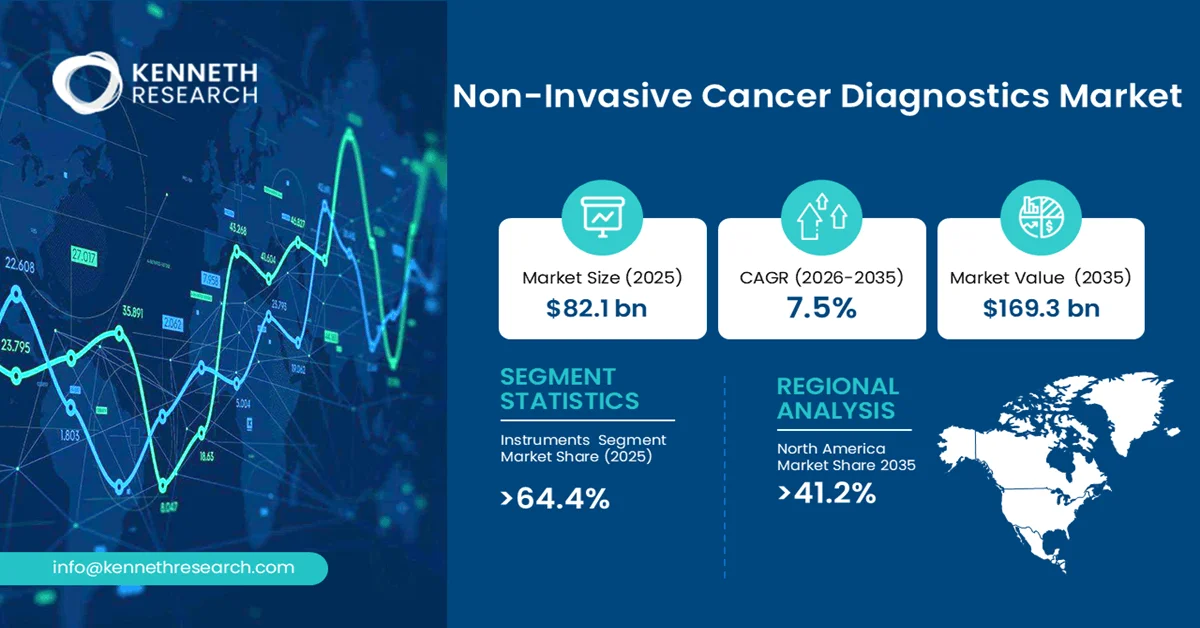
Non-Invasive Cancer Diagnostics Market size was valued at USD 82.1 billion in 2025 and is projected to reach USD 169.3 billion by the end of 2035, rising at a CAGR of 7.5% during the forecast period, i.e., 2026-2035. In 2026, the industry size of the non-invasive cancer diagnostics is estimated at USD 88.3 billion.
The primary growth driver is the rising emphasis on early cancer detection through accessible, patient-friendly diagnostic approaches. Increasing demand for screening, earlier disease identification, and technologies that reduce procedural burden is encouraging healthcare providers to adopt non-invasive diagnostic solutions, supporting broader clinical integration and expanding diagnostic testing opportunities across cancer care pathways.
The non-invasive cancer diagnostics market comprises diagnostic technologies, instruments, and testing solutions used to detect, characterize, monitor, or support the assessment of cancer without requiring conventional surgical tissue extraction or other invasive diagnostic procedures. These approaches can utilize biological samples such as blood, urine, saliva, or other bodily fluids, as well as external imaging and analytical technologies, depending on the diagnostic application.
Key characteristics include reduced procedural burden, the potential for repeated testing, improved patient acceptability, and applicability across screening, early detection, diagnosis, treatment monitoring, and disease surveillance. The market encompasses technologies that analyse molecular, cellular, biochemical, or imaging-related indicators associated with malignancy.
Industrially, non-invasive cancer diagnostics are increasingly relevant to pharmaceutical companies, diagnostic laboratories, hospitals, specialized cancer centers, and medical-device manufacturers. Their integration supports the development of more patient-centric diagnostic pathways while creating opportunities for manufacturers to advance diagnostic instruments, testing platforms, and associated analytical capabilities. The market therefore represents an important component of the broader oncology diagnostics ecosystem, particularly as healthcare systems seek diagnostic approaches capable of supporting earlier and more efficient cancer management.
Key Non-Invasive Cancer Diagnostics Market Insights Summary:
Key Takeaways: Market Trends & Insights
- Non-invasive cancer diagnostics market projected to grow from USD 82.1 billion in 2025 to USD 169.3 billion by 2035 at a 7.5% CAGR
- North America is expected to remain the leading regional market, with a 41.2% share by 2035, supported by advanced diagnostic infrastructure, strong oncology research capabilities, and continued investment in precision medicine
- Instruments is expected to remain the leading product segment, accounting for 64.4% in 2025, supported by increasing adoption of advanced imaging, molecular-analysis platforms, and automated diagnostic systems
- Diagnostic laboratories are projected to witness strong growth as demand increases for molecular diagnostics, biomarker analysis, liquid biopsy, and laboratory-based precision oncology testing
- The market is benefiting from growing emphasis on early cancer detection, expansion of liquid biopsy technologies, integration of advanced molecular diagnostics, and increasing adoption of patient-centric non-invasive testing workflows
Market Drivers
- Rising focus on early cancer detection and liquid biopsy
- Integration of advanced molecular and analytical technologies
- Increasing adoption of patient-centric and repeatable diagnostic workflows
- Growing integration of precision oncology and molecular monitoring into cancer care
Challenges
- Clinical validation and diagnostic performance requirements
- Reimbursement and integration into established diagnostic workflows
Non-Invasive Cancer Diagnostics Market Overview & Supply Chain
Adoption of non-invasive cancer diagnostics is increasing globally as healthcare systems place greater emphasis on earlier cancer detection, patient-centric testing, treatment monitoring, and diagnostic access. Advances in liquid biopsy, molecular analysis, imaging, biomarker detection, and automated instrumentation are expanding the range of diagnostic information that can be obtained without conventional invasive tissue collection. The technology is particularly relevant for applications requiring repeat testing, longitudinal monitoring, and integration with precision oncology workflows. The growing cancer burden is also strengthening the strategic importance of scalable diagnostic infrastructure. According to the World Health Organization (WHO), an estimated 20 million new cancer cases were recorded globally in 2022, reinforcing the need for effective diagnostic and cancer-control capabilities.
The non-invasive cancer diagnostics market value chain begins with specialized inputs, including biological reagents, antibodies, nucleic-acid materials, enzymes, assay components, sensors, optical components, consumables, and software used for diagnostic analysis. Manufacturers integrate these inputs into diagnostic instruments, assay platforms, imaging systems, sample-processing technologies, and analytical solutions, with quality management and regulatory compliance embedded throughout production. Distribution occurs through direct sales, specialized diagnostic distributors, laboratory networks, healthcare procurement systems, and technology partnerships. End users include hospitals, diagnostic laboratories, cancer centers, research institutions, physician practices, and other healthcare providers. Major stakeholders span raw-material suppliers, diagnostic technology manufacturers, laboratory service providers, healthcare organizations, regulators, clinicians, researchers, and technology developers. Increasing integration of molecular diagnostics, automation, digital analytics, and data-management capabilities is also strengthening interdependencies across the value chain, making interoperability, quality assurance, technical support, and regulatory alignment increasingly important to commercial deployment.
Non-Invasive Cancer Diagnostics Market: Growth Drivers & Challenges
Growth Drivers:
- Rising focus on early cancer detection and liquid biopsy: The shift toward earlier cancer detection is accelerating demand for non-invasive diagnostic approaches that can identify disease-associated biomarkers without conventional tissue biopsy. Liquid biopsy is particularly important because blood and other biofluid samples can provide molecular information while supporting repeat testing during the patient journey. Government-backed research is also strengthening the technology pipeline. The U.S. National Cancer Institute’s 2024 liquid biopsy consortium describes liquid biopsy as a non-invasive technique capable of detecting disease biomarkers in blood, urine, and sputum, while its program specifically targets validation of technologies for early-stage cancer detection. This research activity supports continued translation of biomarker-based approaches into clinical workflows. As sensitivity, specificity, sequencing, and analytical capabilities improve, non-invasive testing can expand from monitoring and treatment guidance toward broader screening and early-detection applications, creating new opportunities for diagnostic instrument manufacturers, assay developers, laboratories, and healthcare providers.
- Integration of advanced molecular and analytical technologies: Rapid development in molecular diagnostics, next-generation sequencing, digital PCR, biomarker analysis, artificial intelligence, and automated laboratory workflows is expanding the technical capabilities of non-invasive cancer diagnostics. These technologies enable manufacturers and laboratories to extract increasingly complex information from small biological samples and improve the analytical performance of diagnostic platforms. Integration of multiple biomarkers and analytical methods can strengthen disease characterization while supporting applications such as treatment-response assessment, recurrence surveillance, and molecular profiling. The combination of high-throughput analytical systems with computational interpretation is also encouraging the development of more scalable diagnostic workflows, potentially reducing dependence on highly specialized manual processes. For industry participants, this convergence creates opportunities to differentiate instruments, assays, software, and integrated platforms. Going forward, continued improvements in analytical sensitivity, automation, data interpretation, and workflow interoperability are expected to broaden clinical applications and strengthen collaboration among diagnostic manufacturers, laboratories, biotechnology companies, and healthcare institutions.
Challenges:
- Clinical validation and diagnostic performance requirements: A major restraint is the difficulty of demonstrating consistent clinical validity and diagnostic performance across diverse cancer types, disease stages, and patient populations. Non-invasive tests often analyze biomarkers that can vary with tumor biology, disease burden, biological heterogeneity, and other patient-specific factors. Establishing sufficient sensitivity and specificity therefore requires extensive clinical validation and comparison with established diagnostic pathways. For manufacturers, this can lengthen development cycles, increase regulatory complexity, and create uncertainty around clinical adoption. Laboratories and healthcare providers may also remain cautious when evidence is insufficient to establish how a new test should influence diagnosis or treatment decisions. Commercially, companies must invest substantially in validation studies, quality systems, regulatory submissions, and post-market evidence generation. Over the longer term, stronger standardized methodologies and broader clinical datasets should improve confidence, but demonstrating reliable performance across intended-use populations will remain a critical commercialization requirement.
- Reimbursement and integration into established diagnostic workflows: Limited reimbursement clarity and integration challenges can constrain the commercial adoption of non-invasive cancer diagnostics. Healthcare providers must determine how emerging tests fit within existing screening, diagnostic, pathology, imaging, and oncology workflows, while laboratories may need additional infrastructure, trained personnel, software, and quality-control procedures. When reimbursement pathways are unclear, providers can face uncertainty regarding whether testing costs will be recovered, particularly for newer technologies without established clinical-use pathways. This can slow purchasing decisions and encourage institutions to prioritize established diagnostic methods. For manufacturers, reimbursement uncertainty can therefore extend sales cycles and make market access dependent on evidence demonstrating clinical utility and healthcare-system value. Future adoption will increasingly depend on demonstrating how non-invasive diagnostics complement—not simply replace—existing diagnostic procedures. Clearer coverage frameworks, standardized clinical pathways, interoperable technologies, and evidence-based health-economic assessments could gradually reduce these commercial barriers.
Non-Invasive Cancer Diagnostics Market Size and Forecast:
| Report Attribute | Details |
|---|---|
| Base Year |
2025 |
| Forecast Year |
2026-2035 |
| CAGR |
7.5% |
| Base Year Market Size (2025) |
USD 82.1 billion |
| Forecast Year Market Size (2035) |
USD 169.3 billion |
| Regional Scope |
|
Non-Invasive Cancer Diagnostics Market Segmentation Analysis:
Product Segment Analysis
In the product segment, instruments dominate because non-invasive cancer diagnosis increasingly depends on sophisticated imaging, molecular-analysis, sample-processing, and automated diagnostic platforms. Instruments provide the core infrastructure required to generate, process, and interpret diagnostic information across screening, tumor characterization, staging, treatment planning, and monitoring. Demand is supported by the expanding clinical use of CT, PET, MRI, and other advanced imaging technologies alongside increasingly automated molecular diagnostic workflows. The U.S. National Cancer Institute identifies CT as a non-invasive procedure used for cancer screening, tumor diagnosis, staging, biopsy guidance, treatment planning, response assessment, and recurrence detection.
The segment also benefits from healthcare providers upgrading diagnostic infrastructure and manufacturers introducing higher-performance systems with improved imaging quality, automation, and analytical capabilities. Supply-side investment in integrated hardware and software platforms further strengthens adoption. Going forward, instrument demand is expected to benefit from greater integration of artificial intelligence, multimodal imaging, automation, and quantitative analysis, reinforcing the central role of diagnostic equipment within non-invasive oncology workflows. The U.S. National Cancer Institute states that CT is used for “screening for cancer” as well as diagnosis, staging, treatment planning, treatment-response assessment, and recurrence detection.
End Use Segment Analysis
The diagnostic laboratories sub-segment is projected to grow as cancer care increasingly depends on laboratory-based molecular, biomarker, and liquid-biopsy testing to support diagnosis, treatment selection, response assessment, and recurrence monitoring. The U.S. National Cancer Institute states that laboratory tests of blood, urine, and other body fluids can help doctors diagnose cancer, while molecular diagnostics can analyze DNA, RNA, and proteins and support treatment planning and recurrence assessment.
Industry adoption is being reinforced by the expansion of precision-oncology workflows, where laboratories increasingly perform genomic profiling and biomarker analysis alongside conventional diagnostic procedures. The supply side is also developing through specialized clinical laboratories equipped for sequencing, digital PCR, and other molecular technologies. NCI-supported diagnostic infrastructure demonstrates this direction, including its Molecular Characterization Laboratory, which performs genomic characterization and liquid-biopsy assays for cancer research programs. Going forward, greater laboratory automation, expanded molecular testing menus, and integration of advanced analytical platforms are expected to strengthen the role of diagnostic laboratories in non-invasive cancer diagnostics.
Our in-depth analysis of the global non-invasive cancer diagnostics market includes the following segments:
|
Segment |
Sub-segment |
|
Product |
|
|
End User |
|
Non-Invasive Cancer Diagnostics Market Regional Insights:
North American Market Trends & Insights:
North America accounts for 41.2% of the global market in 2035, supported by its mature healthcare infrastructure, extensive diagnostic laboratory networks, high utilization of advanced imaging and molecular technologies, and strong investment in oncology research.
The region also benefits from established regulatory pathways, sophisticated reimbursement systems, and a concentration of diagnostic technology developers and healthcare institutions. Government-backed cancer-control initiatives further sustain demand for early detection and diagnostic services. In the U.S., the National Cancer Institute reports that 79.8% of women aged 50–74 received a mammogram within the previous two years in 2023, demonstrating substantial utilization of established non-invasive cancer detection technologies. This screening infrastructure provides a strong foundation for further adoption of advanced non-invasive diagnostic platforms and supports continued investment in imaging, molecular diagnostics, laboratory automation, and data-driven diagnostic systems.
The U.S. represents the principal commercial and technology hub within North America, supported by extensive oncology research capabilities, advanced diagnostic infrastructure, and strong integration of precision medicine into clinical practice. Continued investment in cancer screening and diagnostic technologies supports both consumption and technology development.
Canada contributes through nationally coordinated cancer surveillance, screening programs, healthcare infrastructure, and public-sector investment in cancer control. The Government of Canada identifies cancer as a major health priority and maintains national cancer statistics and screening initiatives to support healthcare planning. The combination of U.S. innovation capacity and Canadian public-health infrastructure strengthens North America's position as a leading regional market for non-invasive cancer diagnostics.
Europe Market Trends & Insights:
Asia Pacific is emerging as an important growth region for non-invasive cancer diagnostics as healthcare systems expand diagnostic capacity, improve access to oncology services, and increasingly prioritize earlier detection. Rising investment in hospitals, diagnostic laboratories, molecular testing infrastructure, and advanced imaging is creating broader opportunities for non-invasive diagnostic technologies. Government-led cancer-control programs, screening initiatives, and healthcare modernization efforts are also encouraging adoption by strengthening diagnostic pathways and improving access to specialized services. Industrial activity is supported by the expansion of domestic diagnostic capabilities, collaborations between healthcare institutions and technology developers, and increasing localization of laboratory and medical-device manufacturing. The region also offers significant opportunities for suppliers of imaging equipment, molecular diagnostic platforms, laboratory automation, biomarker assays, and associated analytical software. Over the longer term, improvements in healthcare infrastructure, wider availability of precision-oncology services, and greater integration of digital and molecular diagnostics are expected to create additional opportunities for market participants. Differences in reimbursement, regulatory frameworks, and healthcare access across individual countries will remain important considerations for companies developing regional commercialization strategies.
Japan represents a technologically advanced market within Asia Pacific, supported by sophisticated hospitals, diagnostic laboratories, established cancer-screening infrastructure, and strong capabilities in medical technology and life-science research. Its aging population and emphasis on early diagnosis create favorable conditions for advanced non-invasive diagnostic technologies. Japan also provides an attractive environment for precision diagnostics, laboratory automation, imaging technologies, and biomarker-based testing.
China offers substantial long-term opportunities through healthcare infrastructure expansion, increasing diagnostic capacity, domestic medical-technology development, and government emphasis on cancer prevention and early detection. The country is also strengthening its biotechnology and medical-device ecosystem, creating opportunities for local and international suppliers of molecular diagnostics, imaging platforms, laboratory systems, and digital diagnostic technologies.
Leading Companies Operating in the Global Non-Invasive Cancer Diagnostics Market:
Here is a list of upstream, downstream, and key players operating in the global non-invasive cancer diagnostics market competitive ecosystem:
- Roche(Switzerland)
- Company Overview
- Business Strategy
- Key Product Offerings
- Financial Performance
- Key Performance Indicators
- Risk Analysis
- Recent Development
- Regional Presence
- SWOT Analysis
- Siemens Heathineers(Germany)
- Guardant Health(United States)
- Foundation Medicine(United States)
- Exact Sciences(United States)
Recent Developments
- May 2026 : Guardant Health announced that the U.S. FDA approved Guardant360 Liquid CDx, a blood-based liquid-biopsy test integrating genomic and epigenomic information for comprehensive cancer profiling. The approval also transferred previously authorized companion-diagnostic indications to the new platform.
- March 2025 : Exact Sciences launched Cologuard Plus, a next-generation non-invasive colorectal cancer screening test designed for at-home sample collection. The company stated that the test had received FDA approval and Medicare coverage, enabling its commercial introduction in the United States.
- July 2025 :Exact Sciences announced an expanded partnership with humana under which cologuard plus would become an in-network colorectal cancer screening service for eligible Humana Medicare Advantage members nationwide beginning in August 2025.
Frequently Asked Question
In 2025, the non-invasive cancer diagnostics market exceeded USD 82.1 billion.
The non-invasive cancer diagnostics market is projected to reach USD 169.3 billion by the end of 2035, expanding at a CAGR of 7.5% over the forecast period (2026-2035).
The major players in the market are Roche, Siemens Healthineers, Guardant Health, Foundation Medicine, and Exact Sciences, and others.
In the product segment, the Instruments sub-segment is anticipated to capture the largest market share of 64.4% in the future and exhibit lucrative growth opportunities during 2026-2035. This growth trajectory is largely attributed to increasing adoption of advanced imaging, molecular analysis, and automated diagnostic technologies.
North America is projected to hold the largest market share of 41.2% by the end of 2035 and provide more business opportunities in the future. Continuous investments in advanced diagnostic infrastructure, precision oncology, and cancer screening across the U.S. and Canada are fostering the region's dominance.
Why Choose Kenneth Research ?
-
Insight with Impact : We don’t just gather data — we uncover stories, trends, and opportunities that fuel business growth.
-
Experts Who Get It : Our team speaks your industry’s language and knows what really matters to your customers and market.
-
Custom-Built for You : Forget one-size-fits-all. We craft research and consulting solutions as unique as your business vision.
-
Partners, Not Just Providers : We work with you, not for you — collaborating closely to turn insights into smart, strategic moves.
-
Results That Speak : Our work powers brands, startups, and industry leaders alike — with a track record of ideas that work in the real world.
Report ID: 1054 |
Published Date: 04 Aug 2026 |
Report Format: |
Delivery Timeline: 48-72 Business Hours

Copyright © 2025 Kenneth Research. All rights reserved. Terms of Use | Privacy Policy
