Report ID: 1086 |
Published Date: 14 Aug 2026 |
Report Format: |
Delivery Timeline: 48-72 Business Hours
Neurology Patient Monitoring Market Outlook:
Neurology Patient Monitoring Market size was valued at USD 5.2 billion in 2025 and is projected to reach USD 10.2 billion by the end of 2035, rising at a CAGR of 7.2% during the forecast period, i.e., 2026–2035. In 2026, the industry size of the neurology patient monitoring is estimated at USD 5.4 billion.
The primary growth driver for the neurology patient monitoring market is the increasing global burden of neurological disorders, prompting healthcare systems to expand continuous neurological surveillance, critical care monitoring, and early diagnostic capabilities. The World Health Organization identifies neurological conditions as the leading cause of ill health and disability worldwide, reinforcing demand for advanced monitoring technologies.
The neurology patient monitoring market comprises medical devices, software platforms, and integrated monitoring systems designed to continuously assess neurological function in patients with acute and chronic disorders affecting the brain, spinal cord, and peripheral nervous system. These technologies include electroencephalography (EEG), intracranial pressure (ICP) monitoring, cerebral oximetry, electromyography (EMG), and multimodal neurological monitoring solutions used across intensive care units, emergency departments, operating rooms, and specialized neurology centers.
The market is characterized by its emphasis on real-time physiological monitoring, early detection of neurological deterioration, data-driven clinical decision-making, and integration with digital hospital infrastructure. Modern systems increasingly support continuous bedside monitoring, remote data visualization, automated alerts, and interoperability with electronic medical records, enabling clinicians to respond rapidly to evolving neurological conditions.
Industrially, the market plays a critical role in improving outcomes for patients with traumatic brain injury, stroke, epilepsy, neurocritical illnesses, and postoperative neurosurgical care. It also supports healthcare providers in enhancing patient safety, optimizing critical care workflows, and facilitating evidence-based neurological management, making neurological monitoring an essential component of modern acute and long-term neurological care.
Key Neurology Patient Monitoring Market Insights Summary:
Key Takeaways: Market Trends & Insights
- The neurology patient monitoring market is expected to grow from USD 5.2 billion in 2025 to USD 10.2 billion by 2035 at a CAGR of 7.2%
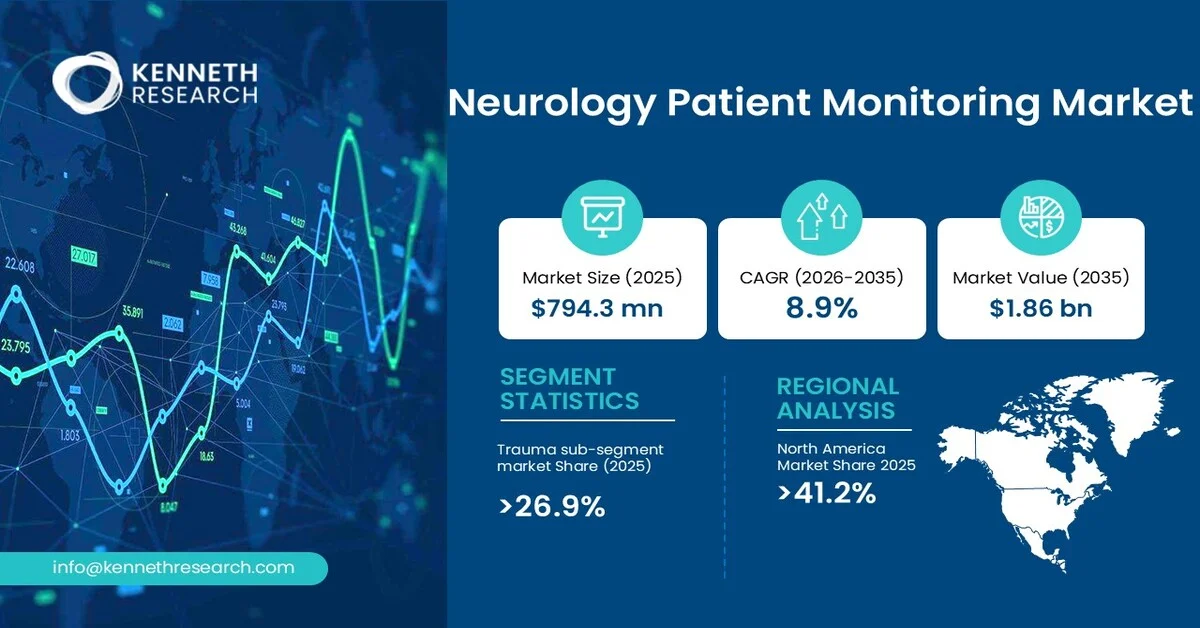
- Trauma remains the leading application segment, accounting for 26.9% of the market in 2025 due to the increasing demand for continuous monitoring in neurocritical care and traumatic brain injury management
- North America held the largest regional share of 41.2% in 2025, supported by advanced healthcare infrastructure, strong neurotechnology innovation, and high adoption of neurological monitoring systems
- CSF management is projected to witness significant growth as hospitals increasingly adopt advanced intracranial pressure monitoring and cerebrospinal fluid management technologies for neurosurgical and critical care applications
- Growing investments in digital healthcare, artificial intelligence-enabled monitoring platforms, and specialized neuroscience care are accelerating the adoption of next-generation neurology patient monitoring solutions worldwide
Market Drivers
- Increasing prevalence of neurological disorders and aging populations
- Growing investment in advanced neurotechnology research
- Increasing digitalization of neurocritical care workflows
- Expansion of specialized neuroscience centers and critical care infrastructure
Challenges
- Complex integration with legacy hospital infrastructure
- High clinical training requirements and workforce constraints
Neurology Patient Monitoring Market Overview & Supply Chain
Global adoption of neurology patient monitoring solutions is accelerating as healthcare systems prioritize continuous neurological assessment, earlier intervention, and data-driven management of acute and chronic neurological disorders. Advances in multimodal monitoring, artificial intelligence-assisted signal interpretation, cloud-enabled connectivity, and integration with hospital information systems are improving clinical decision-making while supporting more efficient neurocritical care workflows. These technologies are increasingly deployed across intensive care units, emergency departments, stroke centers, and neurosurgical facilities to enable real-time assessment of neurological status and reduce the risk of delayed clinical intervention. The growing clinical need is reinforced by the expanding neurological disease burden worldwide.
The neurology patient monitoring industry value chain begins with suppliers of electronic components, medical-grade sensors, electrodes, semiconductors, optical components, display modules, batteries, and specialized software platforms that enable physiological signal acquisition and processing. Device manufacturers integrate these inputs into neurological monitoring systems through engineering, product design, firmware development, quality validation, and regulatory compliance processes. Specialized contract manufacturers frequently support component assembly, calibration, sterilization, and packaging before finished systems are distributed through direct sales teams, authorized distributors, medical equipment providers, and healthcare procurement organizations. Installation, user training, software upgrades, technical maintenance, and after-sales support form essential service components throughout the product lifecycle. Primary end users include hospitals, neurocritical care units, neurosurgical centers, ambulatory surgical facilities, specialty neurology clinics, rehabilitation centers, and research institutions. Major stakeholders include component suppliers, original equipment manufacturers, software developers, healthcare providers, regulatory authorities, reimbursement organizations, clinical researchers, and technology integration partners collaborating to improve neurological patient outcomes.
Neurology Patient Monitoring Market: Growth Drivers & Challenges
Growth Drivers:
- Expanding investment in advanced neurotechnology research: Growing investment in neuroscience research and next-generation neurotechnology is accelerating innovation across the neurology patient monitoring ecosystem. Public funding programs, translational research initiatives, and collaborations between academic institutions, healthcare providers, and medical device manufacturers are enabling the development of more accurate, connected, and data-driven monitoring systems. These investments support advances in multimodal monitoring, artificial intelligence-enabled signal interpretation, wearable neurological sensors, and interoperable clinical platforms that improve real-time patient assessment. As healthcare providers increasingly adopt evidence-based neurological care pathways, demand for sophisticated monitoring technologies continues to strengthen. Looking ahead, sustained research funding is expected to shorten commercialization timelines, expand clinical applications, and encourage greater adoption of precision monitoring solutions across hospitals and neurocritical care settings. Supporting this trend, the U.S. National Institutes of Health (NIH) BRAIN Initiative received $402 million in appropriated funding for FY2024 to accelerate the development of innovative neurotechnologies.
- Increasing digitalization of neurocritical care workflows: The digital transformation of healthcare is reshaping neurocritical care by integrating patient monitoring devices with hospital information systems, cloud-based analytics, and clinical decision support platforms. Neurology patient monitoring systems are evolving beyond standalone devices into connected ecosystems capable of consolidating physiological data from multiple sources for comprehensive neurological assessment. This interoperability enables clinicians to detect subtle changes in neurological status, prioritize high-risk patients, and improve care coordination across departments. The adoption of predictive analytics and remote monitoring capabilities further enhances operational efficiency while supporting standardized treatment protocols in specialized neurological care. Over the coming years, continued advances in artificial intelligence, cybersecurity, and interoperable digital infrastructure are expected to strengthen the role of continuous neurological monitoring as an essential component of precision medicine and value-based healthcare delivery.
Challenges:
- Complex integration with legacy hospital infrastructure: A significant restraint for the neurology patient monitoring market is the complexity of integrating advanced monitoring systems with legacy hospital infrastructure. Many healthcare facilities continue to operate heterogeneous clinical environments where electronic medical records, bedside monitoring platforms, imaging systems, and laboratory information systems have limited interoperability. As a result, deploying new neurology monitoring technologies often requires customized software interfaces, network upgrades, cybersecurity validation, and extensive workflow redesign. These implementation requirements increase deployment timelines and place additional demands on hospital IT resources. Commercially, vendors must invest in integration services, interoperability testing, and long-term technical support, increasing implementation costs and extending procurement cycles. Looking ahead, broader adoption of standardized interoperability frameworks and digital health architectures is expected to reduce integration barriers, although compatibility with aging healthcare infrastructure will remain a challenge in many institutions.
- High clinical training requirements and workforce constraints: The effective use of neurology patient monitoring technologies depends on specialized clinical expertise, creating a substantial barrier to broader adoption. Advanced neurological monitoring systems generate complex physiological data that require interpretation by trained neurologists, neurointensivists, neurosurgeons, and experienced critical care personnel. Many healthcare organizations face shortages of these specialists, while ongoing staff turnover increases the need for continuous education and competency development. In addition, introducing new monitoring platforms often necessitates workflow adjustments, protocol updates, and multidisciplinary coordination, which can temporarily affect operational efficiency. From a commercial perspective, manufacturers are compelled to provide comprehensive clinical training, application support, and educational resources as part of their product offerings, increasing service commitments. Over time, improvements in artificial intelligence-assisted analytics and user-centered interface design may simplify clinical interpretation, but workforce capability will remain a key determinant of successful implementation.
Neurology Patient Monitoring Market Size and Forecast:
| Report Attribute | Details |
|---|---|
| Base Year |
2025 |
| Forecast Year |
2026-2035 |
| CAGR |
7.2% |
| Base Year Market Size (2025) |
USD 5.2 billion |
| Forecast Year Market Size (2035) |
USD 10.2 billion |
| Regional Scope |
|
Neurology Patient Monitoring Market Segmentation Analysis:
Application Segment Analysis
In the application segment, the trauma sub-segment is anticipated to capture the largest market share of 26.9% by the end of 2025.
The trauma segment dominates the neurology patient monitoring market because patients with traumatic brain injuries and other acute neurological emergencies require continuous physiological monitoring to detect rapid changes in neurological status and guide timely clinical intervention. Trauma centers, emergency departments, and neurocritical care units increasingly rely on technologies such as intracranial pressure monitoring, electroencephalography, cerebral oxygenation monitoring, and multimodal neurological assessment to support evidence-based treatment decisions. Demand is further reinforced by expanding trauma care networks, increasing adoption of standardized neurocritical care protocols, and greater emphasis on improving outcomes through early detection of secondary brain injury. On the supply side, manufacturers continue to develop integrated monitoring platforms with enhanced interoperability, real-time analytics, and workflow-friendly interfaces, enabling broader deployment across acute care environments. The segment is expected to maintain its leadership as healthcare providers continue investing in specialized neurological critical care capabilities. Supporting this demand, the U.S. Centers for Disease Control and Prevention (CDC) reported approximately 214,110 traumatic brain injury-related hospitalizations in 2020, highlighting the substantial clinical need for advanced neurological monitoring in trauma care.
Application Segment Analysis
The CSF management is projected to grow as the second-largest segment in neurology patient monitoring market due to four converging demand drivers.
The CSF management segment is projected to experience strong growth as healthcare providers place greater emphasis on the early diagnosis and continuous management of disorders involving abnormal cerebrospinal fluid dynamics, including hydrocephalus, intracranial hemorrhage, traumatic brain injury, and postoperative neurosurgical complications. Demand is increasing for monitoring systems that enable accurate intracranial pressure assessment, CSF drainage management, and timely detection of complications, supporting improved patient outcomes in neurocritical care settings. Adoption is also being driven by advances in smart drainage technologies, digital pressure monitoring, and integrated neurological monitoring platforms that enhance clinical decision-making and streamline intensive care workflows. On the supply side, manufacturers are investing in more precise sensors, programmable systems, and interoperable monitoring solutions that align with modern hospital infrastructure. Future growth is expected to be supported by continued innovation in minimally invasive neurosurgical procedures and connected neurocritical care technologies. According to the U.S. National Institute of Neurological Disorders and Stroke (NINDS), hydrocephalus is most commonly treated with surgery using a shunt system to divert excess cerebrospinal fluid (CSF), reinforcing the sustained clinical demand for CSF management technologies and associated monitoring solutions.
Our in-depth analysis of the global Neurology Patient Monitoring market includes the following segments:
|
Segment |
Sub-segment |
|
Type |
|
Neurology Patient Monitoring Market Regional Insights:
North America Market Trends & Insights:
North America neurology patient monitoring market is projected to hold the largest revenue share of 41.2% by the end of 2025.
The region's dominance is supported by a mature healthcare infrastructure, widespread adoption of advanced neurocritical care technologies, and strong investment in medical device innovation. Hospitals and specialized neuroscience centers continue to integrate multimodal neurological monitoring systems into intensive care, emergency medicine, and neurosurgical workflows to improve patient outcomes and operational efficiency. A well-established regulatory framework, favorable reimbursement mechanisms for neurological procedures, and sustained investment in digital health technologies further strengthen market adoption. In addition, the presence of leading medical device manufacturers, robust clinical research activity, and high utilization of advanced diagnostic equipment reinforce North America's position as a key hub for neurological monitoring technologies. According to the OECD, the United States recorded more than 360 combined CT, MRI, and PET examinations per 1,000 population in 2021, among the highest utilization rates across OECD countries, reflecting the region's advanced diagnostic imaging capacity that supports neurological patient monitoring.
The United States leads regional demand through its extensive network of tertiary hospitals, Level I trauma centers, comprehensive stroke centers, and academic medical institutions that routinely employ advanced neurological monitoring for critical care and neurosurgical applications. Continuous investments in digital health integration and neurotechnology research further accelerate technology adoption.
Canada complements regional growth through ongoing modernization of hospital infrastructure, expansion of specialized neurological services, and provincial investments in diagnostic and critical care capacity. Canadian healthcare providers increasingly emphasize integrated patient monitoring and evidence-based neurological management, encouraging adoption of interoperable monitoring platforms across acute care settings. Together, these country-level strengths sustain North America's leadership in innovation, clinical implementation, and commercialization of neurology patient monitoring solutions.
Asia Pacific Market Trends & Insights:
Asia Pacific is emerging as a high-growth region in the neurology patient monitoring market, supported by expanding healthcare infrastructure, increasing investments in specialized neurological care, and the growing adoption of advanced patient monitoring technologies. Healthcare providers across the region are strengthening neurocritical care capabilities to improve the management of stroke, traumatic brain injury, epilepsy, and other neurological disorders requiring continuous monitoring. Governments are promoting healthcare digitalization, modernization of hospital facilities, and broader access to advanced medical technologies through national health initiatives and innovation programs. In parallel, domestic and international medical device manufacturers are expanding their regional presence through strategic partnerships, local manufacturing, and distribution networks, improving product accessibility and technical support. Future opportunities are expected to arise from the continued expansion of tertiary care hospitals, increasing integration of artificial intelligence into clinical monitoring systems, and growing demand for connected patient monitoring platforms capable of supporting data-driven neurological care across both urban and regional healthcare facilities.
Japan represents a technologically advanced market with widespread adoption of sophisticated medical equipment, strong clinical expertise in neurology and neurosurgery, and continuous investment in precision healthcare. Healthcare institutions are increasingly integrating digital monitoring platforms into critical care environments to enhance clinical decision-making and improve patient safety.
South Korea is experiencing robust growth driven by its advanced hospital infrastructure, supportive healthcare innovation ecosystem, and increasing adoption of smart medical technologies. The country's emphasis on digital healthcare transformation, medical device innovation, and hospital modernization is encouraging broader implementation of integrated neurological monitoring solutions across intensive care units, specialty neurology centers, and academic medical institutions.
Leading Companies Operating in the Global Neurology Patient Monitoring Market:
Here is a list of upstream, downstream, and key players operating in the global neurology patient monitoring market competitive ecosystem:
- Compumedics Limited (Australia)
- Company Overview
- Business Strategy
- Key Product Offerings
- Financial Performance
- Key Performance Indicators
- Risk Analysis
- Recent Development
- Regional Presence
- SWOT Analysis
- Spiegelberg GmbH (Germany)
- Advanced Brain Monitoring, Inc. (United States)
- Ceribell, Inc. (United States)
- Empatica Inc. (United States)
- Masimo Corporation (United States)
Recent Developments
- March 2025: Epitel received U.S. FDA 510(k) clearance for its REMI™ Remote EEG Monitoring System, enabling continuous wireless electroencephalography (EEG) monitoring for neurological patients. The clearance supports earlier seizure detection and expands the adoption of remote neurology patient monitoring in hospitals.
- January 2025: MedTech Dive highlighted AI-enabled patient monitoring as one of the leading medtech trends for 2025, with increasing regulatory clarity from the FDA expected to accelerate the adoption of AI-assisted neurological monitoring systems such as EEG-based seizure detection and brain monitoring platforms.
Frequently Asked Question
In 2025, the neurology patient monitoring market exceeded USD 5.2 billion.
The neurology patient monitoring market is projected to reach USD 10.2 billion by the end of 2035, expanding at a CAGR of 7.2% over the forecast period (2026-2035).
The major players in the market are Compumedics Limited (Australia), Spiegelberg GmbH (Germany), Advanced Brain Monitoring, Inc. (United States), Ceribell, Inc. (United States), Empatica Inc. (United States), Masimo Corporation (United States), and others.
In the application segment, the trauma sub-segment is anticipated to capture the largest market share of 26.9% in the future and exhibit lucrative growth opportunities during 2026–2035. This growth trajectory is largely attributed to the increasing demand for continuous neurological monitoring in traumatic brain injury and other acute neurocritical care applications.
North America is projected to hold the largest market share of 41.2% by the end of 2025 and provide more business opportunities in the future. Continuous investments in advanced neurocritical care infrastructure, digital health technologies, and neurological research across the United States and Canada are fostering the region's dominance.
Why Choose Kenneth Research ?
-
Insight with Impact : We don’t just gather data — we uncover stories, trends, and opportunities that fuel business growth.
-
Experts Who Get It : Our team speaks your industry’s language and knows what really matters to your customers and market.
-
Custom-Built for You : Forget one-size-fits-all. We craft research and consulting solutions as unique as your business vision.
-
Partners, Not Just Providers : We work with you, not for you — collaborating closely to turn insights into smart, strategic moves.
-
Results That Speak : Our work powers brands, startups, and industry leaders alike — with a track record of ideas that work in the real world.
Report ID: 1086 |
Published Date: 14 Aug 2026 |
Report Format: |
Delivery Timeline: 48-72 Business Hours

Copyright © 2025 Kenneth Research. All rights reserved. Terms of Use | Privacy Policy
