Report ID: 1472 |
Published Date: 28 Sep 2026 |
Report Format: |
Delivery Timeline: 48-72 Business Hours
Network Surveillance Cameras Market Outlook:
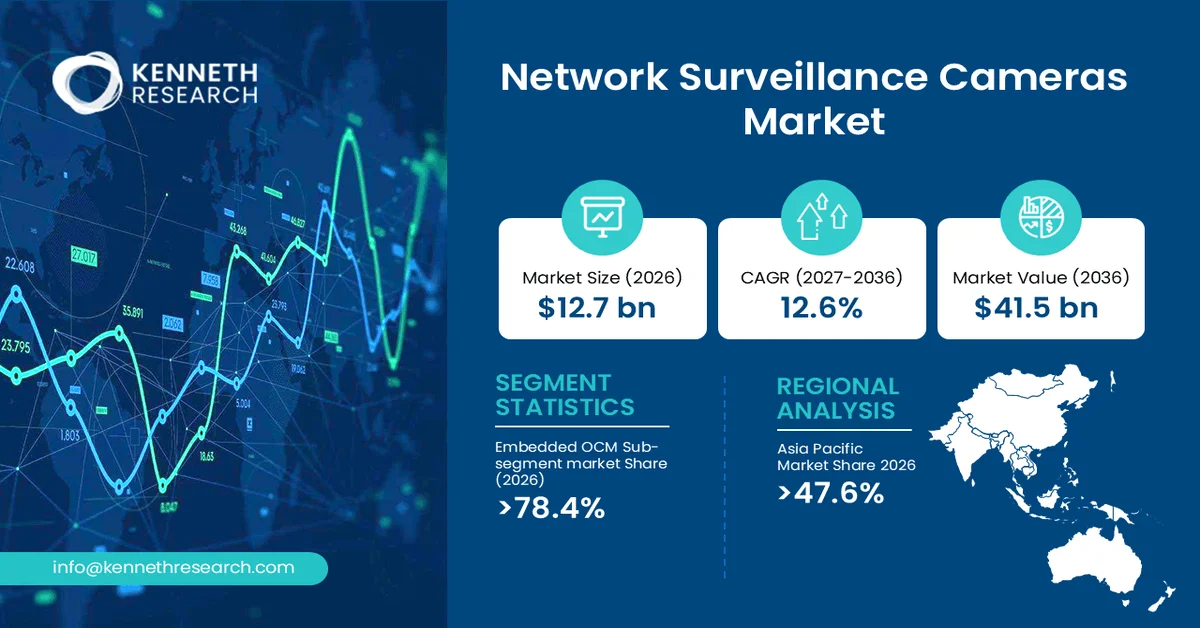
Network Surveillance Cameras Market size was valued at USD 12.7 billion in 2026 and is projected to reach USD 41.5 billion by the end of 2036, rising at a CAGR of 12.6% during the forecast period, i.e., 2027-2036. In 2027, the industry size of the network surveillance cameras is estimated at USD 14.2 billion.
The primary growth driver is the expansion of smart-city and connected urban-management infrastructure, which is increasing demand for networked visual monitoring. Government-backed deployments increasingly integrate cameras with IoT, data platforms, and intelligent analytics, enabling continuous situational awareness, automated event detection, faster response, and centralized management across public and industrial environments.
The network surveillance cameras market comprises cameras that capture and transmit video through IP-based networks for security monitoring, operational oversight, safety management, and situational awareness. These systems typically combine imaging hardware with network connectivity, video management software, storage infrastructure, analytics, and monitoring interfaces, allowing authorized users to access and manage visual information remotely.
Key characteristics include continuous or event-based video capture, digital transmission, centralized management, remote accessibility, integration with Internet of Things infrastructure, and compatibility with analytics technologies such as artificial intelligence and automated event recognition. Network cameras can be deployed across indoor and outdoor environments, including commercial facilities, transportation infrastructure, industrial sites, public spaces, and government facilities.
Key Network Surveillance Cameras Market Insights Summary:
Key Takeaways: Market Trends & Insights
- AI-enabled video analytics are strengthening demand for network surveillance cameras across public safety, transportation, industrial facilities, and commercial infrastructure
- Hardware represents the leading component sub-segment with a 78.4% market share in 2026, reflecting the foundational role of physical camera equipment in surveillance deployments
- Infrared is positioned as the second and fastest-growing product-type segment, supported by demand for continuous monitoring in low-light and perimeter-security environments
- Asia Pacific leads the network surveillance cameras market with a 47.6% market share in 2026, supported by extensive digital infrastructure investment and strong deployment activity across China and Japan
- The market is projected to expand from USD 12.7 billion in 2026 to USD 41.5 billion in 2036, representing a 12.6% CAGR during 2027-2036
Market Drivers
- AI-enabled video analytics and intelligent monitoring
- Expansion of connected infrastructure and remote monitoring
- Growth of smart-city and digitally managed public infrastructure
- Increasing demand for centralized surveillance across distributed facilities
Challenges
- Cybersecurity and network vulnerability
- Deployment complexity and system integration constraints
Network Surveillance Cameras Market Overview & Supply Chain
Adoption of networked surveillance cameras is increasing globally as governments, enterprises, and infrastructure operators strengthen digital security, urban management, operational visibility, and connected monitoring capabilities. Technological progress in IP networking, edge computing, artificial intelligence, and centralized video platforms is expanding the role of cameras from standalone security devices into connected sensing infrastructure. Industrial applications increasingly encompass transportation, manufacturing, utilities, commercial facilities, public safety, and smart-city operations.
The value chain begins with raw-material and component suppliers providing image sensors, semiconductor processors, memory, optical elements, printed circuit boards, housings, cables, networking components, and power-management components. Camera manufacturers integrate these inputs into network surveillance equipment, incorporating firmware, imaging modules, connectivity functions, cybersecurity features, and increasingly edge-based analytics. Specialized software providers contribute video-management platforms, storage management, artificial-intelligence analytics, and system-integration capabilities. Distribution flows through direct enterprise sales, technology distributors, security-system integrators, value-added resellers, and public-sector procurement channels.
Network Surveillance Cameras Market: Growth Drivers & Challenges
Growth Drivers:
- AI-enabled video analytics and intelligent monitoring: The integration of artificial intelligence into network surveillance cameras is increasing their functional value beyond conventional video recording. AI-enabled systems can identify objects, classify activities, detect predefined events, and generate alerts, allowing security teams to focus on incidents requiring attention rather than continuously reviewing footage. This capability is particularly relevant to public safety, transportation, industrial facilities, commercial premises, and critical infrastructure.
- Expansion of connected infrastructure and remote monitoring: The expansion of connected buildings, industrial facilities, transportation networks, utilities, and digitally managed public infrastructure is creating additional deployment opportunities for network surveillance cameras. IP-based systems can connect cameras with enterprise networks, video-management platforms, access-control systems, sensors, and centralized security operations, enabling organizations to monitor geographically distributed locations through integrated infrastructure.
Challenges:
- Cybersecurity and network vulnerability: The increasing connectivity of surveillance cameras creates a larger cybersecurity exposure than isolated monitoring systems. Network cameras are connected to corporate networks, cloud platforms, video-management systems, and other digital infrastructure, creating potential entry points if device credentials, firmware, network configurations, or remote-access controls are inadequately protected. The root cause is the combination of widespread connectivity, distributed deployments, long device lifecycles, and inconsistent security practices across manufacturers and end users.
- Deployment complexity and system integration constraints: Integrating network surveillance cameras into existing security and operational infrastructure can be technically complex, particularly across large facilities or geographically distributed sites. The root cause is the need to coordinate cameras with network infrastructure, storage systems, video-management software, access-control platforms, analytics applications, and legacy equipment. Differences in protocols, software compatibility, device capabilities, and system architectures can increase integration requirements and make standardized deployment more difficult.
Network Surveillance Cameras Market Size and Forecast:
| Report Attribute | Details |
|---|---|
| Base Year |
2026 |
| Forecast Period |
2027-2036 |
| CAGR |
12.6% |
| Base Year Market Size (2026) |
USD 12.7 billion |
| Forecast Year Market Size (2036) |
USD 41.5 billion |
| Regional Scope |
|
Network Surveillance Cameras Market Segmentation Analysis:
Component Segment Analysis
In the component segment, hardware sub-segment is anticipated to capture the largest market share of 78.4% by the end of 2026.
Hardware dominates the component segment because physical camera equipment remains the essential foundation for video capture, network connectivity, processing, storage integration, and deployment across security environments. Current demand is supported by modernization of legacy surveillance infrastructure, expansion of smart-city programmes, and replacement of conventional systems with IP-enabled equipment offering higher resolution, scalability, and remote accessibility. Government deployment provides a direct indication of this demand: India’s Smart Cities Mission reported that 84,000 CCTV surveillance cameras had been installed across its participating cities as of November 2024. On the supply side, manufacturers are increasingly incorporating advanced imaging, onboard processing, cybersecurity controls, and network functionality into camera hardware, while procurement standards are becoming more demanding. This supports continued investment in higher-performance equipment rather than standalone basic devices.
Product Type Segment Analysis
The infrared is projected to grow as the second-largest segment in the network surveillance cameras market due to four converging demand drivers.
Infrared is projected to grow rapidly within the product-type segment because it enables surveillance cameras to maintain visibility in darkness and other low-light conditions without relying on conventional illumination. Demand is supported by security requirements across borders, transportation infrastructure, industrial sites, public facilities, and perimeter-monitoring applications where surveillance must operate continuously. Industry adoption is also supported by camera designs combining infrared illumination with day/night imaging, weather protection, and network connectivity. On the supply side, manufacturers are integrating IR capabilities directly into fixed, bullet, dome, and PTZ network cameras, reducing the need for separate illumination infrastructure. The outlook remains favorable as operators increasingly require continuous surveillance, particularly across large outdoor and security-sensitive environments.
Our in-depth analysis of the network surveillance cameras market includes the following segments:
|
Segment |
Sub-segment |
|
Component |
|
|
Product Type |
|
|
Connection Type |
|
|
End-Use |
|
Network Surveillance Cameras Market Regional Insights:
Asia Pacific Market Trends & Insights:
Asia Pacific network surveillance cameras is projected to hold the largest revenue share of 47.6% by the end of 2026.
Its supported by extensive investment in digital infrastructure, smart-city development, public-security modernization, and industrial automation. The region combines a large manufacturing base for surveillance equipment and electronic components with substantial domestic consumption.
China represents the principal country within the region, benefiting from large-scale manufacturing capabilities, domestic technology ecosystems, smart-city programmes, and government emphasis on integrated digital infrastructure. A 2024 national policy framework further promotes city-wide digital transformation, including integrated urban operating platforms and intelligent infrastructure.
Japan represents another established market, supported by government procurement for surveillance infrastructure across public-sector facilities, including security-camera systems and replacements. Recent procurement activity demonstrates continued institutional deployment and modernization of surveillance equipment.
North America Market Trends & Insights:
North America is a mature market characterized by demand from public safety, transportation, commercial facilities, critical infrastructure, and industrial environments. Adoption is supported by modernization of legacy surveillance systems, expansion of connected infrastructure, artificial-intelligence-enabled monitoring, and increasing requirements for centralized security operations.
The United States represents the region’s principal country market, supported by technology-intensive security deployments and federal, state, and municipal smart-infrastructure programmes. Government analysis confirms that U.S. cities are using connected cameras and other sensors for transportation and law-enforcement applications.
Canada presents complementary opportunities through smart-city development, critical-infrastructure modernization, and connected public services. The Canadian government’s Smart Cities Challenge emphasizes innovation, data, and connected technology, while national-security guidance recognizes video recording devices as potential components of connected urban infrastructure.
Leading Companies Operating in the Global Network Surveillance Cameras Market:
Here is a list of upstream, downstream, and key players operating in network surveillance cameras market competitive ecosystem:
- Hikvision Digital Technology (China)
- Company Overview
- Business Strategy
- Key Product Offerings
- Financial Performance
- Key Performance Indicators
- Risk Analysis
- Recent Development
- Regional Presence
- SWOT Analysis
- Dahua Technology (China)
- Axis Communications (Sweden)
- Hanwha Vision (South Korea)
- Tiandy Technologies (China)
Recent Developments
- In April 2026, Hanwha Vision launched the 2nd Generation X Series AI Fisheye Camera equipped with the Wisenet 9 SoC, delivering 360° monitoring without blind spots. The camera features a dual-NPU architecture that simultaneously performs AI-based image enhancement and advanced edge analytics, precisely classifying and tracking people and vehicles while filtering out unnecessary movements to reduce false alarms. It supports remote pan/tilt/view adjustment via digital rotation and dewarping, and includes three built-in microphones with noise reduction technology.
Frequently Asked Question
In 2026, the network surveillance cameras market exceeded USD 12.7 billion.
The network surveillance cameras market is projected to reach USD 41.5 billion by the end of 2036, expanding at a CAGR of 12.6% over the forecast period (2027-2036).
The major players in the market are Hikvision Digital Technology, Dahua Technology, Axis Communications, Hanwha Vision, Tiandy Technologies, and others.
In the component segment, the hardware sub-segment is anticipated to capture the largest market share of 78.4% in the future and exhibit lucrative growth opportunities during 2027-2036. This growth trajectory is largely attributed to increasing deployment of networked surveillance infrastructure across public, commercial, industrial, and critical-infrastructure environments.
Asia Pacific is projected to hold the largest market share of 47.6% by the end of 2026 and provide more business opportunities in the future. Continuous investments in smart-city development, connected infrastructure, industrial digitalization, and public-security modernization are fostering the region's dominance.
Why Choose Kenneth Research ?
-
Insight with Impact : We don’t just gather data — we uncover stories, trends, and opportunities that fuel business growth.
-
Experts Who Get It : Our team speaks your industry’s language and knows what really matters to your customers and market.
-
Custom-Built for You : Forget one-size-fits-all. We craft research and consulting solutions as unique as your business vision.
-
Partners, Not Just Providers : We work with you, not for you — collaborating closely to turn insights into smart, strategic moves.
-
Results That Speak : Our work powers brands, startups, and industry leaders alike — with a track record of ideas that work in the real world.
Report ID: 1472 |
Published Date: 28 Sep 2026 |
Report Format: |
Delivery Timeline: 48-72 Business Hours

Copyright © 2025 Kenneth Research. All rights reserved. Terms of Use | Privacy Policy
