Report ID: 1426 |
Published Date: 29 Sep 2026 |
Report Format: |
Delivery Timeline: 48-72 Business Hours
Network Cabinet Monitoring Market Outlook:
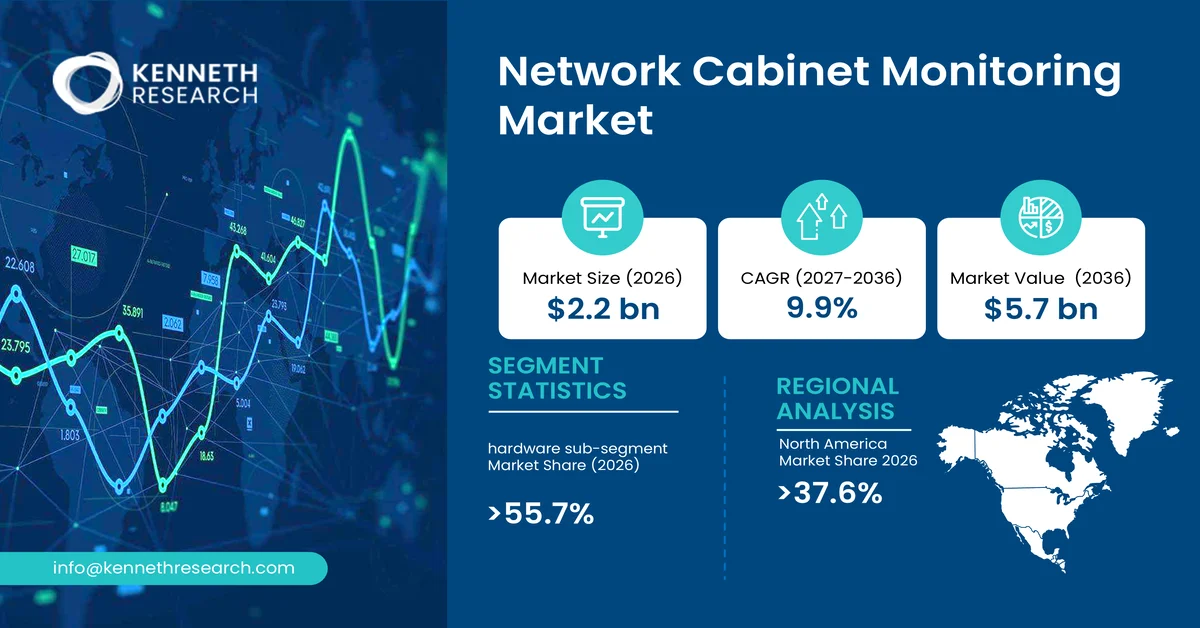
Network cabinet monitoring market size was valued at USD 2.2 billion in 2026 and is projected to reach USD 5.7 billion by the end of 2036, rising at a CAGR of 9.9% during the forecast period, i.e., 2027–2036. In 2027, the industry size of the network cabinet monitoring market is estimated at USD 2.4 billion.
The primary growth driver is rising data-center electricity demand, which increases the need for continuous visibility into rack-level power conditions, thermal loads, and equipment status.
Network cabinet monitoring market refers to technologies, devices, software, and integrated systems used to observe, measure, and manage operating conditions within network cabinets and racks. These solutions can capture parameters such as power consumption, temperature, humidity, airflow, equipment status, access conditions, and environmental changes, depending on configuration.
A typical monitoring architecture combines sensors, intelligent power distribution or measurement hardware, communications interfaces, dashboards, alerting functions, and management software. Key characteristics include continuous or scheduled data collection, threshold-based notifications, centralized visibility, historical data analysis, and integration with infrastructure-management platforms. More advanced deployments can support remote supervision and automated responses to abnormal operating conditions.
Key Network Cabinet Monitoring Market Insights Summary:
Key Takeaways: Market Trends & Insights
- Network cabinet monitoring market is valued at USD 2.2 billion in 2026 and is projected to reach USD 5.7 billion by 2036, expanding at a 9.9% CAGR from 2027 to 2036
- Hardware leads the Component segment with a 55.7% market share in 2026, supported by increasing demand for physical infrastructure monitoring across data centers and network environments
- Power Monitoring is identified as the fastest-growing analysis segment within the Monitoring Type category, driven by increasing requirements for real-time power visibility, capacity management, and infrastructure efficiency
- North America dominates the network cabinet monitoring market with a 37.6% market share in 2026, supported by established data-center infrastructure and continued investment across the United States and Canada
Market Drivers
- Rising data-center power density and electrical complexity
- Expansion of remote infrastructure management and predictive operations
- Increasing deployment of edge computing and distributed network infrastructure
- Growing emphasis on energy efficiency, operational resilience, and infrastructure visibility
Challenges
- Complexity of Retrofitting Monitoring Systems into Legacy Cabinets
- Cybersecurity Exposure from Connected Monitoring Infrastructure
Network Cabinet Monitoring Market Overview & Supply Chain
Adoption of network cabinet monitoring is increasing as digital infrastructure becomes more power-intensive, distributed, and operationally critical. Data centers, telecommunications facilities, enterprise networks, healthcare infrastructure, manufacturing sites, and energy systems increasingly require continuous visibility into cabinet-level power and environmental conditions to support equipment reliability, preventive maintenance, energy management, and operational continuity.
The value chain for network cabinet monitoring begins with raw-material and component suppliers providing electronic components, sensors, semiconductors, printed circuit boards, wiring, enclosures, communication modules, and power-monitoring components. Manufacturers integrate these inputs into monitoring devices, intelligent power distribution units, environmental sensors, gateways, controllers, and software platforms, followed by testing, calibration, firmware development, and systems integration. Distribution occurs through direct sales, specialized technology distributors, systems integrators, value-added resellers, and infrastructure solution providers. End users include data centers, telecommunications operators, enterprises, healthcare organizations, manufacturers, utilities, and other operators of networked infrastructure.
Network Cabinet Monitoring Market - Growth Drivers & Challenges
Growth Drivers
- Rising Data-Center Power Density and Electrical Complexity: The increasing power intensity of digital infrastructure is strengthening demand for cabinet-level monitoring. AI computing, accelerated servers, high-performance networking, and dense storage configurations place greater electrical and thermal demands on individual cabinets, making continuous visibility into power consumption, temperature, and equipment conditions increasingly important.
- Expansion of Remote Infrastructure Management and Predictive Operations: The growing geographic distribution of IT and communications infrastructure is encouraging organizations to adopt remote monitoring capabilities that reduce dependence on continuous on-site supervision. Network cabinets can be deployed across offices, telecommunications locations, industrial facilities, edge-computing sites, healthcare environments, and other distributed installations, creating operational challenges when technicians must physically inspect equipment.
Challenges
- Complexity of Retrofitting Monitoring Systems into Legacy Cabinets: Many enterprises operate network cabinets built around equipment, power architectures, and management systems installed over several technology cycles. Integrating modern sensors and monitoring platforms can therefore require cabinet-level redesign, additional cabling, interface compatibility work, and coordination with existing infrastructure. This complexity increases deployment time and can disrupt operational environments where network availability is critical.
- Cybersecurity Exposure from Connected Monitoring Infrastructure: Network cabinet monitoring introduces connected sensors, gateways, management interfaces, and remote-access capabilities into infrastructure environments that were traditionally isolated from broader IT systems. Poorly secured endpoints or weak access controls can create additional attack surfaces and complicate compliance requirements.
Network Cabinet Monitoring Market Size and Forecast:
| Report Attribute | Details |
|---|---|
| Base Year |
2026 |
| Forecast Year |
2027-2036 |
| CAGR |
9.9% |
| Base Year Market Size (2026) |
USD 2.2 billion |
| Forecast Year Market Size (2036) |
USD 5.7 billion |
| Regional Scope |
|
Network Cabinet Monitoring Market - Segment Analysis
Component Segment Analysis
In the component segment, hardware sub-segment is anticipated to capture the largest market share of 55.7% by the end of 2026.
The Hardware segment leads the component category, accounting for 55.7% of the market in 2026, as organizations increasingly require physical monitoring infrastructure to maintain visibility across power, temperature, environmental conditions, and cabinet-level equipment status. Current demand is being reinforced by expanding data-center capacity, higher equipment density, and the need to improve infrastructure reliability. The U.S. Department of Energy reported that U.S. data centers consumed 176 TWh of electricity in 2023, underscoring the scale of the infrastructure requiring continuous operational oversight.
Monitoring Type Segment Insights
The power monitoring is projected to grow as the second-largest segment in the network cabinet monitoring market due to four converging demand drivers.
Power Monitoring is projected to expand rapidly within the monitoring type category as data-center operators face rising electricity loads, higher rack densities, and greater requirements for real-time visibility into power consumption and infrastructure performance. The International Energy Agency reports that global data-center electricity consumption reached 415 TWh in 2024, highlighting the expanding power requirements of digital infrastructure.Growing deployment of AI-oriented computing and high-density servers is encouraging operators to monitor cabinet-level power conditions more closely to identify abnormal loads, support capacity planning, and improve energy-management practices.
Our in-depth analysis of the network cabinet monitoring market includes the following segments:
|
Segment |
Sub-segment |
|
Component |
|
|
Monitoring Type |
|
|
Application |
|
Network Cabinet Monitoring Market - Regional Analysis
North America Market Trends & Insights:
North America network cabinet monitoring is projected to hold the largest revenue share of 37.6% by the end of 2026.
Its leadership reflects the region’s established data-center ecosystem, extensive enterprise networking infrastructure, and continued investment in high-density computing environments. The United States is experiencing substantial data-center expansion associated with AI and digital services, increasing requirements for cabinet-level visibility across power, cooling, and equipment conditions.
Within the region, the United States represents the principal demand center, supported by hyperscale and enterprise data-center development and federal attention to electricity infrastructure required for expanding digital loads.
Canada contributes through continued data-center development and energy-infrastructure investment. Together, these markets support sustained regional demand as operators prioritize reliability, energy visibility, and infrastructure optimization.
Asia Pacific Market Trends & Insights:
Asia Pacific is emerging as an important market for network cabinet monitoring, supported by rapid digitalization, expanding data-center infrastructure, cloud adoption, and industrial automation. Demand is increasingly tied to the need for higher infrastructure availability, energy efficiency, and centralized visibility across distributed IT environments. Government initiatives are also strengthening the underlying ecosystem.
Within the region, China benefits from coordinated national policies supporting data-center clusters, computing infrastructure, energy coordination, and intelligent-computing deployment. This creates opportunities for monitoring solutions that support operational efficiency and infrastructure management.
India offers a complementary growth avenue through expanding digital services, cloud infrastructure, e-governance requirements, and data-center development. Its emphasis on scalable and highly available digital infrastructure can support wider adoption of cabinet-level environmental, equipment, and power monitoring technologies.
Network Cabinet Monitoring Market Competitive Landscape
Here is a list of upstream, downstream, and key players operating in network cabinet monitoring market competitive ecosystem:
- Schneider Electric SE (France)
- Company Overview
- Business Strategy
- Key Product Offerings
- Financial Performance
- Key Performance Indicators
- Risk Analysis
- Recent Development
- Regional Presence
- SWOT Analysis
- Vertiv Group Corp. (United States)
- Eaton Corporation plc (Ireland)
- Molex (United States)
- Belden Inc. (United States)
Recent Developments
- In June 2026, Molex introduced Leak Detection Cables for data center rack trays using liquid cooling. The customizable cable assemblies provide early leak detection before equipment damage occurs, using a smart detection system that alerts operators to fluid intrusion in space-constrained server configurations.
Frequently Asked Question
In 2026, the network cabinet monitoring market exceeded USD 2.2 billion.
The network cabinet monitoring market is projected to reach USD 5.7 billion by the end of 2036, expanding at a CAGR of 9.9% over the forecast period (2027-2036).
The major players in the market are Schneider Electric SE, Vertiv Group Corp., Eaton Corporation plc, Molex, Belden Inc., and others.
In the Component segment, the Hardware sub-segment is anticipated to capture the largest market share of 55.7% in the future and exhibit lucrative growth opportunities during 2027-2036. This growth trajectory is largely attributed to expanding data-center infrastructure and the increasing need for cabinet-level visibility across power, temperature, and equipment conditions.
North America is projected to hold the largest market share of 37.6% by the end of 2026 and provide more business opportunities in the future. Continuous investments in data-center infrastructure, high-density computing, and enterprise networking across the United States and Canada are fostering the region's dominance.
Why Choose Kenneth Research ?
-
Insight with Impact : We don’t just gather data — we uncover stories, trends, and opportunities that fuel business growth.
-
Experts Who Get It : Our team speaks your industry’s language and knows what really matters to your customers and market.
-
Custom-Built for You : Forget one-size-fits-all. We craft research and consulting solutions as unique as your business vision.
-
Partners, Not Just Providers : We work with you, not for you — collaborating closely to turn insights into smart, strategic moves.
-
Results That Speak : Our work powers brands, startups, and industry leaders alike — with a track record of ideas that work in the real world.
Report ID: 1426 |
Published Date: 29 Sep 2026 |
Report Format: |
Delivery Timeline: 48-72 Business Hours

Copyright © 2025 Kenneth Research. All rights reserved. Terms of Use | Privacy Policy
