Report ID: 1140 |
Published Date: 21 Aug 2026 |
Report Format: |
Delivery Timeline: 48-72 Business Hours
Nano Ceramic Coating Market Outlook:
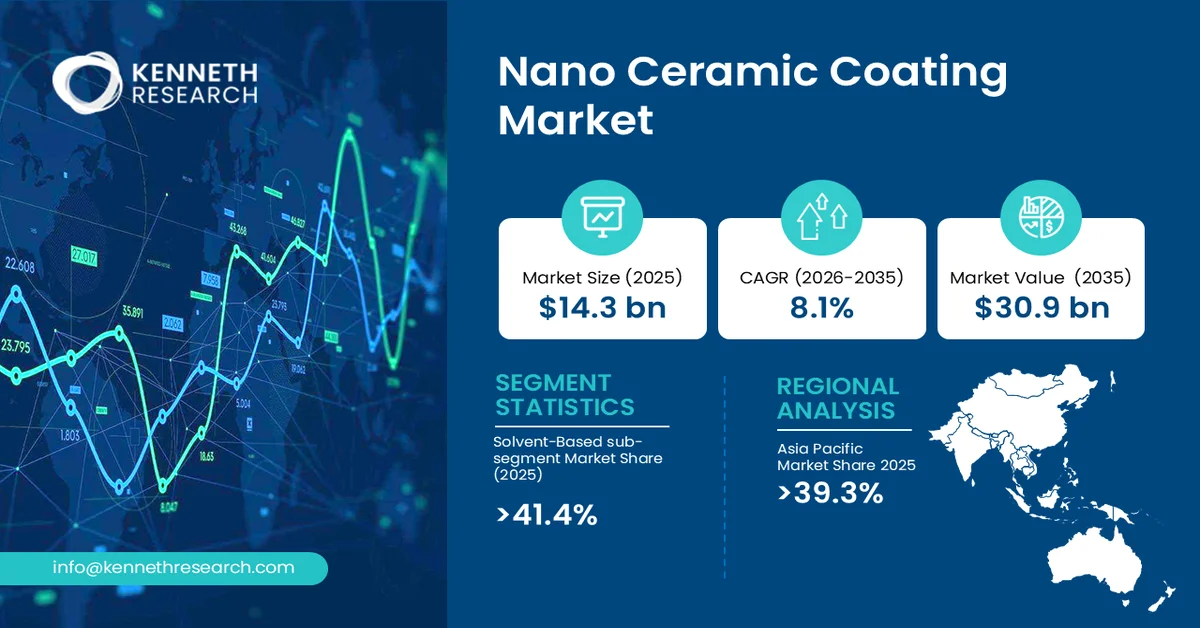
Nano Ceramic Coating Market size was valued at USD 14.3 billion in 2025 and is projected to reach USD 30.9 billion by the end of 2035, rising at a CAGR of 8.1% during the forecast period, i.e., 2026-2035. In 2026, the industry size of nano ceramic coating is estimated at USD 15.5 billion.
The primary growth driver for the nano ceramic coating market is the increasing demand for high-performance surface protection across automotive, industrial, electronics, construction, and aerospace applications. Nano ceramic coatings improve corrosion resistance, scratch protection, chemical stability, UV resistance, and service life while supporting the development of advanced materials for demanding operating environments.
The nano ceramic coating market comprises the production, formulation, commercialization, and application of ceramic-based coatings engineered with nanoscale particles to enhance the surface properties of diverse substrates, including metals, glass, polymers, composites, and ceramics. These coatings create an ultra-thin protective layer that delivers superior hardness, abrasion resistance, corrosion protection, chemical resistance, thermal stability, hydrophobicity, and UV durability compared with conventional coating technologies.
Nano ceramic coatings are formulated using advanced inorganic materials such as silica, alumina, titanium oxide, zirconia, and other ceramic nanomaterials that bond strongly with substrate surfaces to provide long-lasting functional performance. Depending on application requirements, they are available in solvent-based, water-based, and other specialized formulations for industrial processing.
The market plays a significant role across automotive, manufacturing, aerospace, electronics, marine, energy, healthcare, and construction industries by extending equipment life, reducing maintenance frequency, improving operational efficiency, and protecting critical components exposed to harsh mechanical, thermal, and chemical environments. As advanced materials continue to gain industrial importance, nano ceramic coatings have become an integral part of modern surface engineering and high-performance protective coating technologies.
Key Nano Ceramic Coating Market Insights Summary:
Key Takeaways: Market Trends & Insights
- Nano Ceramic Coating Market is projected to grow from USD 15.5 billion in 2026 to USD 30.9 billion by 2035, registering a CAGR of 8.1% during the forecast period
- Solvent-Based formulations held the largest 41.4% market share in 2025, driven by superior adhesion, rapid curing, and widespread adoption across automotive, aerospace, marine, and industrial applications
- Asia Pacific accounted for the largest regional share of 39.3% in 2025, supported by strong manufacturing capabilities, expanding industrial infrastructure, and growing demand from China and India
- The Industrial end-use segment is expected to witness significant growth, fueled by increasing investments in advanced manufacturing, industrial automation, and demand for durable surface protection solutions across production facilities
- Growing adoption of nano ceramic coatings across automotive, electronics, aerospace, construction, and industrial sectors is being driven by the need for enhanced corrosion resistance, abrasion protection, thermal stability, and longer equipment service life
Market Drivers
- Increasing adoption of corrosion-resistant coatings in marine and offshore infrastructure
- Growing utilization of nano ceramic coatings in consumer electronics and semiconductor manufacturing
- Stringent environmental regulations encouraging durable and resource-efficient protective coatings
- Increasing investments in aerospace maintenance, repair, and overhaul (MRO) activities driving demand for advanced surface protection technologies
Challenges
- High Formulation Complexity and Production Costs
- Regulatory Compliance and Performance Standardization Across End-Use Industries
Nano Ceramic Coating Market Overview & Supply Chain
Growing demand for durable, multifunctional, and sustainable surface protection solutions is accelerating the global adoption of nano ceramic coatings across automotive, industrial manufacturing, aerospace, electronics, construction, and energy applications. These coatings enhance corrosion resistance, abrasion protection, thermal stability, and chemical durability while extending asset life and reducing maintenance requirements. Their compatibility with advanced manufacturing processes and high-performance materials also aligns with industries seeking greater operational efficiency and lower lifecycle costs. The increasing emphasis on industrial decarbonization further supports their adoption, as manufacturers prioritize protective technologies that improve equipment longevity and resource efficiency. This trend is reinforced by the International Energy Agency, which reported that investment in clean technology manufacturing reached around USD 200 billion in 2023, increasing by more than 70% compared with 2022, highlighting the rapid expansion of advanced manufacturing ecosystems that utilize high-performance coating technologies.
The nano ceramic coating industry value chain begins with the procurement of specialty raw materials, including ceramic nanoparticles, silica, alumina, titanium dioxide, zirconia, solvents, resins, dispersants, catalysts, and performance additives sourced from advanced chemical and material suppliers. These inputs undergo precision formulation, nanoparticle dispersion, quality testing, and coating production using controlled manufacturing processes to ensure consistent particle distribution, adhesion, and functional performance. Products are then supplied through direct sales channels, industrial distributors, coating solution providers, OEM partnerships, and specialized applicators that serve regional and international markets. Downstream participants include automotive manufacturers and detailing companies, aerospace suppliers, electronics manufacturers, industrial equipment producers, marine operators, construction firms, and energy infrastructure developers that integrate nano ceramic coatings into maintenance and production operations. Key stakeholders across the value chain include raw material manufacturers, formulation specialists, coating producers, equipment suppliers, distributors, certified applicators, regulatory authorities, research institutions, and industrial end users.
Nano Ceramic Coating Market: Growth Drivers & Challenges
Growth Drivers:
- Rising electric vehicle production increases demand for high-performance surface protection: The rapid expansion of electric vehicle (EV) production is creating strong demand for nano ceramic coatings across vehicle exteriors, battery systems, electronic components, sensors, and lightweight structural parts. Manufacturers increasingly require advanced coating technologies that deliver corrosion resistance, thermal stability, scratch protection, and chemical durability without significantly increasing component weight. Nano ceramic coatings help improve the operational reliability and lifespan of critical EV components while reducing maintenance requirements and preserving aesthetic quality. The long-term outlook remains favorable as automotive OEMs continue integrating advanced materials into next-generation mobility platforms. Supporting this trend, the U.S. Department of Energy reported that more than 1.4 million electric vehicles were sold in the United States in 2023, representing a 50% increase from the previous year, demonstrating the accelerating industrial demand for advanced protective coating technologies.
- Expansion of advanced manufacturing and high-value industrial applications: The increasing adoption of precision manufacturing across aerospace, electronics, industrial machinery, medical devices, and renewable energy sectors is strengthening demand for nano ceramic coatings. Modern manufacturing environments require surface engineering solutions capable of withstanding aggressive operating conditions, including abrasion, chemical exposure, high temperatures, and continuous mechanical stress. Nano ceramic coatings improve equipment reliability, reduce maintenance intervals, and enhance component performance, making them valuable across high-value production environments. Continuous innovation in nanomaterial formulations is also enabling coatings with multifunctional properties such as anti-fouling, hydrophobicity, and enhanced thermal insulation, expanding their commercial applicability. As industries prioritize operational efficiency, longer asset lifecycles, and sustainable manufacturing practices, demand is expected to broaden beyond traditional automotive applications into diversified industrial sectors, creating new opportunities for coating manufacturers, technology developers, and specialized application service providers.
Challenges:
- High formulation complexity and production costs: Developing nano ceramic coatings requires precise control over nanoparticle synthesis, dispersion stability, binder compatibility, and curing performance. Maintaining uniform particle distribution while achieving consistent adhesion and long-term durability demands advanced manufacturing processes, specialized equipment, and stringent quality assurance protocols. These technical requirements increase production costs and create barriers for manufacturers attempting to scale commercial output. For end users, the higher acquisition and application costs can delay purchasing decisions, particularly in cost-sensitive industries where conventional coating technologies remain viable alternatives. Manufacturers must also invest continuously in research and process optimization to improve coating performance without compromising cost competitiveness. Over the long term, broader commercialization will depend on advancements in formulation efficiency, manufacturing automation, and raw material optimization that enable premium performance at more accessible price points.
- Regulatory compliance and performance standardization across end-use industries: Nano ceramic coatings are supplied to industries with diverse technical specifications, environmental regulations, and product qualification requirements. Differences in testing methodologies, certification procedures, chemical regulations, and application standards across regions create complexity for manufacturers serving global markets. Companies frequently need to customize formulations and validation processes for individual industries such as automotive, aerospace, electronics, and industrial manufacturing, increasing development timelines and compliance costs. Inconsistent performance benchmarks can also complicate customer evaluation and slow procurement decisions, particularly for mission-critical applications where long-term reliability must be demonstrated through extensive testing. As regulatory expectations for advanced materials continue to evolve, manufacturers will need to strengthen certification capabilities, expand technical documentation, and invest in standardized testing practices to facilitate broader market acceptance while reducing commercialization risks.
Nano Ceramic Coating Market Size and Forecast:
| Report Attribute | Details |
|---|---|
| Base Year |
2025 |
| Forecast Year |
2026-2035 |
| CAGR |
8.1% |
| Base Year Market Size (2025) |
USD 14.3 billion |
| Forecast Year Market Size (2035) |
USD 30.9 billion |
| Regional Scope |
|
Nano Ceramic Coating Market Segmentation Analysis:
Formulation Type Segment Analysis
In the formulation type segment, the Solvent-Based sub-segment is anticipated to capture the largest market share of 41.4% by the end of 2025.
The solvent-based formulation segment dominates the nano ceramic coating market because it delivers superior adhesion, rapid curing, excellent substrate wetting, and high durability in demanding industrial environments. These formulations are widely preferred for applications involving automotive components, heavy machinery, aerospace structures, marine equipment, and industrial infrastructure where resistance to abrasion, chemicals, moisture, and extreme temperatures is essential. Their ability to form uniform protective films on complex geometries and metallic substrates supports consistent performance in high-throughput manufacturing operations. On the supply side, established production technologies, mature raw material supply networks, and extensive application expertise have enabled manufacturers to commercialize solvent-based nano ceramic coatings at industrial scale. Although sustainability regulations are encouraging the development of alternative formulations, solvent-based systems continue to dominate applications requiring premium mechanical performance and long service life. This demand is reflected in ongoing regulatory oversight of industrial surface coating operations.
End Use Segment Analysis
The industrial is projected to grow as the second-largest segment in the nano ceramic coating market due to four converging demand drivers.
The industrial end-use segment is projected to register strong growth as manufacturers increasingly prioritize equipment reliability, operational efficiency, and lifecycle cost optimization. Nano ceramic coatings are being adopted across industrial machinery, processing equipment, fabrication tools, storage systems, and production infrastructure to improve resistance against corrosion, abrasion, chemicals, and thermal stress. As manufacturing facilities modernize through automation and precision engineering, demand is rising for protective coatings that minimize unplanned downtime and extend maintenance intervals. On the supply side, coating manufacturers are expanding advanced formulations that offer improved adhesion, durability, and compatibility with diverse industrial substrates, enabling broader deployment across multiple production environments. The long-term outlook remains favorable as industrial operators continue investing in asset protection and sustainable manufacturing practices. This trend is supported by the United Nations Industrial Development Organization (UNIDO), which reported that global manufacturing value added increased by 2.9% in 2024, reflecting continued expansion in manufacturing activity that underpins demand for advanced industrial surface protection technologies.
Our in-depth analysis of the global nano ceramic coating market includes the following segments:
|
Segment |
Sub-segment |
|
Type |
|
|
Application |
|
|
End Use |
|
|
Formulation Type |
|
Nano Ceramic Coating Market Regional Insights:
Asia Pacific Market Trends & Insights:
Asia Pacific nano ceramic coating market is projected to hold the largest revenue share of 39.3% by the end of 2025.
The region benefits from well-established supply chains for specialty chemicals, advanced ceramics, and nanomaterials, enabling efficient production and commercialization of high-performance coatings. Continuous investments in industrial modernization, clean technology manufacturing, and advanced materials research further strengthen regional competitiveness. Regulatory initiatives supporting sustainable manufacturing, infrastructure development, and higher-value industrial production also encourage the adoption of durable surface protection technologies. Regional demand is reinforced by the scale of manufacturing investment. According to the International Energy Agency (IEA), China accounted for three-quarters of global investments in clean technology manufacturing in 2023, highlighting Asia Pacific's leadership in advanced industrial production and its favorable environment for high-performance coating technologies.
China serves as the region's primary growth engine through its large-scale automotive, electronics, industrial machinery, renewable energy, and advanced manufacturing sectors. Continuous investment in high-value manufacturing and materials innovation supports broad adoption of nano ceramic coatings for equipment protection, productivity improvement, and product quality enhancement.
India is emerging as an important growth market, driven by expanding manufacturing capacity, industrial automation, infrastructure development, and increasing production across automotive, engineering, and electronics industries. Government-backed industrial initiatives, growing domestic manufacturing capabilities, and rising investments in advanced production technologies are expected to accelerate the adoption of nano ceramic coatings across diverse industrial applications in the coming years.
North America Market Trends & Insights:
North America represents a strategically important market for nano ceramic coatings due to strong demand from advanced manufacturing, automotive, aerospace, electronics, energy, and industrial equipment sectors. The region places significant emphasis on asset longevity, operational efficiency, and high-performance materials, encouraging the adoption of coatings that improve corrosion resistance, wear protection, thermal stability, and chemical durability. Continuous investments in smart manufacturing, industrial automation, and advanced materials research are expanding application opportunities across production facilities and critical infrastructure. Government initiatives supporting domestic manufacturing, clean energy technologies, and resilient industrial supply chains further create favorable conditions for advanced surface engineering solutions. In addition, stringent quality standards and growing sustainability objectives are driving industries toward durable coating technologies that reduce maintenance requirements, extend equipment service life, and improve lifecycle performance, positioning the region for sustained long-term demand.
The United States remains the primary contributor to regional growth, supported by its extensive aerospace, automotive, industrial machinery, defense, semiconductor, and energy industries. Ongoing investments in advanced manufacturing technologies and research into next-generation materials continue to expand the use of nano ceramic coatings across high-value industrial applications.
Canada complements regional growth through its strong mining, energy, transportation, and industrial manufacturing sectors, where protective coatings are increasingly adopted to enhance equipment reliability and reduce maintenance costs in demanding operating environments. Collaborative innovation programs, expanding industrial modernization efforts, and increasing focus on sustainable manufacturing are expected to strengthen nano ceramic coating adoption across both countries.
Nano Ceramic Coating Market Competitive Landscape
Here is a list of upstream, downstream, and key players operating in the global nano ceramic coating market competitive ecosystem:
- Ceramic Pro / Nanoshine Group (United States)
- Company Overview
- Business Strategy
- Key Product Offerings
- Financial Performance
- Key Performance Indicators
- Risk Analysis
- Recent Development
- Regional Presence
- SWOT Analysis
- Gtechniq (United Kingdom)
- CARPRO (South Korea)
- Nasiol / Artekya (Turkey)
- Feynlab (Australia)
- Opti-Coat (Australia)
Recent Developments
- In November 2025, Onyx Coating unveiled its next-generation line of automotive ceramic coatings at the SEMA Show 2025 in Las Vegas . The new line features graphene-infused nano coatings, N1 Nano technology, and certified 10H formulas that redefine durability, gloss, and ease of application. The ultra-durable coatings create a mirror-like gloss while offering resistance against scratches, chemicals, and environmental contaminants. Onyx Coating also introduced high-performance paint protection films with self-healing properties and advanced window films combining heat rejection, UV protection, and glare reduction.
- In February 2026, Ceramic Pro introduced its next-generation Ceramic Pro ION product line featuring Ion Exchange Technology—the same chemical strengthening process used in smartphone screen manufacturing—to achieve over 9H pencil hardness . A single layer of ION Base Coat delivers protection equivalent to two or more layers of the previous Ceramic Pro 9H generation. The coating forms a permanent bond with the surface, provides chemical resistance across pH 2–13, and creates pyramid-shaped hydrophobic structures that repel water more effectively than previous-generation coatings. All Ceramic Pro ION products are tested and certified by SGS.
Frequently Asked Question
In 2025, the nano ceramic coating market exceeded USD 14.3 billion.
The nano ceramic coating market is projected to reach USD 30.9 billion by the end of 2035, expanding at a CAGR of 8.1% over the forecast period (2026-2035).
The major players in the market are Ceramic Pro / Nanoshine Group (United States), Gtechniq (United Kingdom), CARPRO (South Korea), Nasiol / Artekya (Turkey), Feynlab (Australia), Opti-Coat (Australia), and others.
In the formulation type segment, the solvent-based sub-segment is anticipated to capture the largest market share of 41.4% in the future and exhibit lucrative growth opportunities during 2026-2035. This growth trajectory is largely attributed to its superior adhesion, rapid curing, excellent durability, and widespread adoption across automotive, aerospace, marine, and industrial manufacturing applications.
Asia Pacific is projected to hold the largest market share of 39.3% by the end of 2025 and provide more business opportunities in the future. Continuous investments in advanced manufacturing, automotive production, and industrial modernization across China and India are fostering the region's dominance.
Why Choose Kenneth Research ?
-
Insight with Impact : We don’t just gather data — we uncover stories, trends, and opportunities that fuel business growth.
-
Experts Who Get It : Our team speaks your industry’s language and knows what really matters to your customers and market.
-
Custom-Built for You : Forget one-size-fits-all. We craft research and consulting solutions as unique as your business vision.
-
Partners, Not Just Providers : We work with you, not for you — collaborating closely to turn insights into smart, strategic moves.
-
Results That Speak : Our work powers brands, startups, and industry leaders alike — with a track record of ideas that work in the real world.
Report ID: 1140 |
Published Date: 21 Aug 2026 |
Report Format: |
Delivery Timeline: 48-72 Business Hours

Copyright © 2025 Kenneth Research. All rights reserved. Terms of Use | Privacy Policy
