Report ID: 1366 |
Published Date: 15 Sep 2026 |
Report Format: |
Delivery Timeline: 48-72 Business Hours
Multispectral Camera Market Outlook:
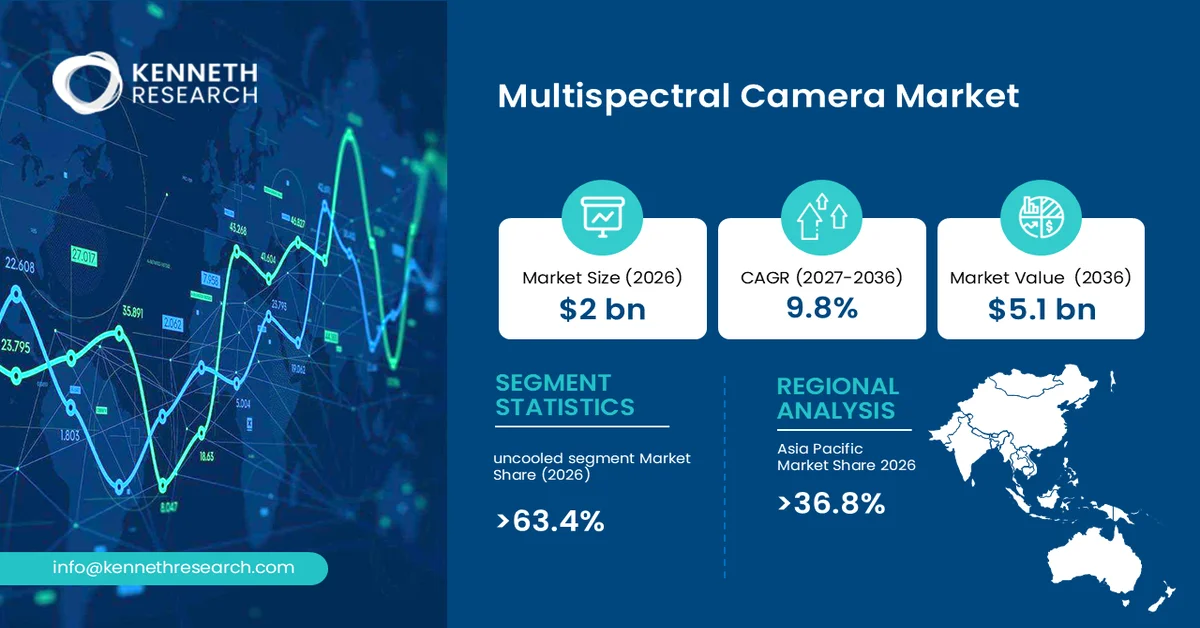
Multispectral Camera Market size was valued at USD 2 billion in 2026 and is projected to reach USD 5.1 billion by the end of 2036, rising at a CAGR of 9.8% during the forecast period, i.e., 2027–2036. In 2027, the industry size of the multispectral camera market is estimated at USD 2.2 billion.
The primary growth driver for the multispectral camera market is the expanding use of advanced remote sensing across defense, agriculture, environmental monitoring, and industrial inspection.
The multispectral camera market comprises imaging systems that capture images across multiple discrete wavelength bands, typically extending beyond conventional visible-light imaging into near-infrared, short-wave infrared, thermal infrared, or other selected spectral ranges. These cameras combine specialized optical filters, detectors, lenses, processing electronics, and imaging software to generate spectral information that can reveal characteristics not readily observable through standard cameras.
Key characteristics include multi-band image acquisition, spectral discrimination, calibrated imaging, high-resolution data capture, and compatibility with fixed, airborne, unmanned, satellite, and mobile platforms.
Key Multispectral Camera Market Insights Summary:
Key Takeaways: Market Trends & Insights
- Multispectral camera market projected to grow from USD 2 billion in 2026 to USD 5.1 billion by 2036 at a 9.8% CAGR
- Asia-Pacific accounted for the largest regional share at 36.8% in 2026, driven by expanding precision agriculture, unmanned systems, defense modernization, and remote-sensing activities across Japan and China
- Uncooled is expected to remain the leading Cooling Technology segment with a 63.4% market share in 2026, supported by demand for compact, lightweight, power-efficient, and deployment-ready imaging systems
- Defence applications are positioned for continued growth as military organizations expand multispectral sensing for surveillance, reconnaissance, target identification, and situational awareness
Market Drivers
- Rising adoption of multispectral imaging in precision agriculture
- Increasing integration with unmanned and advanced sensing platforms
- Growing demand for defense surveillance and reconnaissance applications
- Expansion of industrial inspection and environmental monitoring applications
Challenges
- High System Complexity and Integration Requirements
- Data Processing and Interpretation Requirements
Multispectral Camera Market Overview & Supply Chain
Global adoption of multispectral cameras is increasing as organizations seek more precise, non-invasive methods for identifying crop conditions, environmental changes, materials, and operational anomalies. The technology is particularly relevant to precision agriculture, where spectral information can support crop-health assessment and targeted field management.
The multispectral camera value chain begins with optical and electronic inputs, including image sensors, lenses, spectral filters, detectors, circuit boards, processors, housings, and specialized cooling or thermal-management components. Camera manufacturers integrate these elements into calibrated imaging systems and develop associated firmware, image-processing software, and data interfaces. Production typically involves optical alignment, electronics assembly, calibration, environmental testing, and system validation.
Multispectral Camera Market Growth Drivers & Challenges
Growth Drivers
- Rising Adoption of Multispectral Imaging in Precision Agriculture: The expanding use of multispectral imaging for crop monitoring and precision agriculture is creating sustained demand for multispectral cameras. By capturing information across visible, red-edge, and near-infrared bands, these systems help identify crop stress, vegetation characteristics, growth conditions, and field variability that conventional RGB imaging cannot readily reveal. In 2024, USDA Agricultural Research Service researchers published work demonstrating UAV-based multispectral imaging across five spectral bands to monitor soybean growth and support yield prediction through machine learning.
- Increasing Integration with Unmanned and Advanced Sensing Platforms: The growing deployment of unmanned aerial, maritime, and other remote-sensing platforms is accelerating demand for compact multispectral cameras. UAVs increasingly require lightweight imaging payloads capable of collecting multiple spectral datasets for surveillance, mapping, environmental monitoring, agriculture, and inspection. Multispectral cameras provide greater information depth than conventional imaging while remaining adaptable to autonomous platforms.
Challenges
- High System Complexity and Integration Requirements: Multispectral cameras require precise optical filtering, detector selection, calibration, synchronization, and image processing. Integrating multiple spectral channels while maintaining consistent spatial and radiometric performance can increase system complexity and development requirements. For airborne and defense applications, manufacturers must additionally address size, weight, power consumption, environmental robustness, and platform integration.
- Data Processing and Interpretation Requirements: Multispectral systems generate considerably richer datasets than conventional imaging systems, creating requirements for specialized processing, calibration, storage, and interpretation. Extracting actionable information from multiple spectral bands can require sophisticated algorithms and domain-specific software
Multispectral Camera Market Size and Forecast:
| Report Attribute | Details |
|---|---|
| Base Year |
2026 |
| Forecast Year |
2027-2036 |
| CAGR |
9.8% |
| Base Year Market Size (2026) |
USD 2 billion |
| Forecast Year Market Size (2036) |
USD 5.1 billion |
| Regional Scope |
|
Multispectral Camera Market - Segment Analysis
Cooling Technology Type Segment Analysis
The uncooled segment dominates the multispectral camera market, accounting for 63.4% in 2026, primarily because uncooled systems offer lower power consumption, compact form factors, simpler thermal management, and lower operating complexity than cooled alternatives. These characteristics make them well suited for drones, portable inspection systems, agricultural monitoring platforms, and other applications where size, weight, and power efficiency are important. Demand is also supported by the expanding adoption of precision-agriculture technologies. According to the U.S. Department of Agriculture, 68% of large-scale crop-producing farms used yield monitors, yield maps, and soil maps in 2023, demonstrating the broader movement toward data-driven agricultural monitoring and creating opportunities for multispectral imaging technologies.
Application Type Segment Analysis
The defence segment is projected to grow as military organizations increase adoption of advanced imaging for intelligence, surveillance, reconnaissance, target identification, and situational awareness. Multispectral cameras can combine information across visible and infrared wavelengths, enabling detection and classification in conditions where conventional imaging may be less effective.
Industry adoption is therefore moving toward sensor-equipped unmanned platforms capable of persistent information gathering. Defence agencies are also emphasizing interoperable sensing, automated analysis, and improved surveillance across air, land, and maritime domains.
Our in-depth analysis of the global multispectral camera market includes the following segments:
|
Segment |
Sub-segment |
|
Cooling Technology |
|
|
Platform |
|
|
Imaging Spectrum |
|
|
Application |
|
|
End-Use |
|
Multispectral Camera Market - Regional Analysis
Asia-Pacific Market Trends & Insights:
Asia-Pacific accounted for the largest regional share of the multispectral camera market at 36.8% in 2026, supported by expanding investments in precision agriculture, unmanned systems, remote sensing, defense modernization, and industrial automation. The region benefits from a strong electronics and imaging-component manufacturing base, particularly across Japan and China, enabling localized production and technology integration. Government support for smart agriculture and digital monitoring is also strengthening demand.
Japan represents a technologically advanced market, with government initiatives encouraging smart-agriculture adoption and integration of robotics, AI, IoT, and remote-sensing technologies.
China is another major regional contributor because of its extensive agricultural base, established electronics manufacturing ecosystem, and increasing deployment of unmanned aerial technologies.
North America Market Trends & Insights:
North America represents a strong secondary market for multispectral cameras, supported by demand from defense, precision agriculture, environmental monitoring, aerospace, and industrial inspection. The region benefits from advanced imaging, semiconductor, aerospace, and unmanned-system ecosystems, alongside established research and technology-development capabilities. Government initiatives are further creating opportunities for multispectral sensing through expanded deployment of drones and autonomous platforms.
The United States remains a major technology hub, with strong aerospace and defense capabilities and growing integration of multispectral sensing into UAVs, remote-sensing platforms, agricultural systems, and intelligence applications.
Canada offers additional opportunities through its expanding defense-technology and autonomous-systems ecosystem. Recent government initiatives emphasize uncrewed platforms, sensor integration, surveillance, and advanced manufacturing, supporting demand for compact, rugged, and interoperable multispectral imaging solutions.
Multispectral Camera Market Competitive Landscape
Here is a list of upstream, downstream, and key players operating in the global multispectral camera market competitive ecosystem:
- Teledyne FLIR (U.S)
- Company Overview
- Business Strategy
- Key Product Offerings
- Financial Performance
- Key Performance Indicators
- Risk Analysis
- Recent Development
- Regional Presence
- SWOT Analysis
- Leonardo DRS (U.S)
- Collins Aerospace (U.S)
Recent Developments
- August 2026: Teledyne FLIR Marine introduced the M364C-USV camera for autonomous and uncrewed vessels. The development expands the company’s multispectral/EO-IR imaging capabilities into growing uncrewed maritime applications, strengthening its position in surveillance and situational-awareness systems for USVs.
- June 2026: JAI introduced a single-sensor Visible + SWIR area-scan camera, expanding its multispectral imaging portfolio with SWIR capability.
Frequently Asked Question
In 2026, the multispectral camera market exceeded USD 2 billion.
The multispectral camera market is projected to reach USD 5.1 billion by the end of 2036, expanding at a CAGR of 9.8% over the forecast period (2027-2036).
The major players in the market are MicaSense, Teledyne Vision Solutions, Phase One, and others.
In the Cooling Technology segment, the Uncooled sub-segment is anticipated to capture the largest market share of 63.4% in the future and exhibit lucrative growth opportunities during 2027-2036.
Asia-Pacific is projected to hold the largest market share of 36.8% by the end of 2026 and provide more business opportunities in the future.
Why Choose Kenneth Research ?
-
Insight with Impact : We don’t just gather data — we uncover stories, trends, and opportunities that fuel business growth.
-
Experts Who Get It : Our team speaks your industry’s language and knows what really matters to your customers and market.
-
Custom-Built for You : Forget one-size-fits-all. We craft research and consulting solutions as unique as your business vision.
-
Partners, Not Just Providers : We work with you, not for you — collaborating closely to turn insights into smart, strategic moves.
-
Results That Speak : Our work powers brands, startups, and industry leaders alike — with a track record of ideas that work in the real world.
Report ID: 1366 |
Published Date: 15 Sep 2026 |
Report Format: |
Delivery Timeline: 48-72 Business Hours

Copyright © 2025 Kenneth Research. All rights reserved. Terms of Use | Privacy Policy
