Report ID: 1152 |
Published Date: 24 Aug 2026 |
Report Format: |
Delivery Timeline: 48-72 Business Hours
MS Polymer Adhesives Market Outlook:
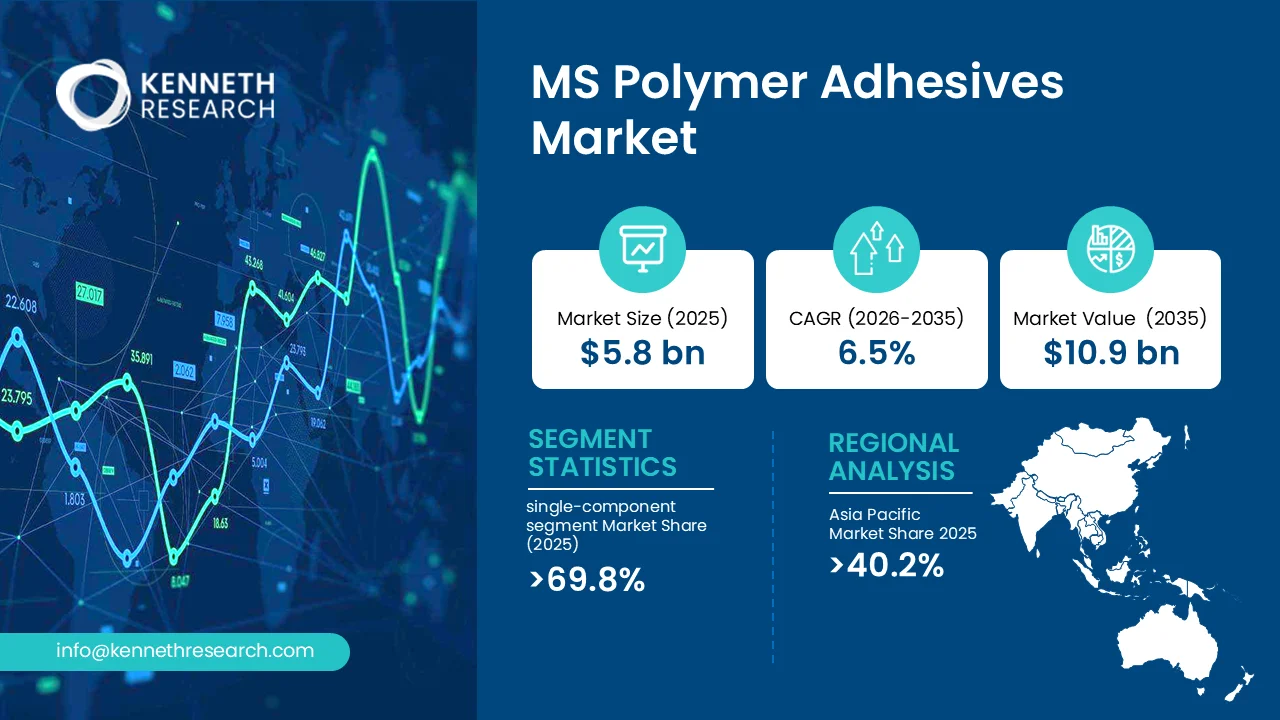
MS Polymer Adhesives Market size was valued at USD 5.8 billion in 2025 and is projected to reach USD 10.9 billion by the end of 2035, rising at a CAGR of 6.5% during the forecast period, i.e., 2026-2035. In 2026, the industry size of MS polymer adhesives is estimated at USD 6.2 billion.
Expansion in global building and infrastructure activity is the primary growth driver for the MS polymer adhesives market. Rising demand for durable, low-VOC, moisture-curing bonding solutions in modern construction, renovation, façade installation, and prefabricated building systems is accelerating the adoption of MS polymer adhesives across residential, commercial, and industrial applications.
MS Polymer Adhesives are advanced hybrid bonding materials formulated using modified silane (MS) polymer technology that combines the elasticity of silicone with the mechanical strength of polyurethane. These moisture-curing adhesives provide durable, flexible, and weather-resistant bonds while remaining free from solvents and isocyanates in many formulations. Their ability to adhere to a broad range of substrates—including metals, concrete, glass, ceramics, plastics, composites, and wood—without extensive surface preparation makes them suitable for demanding industrial applications.
The market encompasses single-component and multi-component formulations designed for construction, transportation, industrial assembly, marine, renewable energy, and general manufacturing applications. MS polymer adhesives are valued for their low shrinkage, UV resistance, paintability, vibration damping, and long-term performance under varying environmental conditions. These characteristics support their increasing use where structural integrity, environmental compliance, and lifecycle durability are critical requirements.
Industrial relevance continues to strengthen as manufacturers seek high-performance adhesive technologies that improve production efficiency, reduce volatile organic compound emissions, and enable reliable bonding of dissimilar materials in modern engineering and construction processes.
Key MS Polymer Adhesives Market Insights Summary:
Key Takeaways: Market Trends & Insights
- The global MS polymer adhesives market is projected to increase from USD 6.2 billion in 2026 to USD 10.9 billion by 2035, reflecting a CAGR of 6.5% during the forecast period
- Single-Component products accounted for the largest Product Type share of 69.8% in 2025 owing to their ease of application, consistent curing performance, and broad industrial adoption
- Asia Pacific held the leading regional position with a 40.2% market share in 2025, supported by strong construction activity, manufacturing capacity, and infrastructure development in China and India
- Building and Construction is projected to be the fastest-growing End-Use Industry segment, driven by rising investments in sustainable buildings, modular construction, and infrastructure modernization
- Growing demand for low-VOC, durable, and multi-substrate bonding solutions across construction, transportation, and industrial manufacturing continues to strengthen long-term market adoption
Market Drivers
- Expansion of sustainable and energy-efficient construction practices
- Increasing adoption of lightweight and multi-material manufacturing
- Growing preference for low-VOC and environmentally compliant adhesive technologies
- Rising demand for prefabricated and modular construction systems
Challenges
- Raw material availability and pricing volatility
- Complex qualification and certification requirements across end-use industries
MS Polymer Adhesives Market Overview & Supply Chain
Global adoption of MS polymer adhesives is increasing as manufacturers and construction companies prioritize durable, low-emission bonding technologies that support sustainability objectives and modern assembly methods. These hybrid adhesives offer strong adhesion across dissimilar substrates, excellent weatherability, and flexibility without requiring extensive mechanical fastening, making them suitable for building envelopes, transportation, industrial equipment, and renewable energy installations. Their compatibility with low-VOC formulations also aligns with evolving environmental regulations and green building standards. The construction sector's continued strategic importance further reinforces demand for high-performance adhesive solutions.
The MS polymer adhesives market value chain begins with the procurement of silane-terminated polymers, specialty resins, plasticizers, fillers, catalysts, pigments, stabilizers, and performance additives sourced from global petrochemical and specialty chemical suppliers. These raw materials undergo formulation, mixing, dispersion, and quality validation to produce application-specific adhesive grades tailored for construction, transportation, marine, electronics, and industrial assembly requirements. Finished products are packaged in cartridges, pouches, drums, or bulk containers before being distributed through direct sales channels, regional distributors, industrial chemical suppliers, and specialized construction material networks. Downstream customers include building contractors, automotive manufacturers, marine equipment producers, industrial fabricators, renewable energy system integrators, and maintenance service providers. Major stakeholders across the value chain comprise raw material manufacturers, adhesive formulators, contract manufacturers, packaging companies, logistics providers, certification agencies, distributors, original equipment manufacturers (OEMs), engineering firms, and end-use industries that influence product development, regulatory compliance, and commercialization.
MS Polymer Adhesives Market: Growth Drivers & Challenges
Growth Drivers:
- Expansion of sustainable and energy-efficient construction practices: The transition toward sustainable construction is significantly accelerating demand for MS polymer adhesives. Building developers and infrastructure contractors are increasingly replacing conventional fastening and solvent-based bonding systems with high-performance hybrid adhesives that improve durability, reduce maintenance requirements, and support environmentally responsible construction practices. MS polymer adhesives provide strong adhesion across multiple substrates while offering excellent weather resistance, elasticity, and low volatile organic compound emissions, making them well suited for modern building envelopes, prefabricated components, façades, flooring, and interior finishing applications. As governments continue promoting energy-efficient buildings and lower-carbon construction, adhesive manufacturers are expanding advanced product portfolios to meet evolving performance and regulatory requirements. According to the International Energy Agency (IEA), global heat pump sales grew by 11% in 2022, reflecting broader investment in energy-efficient building technologies that complement the adoption of advanced construction materials, including high-performance adhesive systems.
- Increasing adoption of lightweight and multi-material manufacturing: The growing use of lightweight materials across transportation, industrial equipment, and engineered products is strengthening the demand for MS polymer adhesives. Manufacturers increasingly rely on bonding technologies instead of traditional welding or mechanical fastening to join metals, composites, plastics, and glass without compromising structural integrity or design flexibility. MS polymer adhesives distribute stress more uniformly, improve vibration damping, and enhance corrosion resistance, making them valuable in applications where lightweight construction and long-term durability are critical. Their compatibility with automated production processes also supports manufacturing efficiency and reduces assembly complexity. As industrial sectors continue integrating advanced materials to improve operational performance, adhesive technologies capable of delivering strong, flexible, and durable bonds across diverse substrates are expected to become increasingly important. Continuous product innovation aimed at faster curing, higher strength, and broader substrate compatibility will further expand adoption across multiple manufacturing industries.
Challenges:
- Volatility in specialty raw material availability and pricing: MS polymer adhesives depend on specialty raw materials such as silane-terminated polymers, performance additives, catalysts, fillers, and specialty resins that are sourced through complex global supply networks. Fluctuations in feedstock availability, geopolitical disruptions, transportation constraints, and changing environmental regulations can create inconsistent procurement conditions for manufacturers. These supply-side pressures increase formulation costs and complicate production planning, particularly for companies operating under long-term customer contracts with fixed pricing commitments. Commercially, manufacturers may experience compressed profit margins or delays in introducing new products due to higher qualification and sourcing costs. Smaller producers are particularly exposed because of their comparatively limited purchasing power and supplier diversification. Looking ahead, companies are expected to strengthen supply chain resilience through regional sourcing strategies, strategic supplier partnerships, inventory optimization, and formulation innovation that reduces dependence on highly constrained specialty inputs.
- Complex qualification requirements across diverse end-use applications: The broad application range of MS polymer adhesives requires manufacturers to satisfy diverse technical, regulatory, and customer-specific qualification standards before products can be commercially adopted. Performance validation often involves extensive laboratory testing, environmental durability assessments, compatibility evaluations, and certification processes tailored to individual industries such as construction, transportation, marine, and industrial manufacturing. These lengthy qualification cycles increase development costs and extend the time required to commercialize new formulations. Commercially, delayed approvals can slow revenue generation, reduce responsiveness to changing customer requirements, and increase competitive pressure from established suppliers with proven product portfolios. Future market participants will need to invest in application engineering, technical support capabilities, and collaborative product development with end users to shorten qualification timelines while maintaining compliance with evolving industry standards.
MS Polymer Adhesives Market Size and Forecast:
| Report Attribute | Details |
|---|---|
| Base Year |
2025 |
| Forecast Year |
2026-2035 |
| CAGR |
6.5% |
| Base Year Market Size (2025) |
USD 5.8 billion |
| Forecast Year Market Size (2035) |
USD 10.9 billion |
| Regional Scope |
|
MS Polymer Adhesives Market Segmentation Analysis:
Product Type Segment Analysis
In the product type segment, the Single-Component sub-segment is anticipated to capture the largest market share of 69.8% by the end of 2025.
The single-component segment dominates the MS polymer adhesives market because it offers superior ease of application, reduced labor requirements, and consistent curing performance across a broad range of industrial and construction environments. Unlike multi-component systems, single-component formulations are supplied ready for use, eliminating on-site mixing and minimizing application errors while improving installation efficiency. Their strong adhesion to concrete, glass, metals, plastics, ceramics, and wood has made them the preferred choice for façade systems, flooring, roofing, sealing, prefabricated construction, and industrial assembly. On the supply side, manufacturers continue expanding production of single-component formulations because they simplify packaging, logistics, storage, and inventory management while supporting automated dispensing systems. Demand is further reinforced by sustained construction activity.
End-Use Industry Segment Analysis
The Building and Construction is projected to grow as the second-largest segment in the MS polymer adhesives market due to four converging demand drivers.
The building and construction segment is projected to witness the fastest growth in the MS polymer adhesives market as developers and contractors increasingly adopt high-performance bonding materials that improve structural durability, installation efficiency, and environmental compliance. MS polymer adhesives are widely used for façade installation, flooring, roofing, glazing, interior finishing, expansion joints, and prefabricated building systems because they provide durable adhesion, weather resistance, and flexibility across diverse construction materials. Industry adoption is also expanding as modular construction and off-site manufacturing gain momentum, where reliable adhesive performance supports faster project execution and improved assembly quality. On the supply side, manufacturers are introducing specialized formulations with enhanced curing characteristics, broader substrate compatibility, and improved resistance to moisture and ultraviolet exposure to address evolving construction requirements. Demand is supported by continued construction activity. According to Eurostat, EU construction production increased by 0.4% in December 2024 compared with November 2024, reflecting ongoing project activity that supports consumption of advanced construction materials, including high-performance adhesive technologies.
Our in-depth analysis of the global MS polymer adhesives market includes the following segments:
|
Segment |
Sub-segment |
|
Product Type |
|
|
End-Use Industry |
|
|
Application |
|
|
Substrate |
|
MS Polymer Adhesives Market Regional Insights:
Asia Pacific Market Trends & Insights:
Asia Pacific MS polymer adhesives market is projected to hold the largest revenue share of 40.2% by the end of 2025.
The region benefits from strong production capabilities for specialty chemicals and adhesive formulations, supported by well-established supply chains and a large base of raw material suppliers. Rapid urbanization, infrastructure modernization, commercial development, and growing adoption of prefabricated construction techniques continue to increase demand for high-performance bonding materials. Regulatory emphasis on sustainable construction, low-emission building materials, and improved manufacturing efficiency further supports the transition toward advanced adhesive technologies. In addition, the concentration of automotive, electronics, and industrial manufacturing facilities strengthens regional consumption, while ongoing investments in production capacity reinforce Asia Pacific's position as a global manufacturing hub.
China and India remain the primary growth engines within the region. China benefits from its large-scale construction industry, mature manufacturing ecosystem, and extensive domestic production of specialty chemicals that support adhesive manufacturing.
India complements regional leadership through rapid infrastructure expansion, increasing industrialization, and rising adoption of modern construction practices. Government investment in transport networks, commercial buildings, housing projects, and manufacturing facilities continues to create favorable conditions for wider use of high-performance MS polymer adhesives across diverse end-use applications.
North America Market Trends & Insights:
North America represents a strategically important market for MS polymer adhesives, supported by strong demand from construction, transportation, industrial manufacturing, marine, and infrastructure maintenance sectors. The region has witnessed increasing adoption of advanced adhesive technologies as manufacturers seek durable, low-emission, and high-performance alternatives to conventional bonding methods. Continued modernization of commercial buildings, industrial facilities, and transportation infrastructure is creating sustained demand for adhesives capable of bonding multiple substrates while withstanding challenging environmental conditions. Government initiatives promoting infrastructure renewal, domestic manufacturing, energy-efficient buildings, and sustainable construction practices further encourage the use of innovative bonding materials. In addition, the region's mature research and development ecosystem, stringent product quality standards, and emphasis on automation provide favorable conditions for the commercialization of next-generation MS polymer adhesive formulations. Future opportunities are expected to emerge from modular construction, electric vehicle manufacturing, renewable energy installations, and advanced industrial assembly applications that require reliable and flexible bonding solutions.
The United States serves as the principal market within North America, driven by its extensive construction sector, advanced manufacturing capabilities, and strong presence of adhesive formulators and industrial end users. Ongoing investment in transportation infrastructure, commercial development, industrial automation, and clean energy projects continues to support demand for high-performance adhesive technologies.
Canada complements regional growth through increasing infrastructure modernization, commercial and residential construction activity, and expanding industrial manufacturing. The country's focus on sustainable building practices, energy-efficient infrastructure, and advanced engineered materials is encouraging broader adoption of MS polymer adhesives across construction, industrial fabrication, and maintenance applications, while cross-border supply chain integration further supports market expansion.
Leading Companies Operating in the Global MS Polymer Adhesives Market:
Here is a list of upstream, downstream, and key players operating in the global MS polymer adhesives market competitive ecosystem:
- Henkel AG & Co. KGaA (Germany)
- Company Overview
- Business Strategy
- Key Product Offerings
- Financial Performance
- Key Performance Indicators
- Risk Analysis
- Recent Development
- Regional Presence
- SWOT Analysis
- Arkema S.A. (Bostik) (France)
- H.B. Fuller Company (United States)
- Dow Inc. (United States)
- Merz + Benteli AG (Switzerland)
- Permabond Engineering Adhesives (United States)
Recent Developments
- In March 2025, WACKER showcased a new generation of silane-terminated polyethers at the European Coatings Show 2025: GENIOSIL® STP-E 140 and GENIOSIL® STP-E 340. These novel polymers enable tin-free sealants and adhesives that are highly elastic with a low modulus of elasticity—properties particularly valued in the construction sector. The binders utilize WACKER's Alpha³ technology, combining both alpha and gamma-silyl groups to achieve greater reactivity while maintaining positive elastic recovery. They adhere to a wide range of substrates and can be processed without solvents or plasticizers.
- In June 2025, Kaneka released eco and sustainability certified MS Polymer™ grades for flooring adhesive applications. With over 45 years of MS Polymer experience, Kaneka reports that their polymers address increasingly strict chemical regulations and indoor air quality specifications. The polymers offer low VOC content, primer-less adhesion to wood and LVT, and are phthalate-free—making them preferred base materials for parquet and LVT floor adhesives.
Frequently Asked Question
In 2025, the MS polymer adhesives market exceeded USD 5.8 billion.
The MS polymer adhesives market is projected to reach USD 10.9 billion by the end of 2035, expanding at a CAGR of 6.5% over the forecast period (2026-2035).
The major players in the market are Henkel AG & Co. KGaA (Germany), Arkema S.A. (Bostik) (France), H.B. Fuller Company (United States), Dow Inc. (United States), Merz + Benteli AG (Switzerland), Permabond Engineering Adhesives (United States), and others.
In the product type segment, the single-component sub-segment is anticipated to capture the largest market share of 69.8% in the future and exhibit lucrative growth opportunities during 2026-2035. This growth trajectory is largely attributed to increasing adoption in sustainable construction and industrial assembly due to its ease of application, strong multi-substrate adhesion, and low-emission performance.
Asia Pacific is projected to hold the largest market share of 40.2% by the end of 2025 and provide more business opportunities in the future. Continuous investments in construction, manufacturing, and infrastructure development across China and India are fostering the region's dominance.
Why Choose Kenneth Research ?
-
Insight with Impact : We don’t just gather data — we uncover stories, trends, and opportunities that fuel business growth.
-
Experts Who Get It : Our team speaks your industry’s language and knows what really matters to your customers and market.
-
Custom-Built for You : Forget one-size-fits-all. We craft research and consulting solutions as unique as your business vision.
-
Partners, Not Just Providers : We work with you, not for you — collaborating closely to turn insights into smart, strategic moves.
-
Results That Speak : Our work powers brands, startups, and industry leaders alike — with a track record of ideas that work in the real world.
Report ID: 1152 |
Published Date: 24 Aug 2026 |
Report Format: |
Delivery Timeline: 48-72 Business Hours

Copyright © 2025 Kenneth Research. All rights reserved. Terms of Use | Privacy Policy
