Report ID: 1079 |
Published Date: 13 Aug 2026 |
Report Format: |
Delivery Timeline: 48-72 Business Hours
Molecular Imaging Market Outlook:
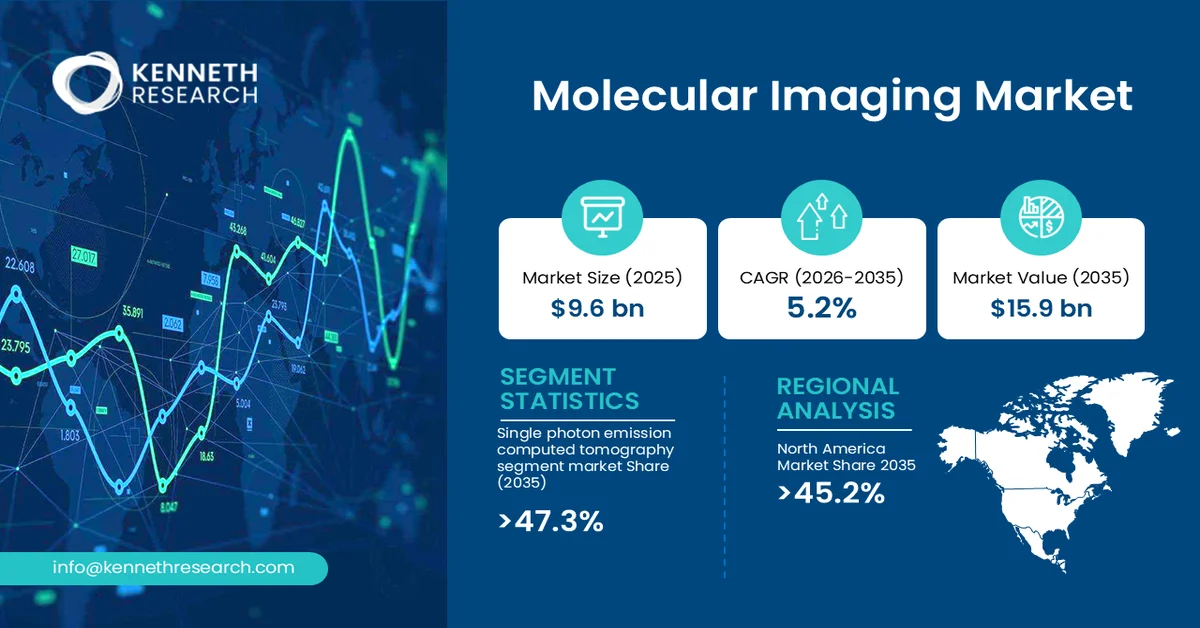
Molecular Imaging Market size was valued at USD 9.6 billion in 2025 and is projected to reach USD 15.9 billion by the end of 2035, rising at a CAGR of 5.2% during the forecast period, i.e., 2026-2035. In 2026, the industry size of molecular imaging is estimated at USD 10.1 billion.
The primary growth driver for the molecular imaging market is the increasing adoption of precision medicine and advanced diagnostic technologies that enable early disease detection, treatment monitoring, and personalized therapeutic decisions.
The molecular imaging market comprises advanced diagnostic technologies, imaging systems, radiotracers, contrast agents, and related solutions that visualize biological processes at molecular and cellular levels within living organisms. Unlike conventional anatomical imaging methods, molecular imaging enables healthcare professionals and researchers to evaluate disease mechanisms, identify biomarkers, monitor therapeutic responses, and support personalized treatment strategies. The industrial relevance of molecular imaging continues to expand as pharmaceutical companies, diagnostic manufacturers, research institutions, and healthcare providers invest in precision diagnostics and targeted therapies
Key Molecular Imaging Market Insights Summary:
Key Takeaways: Market Trends & Insights
- In the modality segment, the single photon emission computed tomography sub-segment is anticipated to capture the revenue share of 47.3% during 2026-2035
- North America molecular imaging market is projected to hold the largest revenue share of 45.2% by the end of 2035
- The major players in the market include Siemens Healthineers, GE HealthCare, Koninklijke Philips, Canon Medical Systems, and United Imaging Healthcare
Market Drivers
- Increasing demand for early disease detection and precision oncology.
- Technological advancements in imaging platforms and radiotracer development.
- Growing adoption of hybrid imaging technologies across healthcare facilities.
- Rising utilization of molecular imaging in pharmaceutical research and drug development.
Challenges
- High cost and complex infrastructure requirements.
- Regulatory and supply chain complexity for radiopharmaceuticals.
Molecular Imaging Market Overview & Supply Chain
Global adoption of molecular imaging technologies is increasing as healthcare systems prioritize early disease diagnosis, precision medicine, and improved treatment monitoring. Advances in radiotracer development, hybrid imaging platforms, artificial intelligence-enabled image analysis, and targeted diagnostic approaches are improving the accuracy and clinical value of molecular imaging. The technology is becoming increasingly relevant across oncology, cardiology, neurology, and pharmaceutical research due to its ability to provide functional insights into biological processes. The World Health Organization (WHO) reported that noncommunicable diseases caused 43 million deaths globally in 2021, emphasizing the continued need for advanced diagnostic technologies that enable earlier detection and improved disease management.
The molecular imaging market value chain begins with the sourcing of essential inputs, including radioactive isotopes, radiochemicals, contrast agents, imaging biomarkers, specialized electronic components, detectors, and software technologies supplied by qualified manufacturers. Production involves the development and manufacturing of imaging systems, radiotracers, molecular probes, and image-processing platforms under strict quality, safety, and regulatory requirements. Radiopharmaceutical manufacturers, medical technology companies, and research organizations play a critical role in ensuring reliable production and availability of imaging solutions.
Molecular Imaging Market: Growth Drivers & Challenges
Growth Drivers:
- Increasing demand for early disease detection and precision oncology: The growing emphasis on early disease detection and precision oncology is a major factor accelerating adoption of molecular imaging technologies. Molecular imaging enables clinicians to visualize biological activity, identify disease characteristics at an early stage, and evaluate treatment effectiveness through functional imaging techniques. Increasing use of targeted radiotracers and advanced imaging platforms is improving diagnostic accuracy, particularly in oncology applications where precise tumor characterization is essential. Healthcare systems, research institutions, and pharmaceutical companies are investing in molecular imaging to support personalized treatment strategies and improve clinical decision-making.
- Technological advancements in imaging platforms and radiotracer development: Continuous advancements in imaging hardware, artificial intelligence, radiotracer technology, and hybrid imaging systems are expanding the capabilities of molecular imaging solutions. Innovations such as improved detector sensitivity, automated image interpretation, and development of disease-specific molecular probes are enhancing diagnostic precision and workflow efficiency. These improvements are encouraging adoption among hospitals, research organizations, and pharmaceutical companies seeking more accurate disease characterization and improved treatment monitoring. The pharmaceutical industry is also leveraging molecular imaging in drug discovery and development by enabling researchers to evaluate biological responses and therapeutic mechanisms more effectively. From a supply perspective, investments in radiopharmaceutical manufacturing, imaging software, and next-generation diagnostic platforms are strengthening commercialization opportunities.
Challenges:
- High cost and complex infrastructure requirements: The molecular imaging market faces limitations due to the high cost of advanced imaging systems, specialized facilities, and supporting infrastructure required for operation. Molecular imaging technologies often require sophisticated equipment, controlled environments, trained professionals, and specialized radiopharmaceutical handling capabilities, increasing the operational burden for healthcare providers. The complexity of installation, maintenance, and regulatory compliance can restrict adoption, particularly among smaller hospitals and diagnostic centers with limited resources. Commercially, these barriers may slow procurement decisions, extend technology adoption cycles, and create uneven access across healthcare systems. Manufacturers must continuously invest in cost optimization, service models, and scalable solutions to improve accessibility.
- Regulatory and supply chain complexity for radiopharmaceuticals: The development and commercialization of molecular imaging solutions are constrained by complex regulatory requirements and supply chain challenges associated with radiopharmaceutical production. Radioactive imaging agents require strict manufacturing controls, specialized transportation systems, regulatory approvals, and time-sensitive distribution processes due to their short operational lifecycles. Variations in regulatory frameworks across regions can increase compliance requirements and delay product commercialization. Additionally, dependence on specialized isotope production and radiochemistry infrastructure creates vulnerabilities within the supply chain. These challenges affect manufacturers, healthcare providers, and research organizations by increasing operational costs and complicating consistent product availability.
Molecular Imaging Market Size and Forecast:
| Report Attribute | Details |
|---|---|
| Base Year |
2025 |
| Forecast Year |
2026-2035 |
| CAGR |
5.2% |
| Base Year Market Size (2025) |
USD 9.6 billion |
| Forecast Year Market Size (2035) |
USD 15.9 billion |
| Regional Scope |
|
Molecular Imaging Market Segmentation Analysis:
Modality Segment Analysis
In the modality segment, the single photon emission computed tomography sub-segment is anticipated to capture the largest revenue share of 47.3% by the end of 2035
Single Photon Emission Computed Tomography (SPECT) is expected to maintain its leading position within the molecular imaging market due to its broad clinical utility, established infrastructure, and extensive application across oncology, cardiology, and neurology. Demand for SPECT systems continues to increase as healthcare providers seek reliable functional imaging techniques that support disease diagnosis, treatment planning, and therapy monitoring. Industry adoption is supported by technological improvements in detector performance, hybrid SPECT/CT systems, and radiopharmaceutical development, which enhance image quality and diagnostic accuracy. Future growth is expected to be supported by increasing integration with artificial intelligence, expanding nuclear medicine applications, and rising demand for non-invasive diagnostic technologies. The U.S. Centers for Medicare & Medicaid Services (CMS) reported that Medicare Part B covers nuclear medicine procedures, including diagnostic imaging services using radioactive tracers, reflecting continued clinical utilization of nuclear imaging technologies.
Application Segment Analysis
The oncology sub-segment is projected to hold second-largest market share in the molecular imaging market during the forecast period.
The oncology application segment is projected to experience strong growth within the molecular imaging market due to increasing demand for precise cancer diagnosis, treatment planning, and therapy monitoring. Molecular imaging technologies enable clinicians to evaluate tumor biology, identify molecular targets, and assess treatment responses, making them increasingly valuable in precision oncology workflows. Healthcare providers are adopting PET, SPECT, and hybrid imaging technologies to support earlier cancer detection and more personalized treatment decisions. On the supply side, advancements in radiopharmaceutical development, targeted imaging agents, artificial intelligence-based image analysis, and integrated imaging platforms are strengthening the availability of oncology-focused solutions. The National Cancer Institute (NCI) estimates that approximately 2,041,910 new cancer cases will be diagnosed in the United States in 2025, reinforcing the need for advanced diagnostic and monitoring technologies.
Our in-depth analysis of the global molecular imaging market includes the following segments:
|
Segment |
Sub-segment |
|---|---|
|
Modality |
|
|
Application |
|
|
End Use |
|
Molecular Imaging Market Regional Insights:
North America Market Trends & Insights:
North America is projected to account for 45.2% of the molecular imaging market in 2035, maintaining its leadership due to advanced healthcare infrastructure, strong diagnostic imaging capabilities, and a mature research ecosystem. The region benefits from the presence of leading medical technology companies, radiopharmaceutical developers, academic research institutions, and specialized healthcare providers supporting molecular imaging innovation. High adoption of advanced diagnostic technologies, continued investment in precision medicine, and supportive regulatory frameworks for imaging agents and medical devices strengthen regional competitiveness. The region also demonstrates strong production capabilities for imaging equipment and radiopharmaceutical solutions while maintaining significant consumption through hospitals, diagnostic centers, and research facilities. Government-backed healthcare research initiatives and collaborations between industry and academia continue to accelerate technological advancements and commercialization of molecular imaging solutions.
The United States represents the primary contributor to regional growth due to its extensive healthcare infrastructure, high adoption of advanced imaging technologies, and strong investment in biomedical research. The country’s pharmaceutical and biotechnology ecosystem also supports innovation in radiotracers and molecular diagnostics.
Canada contributes through its growing medical imaging research capabilities, expanding healthcare technology sector, and investments in precision medicine initiatives. The U.S. National Institutes of Health (NIH) reported that its total funding estimate for fiscal year 2024 was approximately USD 48 billion, supporting biomedical research activities including diagnostic technology development and healthcare innovation.
Asia Pacific Market Trends & Insights:
Asia Pacific is emerging as a fastest growing region in the molecular imaging market, supported by increasing demand for advanced diagnostic technologies, expanding healthcare infrastructure, and rising adoption of precision medicine approaches. Healthcare systems across the region are investing in modern imaging capabilities to improve disease detection, treatment planning, and patient monitoring, particularly for oncology, cardiovascular, and neurological applications. Industrial activity is strengthening through the expansion of medical technology manufacturing, radiopharmaceutical production capabilities, and collaborations between healthcare providers, research institutions, and technology companies. Government initiatives focused on healthcare modernization, biomedical research advancement, and improved access to diagnostic services are supporting regional development. Future opportunities are expected to arise from growing adoption of hybrid imaging platforms, increased integration of artificial intelligence in diagnostics, and expanding research activities focused on molecular biomarkers and targeted imaging agents.
China represents a major growth contributor in Asia Pacific due to its expanding healthcare technology sector, increasing investment in diagnostic infrastructure, and growing emphasis on precision healthcare. The country is strengthening its capabilities in medical imaging equipment manufacturing, radiopharmaceutical development, and clinical research applications.
Japan contributes through its advanced healthcare ecosystem, established medical technology industry, and strong focus on innovation in diagnostic imaging and nuclear medicine. The country’s expertise in robotics, imaging technologies, and biomedical research supports continued advancement of molecular imaging applications. Together, China and Japan are expected to play a significant role in driving regional adoption and technological development within the molecular imaging landscape.
Leading Companies Operating in the Global Molecular Imaging Market:
- Siemens Healthineers (Germany)
- Company Overview
- Business Strategy
- Key Product Offerings
- Financial Performance
- Key Performance Indicators
- Risk Analysis
- Recent Development
- Regional Presence
- SWOT Analysis
- GE HealthCare (United States)
- Koninklijke Philips (Netherlands)
- Canon Medical Systems (Japan)
- United Imaging Healthcare (China)
Recent Developments
- In May 2025, GE HealthCare received FDA 510(k) clearance for Aurora, a dual-head SPECT/CT system, along with Clarify DL AI-powered deep learning image reconstruction technology. The system is designed to improve nuclear medicine imaging capabilities and workflow efficiency. The launch strengthens GE HealthCare’s position in the SPECT segment by combining advanced hardware with artificial intelligence-based reconstruction.
- In November 2025, GE HealthCare announced CE Mark approval for its Omni 128cm total body PET/CT system, designed to support precision care, cancer diagnosis, staging, and treatment planning. The regulatory milestone expands GE HealthCare’s total-body PET/CT portfolio and supports future growth in precision oncology, theranostics research, and advanced molecular imaging workflows.
- In March 2025, GE HealthCare and Swiss Medical Network signed a Master Research Agreement to establish a molecular imaging and theranostics Center of Excellence focused on advancing precision medicine applications and imaging-driven cancer care. The collaboration enhances research capabilities in molecular imaging and theranostics while supporting broader adoption of personalized healthcare approaches.
Frequently Asked Question
In 2025, the molecular imaging market exceeded USD 9.6 billion.
The molecular imaging market is projected to reach USD 15.9 billion by the end of 2035, expanding at a CAGR of 5.2% over the forecast period (2026-2035).
The major players in the market are Siemens Healthineers, GE HealthCare, Koninklijke Philips, Canon Medical Systems, United Imaging Healthcare, and others.
In the modality segment, the single photon emission computed tomography sub-segment is anticipated to capture the largest market share of 47.3% in the future and exhibit lucrative growth opportunities during 2026-2035. This growth trajectory is largely attributed to increasing adoption of functional imaging technologies across oncology, cardiology, and neurological applications.
North America is projected to hold the largest market share of 45.2% by the end of 2035 and provide more business opportunities in the future. Continuous investments in advanced diagnostic technologies, precision medicine, and biomedical research in the U.S. and Canada are fostering the region's dominance.
Why Choose Kenneth Research ?
-
Insight with Impact : We don’t just gather data — we uncover stories, trends, and opportunities that fuel business growth.
-
Experts Who Get It : Our team speaks your industry’s language and knows what really matters to your customers and market.
-
Custom-Built for You : Forget one-size-fits-all. We craft research and consulting solutions as unique as your business vision.
-
Partners, Not Just Providers : We work with you, not for you — collaborating closely to turn insights into smart, strategic moves.
-
Results That Speak : Our work powers brands, startups, and industry leaders alike — with a track record of ideas that work in the real world.
Report ID: 1079 |
Published Date: 13 Aug 2026 |
Report Format: |
Delivery Timeline: 48-72 Business Hours

Copyright © 2025 Kenneth Research. All rights reserved. Terms of Use | Privacy Policy
