Report ID: 1114 |
Published Date: 19 Aug 2026 |
Report Format: |
Delivery Timeline: 48-72 Business Hours
Modified Epoxy Resin Market Outlook:
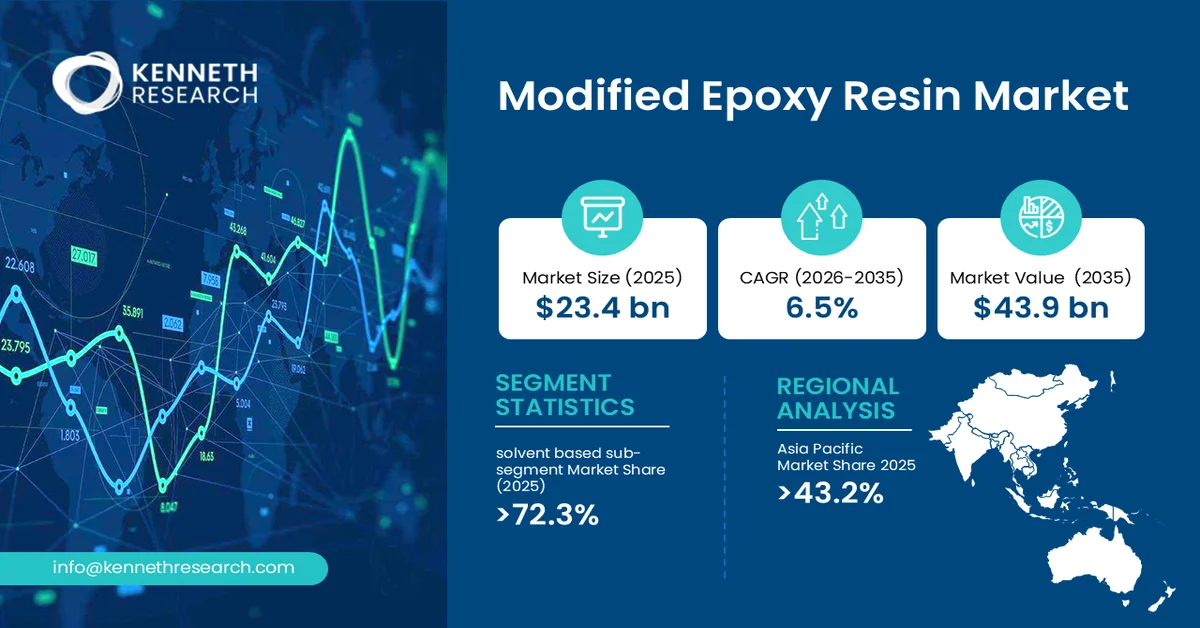
Modified Epoxy Resin Market size was valued at USD 23.4 billion in 2025 and is projected to reach USD 43.9 billion by the end of 2035, rising at a CAGR of 6.5% during the forecast period, i.e., 2026-2035. In 2026, the industry size of the modified epoxy resin is estimated at USD 24.9 billion.
Rising investments in infrastructure modernization and high-performance construction materials are the primary growth driver for the modified epoxy resin market. Modified epoxy resins deliver superior adhesion, corrosion resistance, mechanical strength, and durability, making them indispensable in protective coatings, structural adhesives, flooring systems, and concrete repair applications across expanding industrial and infrastructure projects.
Modified epoxy resin refers to epoxy resin formulations that are chemically or physically altered to enhance specific performance characteristics, including flexibility, impact resistance, weatherability, chemical resistance, thermal stability, and adhesion. These modifications are achieved by incorporating reactive diluents, elastomers, polyurethane, silicone, acrylics, or other specialty additives that broaden the application range beyond conventional epoxy systems. The resulting materials are available in solvent-based, water-based, and other customized formulations designed to meet diverse industrial requirements.
Modified epoxy resins are extensively utilized in protective coatings, structural adhesives, composite materials, flooring systems, sealants, electrical insulation, and marine applications where long-term mechanical integrity and environmental resistance are critical. Their ability to bond dissimilar substrates while maintaining dimensional stability under demanding operating conditions makes them suitable for infrastructure, transportation, aerospace, electronics, and industrial manufacturing.
Key Modified Epoxy Resin Market Insights Summary:
Key Takeaways: Market Trends & Insights
- Modified Epoxy Resin Market projected to grow from USD 23.4 billion in 2025 to USD 43.9 billion by 2035 at a 6.5% CAGR.
- Asia Pacific accounted for the largest regional share at 43.2% in 2025, supported by strong industrial manufacturing, infrastructure development, and expanding specialty chemical production across China and Japan.
- Solvent Based is expected to remain the leading product type segment with a 72.3% market share by 2035, driven by its superior performance in protective coatings, industrial flooring, marine applications, and structural adhesives.
- Building & Construction will continue to witness robust growth owing to increasing infrastructure modernization, commercial development, and rising demand for high-performance bonding, flooring, and corrosion protection materials.
- The market is benefiting from growing adoption of advanced protective coatings, expanding renewable energy and composite applications, increasing industrial asset maintenance, and continued innovation in sustainable, high-performance modified epoxy resin formulations.
Market Drivers
- Expansion of building and construction activities requiring durable structural adhesives and flooring systems.
- Growing adoption of lightweight composite materials in automotive and aerospace manufacturing.
- Rising investment in electrical and electronic insulation materials for advanced power infrastructure.
- Increasing research and development focused on sustainable, low-VOC, and high-performance modified epoxy formulations.
Challenges
- Volatility in petrochemical-based raw material supply and pricing.
- Balancing high performance with tightening environmental and regulatory requirements.
Modified Epoxy Resin Market Overview & Supply Chain
The adoption of modified epoxy resins is increasing globally as industries seek materials capable of delivering higher durability, corrosion protection, structural integrity, and long service life under demanding operating conditions. Advancements in protective coatings, composite manufacturing, electrical insulation, transportation, renewable energy infrastructure, and sustainable construction continue to expand their industrial relevance. Regulatory emphasis on durable infrastructure, improved material performance, and longer asset life further supports the use of modified epoxy formulations across multiple sectors. According to Statistics Canada, Canadian manufacturers produced 3.8 million tonnes of polyethylene, a synthetic resin, in 2023, reflecting sustained activity across the broader synthetic resin industry that supports downstream specialty resin applications, including modified epoxy systems.
The modified epoxy resin value chain begins with the procurement of petrochemical-derived raw materials such as epoxy base resins, curing agents, reactive diluents, flexibilizers, toughening agents, pigments, fillers, solvents, and specialty performance additives supplied by chemical manufacturers. These inputs undergo formulation, blending, modification, quality testing, and packaging by resin producers to achieve application-specific mechanical, thermal, and chemical performance characteristics. Finished products are distributed through direct sales networks, industrial distributors, specialty chemical suppliers, and regional channel partners serving diverse manufacturing sectors. Key end users include building and construction companies, automotive manufacturers, aerospace suppliers, marine equipment producers, electrical and electronics manufacturers, industrial equipment manufacturers, and protective coating applicators. Major stakeholders across the value chain comprise raw material suppliers, specialty additive manufacturers, resin formulators, contract manufacturers, logistics providers, distributors, regulatory authorities, certification bodies, engineering contractors, OEMs, and industrial maintenance service providers, all contributing to product development, commercialization, compliance, and end-use performance.
Modified Epoxy Resin Market: Growth Drivers & Challenges
Growth Drivers:
- Expanding renewable energy infrastructure and advanced composite manufacturing: The accelerating deployment of renewable energy infrastructure is creating sustained demand for modified epoxy resins with enhanced mechanical strength, fatigue resistance, and environmental durability. Wind turbine blades, electrical insulation systems, protective coatings, and structural composite components require resin formulations capable of maintaining long-term performance under severe operating conditions. As governments continue investing in clean energy, manufacturers are increasingly developing modified epoxy systems tailored for high-performance composite fabrication and corrosion-resistant applications. This trend is also encouraging innovation in resin chemistry to improve processing efficiency and lifecycle performance. According to the International Energy Agency (IEA), almost 700 GW of new renewable power capacity was added globally in 2024, marking another record expansion in renewable deployment and increasing demand for advanced material systems used throughout renewable energy infrastructure.
- Increasing demand for high-performance protective coatings across industrial assets: Industrial operators are placing greater emphasis on extending the operational life of critical infrastructure while reducing maintenance frequency and lifecycle costs. Modified epoxy resins provide superior adhesion, chemical resistance, abrasion resistance, and substrate protection, making them essential in protective coating systems used for bridges, manufacturing plants, pipelines, marine structures, storage tanks, and processing facilities. Continuous modernization of industrial assets and stricter performance expectations are encouraging the replacement of conventional coating technologies with advanced modified epoxy formulations. Manufacturers are simultaneously introducing lower-emission, application-specific, and high-durability resin systems that satisfy evolving environmental requirements without compromising performance. As industrial facilities increasingly prioritize asset reliability and predictive maintenance strategies, demand for customized modified epoxy technologies is expected to expand across heavy industry, transportation, utilities, and energy infrastructure, reinforcing long-term market development.
Challenges:
- Volatility in petrochemical-based raw material supply and pricing: Modified epoxy resin production depends heavily on petrochemical-derived feedstocks, specialty curing agents, reactive modifiers, solvents, and performance additives, many of which are exposed to fluctuations in crude oil prices, supply disruptions, geopolitical developments, and transportation bottlenecks. This volatility complicates procurement planning and increases formulation costs for manufacturers. Frequent changes in input prices reduce pricing stability, making it difficult to maintain long-term supply agreements with downstream customers. Commercially, producers face pressure to absorb higher production costs or transfer them to end users, potentially affecting competitiveness in price-sensitive applications. Companies are responding by diversifying supplier networks, qualifying alternative raw materials, and optimizing formulations to reduce dependency on vulnerable inputs. Over the long term, greater supply chain resilience and strategic sourcing initiatives are expected to become critical competitive differentiators across the modified epoxy resin industry.
- Balancing high performance with tightening environmental and regulatory requirements: Manufacturers of modified epoxy resins must continually improve product performance while complying with increasingly stringent environmental, occupational safety, and chemical compliance requirements across global markets. Many traditional formulations require reformulation to reduce volatile emissions, improve worker safety, and satisfy evolving sustainability expectations without compromising mechanical strength, adhesion, or chemical resistance. This transition demands significant investment in research, testing, certification, and production upgrades, increasing development costs and extending commercialization timelines. Smaller manufacturers often encounter greater financial and technical barriers when adapting to these changing requirements, which can limit product portfolios and market access. Looking ahead, companies capable of developing compliant, high-performance formulations while maintaining manufacturing efficiency are likely to strengthen their competitive position as customer procurement increasingly incorporates environmental performance alongside technical specifications.
Modified Epoxy Resin Market Size and Forecast:
| Report Attribute | Details |
|---|---|
| Base Year |
2025 |
| Forecast Year |
2026-2035 |
| CAGR |
6.5% |
| Base Year Market Size (2025) |
USD 23.4 billion |
| Forecast Year Market Size (2035) |
USD 43.9 billion |
| Regional Scope |
|
Modified Epoxy Resin Market Segmentation Analysis:
Product Type Segment Analysis
In the product type segment, the solvent based sub-segment is anticipated to capture the largest market share of 72.3% by the end of 2025.
The solvent-based segment dominates the modified epoxy resin market because it delivers superior adhesion, corrosion resistance, chemical durability, and curing performance in demanding industrial environments. These formulations are extensively used in protective coatings, heavy-duty flooring, marine coatings, industrial equipment, pipelines, and infrastructure projects where long-term durability and resistance to aggressive operating conditions are essential. Demand remains particularly strong in industrial construction and asset maintenance projects requiring high-performance coating systems capable of withstanding moisture, chemicals, and mechanical stress. On the supply side, manufacturers continue to invest in advanced solvent-based formulations due to their proven field performance, established production processes, and broad compatibility with existing industrial application equipment. According to Japan's Ministry of Land, Infrastructure, Transport and Tourism (MLIT), the country's construction investment outlook for FY2023 highlights sustained investment across building and civil engineering activities, supporting continued demand for high-performance protective materials used throughout infrastructure development and maintenance. As industrial modernization and infrastructure rehabilitation continue globally, solvent-based modified epoxy resins are expected to retain a significant role in applications where maximum performance and long-term protection remain critical.
Application Segment Analysis
The building & construction application segment is projected to witness strong growth as infrastructure modernization, commercial developments, industrial facilities, and residential projects increasingly require durable materials capable of delivering long service life and reduced maintenance. Modified epoxy resins are extensively used in structural adhesives, concrete repair systems, protective coatings, flooring, waterproofing, and reinforcement applications because of their superior bonding strength, abrasion resistance, and chemical durability. Adoption is also rising as contractors prioritize materials that improve structural reliability while supporting efficient project execution. On the supply side, manufacturers are expanding product portfolios with application-specific formulations offering enhanced workability, faster curing, and improved environmental performance to meet evolving construction standards. According to the U.S. Census Bureau, the value of construction put in place reached a seasonally adjusted annual rate of USD 2.192 trillion in December 2024, demonstrating continued investment in construction activities that support demand for high-performance resin-based materials across the sector. As governments and private developers continue investing in resilient infrastructure and building rehabilitation, the Building & Construction segment is expected to remain a key growth avenue for modified epoxy resin applications.
Our in-depth analysis of the global modified epoxy resin market includes the following segments:
|
Segment |
Sub-segment |
|
Product Type |
|
|
Application |
|
|
Modification Type |
|
|
End User |
|
|
Distribution Channel |
|
Modified Epoxy Resin Market Regional Insights:
Asia Pacific Market Trends & Insights:
Asia Pacific accounted for 43.2% of the modified epoxy resin market in 2025, making it the leading regional market.
The region's dominance is supported by its extensive manufacturing base, large-scale infrastructure development, expanding industrial production, and strong demand from construction, transportation, electronics, marine, and heavy engineering industries. The presence of integrated chemical manufacturing ecosystems, well-established downstream processing industries, and continuous investment in industrial modernization enables efficient production and commercialization of modified epoxy resin products. Favorable industrial policies, ongoing capacity expansion by specialty chemical manufacturers, and sustained investments in advanced manufacturing technologies further strengthen regional competitiveness. In addition, increasing demand for durable protective coatings, structural adhesives, and high-performance composite materials across both public and private sector projects continues to reinforce Asia Pacific's leadership position.
Japan remains a major contributor through its advanced specialty chemical industry, technological innovation, and strong demand for high-performance materials in automotive, electronics, industrial machinery, and infrastructure maintenance applications.
China continues to drive regional growth with extensive industrial manufacturing, large-scale infrastructure investment, and expanding downstream consumption of advanced coating and composite materials. According to the National Bureau of Statistics of China, the country's total output value of the construction industry reached RMB 32.65 trillion in 2024, highlighting the scale of construction activity that supports demand for high-performance resin systems used in protective coatings, flooring, adhesives, and structural applications. The combination of Japan's innovation capabilities and China's manufacturing scale is expected to sustain Asia Pacific's leadership in the modified epoxy resin market.
North America Market Trends & Insights:
North America represents a strategically important market for modified epoxy resins due to its mature industrial base, advanced manufacturing capabilities, and continuous investment in infrastructure renewal. Demand is driven by applications in protective coatings, structural adhesives, industrial flooring, composites, electrical insulation, transportation, and energy infrastructure. The region also benefits from strong research and development capabilities that support the commercialization of high-performance resin formulations tailored to evolving industrial requirements. Government initiatives promoting resilient infrastructure, domestic manufacturing, and modernization of industrial assets are encouraging the adoption of durable materials with enhanced lifecycle performance. Additionally, increasing emphasis on sustainable manufacturing practices and compliance with environmental regulations is stimulating innovation in lower-emission and application-specific modified epoxy resin technologies. As industries continue to prioritize asset protection, operational efficiency, and long-term durability, North America is expected to present significant opportunities for manufacturers offering technologically advanced resin solutions.
The United States remains the region's primary market, supported by its extensive construction sector, large industrial manufacturing base, aerospace and automotive industries, and significant investments in energy, utilities, and transportation infrastructure. Strong innovation in specialty chemicals and advanced materials further accelerates the development and adoption of customized modified epoxy formulations across diverse end-use industries.
Canada complements regional growth through expanding infrastructure development, mining, energy, marine, and commercial construction activities, where high-performance protective coatings and structural materials are widely utilized. The country's focus on industrial modernization, sustainable construction, and advanced manufacturing continues to create favorable conditions for the adoption of modified epoxy resin products across both public and private sector projects.
Leading Companies Operating in the Global Modified Epoxy Resin Market:
- Olin Corporation(United States)
- Company Overview
- Business Strategy
- Key Product Offerings
- Financial Performance
- Key Performance Indicators
- Risk Analysis
- Recent Development
- Regional Presence
- SWOT Analysis
- Westlake Corporation(United States)
- Huntsman Corporation(United States)
- Aditya Birla Chemicals(India)
Recent Developments
- March 2025: Westlake Epoxy launched the EpoVIVE™ portfolio at the European Coatings Show (ECS) 2025, introducing sustainable epoxy resins, curing agents, and waterborne systems with lower VOCs and improved safety profiles.
- February 2025: Westlake Epoxy announced new EpoVIVE™ composite solutions for JEC World 2025, including epoxy technologies for wind energy, hydrogen storage, and lightweight composite applications.
Frequently Asked Question
In 2025, the modified epoxy resin market exceeded USD 23.4 billion.
The modified epoxy resin market is projected to reach USD 43.9 billion by the end of 2035, expanding at a CAGR of 6.5% over the forecast period (2026-2035).
The major players in the market are Olin Corporation, Westlake Corporation, Hexion Inc., Huntsman Corporation, Sika AG, Aditya Birla Chemicals, Kukdo Chemical Co., Ltd., and others.
In the product type segment, the solvent based sub-segment is anticipated to capture the largest market share of 72.3% in the future and exhibit lucrative growth opportunities during 2026-2035. This growth trajectory is largely attributed to its widespread adoption in high-performance protective coatings, industrial flooring, and structural applications requiring superior durability and corrosion resistance.
Asia Pacific is projected to hold the largest market share of 43.2% by the end of 2025 and provide more business opportunities in the future. Continuous investments in industrial manufacturing, infrastructure development, and advanced materials production across Japan and China are fostering the region's dominance.
Why Choose Kenneth Research ?
-
Insight with Impact : We don’t just gather data — we uncover stories, trends, and opportunities that fuel business growth.
-
Experts Who Get It : Our team speaks your industry’s language and knows what really matters to your customers and market.
-
Custom-Built for You : Forget one-size-fits-all. We craft research and consulting solutions as unique as your business vision.
-
Partners, Not Just Providers : We work with you, not for you — collaborating closely to turn insights into smart, strategic moves.
-
Results That Speak : Our work powers brands, startups, and industry leaders alike — with a track record of ideas that work in the real world.
Report ID: 1114 |
Published Date: 19 Aug 2026 |
Report Format: |
Delivery Timeline: 48-72 Business Hours

Copyright © 2025 Kenneth Research. All rights reserved. Terms of Use | Privacy Policy
