Report ID: 1310 |
Published Date: 11 Sep 2026 |
Report Format: |
Delivery Timeline: 48-72 Business Hours
Mobile Gamma Cameras Market Outlook:
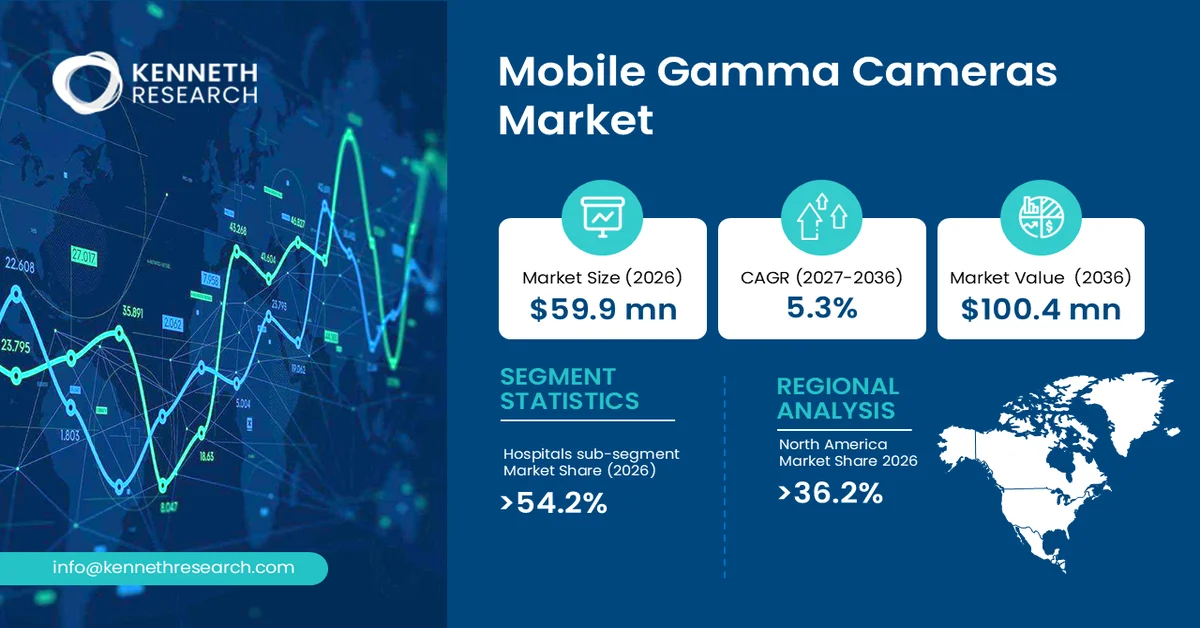
Mobile Gamma Cameras Market size was valued at USD 59.9 million in 2026 and is projected to reach USD 100.4 million by the end of 2036, rising at a CAGR of 5.3% during the forecast period, i.e., 2027–2036. In 2027, the industry size of the mobile gamma cameras market is estimated at USD 63.1 million.
The primary growth driver for the mobile gamma cameras market is increasing demand for flexible nuclear medicine imaging in hospitals and diagnostic facilities.
The mobile gamma cameras market comprises portable and mobile nuclear medicine imaging systems designed to detect gamma radiation emitted by administered radiopharmaceuticals and generate diagnostic images. These systems generally incorporate gamma-ray detectors, collimators, imaging electronics, acquisition software, positioning mechanisms, and mobile platforms that allow equipment to be transported between clinical locations.
Key characteristics include portability, maneuverability, compact system configurations, imaging sensitivity, spatial resolution, and compatibility with nuclear medicine workflows. Mobile gamma cameras can support planar imaging and, depending on system configuration, specialized SPECT applications.
Key Mobile Gamma Cameras Market Insights Summary:
Key Takeaways: Market Trends & Insights
- Mobile gamma cameras market is projected to grow from USD 59.9 million in 2026 to USD 100.4 million by 2036, expanding at a 5.3% CAGR.
- North America accounted for the largest regional share at 36.2% in 2026, supported by advanced healthcare infrastructure, established nuclear medicine capabilities, and strong adoption of sophisticated diagnostic imaging technologies.
- Hospitals are expected to remain the leading End User segment, accounting for 54.2% in 2026, driven by their extensive diagnostic infrastructure, multidisciplinary clinical services, and demand for flexible nuclear medicine imaging.
- Single Head is positioned as the key Product Type segment, supported by its compact configuration, portability, operational flexibility, and suitability for a broad range of nuclear medicine procedures.
Market Drivers
- Growing adoption of nuclear medicine for cancer diagnosis
- Increasing demand for flexible and patient-centric imaging
- Expansion of nuclear medicine infrastructure in hospitals
- Technological improvements in detectors, image processing, and mobile system design
Challenges
- High system cost and technical complexity
- Radiation-safety and regulatory requirements
Mobile Gamma Cameras Market: Market Overview & Supply Chain
Adoption of the mobile gamma cameras market is increasing as healthcare providers seek flexible nuclear medicine imaging capabilities that can complement fixed diagnostic infrastructure. Mobile systems can support imaging closer to patients, improve equipment utilization, and serve facilities where dedicated nuclear medicine rooms are constrained. The broader clinical relevance of nuclear medicine is substantial: the World Health Organization reports that more than 40 million nuclear medicine procedures are performed worldwide annually, demonstrating the established role of nuclear medicine in diagnostic and therapeutic healthcare. The technology is also relevant to cancer diagnosis, treatment planning, disease monitoring, and specialized imaging workflows.
The industry value chain begins with specialized detector materials, scintillation components, photodetectors, semiconductor electronics, collimators, mechanical assemblies, batteries, displays, and imaging software. Manufacturers integrate these inputs into detector heads, acquisition electronics, mobile platforms, control systems, and image-processing architectures before undertaking calibration, quality assurance, and regulatory testing.
Mobile Gamma Cameras Market: Growth Drivers & Challenges
Growth Drivers
- Growing Adoption of Nuclear Medicine for Cancer Diagnosis: Increasing use of nuclear medicine in oncology is supporting demand for gamma-camera systems, including mobile configurations that can provide greater flexibility within healthcare facilities. Nuclear medicine enables functional and molecular imaging, making it valuable for detecting disease activity, assessing treatment response, and supporting cancer staging. India's Atomic Energy Regulatory Board explains that gamma cameras detect radiation emitted by radiopharmaceuticals and are used for imaging in cancer, cardiac, endocrine, and neurological conditions.
- Increasing Demand for Flexible and Patient-Centric Imaging: The second growth driver is the healthcare industry's increasing emphasis on flexible diagnostic workflows and patient-centric imaging. Conventional fixed nuclear medicine systems require dedicated rooms and patient movement to centralized imaging departments. Mobile gamma cameras can provide greater operational flexibility by allowing imaging equipment to be moved within suitable clinical environments. This capability can be valuable when patients have limited mobility, when specialized imaging is required near treatment areas, or when healthcare organizations seek to improve utilization of diagnostic equipment.
Challenges
- High System Cost and Technical Complexity: Mobile gamma cameras require sophisticated detectors, collimators, electronics, imaging software, mechanical systems, and radiation-shielding considerations. Integrating these elements into a mobile platform while maintaining image quality and operational reliability creates substantial engineering and manufacturing complexity. Healthcare providers must also evaluate lifecycle costs, maintenance requirements, calibration, and staff training before deployment. These factors can limit adoption among smaller healthcare facilities and organizations operating under constrained capital budgets.
- Radiation-Safety and Regulatory Requirements: The use of radioactive materials and gamma-radiation detection creates stringent requirements for facility operation, equipment quality assurance, personnel protection, and regulatory compliance. The Atomic Energy Regulatory Board requires nuclear medicine facilities to meet applicable regulatory requirements and obtain regulatory consent through its licensing framework. Such requirements can lengthen procurement and deployment processes and increase compliance costs.
Mobile Gamma Cameras Market Size and Forecast:
| Report Attribute | Details |
|---|---|
| Base Year |
2026 |
| Forecast Year |
2027-2036 |
| CAGR |
5.3% |
| Base Year Market Size (2026) |
USD 59.9 million |
| Forecast Year Market Size (2036) |
USD 100.4 million |
| Regional Scope |
|
Mobile Gamma Cameras Market: Segment Analysis
End User Segment Analysis
In the end user segment, the Hospitals sub-segment is anticipated to capture the largest market share of 54.2% in 2026.
Hospitals maintain the strongest demand because they provide comprehensive nuclear medicine, oncology, cardiology, and diagnostic imaging services that require gamma-camera capabilities. Mobile systems are particularly relevant where imaging must be brought closer to patients or deployed across different clinical areas.
Hospitals also benefit from centralized clinical expertise, radiopharmaceutical handling capabilities, radiation-safety infrastructure, and multidisciplinary diagnostic workflows, supporting integration of mobile gamma cameras into broader nuclear medicine services. On the supply side, manufacturers are developing increasingly compact and maneuverable systems that can complement fixed imaging equipment. Going forward, hospital investments in oncology imaging, specialized diagnostics, and flexible clinical workflows are expected to sustain demand for mobile gamma-camera systems.
Product Type Segment Analysis
In the product type segment, the single head sub-segment is projected to grow as healthcare facilities seek compact, flexible, and cost-efficient gamma-camera configurations for general nuclear medicine imaging. Single-head systems are particularly suited to mobile applications because their relatively straightforward architecture can support portability and deployment across different clinical areas. The International Atomic Energy Agency identifies a single-head gamma camera with computer and SPECT capability as a minimum equipment configuration for a new nuclear medicine department, reinforcing its relevance as an accessible entry point for nuclear medicine imaging.
Demand is further supported by the broad range of planar imaging procedures that can be performed using single-head systems, including thyroid, bone, cardiac, and other nuclear medicine examinations.
Our in-depth analysis of the global mobile gamma cameras market includes the following segments:
|
Segment |
Sub-segment |
|
Product Type |
|
|
Indications |
|
|
End Users |
|
Mobile Gamma Cameras Market - Regional Analysis
North America Market Trends & Insights:
North America is the dominant region, accounting for 36.2% in 2026, supported by advanced healthcare infrastructure, established nuclear medicine services, strong hospital networks, and continued investment in sophisticated diagnostic imaging.
The region benefits from high adoption of specialized imaging technologies and a mature regulatory environment for medical devices and radioactive materials. Canada’s national medical imaging inventory identified 331 SPECT-CT units across its surveyed provinces in 2022–2023, demonstrating the region’s established nuclear medicine equipment base.
The U.S. represents the largest commercial opportunity within North America, supported by extensive hospital networks, oncology centers, academic medical institutions, and specialized nuclear medicine departments.
Canada is also strengthening its nuclear medicine infrastructure through hospital modernization and advanced imaging investments. For example, Nova Scotia Health introduced a new hybrid SPECT/CT system at QEII Health Sciences Centre to improve diagnostic capabilities for cancer and heart disease.
Asia-Pacific Market Trends & Insights:
Asia-Pacific represents a significant opportunity for the mobile gamma cameras market as healthcare systems expand diagnostic capacity, modernize hospitals, and improve access to specialized nuclear medicine services. Rising healthcare investment, increasing cancer-care requirements, and the development of advanced medical-imaging infrastructure are supporting demand for sophisticated nuclear imaging technologies. Mobile gamma cameras can address facilities requiring greater flexibility without relying exclusively on permanently installed imaging systems.
Japan has a mature healthcare and medical-technology ecosystem, supported by advanced hospitals, specialized diagnostic centers, and established nuclear medicine expertise. Its sophisticated healthcare infrastructure provides opportunities for high-performance and compact imaging platforms.
China offers substantial longer-term potential because of hospital modernization, expanding diagnostic capacity, and increasing emphasis on advanced medical equipment. Government healthcare programs and investments in domestic medical-technology capabilities can support wider deployment of nuclear imaging equipment.
Mobile Gamma Cameras Market: Competitive Landscape
Here is a list of upstream, downstream, and key players operating in the global mobile gamma cameras market competitive ecosystem:
- Digirad (U.S)
- Company Overview
- Business Strategy
- Key Product Offerings
- Financial Performance
- Key Performance Indicators
- Risk Analysis
- Recent Development
- Regional Presence
- SWOT Analysis
- Inter Medical Medizintechnik (Germany)
- MiE GmbH (Germany)
Recent Developments
- January 2025: Digirad’s product portfolio was refreshed on the Catalyst MedTech platform in January 2025, with dedicated entries for the Ergo, X-ACT+, and Cardius 3 systems.
- May 2025: MiE Medical Imaging Electronics issued a revised Manufacturer’s Self-Declaration under Regulation (EU) 2023/607, dated May 5, 2025. The declaration covers its PICOLA-SCINTRON, SYNGULA-SCINTRON, ECAM-SCINTRON and SCINTRON systems and documents the applicable regulatory transition arrangements for these medical devices.
Frequently Asked Question
In 2026, the mobile gamma cameras market exceeded USD 59.9 million.
The mobile gamma cameras market is projected to reach USD 100.4 million by the end of 2036, expanding at a CAGR of 5.3% over the forecast period (2027-2036).
The major players in the market are Digirad, Inter Medical Medizintechnik, and MiE GmbH, and others.
In the end user segment, the hospitals sub-segment is anticipated to capture the largest market share of 54.2% in the future and exhibit lucrative growth opportunities during 2027-2036.
North America is projected to hold the largest market share of 36.2% by the end of 2026 and provide more business opportunities in the future.
Why Choose Kenneth Research ?
-
Insight with Impact : We don’t just gather data — we uncover stories, trends, and opportunities that fuel business growth.
-
Experts Who Get It : Our team speaks your industry’s language and knows what really matters to your customers and market.
-
Custom-Built for You : Forget one-size-fits-all. We craft research and consulting solutions as unique as your business vision.
-
Partners, Not Just Providers : We work with you, not for you — collaborating closely to turn insights into smart, strategic moves.
-
Results That Speak : Our work powers brands, startups, and industry leaders alike — with a track record of ideas that work in the real world.
Report ID: 1310 |
Published Date: 11 Sep 2026 |
Report Format: |
Delivery Timeline: 48-72 Business Hours

Copyright © 2025 Kenneth Research. All rights reserved. Terms of Use | Privacy Policy
