Report ID: 1443 |
Published Date: 29 Sep 2026 |
Report Format: |
Delivery Timeline: 48-72 Business Hours
Mining Conveyor System Market Outlook:
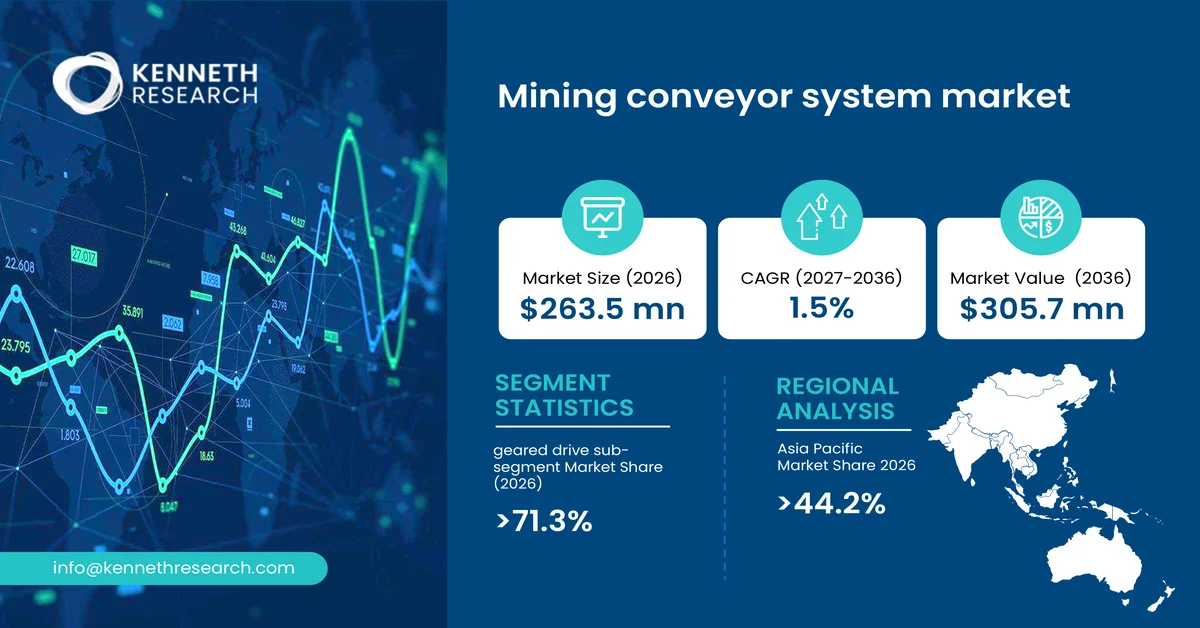
Mining conveyor system market size was valued at USD 263.5 million in 2026 and is projected to reach USD 305.7 million by the end of 2036, rising at a CAGR of 1.5% during the forecast period, i.e., 2027–2036. In 2027, the industry size of the mining conveyor system market is estimated at USD 267.4 million.
The primary growth driver for the mining conveyor system market is the increasing need for efficient, continuous, and cost-effective material transportation across large-scale mining operations.
The mining conveyor system market comprises mechanical conveying equipment, drive systems, belts, pulleys, idlers, loading and transfer equipment, control systems, and associated technologies used to transport mined materials within and around mining operations. These systems can handle ore, coal, overburden, aggregates, and other bulk materials across surface and underground mining environments.
Mining conveyor systems include fixed, mobile, overland, in-pit, stacker, feeder, and other specialized configurations designed according to mine layout, material characteristics, conveying distance, elevation, throughput requirements, and operating conditions.
Key Mining Conveyor System Market Insights Summary:
Key Takeaways: Market Trends & Insights
- Mining conveyor system market projected to grow from USD 263.5 million in 2026 to USD 305.7 million by 2036 at a 1.5% CAGR.
- Asia-Pacific accounted for the largest regional share at 44.2% in 2026, driven by extensive mining and mineral-processing activities, particularly across Japan and China, alongside continued mine modernization.
- Geared Drive is expected to remain the leading Drive Type segment with a 71.3% market share in 2026.
- Open-Pit Mining will continue to represent a significant application opportunity as large surface mines increasingly adopt continuous conveying, overland transportation, and integrated material-handling systems to improve operational efficiency.
Market Drivers
- Expansion of mineral production and critical-mineral supply chains
- Increasing shift toward automated and energy-efficient material handling
- Growing adoption of in-pit and overland conveying solutions
- Rising focus on mine productivity, operational continuity, and predictive maintenance
Challenges
- High Initial Investment and Complex Mine-Specific Engineering
- Maintenance Requirements and Exposure to Harsh Mining Conditions
Mining Conveyor System Market – Market Overview & Supply Chain
The adoption of mining conveyor systems is increasing globally as mining companies seek continuous, reliable, and energy-efficient material transportation across extraction, crushing, processing, and stockpiling operations. Conveyors can reduce dependence on truck-based haulage in applications where continuous conveying is technically and economically suitable, while automated monitoring, advanced drive systems, belt-condition monitoring, and remote-control capabilities are improving operational visibility and reliability. Their relevance is reinforced by the continued importance of mineral production to industrial activity.
The mining conveyor system market value chain begins with raw materials and components such as steel, rubber, electrical equipment, motors, gearboxes, pulleys, idlers, bearings, sensors, control systems, and specialized belt materials sourced from mining-equipment and industrial-component suppliers. Conveyor manufacturers and engineering companies integrate these inputs into complete systems, including belt conveyors, overland conveyors, in-pit conveying solutions, mobile units, transfer systems, drives, and automated control infrastructure.
Mining Conveyor System Market: Growth Drivers & Challenges
Growth Drivers
- Expansion of Mineral Production and Critical-Mineral Supply Chains: The expansion of mineral production and the strategic importance of critical minerals are strengthening demand for efficient bulk-material handling infrastructure. Mining operations increasingly require conveyor systems that can transport ore, waste rock, and processed materials continuously between extraction, crushing, screening, and processing stages. This becomes particularly important as mines pursue higher operational continuity, lower dependence on truck haulage, and improved material-flow coordination.
- Increasing Shift Toward Automated and Energy-Efficient Material Handling: Mining companies are increasingly adopting automated and energy-efficient material-handling systems to improve productivity, operational control, and equipment utilization. Conveyor systems support this transition because their operation can be coordinated with crushers, stackers, feeders, and processing equipment through centralized control platforms. Modern conveyor installations can incorporate variable-speed drives, remote monitoring, belt-condition sensors, automated fault detection, and predictive-maintenance capabilities, enabling operators to identify developing problems before they result in prolonged interruptions.
Challenges
- High Initial Investment and Complex Mine-Specific Engineering: Mining conveyor systems often require substantial upfront investment because equipment must be engineered around mine geometry, material characteristics, conveying distance, elevation changes, throughput requirements, and environmental conditions. Large installations may involve extensive civil works, transfer stations, structural supports, electrical infrastructure, drive systems, and control equipment, increasing project complexity and procurement lead times. Mine operators must also evaluate whether conveyor deployment provides sufficient operational benefits compared with truck haulage or other material-handling alternatives.
- Maintenance Requirements and Exposure to Harsh Mining Conditions; Mining conveyors operate in demanding environments characterized by abrasive materials, dust, moisture, temperature variations, heavy loads, vibration, and continuous operating cycles. These conditions can accelerate wear across belts, idlers, pulleys, bearings, drives, and transfer points, creating maintenance requirements that directly affect system availability. Conveyor failures can interrupt downstream crushing and processing operations, potentially causing operational bottlenecks and increasing maintenance costs.
Mining Conveyor System Market Size and Forecast:
| Report Attribute | Details |
|---|---|
| Base Year |
2026 |
| Forecast Year |
2027-2036 |
| CAGR |
1.5% |
| Base Year Market Size (2026) |
USD 263.5 million |
| Forecast Year Market Size (2036) |
USD 305.7 million |
| Regional Scope |
|
Mining Conveyor System Market – Segment Analysis
Drive Type Segment Analysis
In the drive type segment, the geared drive sub-segment is anticipated to capture the largest market share of 71.3% by the end of 2026.
The geared drive segment dominates the mining conveyor system market because geared drive systems provide the high torque, controlled speed, and mechanical power transmission required for continuous movement of heavy bulk materials under demanding mining conditions. Their established engineering design makes them suitable for high-load conveyor applications involving ore, coal, overburden, and crushed minerals, while their compatibility with variable-speed and automated control systems supports modern mine-automation initiatives. Demand is further reinforced by the continuing scale of mineral extraction.
Application Type Segment Analysis
The open-pit mining segment is projected to grow as large surface mines increasingly require continuous and coordinated transportation of extracted material over substantial distances. Open-pit operations generate significant material flows between extraction areas, crushers, stockpiles, and processing facilities, creating opportunities for conveyors to complement or replace portions of truck-based haulage. Conveyor deployment can improve material-flow continuity and integrate extraction with crushing and processing systems, particularly in large, long-life mining projects. The supply side is responding with overland conveyors, in-pit conveying systems, mobile conveyors, transfer stations, and automated controls designed for complex surface-mine layouts. Going forward, expansion and modernization of large open-pit mines should sustain demand for scalable conveying systems capable of handling changing mine depths, haul distances, and production requirements.
Our in-depth analysis of the global mining conveyor system market includes the following segments:
|
Segment |
Sub-segment |
|
Conveyor Type |
|
|
Service Type |
|
|
Application |
|
|
Drive Type |
|
Mining Conveyor System Market – Regional Analysis
Asia-Pacific Market Trends & Insights:
Asia-Pacific dominates the mining conveyor system market, accounting for 44.2% of the market in 2026, supported by its extensive mining base, large-scale mineral processing industries, infrastructure development, and sustained investment in mine modernization. The region has strong demand for conveying systems because mining operations increasingly require continuous material transportation across extraction, crushing, processing, and stockpiling stages. Government policies supporting mineral security, industrial development, and critical-mineral supply chains further strengthen investment prospects.
Japan’s advanced manufacturing and materials-processing industries support demand for reliable bulk-material handling equipment, particularly for mineral processing, steelmaking, recycling, and industrial applications. Its emphasis on automation, operational efficiency, and sophisticated industrial infrastructure favors technologically advanced conveyor systems incorporating monitoring and control capabilities.
China represents the region’s largest mining and mineral-processing ecosystem, creating substantial requirements for high-capacity conveying infrastructure. Strong domestic mineral production, extensive processing capacity, and continued industrial development support demand for fixed, mobile, and overland conveyor systems.
North America Market Trends & Insights:
North America represents an important secondary market for mining conveyor systems, supported by established mining industries, renewed investment in domestic mineral supply chains, and increasing emphasis on operational efficiency. Mining companies across the region are evaluating conveying technologies to improve material-flow continuity, reduce dependence on truck haulage in suitable applications, and integrate mine operations with crushing and processing infrastructure.
The United States has a mature mining and mineral-processing base, with increasing policy attention on domestic mineral supply security and resilient critical-mineral supply chains. Mine operators are expected to prioritize automation, equipment reliability, energy efficiency, and lifecycle cost optimization, supporting demand for technologically advanced conveyor systems.
Canada offers opportunities through its extensive mining sector and development of mineral resources across geographically dispersed operations.
Mining Conveyor System Market – Competitive Landscape
Here is a list of upstream, downstream, and key players operating in the global mining conveyor system market competitive ecosystem:
- Metso (Finland)
- Company Overview
- Business Strategy
- Key Product Offerings
- Financial Performance
- Key Performance Indicators
- Risk Analysis
- Recent Development
- Regional Presence
- SWOT Analysis
- TAKRAF Group (Germany)
- BEUMER Group (Germany)
Recent Developments
- In June 2026, TAKRAF published an update on its IPCC and conveying systems, highlighting integrated in-pit crushing, overland conveying, and high-capacity conveyor solutions for large-scale mining operations. The company specifically positioned conveying as an alternative to conventional truck haulage for demanding mine environments.
- In September 2025, Metso was granted a significant order to replace a customer’s aging railcar dumper cells in the Pilbara region of Western Australia. The project marks a continuation of a long-standing partnership, with Metso serving the customer as its major supplier for car dumpers since 2002.
Frequently Asked Question
In 2026, the mining conveyor system market exceeded USD 263.5 million.
The mining conveyor system market is projected to reach USD 305.7 million by the end of 2036, expanding at a CAGR of 1.5% over the forecast period (2027-2036).
The major players in the market are Metso, TAKRAF Group, BEUMER Group, thyssenkrupp Polysius, and others.
In the drive type segment, the geared drive sub-segment is anticipated to capture the largest market share of 71.3% in the future and exhibit lucrative growth opportunities during 2027-2036.
Asia-Pacific is projected to hold the largest market share of 44.2% by the end of 2026 and provide more business opportunities in the future.
Why Choose Kenneth Research ?
-
Insight with Impact : We don’t just gather data — we uncover stories, trends, and opportunities that fuel business growth.
-
Experts Who Get It : Our team speaks your industry’s language and knows what really matters to your customers and market.
-
Custom-Built for You : Forget one-size-fits-all. We craft research and consulting solutions as unique as your business vision.
-
Partners, Not Just Providers : We work with you, not for you — collaborating closely to turn insights into smart, strategic moves.
-
Results That Speak : Our work powers brands, startups, and industry leaders alike — with a track record of ideas that work in the real world.
Report ID: 1443 |
Published Date: 29 Sep 2026 |
Report Format: |
Delivery Timeline: 48-72 Business Hours

Copyright © 2025 Kenneth Research. All rights reserved. Terms of Use | Privacy Policy
