Report ID: 1374 |
Published Date: 10 Sep 2026 |
Report Format: |
Delivery Timeline: 48-72 Business Hours
Military Thermal Imaging Market Outlook:
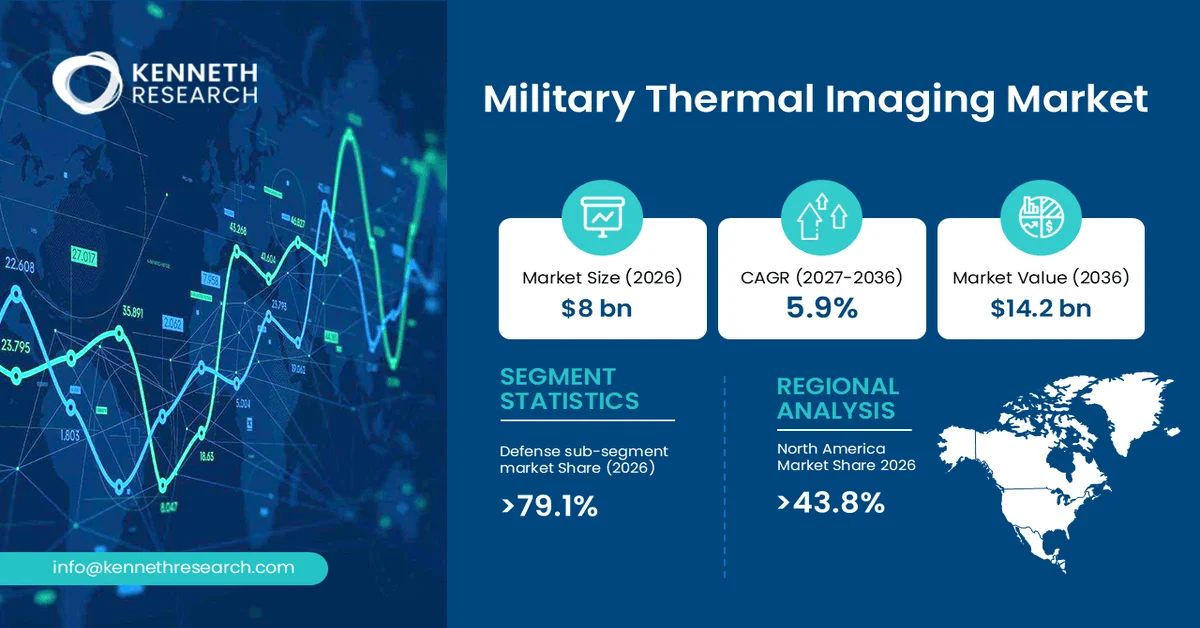
Military Thermal Imaging Market size was valued at USD 8 billion in 2026 and is projected to reach USD 14.2 billion by the end of 2036, rising at a CAGR of 5.9% during the forecast period, i.e., 2027-2036. In 2027, the industry size of the military thermal imaging market is estimated at USD 8.5 billion.
The primary growth driver for the military thermal imaging market is the increasing requirement for reliable detection, recognition, and target identification across day, night, obscured, and adverse battlefield conditions.
The military thermal imaging market comprises thermal imaging equipment, systems, sensors, and integrated solutions designed for defense and military applications. These systems detect infrared radiation emitted by objects and convert differences in thermal energy into images, enabling personnel and platforms to identify people, vehicles, equipment, terrain features, and other objects under conditions where conventional optical systems have limited effectiveness.
The market includes cooled and uncooled thermal imaging technologies deployed across weapon sights, night-vision systems, surveillance and reconnaissance equipment, targeting systems, armored vehicles, unmanned platforms, airborne systems, maritime platforms, and soldier-mounted equipment.
Key Military Thermal Imaging Market Insights Summary:
Key Takeaways: Market Trends & Insights
- The military thermal imaging market is projected to expand from USD 8.5 billion in 2027 to USD 14.2 billion by 2036, supported by continued modernization of military sensing and targeting capabilities.
- The defense end-use segment leads the market, driven by the increasing deployment of thermal imaging for reconnaissance, surveillance, target acquisition, and weapon-sighting applications.
- Uncooled thermal imaging is gaining importance because its compact, lightweight, and lower-power architecture supports broader deployment across soldier-mounted sights, crew-served weapons, and other portable military systems.
- North America remains the leading regional market, supported by defense modernization programs and continued development and procurement of advanced thermal imaging capabilities in the U.S. and Canada
Market Drivers
- Rising defense modernization and procurement of advanced soldier systems
- Increasing integration of thermal imaging with unmanned and networked defense platforms
Challenges
- High system complexity and integration requirements
- Export controls and technology-transfer restrictions
Military Thermal Imaging Market Overview & Supply Chain
The military thermal imaging market comprises thermal cameras, weapon sights, surveillance systems, targeting systems, and integrated infrared imaging solutions used by defense forces for reconnaissance, surveillance, target acquisition, situational awareness, and night operations. Demand is supported by the need to maintain detection and identification capabilities in darkness and degraded visibility, including environments affected by smoke, dust, fog, and other battlefield obscurants. The U.S. Army continues to procure and modernize thermal imaging capabilities across individual weapon sights and vehicle-based forward-looking infrared systems.
The supply chain begins with specialized materials and technologies required for infrared optics, detector arrays, microbolometers, focal-plane arrays, optical coatings, electronics, image-processing hardware, and thermal-management components. These inputs are supplied to sensor and imaging-system manufacturers, which develop detector assemblies, thermal cores, optical modules, and imaging engines. System manufacturers then integrate these technologies with lenses, displays, processors, power systems, communications interfaces, stabilization mechanisms, and software to produce complete military thermal imaging equipment.
Military Thermal Imaging Market: Growth Drivers & Challenges
Growth Drivers:
- Rising defense modernization and procurement of advanced soldier systems: Defense modernization programs are increasing demand for thermal imaging across infantry equipment, armored vehicles, surveillance platforms, and targeting systems. Military forces are replacing legacy night-vision and optical equipment with thermal systems that provide passive detection and improved target recognition in darkness and visually degraded environments. This transition is particularly important for dismounted soldiers, who require lightweight, low-power, and rugged thermal sights that can be integrated with existing weapons and digital battlefield networks.
- Increasing integration of thermal imaging with unmanned and networked defense platforms: The integration of thermal imaging into unmanned aerial systems, unmanned ground vehicles, and networked surveillance platforms is creating additional demand for compact and energy-efficient imaging solutions. Thermal payloads enable unmanned platforms to conduct reconnaissance, perimeter monitoring, target tracking, and search operations during nighttime or in obscured environments without exposing personnel to unnecessary risks. Military customers increasingly require imaging systems that can transmit data in real time to command-and-control networks, enabling faster operational decisions and coordinated responses.
Challenges:
- High system complexity and integration requirements: Military thermal imaging systems must operate reliably across extreme temperatures, vibration, shock, dust, moisture, electromagnetic interference, and rapidly changing battlefield conditions. Meeting these requirements increases engineering complexity because thermal cameras and sights must combine infrared detectors, optics, image processors, displays, power systems, stabilization, and communications within compact and rugged architectures. Integration becomes more difficult when thermal imaging equipment is incorporated into existing weapons, vehicles, aircraft, unmanned platforms, or digital command networks, as compatibility and qualification requirements can vary substantially between platforms.
- Export controls and technology-transfer restrictions: Strict controls governing military-grade infrared and thermal imaging technologies can constrain international sales, technology partnerships, and global supply-chain flexibility. Governments classify certain thermal imaging cameras, infrared focal-plane arrays, and military-configured night-vision equipment according to performance and intended use, creating licensing and compliance obligations for manufacturers and exporters.
Military Thermal Imaging Market Size and Forecast:
| Report Attribute | Details |
|---|---|
| Base Year |
2026 |
| Forecast Period |
2027-2036 |
| CAGR |
5.9% |
| Base Year Market Size (2026) |
USD 8 billion |
| Forecast Year Market Size (2036) |
USD 14.2 billion |
| Regional Scope |
|
Military Thermal Imaging Market Segmentation Analysis:
End-Use Segment Analysis
In the end-use segment, the defense sub-segment is anticipated to capture the largest market share of 79.1% in 2026.
The defense segment dominates the military thermal imaging market because thermal imaging is fundamental to mission-critical applications including target acquisition, reconnaissance, surveillance, weapon sighting, vehicle observation, and battlefield situational awareness. Defense forces require imaging capabilities that remain effective during darkness and through battlefield obscurants, making thermal systems particularly valuable for infantry, armored formations, special operations units, and surveillance assets. Demand is also supported by modernization of soldier equipment and integration of thermal sights with digital battlefield architectures.
Technology Type Segment Analysis
Uncooled thermal imaging is experiencing strong adoption because it provides a practical balance of performance, size, weight, power consumption, and system complexity for portable military applications. Unlike cooled systems, uncooled imagers do not require cryogenic cooling, enabling manufacturers to develop more compact and power-efficient thermal sights and observation devices. This makes the technology particularly suitable for dismounted soldiers, crew-served weapons, handheld imagers, and other applications where equipment weight and battery endurance directly influence operational effectiveness.
Our in-depth analysis of the global military thermal imaging market includes the following segments:
|
Segment |
Sub-segment |
|
Platform |
|
|
Technology |
|
|
Application |
|
|
End User |
|
Military Thermal Imaging Market Regional Insights:
North America Market Trends & Insights:
North America dominates the military thermal imaging market, accounting for 43.8% in 2026, supported by strong defense modernization programs, advanced electro-optical and infrared capabilities, and sustained procurement of surveillance and targeting systems. The region benefits from an established defense-industrial base capable of developing and integrating thermal imaging across individual weapons, armored vehicles, aircraft, unmanned platforms, and other military assets.
In the U.S., demand is supported by modernization of soldier systems, vehicle-based infrared capabilities, and advanced electro-optical targeting architectures.
In Canada, defense modernization and requirements for improved surveillance and situational awareness are supporting adoption opportunities for thermal imaging technologies. The combination of established defense manufacturers, government procurement programs, technology-development initiatives, and strong military demand provides North America with a significant competitive and technological advantage.
Asia-Pacific Market Trends & Insights:
Asia-Pacific represents an important growth opportunity for the military thermal imaging market as countries strengthen defense capabilities, modernize military platforms, and expand investments in surveillance, unmanned systems, and advanced sensing technologies. Government-led defense modernization is encouraging greater adoption of sophisticated electro-optical and infrared capabilities across land, air, and maritime platforms.
In Japan, opportunities are emerging from modernization of surveillance, target-identification, unmanned, and cross-domain capabilities.
In China, domestic defense technology development and modernization of military equipment are expected to support demand for thermal imaging across multiple platforms. The region's expanding defense technology ecosystem, increasing focus on autonomous and network-enabled operations, and emphasis on strengthening indigenous defense-industrial capabilities are expected to create further opportunities for thermal imaging manufacturers.
Leading Companies Operating in the Global Military Thermal Imaging Market:
Here is a list of upstream, downstream, and key players operating in the global military thermal imaging market competitive ecosystem:
- Teledyne FLIR (U.S)
- Company Overview
- Business Strategy
- Key Product Offerings
- Financial Performance
- Key Performance Indicators
- Risk Analysis
- Recent Development
- Regional Presence
- SWOT Analysis
- Leonardo DRS (U.S)
- L3Harris Technologies (U.S)
Recent Developments
- June 2025: Teledyne FLIR OEM announced NDAA compliance for its Neutrino, Boson, Hadron, and Lepton thermal camera modules.
- May 2026: Leonardo DRS launched the Tenum 640 Orbit uncooled LWIR thermal camera module at SOF Week. The module is optimized for integration into unmanned air, ground, and maritime platforms, supporting the expansion of compact thermal imaging capabilities across unmanned military systems.
Frequently Asked Question
In 2026, the military thermal imaging market exceeded USD 8 billion.
The military thermal imaging market is projected to reach USD 14.2 billion by the end of 2036, expanding at a CAGR of 5.9% over the forecast period (2027-2036).
The major players in the market are Teledyne FLIR, Leonardo DRS, L3Harris Technologies, Safran Electronics & Defense, RTX (Raytheon), and others.
In the end-use segment, the defense sub-segment is anticipated to capture the largest market share of 79.1% in the future and exhibit lucrative growth opportunities during 2027-2036.
North America is projected to hold the largest market share of 43.8% by the end of 2026 and provide more business opportunities in the future.
Why Choose Kenneth Research ?
-
Insight with Impact : We don’t just gather data — we uncover stories, trends, and opportunities that fuel business growth.
-
Experts Who Get It : Our team speaks your industry’s language and knows what really matters to your customers and market.
-
Custom-Built for You : Forget one-size-fits-all. We craft research and consulting solutions as unique as your business vision.
-
Partners, Not Just Providers : We work with you, not for you — collaborating closely to turn insights into smart, strategic moves.
-
Results That Speak : Our work powers brands, startups, and industry leaders alike — with a track record of ideas that work in the real world.
Report ID: 1374 |
Published Date: 10 Sep 2026 |
Report Format: |
Delivery Timeline: 48-72 Business Hours

Copyright © 2025 Kenneth Research. All rights reserved. Terms of Use | Privacy Policy
