Report ID: 1350 |
Published Date: 28 Sep 2026 |
Report Format: |
Delivery Timeline: 48-72 Business Hours
Military Displays Market Outlook:
Military Displays Market size was valued at USD 1.9 billion in 2026 and is projected to reach USD 3.3 billion by the end of 2036, rising at a CAGR of 5.9% during the forecast period, i.e., 2027-2036. In 2027, the industry size of the military displays is estimated at USD 2 billion.
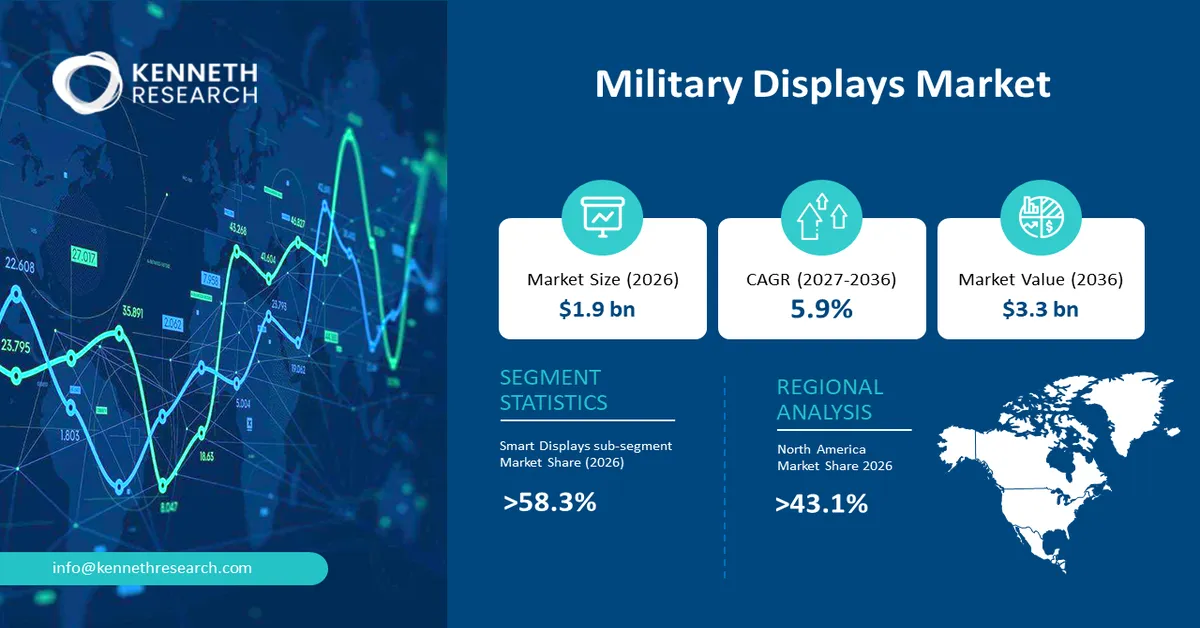
Increasing military modernization and the deployment of digitally connected battlefield systems are driving demand for advanced military displays.
The military displays market comprises ruggedized and mission-critical electronic display systems designed to provide visual information and interactive interfaces across military and defense applications. These displays are engineered to operate reliably under demanding conditions, including shock, vibration, extreme temperatures, electromagnetic interference, dust, moisture, and varying lighting environments. The market includes smart and conventional display systems, with technologies such as LCD, LED, AMOLED, and OLED supporting different operational requirements.
Military displays are integrated into aircraft cockpits, armored and tactical vehicles, naval platforms, command centers, soldier systems, and other defense equipment. Smart displays increasingly combine display hardware with embedded processing and interactive capabilities, enabling real-time visualization of sensor, navigation, targeting, communication, and battlefield-management information.
Key Military Displays Market Insights Summary:
Key Takeaways: Market Trends & Insights
- The military displays market is projected to increase from USD 1.9 billion in 2026 to USD 3.3 billion by 2036, registering a 5.9% CAGR during 2027-2036.
- Smart Displays led the Type segment with a 58.3% share in 2026, supported by growing demand for multifunctional interfaces across digitally enabled defense platforms.
- Small and Medium-Sized Panels represent the leading sub-segment within the Computer Display category, benefiting from their suitability for space-constrained aircraft, vehicles, naval platforms, and tactical systems.
- North America accounted for the largest regional share at 43.1% in 2026, supported by defense modernization and advanced military-electronics capabilities in the U.S. and Canada.
Market Drivers
- Defense platform modernization and digitalization
- Growing adoption of advanced avionics and situational-awareness systems
- Increasing integration of network-centric warfare technologies
- Rising demand for rugged, multifunctional, and high-performance operator interfaces
Challenges
- Complex Qualification and Environmental Requirements
- Integration and Supply Chain Complexity
Military Displays Market Overview & Supply Chain
The military displays market is becoming increasingly important as defense forces transition toward digitally enabled platforms, network-centric operations, and real-time battlefield information systems. Ruggedized displays support mission-critical visualization across aircraft, armored vehicles, naval platforms, command centers, and soldier systems. Their ability to withstand shock, vibration, temperature variations, moisture, dust, and electromagnetic interference makes them suitable for demanding operational environments.
The supply chain begins with display panels, semiconductor components, optical materials, touch sensors, controllers, power-management components, chassis materials, and protective coatings. Specialized manufacturers then perform panel preparation, optical bonding, strengthening, electronics integration, enclosure fabrication, and environmental protection. The resulting display assemblies undergo qualification and testing for vibration, shock, temperature, electromagnetic compatibility, sunlight readability, and other military operating requirements.
Military Displays Market: Growth Drivers & Challenges
Growth Drivers:
- Increasing defense modernization and digitalization: Defense forces are increasingly modernizing aircraft, armored vehicles, naval platforms, command-and-control systems, and soldier equipment with digital mission electronics. This transition increases the need for rugged displays capable of presenting navigation, targeting, sensor, communications, and situational-awareness information through a single interface. Smart displays are particularly suited to these applications because they can combine high-resolution visualization with interactive controls and embedded processing. Modernization programs also require displays that remain operational under vibration, shock, temperature fluctuations, electromagnetic interference, and demanding lighting conditions.
- Growing adoption of advanced avionics and situational-awareness systems: The increasing sophistication of military avionics and battlefield-management systems is strengthening demand for advanced display interfaces. Modern aircraft and other defense platforms collect information from multiple sensors and onboard systems, requiring operators to interpret large volumes of mission data quickly. Multifunction displays and smart displays can consolidate information into configurable interfaces, helping personnel monitor aircraft status, navigation, threats, targeting information, and communications.
Challenges:
- Complex qualification and environmental requirements: Military displays must operate reliably under severe environmental and operational conditions, including shock, vibration, temperature extremes, moisture, dust, electromagnetic interference, and intense sunlight. Meeting these requirements increases engineering, testing, certification, and validation complexity compared with conventional commercial displays. Suppliers must often customize display architecture, enclosure design, thermal management, optical performance, and protection mechanisms for specific military platforms.
- Integration and supply chain complexity: Modern military displays increasingly function as interfaces within interconnected defense electronics architectures rather than as standalone visualization devices. Integration with mission computers, sensors, communication networks, navigation systems, and command-and-control equipment creates compatibility and cybersecurity challenges. Different platforms may also use distinct hardware, software, communication protocols, and interface requirements, increasing customization needs for display suppliers.
Military Displays Market Size and Forecast:
| Report Attribute | Details |
|---|---|
| Base Year |
2026 |
| Forecast Period |
2027-2036 |
| CAGR |
5.9% |
| Base Year Market Size (2026) |
USD 1.9 billion |
| Forecast Year Market Size (2036) |
USD 3.3 billion |
| Regional Scope |
|
Military Displays Market Segmentation Analysis:
Type Segment Analysis
The Type segment is led by Smart Displays, which accounted for 58.3% of the market in 2026.
Smart displays are increasingly preferred across modern defense platforms because they combine high-resolution visualization with interactive controls, connectivity, and multifunctional capabilities. Unlike conventional displays, smart systems can serve as integrated interfaces for mission computers, sensors, communications, navigation, targeting, and battlefield-management systems. Their ability to consolidate information from multiple onboard systems supports faster interpretation of mission-critical data and improves operator awareness.
Demand is particularly strong in digitally modernized aircraft, armored vehicles, naval platforms, command-and-control systems, and soldier-worn equipment. The development of network-centric military architectures is also increasing the need for displays capable of interfacing with interconnected sensors and computing systems.
Computer Display Segment Analysis
The Computer Display segment is led by Small and Medium-Sized Panels, supported by their suitability for space-constrained military platforms and mission-critical operator interfaces. These panels provide a practical balance between visibility, compact form factors, power consumption, and integration flexibility, making them suitable for aircraft cockpits, armored vehicles, naval systems, command-and-control equipment, and portable military computers. Their relatively compact footprint also enables manufacturers and defense integrators to incorporate multiple displays within constrained platform interiors without imposing excessive weight or space requirements. Demand is further supported by the modernization of military computing systems, where operators require clear visualization of navigation, communications, targeting, sensor, and tactical information.
Our in-depth analysis of the global military displays market includes the following segments:
|
Segment |
Sub-segment |
|
Product Type |
|
|
Type |
|
|
By Computer Display |
|
|
Technology |
|
|
End Industry |
|
Military Displays Market Regional Insights:
North America Market Trends & Insights:
North America is the dominant region in the military displays market, accounting for 43.1% in 2026.
The region benefits from substantial defense modernization activity, advanced military electronics capabilities, and continued investment in networked command, control, communications, surveillance, and mission systems. Demand for ruggedized and smart displays is supported by the modernization of aircraft, ground vehicles, naval platforms, and command-and-control infrastructure, where operators require real-time visualization of increasingly complex mission data.
The U.S. represents the primary demand center in North America because of its large defense technology ecosystem and continuous modernization of military platforms.
Canada is also strengthening demand through major modernization programs. Its Department of National Defence is advancing NORAD modernization, including upgrades to surveillance, command, control, and communications capabilities, while also investing in future air, maritime, and other defense platforms.
Asia-Pacific Market Trends & Insights:
Asia-Pacific is expected to remain an important regional market for military displays, supported by ongoing defense modernization, increasing adoption of advanced military electronics, and the development of digitally connected platforms. Countries across the region are strengthening capabilities in surveillance, command and control, avionics, unmanned systems, and networked defense architectures.
Japan represents a significant opportunity within the region because its defense modernization efforts increasingly emphasize advanced surveillance, information, and command-and-control capabilities.
China is another major market, supported by the continued modernization and digitalization of its armed forces. Japan's Ministry of Foreign Affairs reported that China has been enhancing its military capabilities across areas including aerospace, cyberspace, electromagnetic operations, artificial intelligence, and unmanned systems, while pursuing greater integration of informatization and smart technologies.
Leading Companies Operating in the Military Displays Market:
Here is a list of upstream, downstream, and key players operating in the global military displays market competitive ecosystem:
- Elbit Systems (Israel)
- Company Overview
- Business Strategy
- Key Product Offerings
- Financial Performance
- Key Performance Indicators
- Risk Analysis
- Recent Development
- Regional Presence
- SWOT Analysis
- L3Harris Technologies (U.S)
- Collins Aerospace (U.S)
Recent Developments
- February 2026: Elbit Systems announced an agreement to supply a helmet display and tracking system for the Israeli Air Force’s UH-60 Black Hawk helicopter fleet.
- April 2026: The U.S. Army selected L3Harris to provide its NOVA next-generation night-vision goggle system for the Binocular Night Observation Device (BiNOD) program.
Frequently Asked Question
In 2026, the military displays market exceeded USD 1.9 billion.
The military displays market is projected to reach USD 3.3 billion by the end of 2036, expanding at a CAGR of 5.9% over the forecast period (2027-2036).
The major players in the market are Elbit Systems, L3Harris Technologies, Collins Aerospace, BAE Systems, Thales, and others.
In the Type segment, the Smart Displays sub-segment is anticipated to capture the largest market share of 58.3% in 2026 and exhibit lucrative growth opportunities during 2027-2036.
North America is projected to hold the largest market share of 43.1% by the end of 2026 and provide more business opportunities in the future.
Why Choose Kenneth Research ?
-
Insight with Impact : We don’t just gather data — we uncover stories, trends, and opportunities that fuel business growth.
-
Experts Who Get It : Our team speaks your industry’s language and knows what really matters to your customers and market.
-
Custom-Built for You : Forget one-size-fits-all. We craft research and consulting solutions as unique as your business vision.
-
Partners, Not Just Providers : We work with you, not for you — collaborating closely to turn insights into smart, strategic moves.
-
Results That Speak : Our work powers brands, startups, and industry leaders alike — with a track record of ideas that work in the real world.
Report ID: 1350 |
Published Date: 28 Sep 2026 |
Report Format: |
Delivery Timeline: 48-72 Business Hours

Copyright © 2025 Kenneth Research. All rights reserved. Terms of Use | Privacy Policy
