Report ID: 1184 |
Published Date: 26 Aug 2026 |
Report Format: |
Delivery Timeline: 48-72 Business Hours
Military Cyber Security Market Outlook:
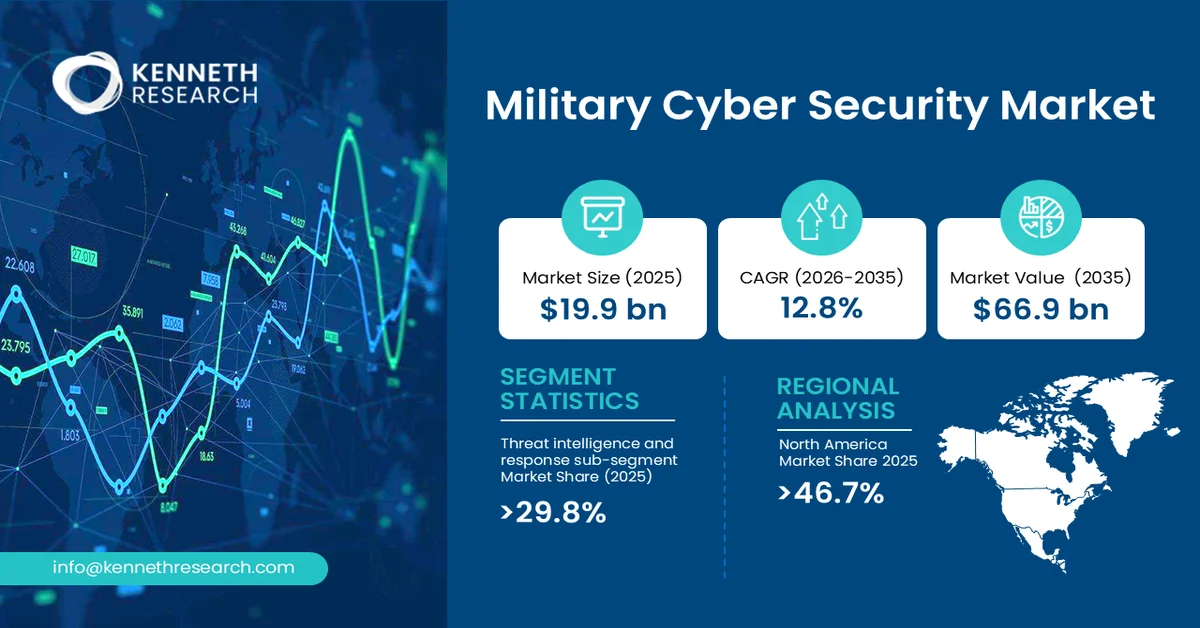
Military Cyber Security Market size was valued at USD 19.9 billion in 2025 and is projected to reach USD 66.9 billion by the end of 2035, rising at a CAGR of 12.8% during the forecast period, i.e., 2026-2035. In 2026, the industry size of military cyber security is estimated at USD 22.6 billion.
The primary growth driver is the escalating need for cyber resilience across military networks, defense infrastructure, and mission systems as adversaries increasingly use cyberspace for espionage, disruption, and operational advantage. Defense organizations are therefore prioritizing resilient architectures, threat-informed defenses, intelligence capabilities, and coordinated cyber operations to protect mission continuity and national security.
The military cyber security market comprises technologies, software, services, and integrated capabilities designed to protect military information systems, communications networks, operational platforms, mission applications, and defense-related data from unauthorized access, malicious activity, disruption, exploitation, and compromise. The market encompasses defensive capabilities such as network protection, endpoint and system security, identity and access controls, vulnerability management, security monitoring, threat intelligence, incident detection and response, and cyber-resilience solutions.
A defining characteristic of military cyber security is its mission-oriented requirement for continuous protection while maintaining the availability, reliability, integrity, and resilience of systems supporting military operations. Unlike conventional enterprise cybersecurity, military environments must account for contested operational conditions, sensitive information, interconnected defense infrastructure, and sophisticated state-sponsored and other threat actors.
Key Military Cyber Security Market Insights Summary:
Key Takeaways: Market Trends & Insights
- Military cyber security demand is supported by rising cyber threats and increasing dependence on digitally connected defense systems
- Threat Intelligence and Response leads the application landscape with 29.8% market share in 2025
- Network Security is positioned as a high-growth security layer as military networks become more distributed and interconnected
- North America leads the market with 46.7% market share in 2025, supported by strong defense technology capabilities and cybersecurity investment
Market Drivers
- Increasing cybersecurity requirements for software-driven military systems
- Expansion of zero trust cybersecurity architectures
- Growing protection requirements for the defense industrial base
- Increasing integration of cloud and digitally connected military infrastructure
Challenges
- Legacy-system integration and modernization complexity
- High complexity of zero trust implementation
Military Cyber Security Market Overview & Supply Chain
Global adoption of military cyber security is increasing as armed forces integrate digital networks, connected platforms, cloud environments, autonomous systems, and data-intensive command structures into defense operations. Cybersecurity has therefore become a core component of military readiness rather than a standalone IT function. NATO identifies cyberspace as an operational domain and emphasizes stronger resilience against increasingly sophisticated cyber threats.
The military cyber security market value chain begins with specialized input providers supplying computing hardware, secure networking components, semiconductors, cryptographic technologies, sensors, software frameworks, threat-data feeds, and technical expertise. Solution developers and cybersecurity manufacturers then integrate these inputs into network-security platforms, endpoint protection, identity controls, security monitoring, threat intelligence, incident-response systems, and mission-specific cyber capabilities. System integrators and defense technology contractors combine these solutions with military communications, command-and-control architectures, weapon platforms, and broader defense infrastructure. Distribution occurs primarily through direct government procurement, defense contracts, prime contractors, authorized technology partners, and specialized cybersecurity providers. End users include defense ministries, armed forces, intelligence organizations, military commands, and defense-support agencies.
Military Cyber Security Market - Growth Drivers & Challenges
Growth Drivers:
- Rising cybersecurity requirements for software-driven military systems: The increasing software dependence of modern military systems is strengthening demand for cybersecurity capabilities embedded throughout development, testing, deployment, and sustainment. Software now influences communications, sensing, command functions, mission applications, and platform interoperability, making cyber protection an integral element of defense-system performance. This creates demand for secure software development, vulnerability identification, application security, continuous testing, threat monitoring, and cyber-resilient architectures.
- Expansion of zero trust cybersecurity architectures: The shift toward Zero Trust cybersecurity architectures is creating broader requirements for identity security, access management, endpoint protection, network segmentation, data security, continuous monitoring, and threat detection. Military organizations operate increasingly distributed environments in which personnel, devices, applications, mission systems, and partner networks may interact across different security boundaries. Zero Trust addresses this complexity by reducing implicit trust and requiring stronger validation of users, devices, resources, and access requests. This expands cybersecurity spending beyond conventional perimeter defenses and supports demand for integrated security layers capable of protecting both legacy and modern military environments. The approach also encourages organizations to consolidate security visibility and improve their ability to detect and contain adversary activity.
Challenges:
- Legacy-system integration and modernization complexity: Military organizations often operate heterogeneous technology environments in which legacy platforms must remain connected with newer cloud, software-defined, and network-centric systems. The resulting integration complexity makes it difficult to implement contemporary cybersecurity architectures without disrupting mission-critical operations. Older systems may lack modern security capabilities, standardized interfaces, or vendor support, while replacement can require extensive redesign, testing, certification, and operational transition. This creates commercial friction because cybersecurity suppliers must frequently customize solutions for fragmented environments rather than deploy standardized platforms. Integration requirements can also lengthen procurement cycles and increase implementation complexity for defense contractors and technology providers.
- High complexity of zero trust implementation: Zero Trust adoption presents a significant implementation challenge because military organizations must integrate security technologies, identity systems, endpoints, applications, networks, and data environments that were often developed independently. The absence of a single standardized implementation model can make architecture design and technology selection difficult, particularly where existing systems were not designed for continuous authentication or granular access control. Commercial implications include greater integration effort, specialized engineering requirements, workforce training, and longer deployment cycles. Vendors may also face difficulty demonstrating interoperability across heterogeneous defense environments, limiting the effectiveness of standalone solutions.
Military Cyber Security Market Size and Forecast:
| Report Attribute | Details |
|---|---|
| Base Year |
2025 |
| Forecast Year |
2026-2035 |
| CAGR |
12.8% |
| Base Year Market Size (2025) |
USD 19.9 billion |
| Forecast Year Market Size (2035) |
USD 66.9 billion |
| Regional Scope |
|
Military Cyber Security Market Segmentation Analysis:
Solution Segment Analysis
In the solution segment, the Threat Intelligence and Response sub-segment is anticipated to capture the largest market share of 29.8% by the end of 2025.
Threat Intelligence and Response dominates the military cyber security market because military organizations require continuous visibility into adversary tactics, techniques, vulnerabilities, and malicious activity to identify threats before they compromise mission systems. Demand is strengthened by persistent nation-state cyber operations and the increasing complexity of defense networks, where conventional perimeter protection alone is insufficient. The U.S. Government Accountability Office reported that the Department of Defense had experienced over 12,000 cyber incidents since 2015, underscoring the operational requirement for stronger detection, analysis, information sharing, and response capabilities. Adoption is increasingly centered on integrated threat intelligence, automated detection, threat hunting, incident analysis, and rapid remediation.
Security Layer Segment Analysis
The Network Security is projected to grow as the second-largest segment in the military cyber security market due to four converging demand drivers.
Network Security is projected to grow strongly as military organizations expand interconnected command, communications, operational, and information environments that require continuous protection against unauthorized access, intrusion, lateral movement, and disruption. Military adoption is shifting toward layered architectures that combine network detection with identity controls, endpoint telemetry, vulnerability management, and automated response. On the supply side, cybersecurity providers are developing integrated network-security platforms capable of supporting distributed and heterogeneous defense environments. Future growth should benefit from modernization of legacy networks, wider Zero Trust implementation, and increasing requirements for resilient communications infrastructure.
Our in-depth analysis of the global military cyber security market includes the following segments:
|
Segment |
Sub-segment |
|
Solution |
|
|
Security Layer |
|
|
Deployment |
|
|
Operation Domain |
|
|
Component |
|
Military Cyber Security Market Regional Insights:
North America Market Trends & Insights:
North America military cyber security market is projected to hold the largest revenue share of 46.7% by the end of 2025.
Its supported by strong defense technology capabilities, extensive military digitization, established cybersecurity infrastructure, and sustained government investment. The United States provides the region’s principal demand base through large-scale defense modernization, advanced cyber operations, and a mature defense-industrial ecosystem, while Canada contributes through military cyber capability development, secure communications, and continental defense cooperation. Regulatory and strategic support further strengthens regional adoption. The U.S. Department of Defense’s FY2026 budget proposal allocated $15.1 billion for cybersecurity, highlighting the scale of government-backed investment supporting cyber resilience, joint all-domain operations, and protection of U.S. interests in cyberspace.
The United States leads regional consumption and technology development, supported by defense procurement, cybersecurity modernization, research programs, and a broad supplier ecosystem spanning prime contractors and specialized technology companies.
Canada is strengthening its complementary role through military cyber capability development and deeper integration with allied defense structures. Canada’s Department of National Defence established the CAF Cyber Command and advanced defensive and offensive cyber capabilities, reinforcing domestic capacity and interoperability with allied partners.
Asia Pacific Market Trends & Insights:
Asia Pacific represents a significant opportunity for military cyber security as governments strengthen digital defense capabilities in response to increasingly sophisticated cyber threats and the growing dependence of armed forces on networked command, communications, and information systems. Industrial activity is expanding around secure communications, cyber defense, intelligence, advanced analytics, and protection of defense infrastructure. Government initiatives are also moving toward more coordinated national cyber defense frameworks and closer cooperation between defense organizations, critical infrastructure operators, and private-sector technology providers.
China is developing dedicated cyberspace capabilities as part of its broader national security architecture, with emphasis on network defense, intrusion detection, information security, and protection of national cyber sovereignty. This creates opportunities for domestic cybersecurity technology providers and defense-oriented systems integrators.
Japan is pursuing a complementary modernization path, strengthening cyber defense across the Self-Defense Forces while expanding coordination with ministries, critical infrastructure operators, defense companies, allies, and other partners. Japan’s Ministry of Defense has specifically highlighted continuous risk management, cyber threat hunting, and stronger protection for command-and-control and priority equipment systems.
Leading Companies Operating in the Global Military Cyber Security Market:
Here is a list of upstream, downstream, and key players operating in the global military cyber security market competitive ecosystem:
- Lockheed Martin Corporation (United States)
- Company Overview
- Business Strategy
- Key Product Offerings
- Financial Performance
- Key Performance Indicators
- Risk Analysis
- Recent Development
- Regional Presence
- SWOT Analysis
- BAE Systems plc (United Kingdom)
- Thales Group (France)
- General Dynamics Corporation (United States)
- Booz Allen Hamilton Inc. (United States)
- IBM Corporation (United States)
Recent Developments
- In February 2026, Booz Allen Hamilton was awarded a $421 million task order by the U.S. Department of Homeland Security to continue supporting the Cybersecurity Infrastructure Security Agency's (CISA) Continuous Diagnostics and Mitigation (CDM) DEFEND program. The three-year award carries a ceiling of $1.2 billion and expands critical incident support to include advancing zero trust maturity across 13 government agencies, including NASA, IRS, and the Department of Health and Human Services.
- In 2026, IBM released its X-Force Threat Intelligence Index 2026, documenting a 44% year-over-year increase in attacks exploiting public-facing applications. The report highlighted that cyber attackers are leveraging AI tools for faster vulnerability discovery, enabling unprecedented attack speeds against traditional defense mechanisms..
Frequently Asked Question
In 2025, the military cyber security market exceeded USD 19.9 billion
The military cyber security market is projected to reach USD 66.9 billion by the end of 2035, expanding at a CAGR of 12.8% over the forecast period (2026-2035)
The major players in the market are Lockheed Martin Corporation, BAE Systems plc, Thales Group, General Dynamics Corporation, Booz Allen Hamilton Inc., IBM Corporation, and others
In the Solution segment, the Threat Intelligence and Response sub-segment is anticipated to capture the largest market share of 29.8% in the future and exhibit lucrative growth opportunities during 2026-2035. This growth trajectory is largely attributed to the increasing need for continuous visibility into adversary tactics, vulnerabilities, and malicious activity.
North America is projected to hold the largest market share of 46.7% by the end of 2025 and provide more business opportunities in the future. Continuous investments in defense modernization, cybersecurity infrastructure, and military cyber capabilities across the United States and Canada are fostering the region's dominance
Why Choose Kenneth Research ?
-
Insight with Impact : We don’t just gather data — we uncover stories, trends, and opportunities that fuel business growth.
-
Experts Who Get It : Our team speaks your industry’s language and knows what really matters to your customers and market.
-
Custom-Built for You : Forget one-size-fits-all. We craft research and consulting solutions as unique as your business vision.
-
Partners, Not Just Providers : We work with you, not for you — collaborating closely to turn insights into smart, strategic moves.
-
Results That Speak : Our work powers brands, startups, and industry leaders alike — with a track record of ideas that work in the real world.
Report ID: 1184 |
Published Date: 26 Aug 2026 |
Report Format: |
Delivery Timeline: 48-72 Business Hours

Copyright © 2025 Kenneth Research. All rights reserved. Terms of Use | Privacy Policy
