Report ID: 1407 |
Published Date: 25 Sep 2026 |
Report Format: |
Delivery Timeline: 48-72 Business Hours
Military Battery Market Outlook:
Military Battery Market size was valued at USD 1.7 billion in 2026 and is projected to reach USD 2.6 billion by the end of 2036, rising at a CAGR of 4.3% during the forecast period, i.e., 2027-2036. In 2027, the industry size of the military battery is estimated at USD 1.8 billion.
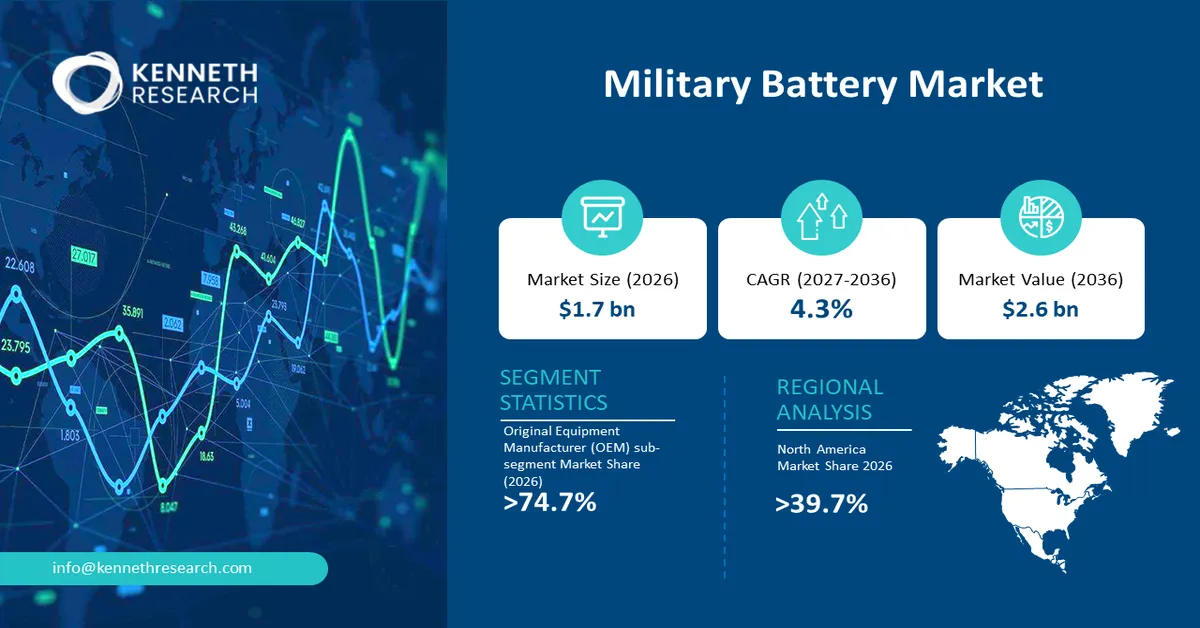
Military Battery Market growth is primarily driven by rising demand for reliable, high-density energy storage across combat platforms, communications, sensors, weapons, and autonomous systems. The U.S. Department of Energy states that the Department of Defense requires advanced energy storage for critical missions and reported more than $200 million in annual battery procurements.
Military Battery Market refers to the industry supplying rechargeable and non-rechargeable battery technologies designed to provide dependable electrical power for defense platforms, equipment, infrastructure, and personnel. These batteries support applications ranging from portable soldier systems and tactical communications to vehicles, unmanned platforms, sensors, weapons, and mission-critical power systems.
Military batteries are distinguished by demanding operational requirements. They must deliver dependable performance under extreme temperatures, shock, vibration, prolonged storage, rapid deployment, and other harsh field conditions. Battery technologies can include lithium-ion and other advanced chemistries selected according to requirements for energy density, power delivery, weight, durability, safety, rechargeability, and service life.
Key Military Battery Market Insights Summary:
Key Takeaways: Market Trends & Insights
- Military battery market is valued at USD 1.7 billion in 2026 and is projected to reach USD 2.6 billion by 2036
- The market is expected to expand at a CAGR of 4.3% from 2027 to 2036
- Original Equipment Manufacturer (OEM) leads the End User segment with a 74.7% market share in 2026
- North America dominates the market with a 39.7% market share in 2026, supported by the United States and Canada
- The 100–200 Wh/kg power density segment is projected to grow as defense forces increasingly require lightweight, high-energy batteries for unmanned systems, tactical communications, surveillance equipment, and advanced military platforms
Market Drivers
- Electrification of military platforms and tactical equipment
- Advancement of high-performance battery technologies
- Expansion of autonomous and unmanned defense systems
- Increasing emphasis on resilient and domestically secure battery supply chains
Challenges
- Stringent performance and safety requirements
- Fragmented requirements and supply-chain constraints
Military Battery Market Overview & Supply Chain
Adoption of military battery systems is increasing globally as defense forces modernize platforms, expand autonomous and electrically powered systems, and require dependable energy for communications, sensors, weapons, and field operations. Advances in lithium-ion chemistry, battery-management systems, thermal management, and modular energy-storage architectures are improving performance while supporting increasingly distributed and mobile military operations. Supply-chain resilience has also become a strategic consideration, as governments seek secure access to critical minerals, processing capabilities, battery manufacturing, and recycling infrastructure.
The military battery value chain begins with raw-material and component suppliers providing lithium, nickel, cobalt, graphite, manganese, specialty chemicals, electrolytes, separators, current collectors, and other engineered materials. These inputs move through refining, processing, electrode production, cell assembly, testing, and battery-pack integration, where manufacturers incorporate battery-management, thermal-management, protection, and power-conversion systems. Specialized defense manufacturers then configure batteries to meet platform-specific requirements for weight, durability, safety, storage, transport, and environmental performance. Distribution involves qualified logistics providers, defense contractors, system integrators, and government procurement channels, with traceability and secure handling becoming important considerations. End users include military services, defense agencies, platform operators, and personnel using batteries across vehicles, aircraft, naval systems, unmanned platforms, communications equipment, sensors, weapons, and portable electronics.
Military Battery Market: Growth Drivers & Challenges
Growth Drivers:
- Increasing electrification and demand for mission-critical power: The growing electrification of military platforms and equipment is strengthening demand for advanced battery systems that can provide dependable, mobile, and low-signature power. Modern defense operations increasingly depend on electronic warfare systems, communications, sensors, autonomous equipment, surveillance technologies, and electrically enabled vehicles, creating greater requirements for compact and reliable energy storage. Battery-powered and hybrid platforms can also reduce acoustic and thermal signatures, supporting stealthier operations and greater tactical flexibility.
- Advancement of high-performance battery technologies: Continuous development of battery chemistry, cell architecture, thermal management, charging systems, and power electronics is creating opportunities for military applications that require greater endurance without proportionally increasing equipment weight. Defense organizations are increasingly seeking technologies that can deliver improved energy availability while remaining suitable for harsh operational environments.
Challenges:
- Stringent performance and safety requirements: Military batteries must operate reliably under conditions substantially more demanding than conventional commercial applications. Extreme temperatures, shock, vibration, prolonged storage, rapid deployment requirements, and stringent transport and safety qualification can complicate battery design and increase development effort. The U.S. Department of Defense has identified shortcomings in existing lithium-ion battery technology involving transportability, operational safety, storage, austere-environment performance, weight, and cost.
- Fragmented requirements and supply-chain constraints: Military battery procurement is constrained by fragmented specifications, specialized form factors, relatively complex qualification requirements, and dependence on secure sources of materials and components. These conditions make it difficult for defense organizations to leverage the scale, manufacturing efficiency, and rapid innovation available in commercial battery markets. The U.S. Defense Innovation Unit has specifically identified low-demand signals, complex specifications, sole-source dependencies, variable procurement practices, and high costs as barriers to effective battery lifecycle management.
Military Battery Market Size and Forecast:
| Report Attribute | Details |
|---|---|
| Base Year |
2026 |
| Forecast Period |
2027-2036 |
| CAGR |
4.3% |
| Base Year Market Size (2026) |
USD 1.7 billion |
| Forecast Year Market Size (2036) |
USD 2.6 billion |
| Regional Scope |
|
Military Battery Market Segmentation Analysis:
End User Segment Analysis
In the end user segment, original equipment manufacturer (OEM) sub-segment is anticipated to capture the largest market share of 74.7% by the end of 2026.
The Original Equipment Manufacturer (OEM) segment leads the military battery market because batteries are increasingly integrated directly into the design and production of defense platforms rather than being treated solely as aftermarket components. Demand is supported by the modernization of aircraft, ground vehicles, naval platforms, unmanned systems, communications equipment, and mission electronics, all of which require power architectures engineered around platform-specific operational requirements. Government procurement activity demonstrates the scale of platform-level demand feeding this channel. In July 2024, the U.S. Department of Defense awarded a $2,089,200,000 contract for low-rate initial production of the Lower Tier Air and Missile Defense System, illustrating continued investment in sophisticated defense platforms where integrated power systems are essential
Power Density Segment Analysis
The 100-200 wh/kg is projected to grow as the second-largest segment in the military battery market due to four converging demand drivers.
The 100–200 Wh/kg segment is projected to expand as defense forces increasingly require batteries that provide greater energy availability while maintaining manageable system weight. This requirement is particularly relevant for unmanned aerial systems, soldier-worn electronics, tactical communications, surveillance equipment, and other power-constrained military applications. Higher specific energy can extend mission endurance and reduce the frequency of battery replacement, improving operational efficiency and logistical flexibility. Technological progress in lithium-ion architectures, electrode materials, and cell design is strengthening the supply base for these applications. Government-backed battery research also demonstrates continued progress toward higher energy performance. The U.S. Department of Energy reported that a battery-development project achieved more than 310 Wh/kg specific energy in prototype cells during its FY2022 progress assessment.
Our in-depth analysis of the military battery market includes the following segments:
|
Segment |
Sub-segment |
|
Platform |
|
|
Battery Type |
|
|
Composition |
|
|
Power Density |
|
|
End User |
|
Military Battery Market Regional Insights:
North America Market Trends & Insights:
North America military battery market is projected to hold the largest revenue share of 39.7% by the end of 2026.
Its dominance is supported by substantial defense modernization, established battery and aerospace manufacturing capabilities, advanced military-electronics ecosystems, and sustained government investment in resilient energy infrastructure.
The United States remains the region's primary demand center, supported by large-scale defense procurement, modernization of combat platforms, autonomous systems, and military installations. Government initiatives targeting batteries, energy storage, and critical minerals are also strengthening domestic production capabilities.
Canada complements regional development through defense innovation programs and requirements for lightweight, reliable power for dismounted soldiers. Its Department of National Defence specifically seeks advanced portable power technologies capable of supporting soldiers operating in demanding environments, reinforcing demand for specialized battery solutions. Together, U.S. procurement strength and Canadian innovation activity should sustain North America's leadership as defense forces increasingly integrate advanced energy-storage technologies.
Asia Pacific Market Trends & Insights:
Asia Pacific represents a significant opportunity for the military battery market as defense modernization, autonomous-system deployment, digitization of armed forces, and demand for portable and resilient power systems increase across the region. Industrial capabilities in battery manufacturing, electronics, advanced materials, and electric mobility provide a strong technology base for military applications.
China remains a major industrial center because of its established battery manufacturing ecosystem, extensive electronics supply chain, and growing emphasis on advanced military technologies.
India is emerging as an important demand and production base through defense indigenization, domestic manufacturing, and development of indigenous military technologies. For suppliers, both markets offer opportunities for localized partnerships, technology development, and integration with domestic defense contractors.
Leading Companies Operating in the Military Battery Market:
Here is a list of upstream, downstream, and key players operating in military battery market competitive ecosystem:
- Ultralife Corporation (United States)
- Company Overview
- Business Strategy
- Key Product Offerings
- Financial Performance
- Key Performance Indicators
- Risk Analysis
- Recent Development
- Regional Presence
- SWOT Analysis
- EaglePicher Technologies (United States)
- EnerSys (United States)
- Tadiran Batteries GmbH (Israel/Germany)
- Stryten Energy LLC (United States)
Recent Developments
- In September 2025, Ultralife Corporation received an award valued at approximately $5.2 million from the U.S. Government's Defense Logistics Agency (DLA) for its lithium manganese dioxide, non-rechargeable BA-5390 military batteries. The majority of the shipments are scheduled throughout 2026 with completion in early 2027. Ultralife has been a long-standing supplier to the U.S. military, and the BA-5390 battery remains recognized for its long life, safety record, and reliability under the toughest conditions.
- In September 2025, EnerSys launched the Hawker® ARMASAFE™ iON-X 24-volt batteries featuring rechargeable lithium-ion technology in two models – 105 Ah and 162 Ah. These 6T size batteries are designed for high-current vehicle starting applications and the high energy storage power needs of onboard electronics and accessories. They meet MIL-PRF-32565C requirements and benefit from over 20 years of lithium-ion development expertise delivered by EnerSys' Bren-Tronics LLC business segment.
Frequently Asked Question
In 2026, the military battery market exceeded USD 1.7 billion.
The military battery market is projected to reach USD 2.6 billion by the end of 2036, expanding at a CAGR of 4.3% over the forecast period (2027-2036).
The major players in the market are Ultralife Corporation, EaglePicher Technologies, EnerSys, Tadiran Batteries GmbH, Stryten Energy LLC, and others.
In the End User segment, the Original Equipment Manufacturer (OEM) sub-segment is anticipated to capture the largest market share of 74.7% in the future and exhibit lucrative growth opportunities during 2027-2036. This growth trajectory is largely attributed to increasing electrification of military platforms and tactical equipment.
North America is projected to hold the largest market share of 39.7% by the end of 2026 and provide more business opportunities in the future. Continuous defense modernization and investments in advanced battery technologies across the United States and Canada are fostering the region's dominance.
Why Choose Kenneth Research ?
-
Insight with Impact : We don’t just gather data — we uncover stories, trends, and opportunities that fuel business growth.
-
Experts Who Get It : Our team speaks your industry’s language and knows what really matters to your customers and market.
-
Custom-Built for You : Forget one-size-fits-all. We craft research and consulting solutions as unique as your business vision.
-
Partners, Not Just Providers : We work with you, not for you — collaborating closely to turn insights into smart, strategic moves.
-
Results That Speak : Our work powers brands, startups, and industry leaders alike — with a track record of ideas that work in the real world.
Report ID: 1407 |
Published Date: 25 Sep 2026 |
Report Format: |
Delivery Timeline: 48-72 Business Hours

Copyright © 2025 Kenneth Research. All rights reserved. Terms of Use | Privacy Policy
