Report ID: 1427 |
Published Date: 29 Sep 2026 |
Report Format: |
Delivery Timeline: 48-72 Business Hours
Microgrid Market Outlook:
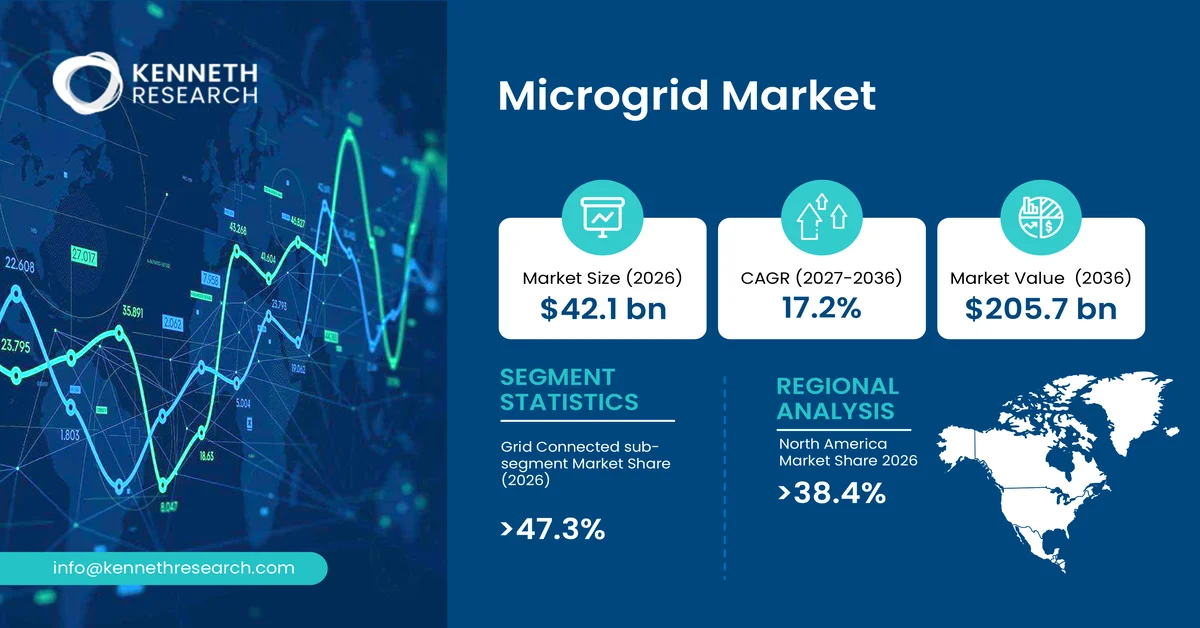
Microgrid Market size was valued at USD 42.1 billion in 2026 and is projected to reach USD 205.7 billion by the end of 2036, rising at a CAGR of 17.2% during the forecast period, i.e., 2027–2036. In 2027, the industry size of the microgrid market is estimated at USD 49.3 billion.
The primary growth driver for the microgrid market is the increasing need for reliable, resilient, and flexible electricity infrastructure.
The microgrid market comprises localized electricity systems that integrate distributed energy resources, electrical loads, energy storage, control technologies, and grid-interconnection equipment within defined electrical boundaries. These systems function as coordinated and controllable energy networks and can operate while connected to the utility grid or independently in islanded mode.
Microgrids can incorporate solar photovoltaic systems, wind generation, natural-gas or diesel generators, battery energy storage, combined heat and power systems, power converters, protection equipment, and advanced microgrid controllers. Their key characteristics include localized generation, intelligent load management, bidirectional power flows, islanding capability, and coordinated operation of multiple energy resources.
Key Microgrid Market Insights Summary:
Key Takeaways: Microgrid Market
- The microgrid market is projected to grow from USD 42.1 billion in 2026 to USD 205.7 billion by 2036, registering a 17.2% CAGR during 2027–2036.
- Grid Connected microgrids dominate the Connection Type segment, accounting for 47.3% in 2026, supported by demand for reliable power, grid resilience, and distributed energy integration.
- Solar PV is the leading sub-segment within the Power Source category, benefiting from expanding renewable-energy deployment and integration with battery storage and intelligent controls.
- North America holds the dominant regional position with a 38.4% share in 2026, supported by microgrid deployment and grid-modernization activity across the U.S. and Canada.
Market Drivers
- Rising demand for grid resilience and reliable power
- Integration of renewable energy and energy storage
- Increasing electrification of industrial and commercial operations
- Grid modernization and deployment of distributed energy resources
Challenges
- High Initial Capital and Integration Costs
- Complex Grid Interconnection and Regulatory Requirements
Microgrid Market: Market Overview & Supply Chain
The adoption of microgrids is increasing globally as electricity demand rises, grids face greater resilience requirements, and industries integrate distributed renewable generation, energy storage, and flexible loads. Microgrids enable localized generation and intelligent energy management while providing the ability to continue supplying critical loads during grid disruptions. Their relevance is increasing across industrial facilities, data centers, healthcare campuses, military installations, commercial buildings, utilities, and remote communities.
The microgrid supply chain begins with inputs such as photovoltaic modules, wind-generation equipment, batteries, generators, power converters, switchgear, transformers, sensors, controllers, and energy-management software. Equipment manufacturers and system integrators combine these technologies into configured microgrid solutions based on site requirements, operating conditions, and desired levels of grid independence. Engineering, procurement, and construction providers subsequently install and commission systems, while specialized control and software providers support monitoring, optimization, protection, and remote management.
Microgrid Market: Growth Drivers & Challenges
Growth Drivers
- Rising Demand for Grid Resilience and Reliable Power: The increasing need for resilient electricity infrastructure is accelerating microgrid deployment across critical and energy-intensive facilities. Microgrids can isolate from the utility network during disturbances and continue supplying prioritized loads through locally available generation and storage. This capability is particularly valuable for data centers, healthcare facilities, military installations, manufacturing plants, campuses, and remote communities where power interruptions can create substantial operational and economic consequences.
- Integration of Renewable Energy and Energy Storage: The growing deployment of renewable generation is strengthening demand for microgrids capable of coordinating intermittent power sources with flexible loads and energy storage. Solar photovoltaic systems, batteries, and other distributed resources can be integrated through microgrid controllers that balance electricity supply and demand according to operating conditions. This architecture allows organizations to increase on-site renewable consumption while improving energy flexibility and reducing dependence on centralized electricity networks.
Challenges
- High Initial Capital and Integration Costs: Microgrid projects require substantial upfront investment because multiple technologies—including generation assets, batteries, inverters, switchgear, protection equipment, communications infrastructure, and control systems—must operate as an integrated electrical network. Costs can increase further when projects require site-specific engineering, interconnection upgrades, cybersecurity measures, or complex controls. These requirements can lengthen project-development cycles and make investment decisions more difficult for smaller commercial and industrial users.
- Complex Grid Interconnection and Regulatory Requirements: Microgrid deployment can be constrained by complex interconnection procedures, differing utility requirements, permitting processes, protection standards, and regulations governing distributed energy resources. Projects that operate in both grid-connected and islanded modes require coordinated protection and controls to maintain safe power flows under changing operating conditions.
Microgrid Market Size and Forecast:
| Report Attribute | Details |
|---|---|
| Base Year |
2026 |
| Forecast Year |
2027-2036 |
| CAGR |
17.2% |
| Base Year Market Size (2026) |
USD 42.1 billion |
| Forecast Year Market Size (2036) |
USD 205.7 billion |
| Regional Scope |
|
Microgrid Market: Segment Analysis
Connection Type Segment Analysis
In the Connection Type segment, the Grid Connected sub-segment dominates the microgrid market, accounting for 47.3% in 2026. Grid-connected microgrids are gaining traction because they combine the reliability benefits of localized generation and storage with continued access to the utility network. This configuration allows commercial, industrial, institutional, and community users to optimize distributed energy resources under normal conditions while retaining islanding capability during grid disturbances.
Demand is further supported by the integration of solar PV, battery storage, backup generation, advanced inverters, and intelligent controllers into existing electricity infrastructure. Utilities and large energy consumers are increasingly evaluating grid-connected architectures because they can provide resilience while remaining coordinated with broader grid operations.
Power Source Type Segment Analysis
In the power Source segment, the solar PV sub-segment is projected to experience strong growth as microgrid developers increasingly integrate renewable generation with battery storage and intelligent energy-management systems. Solar PV provides a scalable on-site electricity source that can reduce reliance on centralized grids while supporting resilient operation during grid disturbances. The technology is particularly suitable for commercial facilities, industrial sites, campuses, remote communities, and critical infrastructure because installations can be combined with storage and advanced controls to balance variable generation with local demand.
Our in-depth analysis of the global microgrid market includes the following segments:
|
Segment |
Sub-segment |
|
By Power Source |
|
|
Connection Type |
|
|
End Use |
|
Microgrid Market: Regional Analysis
North America Market Trends & Insights:
North America is anticipated to dominate the microgrid market, accounting for 38.4% of the market in 2026. The region’s leading position is supported by increasing investments in grid modernization, electricity resilience, distributed energy resources, and advanced energy-management technologies.
The U.S. represents the leading country within the North American microgrid market, supported by strong investments in grid modernization, distributed energy resources, renewable generation, battery storage, and resilient power infrastructure.
Canada is an important market within North America, supported by the need to improve electricity reliability across remote communities, industrial facilities, commercial sites, and critical infrastructure.
Asia-Pacific Market Trends & Insights:
Asia-Pacific is expected to witness significant growth in the microgrid market during the forecast period, driven by rising electricity demand, expanding renewable-energy deployment, grid modernization, and the need to improve power reliability across developing and highly industrialized economies.
Japan represents a key market within Asia-Pacific, supported by its focus on energy resilience, distributed renewable generation, energy storage, and decentralized electricity systems.
China is a major market within Asia-Pacific, driven by extensive investments in renewable energy, energy storage, distributed generation, and modernization of electricity infrastructure. The country's expanding solar PV capacity and growing deployment of distributed energy resources are creating opportunities for microgrid systems that can coordinate local generation, storage, and electricity demand.
Microgrid Market – Competitive Landscape
Here is a list of upstream, downstream, and key players operating in the global microgrid market competitive ecosystem:
- Schneider Electric (France)
- Company Overview
- Business Strategy
- Key Product Offerings
- Financial Performance
- Key Performance Indicators
- Risk Analysis
- Recent Development
- Regional Presence
- SWOT Analysis
- Siemens (Germany)
- Eaton (Ireland)
- GE Vernova (U.S)
- ABB (Switzerland)
Recent Developments
- May 2026 –Siemens unveiled its advanced microgrid at its Wendell, North Carolina headquarters. The 1.25 MW AC microgrid combines solar PV, battery energy storage, Siemens microgrid controls, and intelligent energy management, and can operate independently from the grid.
- November 2025 – ABB announced three orders from VoltaGrid to supply grid-stabilization technology for multiple U.S. facilities being developed for AI infrastructure.
Frequently Asked Question
In 2026, the microgrid market exceeded USD 42.1 billion.
The microgrid market is projected to reach USD 205.7 billion by the end of 2036, expanding at a CAGR of 17.2% over the forecast period (2027-2036).
The major players in the market are Schneider Electric, Siemens, Eaton, GE Vernova, ABB, and others.
In the connection type segment, the grid connected sub-segment is anticipated to capture the largest market share of 47.3% in the future and exhibit lucrative growth opportunities during 2027-2036.
North America is projected to hold the largest market share of 38.4% by the end of 2026 and provide more business opportunities in the future.
Why Choose Kenneth Research ?
-
Insight with Impact : We don’t just gather data — we uncover stories, trends, and opportunities that fuel business growth.
-
Experts Who Get It : Our team speaks your industry’s language and knows what really matters to your customers and market.
-
Custom-Built for You : Forget one-size-fits-all. We craft research and consulting solutions as unique as your business vision.
-
Partners, Not Just Providers : We work with you, not for you — collaborating closely to turn insights into smart, strategic moves.
-
Results That Speak : Our work powers brands, startups, and industry leaders alike — with a track record of ideas that work in the real world.
Report ID: 1427 |
Published Date: 29 Sep 2026 |
Report Format: |
Delivery Timeline: 48-72 Business Hours

Copyright © 2025 Kenneth Research. All rights reserved. Terms of Use | Privacy Policy
