Report ID: 1345 |
Published Date: 28 Sep 2026 |
Report Format: |
Delivery Timeline: 48-72 Business Hours
Micro Led Market Outlook:
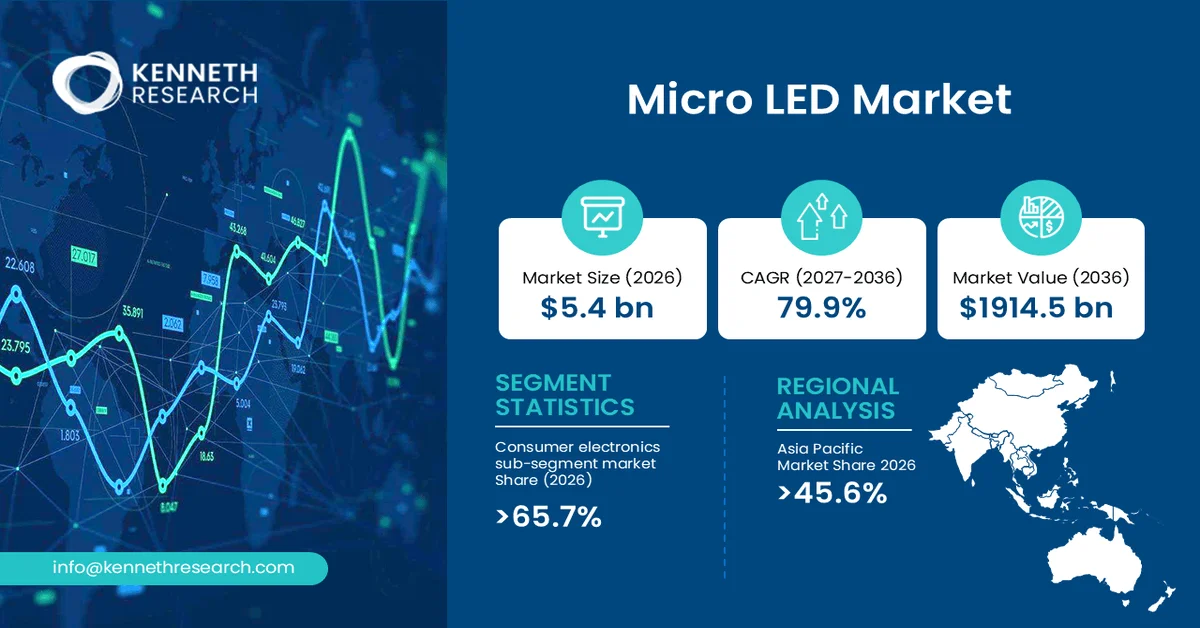
Micro Led Market size was valued at USD 5.4 billion in 2026 and is projected to reach USD 1914.5 billion by the end of 2036, rising at a CAGR of 79.9% during the forecast period, i.e., 2027-2036. In 2027, the industry size of the micro led is estimated at USD 9.7 billion.
The primary growth driver for the micro led market is rising demand for high-performance displays that combine exceptional brightness, contrast, fast response, energy efficiency, and compact pixel structures.
The micro led market encompasses the development, manufacturing, integration, and commercialization of display technologies that use microscopic light-emitting diodes as individual pixels or pixel elements. Unlike conventional displays that rely on backlighting or organic emissive layers, micro-LED displays employ inorganic LED components that generate light directly, enabling high brightness, strong contrast, rapid response, and long operational life.
Manufacturing typically involves epitaxial wafer production, LED chip fabrication, mass transfer, bonding, testing, repair, color conversion where applicable, and final display integration. The micro led market has industrial relevance because it connects semiconductor manufacturing with advanced display engineering.
Key Micro LED Market Insights Summary:
Key Takeaways: Market Trends & Insights
- Micro led market is projected to grow from USD 5.4 billion in 2026 to USD 1914.5 billion by 2036, expanding at a 79.9% CAGR.
- Asia-Pacific accounted for the largest regional share at 45.6% in 2026, supported by established display manufacturing ecosystems, strong consumer-electronics production, and continued investment in advanced display technologies across Japan and China.
- Consumer Electronics is expected to remain the leading Application segment, accounting for 65.7% in 2026, driven by demand for premium televisions, smart devices, wearables, and high-performance display interfaces.
- Rigid Micro LED Displays are positioned for continued growth as demand expands across premium televisions, professional visualization, signage, automotive interfaces, and other applications requiring high brightness and durable display performance.
Market Drivers
- Advanced display performance and energy efficiency
- Expansion of connected and immersive device ecosystems
- Increasing integration of displays into automotive and mobility platforms
- Continued development of mass-transfer, bonding, inspection, and repair technologies
Challenges
- High manufacturing complexity and yield constraints
- Capital intensity and supply-chain coordination
Micro LED Market Overview & Supply Chain
Global adoption of the micro led market is increasing as display manufacturers and device companies seek technologies capable of supporting increasingly immersive, connected, and high-resolution user interfaces. The technology is relevant to consumer electronics, automotive systems, professional visualization, smart devices, and emerging spatial-computing applications. The expansion of connected-device ecosystems is reinforcing the requirement for advanced display interfaces. Eurostat reported that 93% of people aged 16–74 in the European Union used the internet in 2024, illustrating the breadth of the digital environment in which connected display devices operate.
The industry value chain begins with semiconductor-grade materials and LED-related inputs, including compound-semiconductor wafers, epitaxial materials, substrates, electrodes, bonding materials, and backplane components. LED manufacturers undertake epitaxy, wafer processing, chip fabrication, testing, and preparation of microscopic emitters. Display manufacturers then integrate these components through mass-transfer, alignment, bonding, interconnection, repair, color-conversion, encapsulation, and calibration processes. Equipment suppliers provide transfer, inspection, metrology, and assembly systems, while software and electronics suppliers support driver circuits and display control.
Micro LED Market: Growth Drivers & Challenges
Growth Drivers:
- Advanced display performance and energy efficiency: The performance advantages of micro-LED architecture are encouraging investment in applications where conventional display technologies face limitations in brightness, response, durability, or power efficiency. A Japanese government-backed technology-development project reports that micro-LED displays can achieve one-third or less of the power consumption of LCD and OLED displays while also providing substantially stronger contrast and faster response. This combination strengthens the business case for premium displays in environments requiring high visual performance and continuous operation.
- Expansion of connected and immersive device ecosystems: The second driver is the expansion of device categories requiring increasingly sophisticated visual interfaces. Smart televisions, wearables, automotive interfaces, augmented-reality equipment, professional visualization systems, and large-format displays are creating multiple application pathways for micro-LED technology. Its modular architecture can support different screen formats and specialized form factors, allowing manufacturers to address both compact and large-area applications. Automotive manufacturers are particularly interested in advanced displays as vehicles incorporate larger digital cockpits, passenger screens, head-up displays, and connected interfaces.
Challenges:
- High manufacturing complexity and yield constraints: A major restraint is the difficulty of manufacturing displays containing very large numbers of microscopic LED emitters with consistently high electrical and optical performance. Mass transfer, alignment, bonding, inspection, repair, and color uniformity must all operate at industrial scale. A small defect rate can create significant rework requirements because individual defective emitters can affect pixel performance and overall panel quality. These challenges increase capital requirements and make process control particularly important.
- Capital intensity and supply-chain coordination: The second challenge is the capital-intensive nature of establishing an integrated micro-LED production ecosystem. Successful commercialization requires coordination among epitaxy suppliers, LED-chip manufacturers, backplane producers, transfer-equipment companies, materials suppliers, testing providers, and display assemblers. Any weakness in one stage can affect throughput or final yield. The requirement for specialized equipment and process knowledge also increases barriers for new entrants.
Micro LED Market Size and Forecast:
| Report Attribute | Details |
|---|---|
| Base Year |
2026 |
| Forecast Period |
2027-2036 |
| CAGR |
79.9% |
| Base Year Market Size (2026) |
USD 5.4 billion |
| Forecast Year Market Size (2036) |
USD 1914.5 billion |
| Regional Scope |
|
Micro LED Market Segmentation Analysis:
Application Segment Analysis
In the application segment, the consumer electronics sub-segment is anticipated to capture the largest market share of 65.7% in 2026.
Consumer electronics represents the leading application segment because televisions, smart devices, wearables, and other personal electronics increasingly compete on visual performance, thin form factors, brightness, and energy efficiency. Micro-LED technology is particularly attractive for premium products because its self-emissive architecture can provide strong contrast and high brightness while supporting long operating life. Demand is also reinforced by the growing prevalence of connected entertainment devices. Eurostat reported that 57.9% of individuals in the European Union used internet-connected televisions in 2024, making connected TVs the most widely used internet-connected device category measured in its survey. On the supply side, major display and consumer-electronics companies are developing micro-LED architectures, transfer processes, and modular panels aimed at premium television and personal-device applications. Manufacturers are also pursuing smaller LED dimensions and improved manufacturing yields to expand addressable product categories.
Panel Type Segment Analysis
Rigid micro-LED displays are positioned for growth because their established panel structure is well suited to applications requiring high brightness, durability, consistent image quality, and large-area integration. Demand is emerging across premium televisions, professional visualization, signage, control environments, and automotive interfaces. Automotive applications provide an additional pathway as vehicle manufacturers increasingly incorporate sophisticated digital displays into cabins. On the supply side, rigid architectures benefit from established approaches to backplane integration and modular display construction, while manufacturers continue improving mass transfer, bonding, inspection, and repair capabilities. Their structural stability also makes them suitable for large-format commercial and automotive installations.
Our in-depth analysis of the global micro led market includes the following segments:
|
Segment |
Sub-segment |
|
Display Size |
|
|
Panel Type |
|
|
Application |
|
Micro LED Market Regional Insights:
Asia-Pacific Market Trends & Insights:
Asia-Pacific is the dominant region, accounting for 45.6% in 2026 according to the provided input.
Its leadership is supported by a deeply established display-manufacturing ecosystem, strong consumer-electronics production, advanced semiconductor capabilities, and sustained investment in next-generation display technologies. The region also benefits from close integration between panel makers, electronics OEMs, semiconductor companies, and specialized display-equipment providers, improving commercialization pathways.
Japan remains strategically important through its established electronics, semiconductor, imaging, and display-technology capabilities. Japanese companies are positioned across premium displays and professional visualization, while government-backed technology programs support development of advanced display manufacturing.
China provides greater manufacturing depth and a broad domestic demand base, supported by an extensive new-display industrial chain encompassing materials, equipment, panels, modules, and downstream applications.
North America Market Trends & Insights:
North America represents an important secondary opportunity for the micro led market because demand is increasingly linked to premium consumer electronics, professional visualization, virtual production, automotive interfaces, corporate environments, and high-end residential applications. The region's strength is less dependent on large-scale panel manufacturing and more connected to technology commercialization, system integration, content production, and high-value end-user deployments.
The U.S provides the largest commercial opportunity within the region through its concentration of technology companies, entertainment and media organizations, automotive manufacturers, premium retail operators, and enterprise customers.
Canada offers a complementary technology-development base. Government support for VueReal's custom MicroLED display production line is aimed at expanding Canadian display production and preparing the company for higher-volume scale-up.
Leading Companies Operating in the Global Micro LED Market:
Here is a list of upstream, downstream, and key players operating in the global micro led market competitive ecosystem:
- LG Electronics (South Korea)
- Company Overview
- Business Strategy
- Key Product Offerings
- Financial Performance
- Key Performance Indicators
- Risk Analysis
- Recent Development
- Regional Presence
- SWOT Analysis
- Samsung Electronics (South Korea)
- Sony (Japan)
Recent Developments
- March 2026: LG Electronics introduced its new 2026 MAGNIT Micro LED display for premium commercial and luxury residential environments.
- January 2026: Samsung showcased its next-generation Micro LED technology at CES 2026, including a large-format Micro LED display designed to deliver immersive viewing experiences.
Frequently Asked Question
In 2026, the global micro led market exceeded USD 5.4 billion.
The micro led market is projected to reach USD 1914.5 billion by the end of 2036, expanding at a CAGR of 79.9% over the forecast period (2027-2036).
The major players in the market are Samsung Electronics, LG Electronics, Sony, AUO, and BOE, and others.
In the application segment, the consumer electronics sub-segment is anticipated to capture the largest market share of 65.7% in the future and exhibit lucrative growth opportunities during 2027-2036.
Asia-Pacific is projected to hold the largest market share of 45.6% by the end of 2026 and provide more business opportunities in the future.
Why Choose Kenneth Research ?
-
Insight with Impact : We don’t just gather data — we uncover stories, trends, and opportunities that fuel business growth.
-
Experts Who Get It : Our team speaks your industry’s language and knows what really matters to your customers and market.
-
Custom-Built for You : Forget one-size-fits-all. We craft research and consulting solutions as unique as your business vision.
-
Partners, Not Just Providers : We work with you, not for you — collaborating closely to turn insights into smart, strategic moves.
-
Results That Speak : Our work powers brands, startups, and industry leaders alike — with a track record of ideas that work in the real world.
Report ID: 1345 |
Published Date: 28 Sep 2026 |
Report Format: |
Delivery Timeline: 48-72 Business Hours

Copyright © 2025 Kenneth Research. All rights reserved. Terms of Use | Privacy Policy
