Report ID: 1112 |
Published Date: 19 Aug 2026 |
Report Format: |
Delivery Timeline: 48-72 Business Hours
Medical Fluoropolymers Market Outlook:
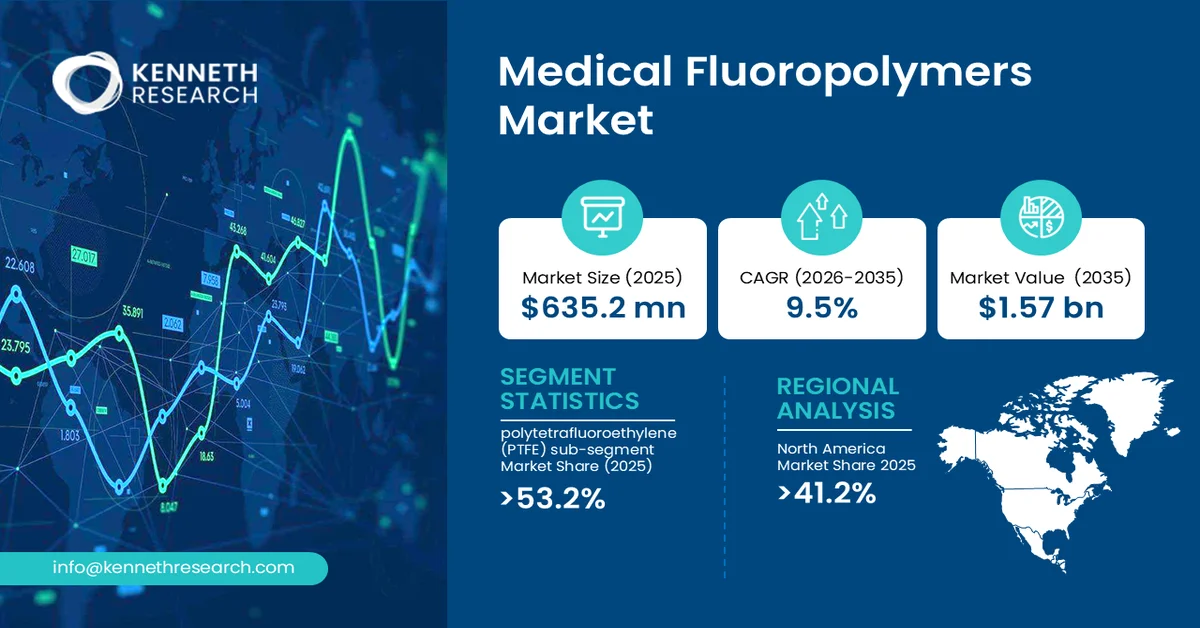
Medical Fluoropolymers Market size was valued at USD 635.2 million in 2025 and is projected to reach USD 1.57 billion by the end of 2035, rising at a CAGR of 9.5% during the forecast period, i.e., 2026-2035. In 2026, the industry size of the medical fluoropolymers is estimated at USD 695.5 million.
The primary growth driver of the medical fluoropolymers market is the increasing demand for high-performance, biocompatible materials in advanced medical devices and minimally invasive procedures. Superior chemical resistance, low friction, sterilization compatibility, and long-term durability make medical fluoropolymers indispensable for manufacturing critical components used across modern healthcare applications.
The medical fluoropolymers market comprises the production, processing, and commercialization of fluoropolymer materials specifically engineered for healthcare and life science applications. These high-performance polymers, including polytetrafluoroethylene (PTFE), fluorinated ethylene propylene (FEP), perfluoroalkoxy alkane (PFA), ethylene tetrafluoroethylene (ETFE), and polyvinylidene fluoride (PVDF), are utilized in manufacturing medical tubing, catheters, guidewires, surgical instruments, implantable device components, pharmaceutical processing systems, diagnostic equipment, and laboratory consumables. Their exceptional chemical inertness, low coefficient of friction, thermal stability, electrical insulation, and resistance to repeated sterilization enable reliable performance in demanding clinical environments.
Medical fluoropolymers play a critical role in supporting precision medicine, minimally invasive interventions, pharmaceutical manufacturing, and infection-control practices. Their ability to maintain structural integrity under exposure to aggressive chemicals, bodily fluids, and sterilization methods enhances patient safety and device longevity. As healthcare systems increasingly adopt technologically advanced medical devices and high-purity processing equipment, medical fluoropolymers remain essential materials that support innovation, regulatory compliance, and consistent product performance across the global healthcare industry.
Key Medical Fluoropolymers Market Insights Summary:
Key Takeaways: Market Trends & Insights
- Medical Fluoropolymers Market projected to grow from USD 635.2 million in 2025 to USD 1.57 billion by 2035 at a 9.5% CAGR
- North America accounted for the largest regional share at 41.2% in 2025, driven by its strong medical device manufacturing base, advanced healthcare infrastructure, and robust regulatory ecosystem
- Polytetrafluoroethylene (PTFE) is expected to remain the leading product segment with a 53.2% market share, supported by its superior biocompatibility, chemical resistance, low-friction properties, and widespread use in minimally invasive medical devices
- Medical Tubing is projected to witness strong growth within the application segment due to increasing demand for high-performance catheter systems, drug delivery devices, fluid management systems, and biopharmaceutical processing equipment
- The market is benefiting from expanding adoption of minimally invasive procedures, growing investment in advanced medical device manufacturing, increasing pharmaceutical and bioprocessing activities, and continuous innovation in high-purity fluoropolymer technologies for critical healthcare applications
Market Drivers
- Rising demand for minimally invasive and interventional medical devices
- Expansion of high-purity pharmaceutical and biopharmaceutical manufacturing
- Increasing preference for sterilization-resistant and biocompatible polymer materials
- Advancements in precision medical tubing and implantable device technologies
Challenges
- High regulatory qualification and material validation requirements
- Processing complexity and elevated manufacturing costs
Medical Fluoropolymers Market Overview & Supply Chain
The adoption of medical fluoropolymers is increasing globally as healthcare providers and medical device manufacturers seek materials capable of delivering long-term performance under demanding clinical conditions. Their outstanding biocompatibility, chemical inertness, low friction, dielectric strength, and compatibility with multiple sterilization methods make them suitable for catheters, guidewires, implantable devices, pharmaceutical fluid-handling systems, and diagnostic equipment. Growing regulatory emphasis on device safety, quality assurance, and manufacturing traceability has further accelerated the use of high-purity fluoropolymer materials across the healthcare value chain. Reflecting the expanding medical device ecosystem, the U.S. Food and Drug Administration (FDA) reported 31,382 registered medical device establishments in FY 2023, highlighting the scale of regulated manufacturing that depends on reliable, high-performance materials such as medical fluoropolymers. This expanding regulatory and manufacturing landscape continues to strengthen demand for advanced fluoropolymer solutions across global healthcare industries.
The medical fluoropolymers value chain begins with the procurement of fluorinated monomers, specialty chemicals, processing additives, and high-purity resins supplied by chemical manufacturers operating under stringent quality and environmental standards. Polymer producers convert these raw materials into medical-grade fluoropolymer compounds through controlled polymerization, purification, extrusion, molding, and compounding processes that comply with medical manufacturing requirements. These materials are then supplied to original equipment manufacturers (OEMs) and specialized component fabricators producing medical tubing, catheters, guidewires, implantable components, fluid management systems, seals, and laboratory equipment. Following quality validation, sterilization compatibility testing, and regulatory documentation, finished components are distributed through medical device manufacturers, contract manufacturing organizations, and healthcare distribution networks. The principal end users include hospitals, ambulatory surgical centers, diagnostic laboratories, pharmaceutical manufacturers, and research institutions. Key stakeholders comprise raw material suppliers, fluoropolymer manufacturers, device OEMs, contract manufacturers, regulatory authorities, distributors, healthcare providers, and clinical procurement organizations.
Medical Fluoropolymers Market: Growth Drivers & Challenges
Growth Drivers:
- Rising demand for minimally invasive and interventional medical devices: The growing adoption of minimally invasive procedures is a significant catalyst for the medical fluoropolymers market. Devices such as catheters, guidewires, introducer sheaths, endoscopic instruments, and vascular access systems require materials that combine flexibility with chemical resistance, lubricity, and sterilization compatibility. Medical fluoropolymers fulfill these requirements while enabling improved device performance and patient safety. As healthcare providers increasingly shift toward procedures that reduce recovery time and hospital stays, manufacturers continue to integrate fluoropolymer components into next-generation medical devices. Supporting this trend, the U.S. Food and Drug Administration (FDA) authorized 124 novel medical devices through its De Novo pathway during FY 2023, demonstrating continued innovation in medical technologies that utilize advanced engineering materials for specialized clinical applications. Continued product innovation and regulatory approvals are expected to expand opportunities for fluoropolymer-based medical components across diverse therapeutic areas.
- Expansion of high-purity pharmaceutical and biopharmaceutical manufacturing: The expansion of pharmaceutical and biopharmaceutical manufacturing is driving increased demand for medical fluoropolymers because production environments require materials capable of maintaining purity while resisting aggressive chemicals and repeated sterilization cycles. Fluoropolymer-based tubing, liners, seals, valves, and fluid transfer systems help minimize contamination risks, ensuring compliance with stringent quality standards during drug manufacturing and processing. Their excellent resistance to solvents, acids, and high temperatures supports reliable operation in aseptic production facilities and single-use bioprocessing systems. As biologics, vaccines, cell therapies, and other advanced therapeutics continue to gain prominence, manufacturers are investing in upgraded production infrastructure equipped with high-performance polymer components. This transition toward more sophisticated pharmaceutical manufacturing processes is expected to sustain long-term demand for medical fluoropolymers across production, packaging, laboratory processing, and sterile fluid management applications.
Challenges:
- High regulatory qualification and material validation requirements: Medical fluoropolymers used in healthcare applications must undergo extensive material qualification, biocompatibility assessments, extractables and leachables evaluations, sterilization validation, and comprehensive documentation before they can be incorporated into regulated medical devices or pharmaceutical processing systems. Any modification in resin grade, processing conditions, additives, or supplier often requires additional verification and regulatory review, increasing development timelines and qualification costs. These stringent compliance requirements can delay commercialization of new products and discourage rapid material substitution, particularly for small and mid-sized device manufacturers with limited regulatory resources. Commercially, prolonged validation cycles reduce manufacturing flexibility and increase product development expenses. Although harmonization of global medical regulations and improved material characterization technologies may streamline future approvals, rigorous regulatory expectations will continue to represent a significant barrier for new market entrants and innovative fluoropolymer formulations.
- Processing complexity and elevated manufacturing costs: Medical-grade fluoropolymers require specialized processing technologies because of their unique thermal behavior, high purity requirements, and demanding performance specifications. Manufacturing operations frequently involve dedicated extrusion systems, precision molding equipment, contamination-controlled environments, and strict quality assurance protocols to ensure consistent product performance. These specialized production requirements result in higher capital investment, increased operational expenses, and greater technical expertise compared with conventional engineering polymers. In addition, maintaining batch consistency while meeting stringent healthcare quality standards can reduce manufacturing efficiency and limit production scalability. Commercially, these factors contribute to higher component costs, influencing procurement decisions for cost-sensitive healthcare applications. Looking ahead, advances in processing technologies, automation, and material engineering may gradually improve manufacturing efficiency, but production complexity is expected to remain a key operational challenge for the medical fluoropolymers industry.
Medical Fluoropolymers Market Size and Forecast:
| Report Attribute | Details |
|---|---|
| Base Year |
2025 |
| Forecast Year |
2026-2035 |
| CAGR |
9.5% |
| Base Year Market Size (2025) |
USD 635.2 million |
| Forecast Year Market Size (2035) |
USD 1.57 billion |
| Regional Scope |
|
Medical Fluoropolymers Market Segmentation Analysis:
Product Segment Analysis
In the product segment, the polytetrafluoroethylene (PTFE) sub-segment is anticipated to capture the largest market share of 53.2% by the end of 2025.
Polytetrafluoroethylene (PTFE) dominates the medical fluoropolymers market owing to its unmatched combination of biocompatibility, exceptionally low coefficient of friction, chemical inertness, dielectric insulation, and resistance to repeated sterilization. These characteristics make PTFE the preferred material for manufacturing catheters, guidewires, vascular grafts, implantable components, seals, and pharmaceutical fluid-handling systems where consistent performance and patient safety are critical. Demand continues to expand as healthcare providers increasingly adopt minimally invasive procedures that require precision-engineered, low-friction medical devices. On the supply side, established manufacturing capabilities, mature processing technologies, and long-standing regulatory acceptance have enabled reliable commercial production of medical-grade PTFE, supporting its widespread integration across medical device manufacturing. Reinforcing its importance, the U.S. Food and Drug Administration (FDA) states that fluoropolymers such as PTFE are essential for numerous medical devices—including cardiovascular stents, pacemakers, vascular grafts, and guidewires—and notes that no other materials currently exist that can perform these critical roles in many applications. This strong clinical dependence, together with continued innovation in interventional healthcare technologies, is expected to sustain PTFE's leadership throughout the forecast period.
Application Type Segment Analysis
Medical tubing is projected to witness robust growth in the medical fluoropolymers market as healthcare systems increasingly rely on high-performance tubing for minimally invasive procedures, drug delivery, dialysis, cardiovascular interventions, endoscopy, and biopharmaceutical fluid transfer. Fluoropolymer-based medical tubing offers exceptional chemical resistance, low friction, flexibility, and compatibility with repeated sterilization, making it suitable for demanding clinical and pharmaceutical environments. Adoption is also increasing as device manufacturers prioritize materials that maintain purity and dimensional stability while complying with stringent regulatory requirements. On the supply side, advancements in precision extrusion technologies and expanded manufacturing capabilities for multi-layer and thin-wall tubing are enabling production of increasingly sophisticated medical devices. Supporting sustained demand, the U.S. Food and Drug Administration (FDA) continues to maintain a dedicated regulatory framework for medical device supply chain resilience, including numerous categories of catheter, cannula, tubing, vascular bypass, and oxygen tubing devices, underscoring their critical role in healthcare delivery and the importance of uninterrupted supply. Continued innovation in interventional medicine and biopharmaceutical manufacturing is expected to further accelerate demand for fluoropolymer-based medical tubing throughout the forecast period.
Our in-depth analysis of the global medical fluoropolymers market includes the following segments:
|
Segment |
Sub-segment |
|
Product |
|
|
Application |
|
|
End User |
|
|
Processing Method |
|
Medical Fluoropolymers Market Regional Insights:
North America Market Trends & Insights:
North America accounted for 41.2% of the medical fluoropolymers market in 2025, making it the leading regional market.
The region's dominance is supported by its well-established medical device manufacturing ecosystem, advanced healthcare infrastructure, robust research and development capabilities, and stringent regulatory framework that emphasizes the use of high-performance, biocompatible materials. Strong investment in minimally invasive technologies, pharmaceutical manufacturing, and high-value medical components continues to drive demand for medical-grade fluoropolymers across diverse healthcare applications. The region also benefits from close collaboration between material suppliers, medical device manufacturers, healthcare institutions, and regulatory agencies, enabling rapid commercialization of innovative products. Supporting this industrial leadership, the U.S. Food and Drug Administration (FDA) reported that 30,120 medical device establishments were registered in FY 2024, demonstrating the scale of the regulated manufacturing base that underpins demand for advanced fluoropolymer materials throughout North America.
The United States represents the largest contributor to regional demand owing to its concentration of global medical device manufacturers, continuous investment in medical technology innovation, and comprehensive regulatory oversight that encourages the adoption of high-performance polymer materials in critical healthcare applications. Strong capabilities in interventional cardiology, diagnostics, drug delivery systems, and pharmaceutical processing further reinforce demand for fluoropolymer components.
Canada complements regional leadership through its expanding medical device industry, advanced life sciences sector, and supportive innovation ecosystem. Canadian manufacturers increasingly utilize medical fluoropolymers in diagnostic equipment, patient care devices, laboratory systems, and specialized medical tubing, while collaboration among industry, research institutions, and healthcare providers continues to strengthen the country's role within the North American medical materials supply chain.
Europe Market Trends & Insights:
Asia Pacific is projected to experience strong growth in the medical fluoropolymers market, supported by expanding healthcare infrastructure, increasing medical device manufacturing, and rising investments in pharmaceutical and biotechnology production. The region has become an important manufacturing hub for medical components due to its skilled workforce, growing industrial capabilities, and integrated supply chains. Governments across Asia Pacific continue to promote domestic medical technology production, strengthen healthcare resilience, and encourage innovation through industrial development policies, regulatory modernization, and investment in advanced manufacturing. Increasing demand for minimally invasive procedures, diagnostic technologies, and high-purity pharmaceutical processing equipment is further accelerating the adoption of medical-grade fluoropolymers. Additionally, expanding contract manufacturing activities and greater emphasis on quality compliance are creating new opportunities for suppliers of high-performance fluoropolymer materials used in precision medical applications.
Japan remains a key contributor to regional growth through its advanced medical device industry, strong expertise in precision manufacturing, and continuous development of high-value healthcare technologies. Demand for medical fluoropolymers is supported by innovation in catheter systems, diagnostic equipment, surgical instruments, and pharmaceutical manufacturing processes that require reliable, high-purity materials.
China is rapidly strengthening its position through significant investments in domestic medical device production, expanding biopharmaceutical manufacturing capacity, and ongoing modernization of healthcare infrastructure. The country's growing focus on advanced manufacturing, localization of medical technologies, and development of sophisticated healthcare products is increasing the use of fluoropolymer materials in medical tubing, fluid management systems, implantable device components, and laboratory equipment, positioning China as a major future growth engine for the regional market.
Leading Companies Operating in the Global Medical Fluoropolymers Market:
Here is a list of upstream, downstream, and key players operating in the global medical fluoropolymers market competitive ecosystem:
- Zeus Industrial Products, Inc.(United States)
- Company Overview
- Business Strategy
- Key Product Offerings
- Financial Performance
- Key Performance Indicators
- Risk Analysis
- Recent Development
- Regional Presence
- SWOT Analysis
- W. L. Gore & Associates(United States)
- Saint-Gobain Life Sciences(France)
- Tef Cap Industries(United States)
- Adtech Polymer Engineering Ltd.(United Kingdom)
Recent Developments
- May 2025: Saint-Gobin Life Sciences Introduced a portfolio of PFAS-Free™ medical tubing solutions designed to provide alternatives for selected medical device applications while addressing evolving regulatory expectations.
- January 2025: Zeus Expanded its StreamLiner™ family with additional advanced liner technologies for catheter manufacturing, enhancing device design flexibility and performance.
Frequently Asked Question
In 2025, the medical fluoropolymers market exceeded USD 635.2 million.
The medical fluoropolymers market is projected to reach USD 1.57 billion by the end of 2035, expanding at a CAGR of 9.5% over the forecast period (2026-2035).
The major players in the market are Zeus Industrial Products, Inc., W. L. Gore & Associates, Saint-Gobain Life Sciences, Tef Cap Industries, Fluortek Inc., Adtech Polymer Engineering Ltd., and others.
In the product segment, the polytetrafluoroethylene sub-segment is anticipated to capture the largest market share of 53.2% in the future and exhibit lucrative growth opportunities during 2026–2035. This growth trajectory is largely attributed to its widespread use in minimally invasive medical devices owing to its superior biocompatibility, chemical resistance, and low-friction performance.
North America is projected to hold the largest market share of 41.2% by the end of 2025 and provide more business opportunities in the future. Continuous investments in medical device innovation, advanced healthcare infrastructure, and strong manufacturing capabilities across the U.S. and Canada are fostering the region's dominance.
Why Choose Kenneth Research ?
-
Insight with Impact : We don’t just gather data — we uncover stories, trends, and opportunities that fuel business growth.
-
Experts Who Get It : Our team speaks your industry’s language and knows what really matters to your customers and market.
-
Custom-Built for You : Forget one-size-fits-all. We craft research and consulting solutions as unique as your business vision.
-
Partners, Not Just Providers : We work with you, not for you — collaborating closely to turn insights into smart, strategic moves.
-
Results That Speak : Our work powers brands, startups, and industry leaders alike — with a track record of ideas that work in the real world.
Report ID: 1112 |
Published Date: 19 Aug 2026 |
Report Format: |
Delivery Timeline: 48-72 Business Hours

Copyright © 2025 Kenneth Research. All rights reserved. Terms of Use | Privacy Policy
